
Cosmetics Manufacturing for Southeast Asia
Six markets, one technical framework, six separate notifications. What each authority asks of the factory, where our certifications carry weight, and how tropical conditions change the formulation brief.
One rulebook, six front doors
The ASEAN Cosmetic Directive harmonises the technical substance across Indonesia, Thailand, Vietnam, the Philippines, Malaysia and Singapore: ingredient annexes, labelling requirements, and the structure of the Product Information File. That genuinely reduces work, because one dossier structure serves all six.
What it does not do is give you a single registration. Each market still requires its own notification with its own authority, and most require a locally established entity to hold it. The practical consequence for a launch plan is that your critical path is usually notification timelines, not production. Brands that treat the region as one market discover this late, after packaging has already been printed.
Our side of that work is the manufacturer documentation each dossier calls for, and formulation that suits the climate rather than fighting it. Below is what each market asks, what we can supply, and the parts that will remain yours regardless of who manufactures for you.
The six markets
Notification authority and the requirement most likely to affect your timeline. Each links to the full guide.
Indonesia
BPOMNotification through BPOM, with a local licence holder required. Halal certification becomes mandatory for cosmetics from 17 October 2026, and the recognised certifying body is BPJPH — a halal certificate issued elsewhere is not automatically accepted.
Full guide →Thailand
Thai FDANotification with a three-year validity, and a Product Information File that must be available on request. Renewal is on you to track; a lapsed notification stops shipments at customs rather than generating a warning.
Full guide →Vietnam
DAVProduct notification through the Drug Administration of Vietnam, with labelling rules that are enforced more literally than most first-time exporters expect.
Full guide →Philippines
Philippine FDAA Cosmetic Product Notification requires a Licence to Operate and a local Market Authorisation Holder. Whitening products receive additional scrutiny, so claim wording matters more here than in neighbouring markets.
Full guide →Malaysia
NPRANotification through NPRA. Halal certification is commercially close to essential in much of the retail channel, and JAKIM recognition is the reference point buyers will ask about.
Full guide →Singapore
HSANotification through HSA under the ASEAN framework. Typically the lightest administrative load of the six, which is why it is often used as a first launch market before the larger ones.
Full guide →Our documentation for an ASEAN dossier
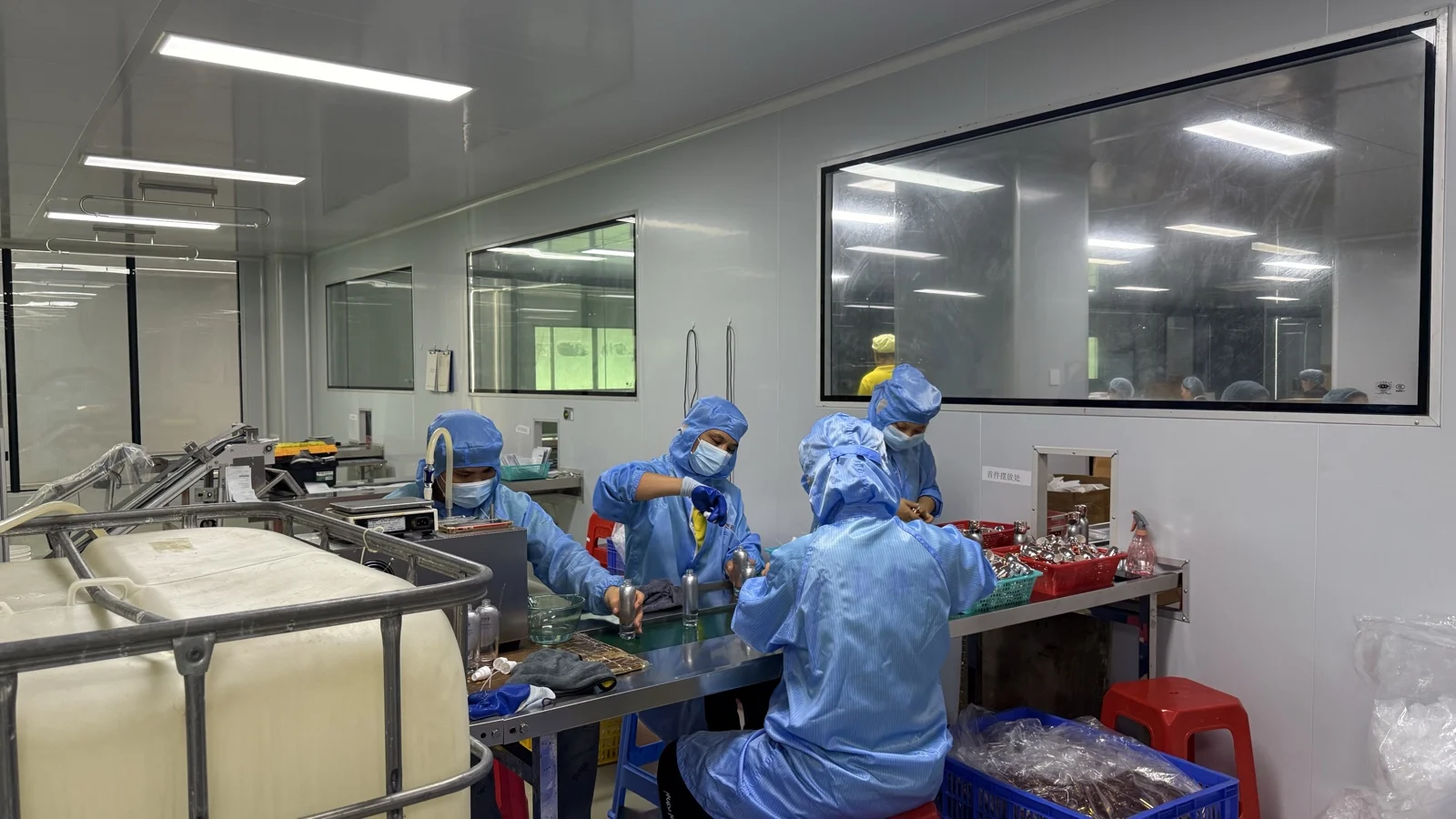
Notification dossiers in this region ask for GMP evidence covering the actual manufacturing site. We hold ISO 22716:2007 under certificate HBPCER20260352 and GMPC under certificate HBPCER20260353, both issued by Intertek on 16 July 2026 and valid to 15 July 2029. Both can be checked by anyone at certs.intertek.com.cn, the database address printed on the certificates themselves.
We publish the numbers rather than describing the certificates because the check is the point. Our legal entity, Jiumei (Guangzhou) Biomedical Co., Ltd. (Unified Social Credit Identifier 91440101MA59F7726Y), is the name printed on those certificates, so you can confirm that the company quoting you is the company that was audited. That is worth doing: a trading company can show you a certificate belonging to a factory it does not own, and matching the entity name across documents is how you catch it.
Alongside the certificates we supply formula and ingredient documentation, product specifications, Certificates of Analysis per batch, and stability and testing data. Third-party testing through SGS is supported on request where a market or a buyer wants independent verification.
To be clear about the limit: a GMP certificate covers how a factory operates, not your specific product. It is not a product registration or approval in any of these markets, and it does not remove your obligation to complete notification, safety assessment and labelling compliance. Certification gets a supplier onto your shortlist. It does not distinguish them on it.
What tropical conditions change
Year-round heat and humidity affect which formats sell and which textures get rejected. These are the four adjustments that come up in almost every regional project.
Sun care built for the actual UV load
SPF50+ with high PA rating is the commercial baseline across the region, not a premium tier. Filter selection has to reconcile ASEAN permitted lists with the no-white-cast texture the market expects.
Relevant formats: Aqua Shield Sun Essence SPF50 PA, Sport Water-Resistant Sunscreen SPF50
Humidity changes the texture brief
Rich occlusive creams that sell well in temperate markets are frequently rejected here on feel alone. Gel-creams, essence lotions and lightweight emulsions are the formats that hold up in year-round humidity.
Relevant formats: Lightweight Oil Control Moisturizing Gel Cream, Multi-HA Hydrating Serum
Oil control and post-acne care as a core category
Sebum-related concerns dominate the regional skincare conversation. Acid levels are set within the limits of your destination market, and claim wording is adjusted where a market treats anti-acne language as a therapeutic claim.
Relevant formats: Oil Control Clarifying Cleanser, Oil Control Purifying Toner
Brightening, with claim wording handled market by market
Demand is strong but the regulatory treatment is not uniform: several authorities scrutinise whitening claims specifically. We formulate the product and flag where the claim, rather than the formula, is the constraint.
Relevant formats: Niacinamide Brightening Dark Spot Serum, Centella Repair Serum
Formulation baselines are adjustable for your target market and price point. Ingredient levels are set within the limits of your destination market rather than to a fixed house recipe.
Questions buyers ask about this region
Does the ASEAN Cosmetic Directive mean one registration covers all six markets?
No, and this is the most common misunderstanding we hear. The directive harmonises the technical framework — ingredient annexes, labelling requirements, the Product Information File structure — so you are working from one broadly consistent rulebook. But notification is still filed country by country, with a separate submission to each authority: BPOM in Indonesia, the Thai FDA, DAV in Vietnam, the Philippine FDA, NPRA in Malaysia and HSA in Singapore. Several also require a locally established entity to hold the notification, which means you need a local partner or agent in each market rather than filing from abroad. Budget for six processes, not one.
Which of your certifications actually help with Southeast Asian registration?
The GMP evidence is the part that matters to these authorities. We hold ISO 22716:2007 under certificate HBPCER20260352 and GMPC under certificate HBPCER20260353, both issued by Intertek on 16 July 2026 and valid to 15 July 2029, and both verifiable by anyone at certs.intertek.com.cn. Notification dossiers across the region ask for a GMP statement or certificate for the actual manufacturing site, and a certificate from a named certification body that you can check in that body's own database is stronger evidence than a self-declaration. Our legal entity, Jiumei (Guangzhou) Biomedical Co., Ltd., appears on those certificates, so you can confirm the company quoting you is the company that was audited. What the certificates do not do is register your product — they cover how the factory operates, not what you are selling.
Is your halal certification accepted across the region?
It is a strong starting point rather than a universal pass, and you should confirm before assuming. Halal certification is issued by individual certification bodies, and importing countries decide which bodies they recognise: Indonesia works through BPJPH, Malaysia through JAKIM, and recognition arrangements between bodies change over time. A certificate accepted in one market may need to be reissued by a locally recognised body for another. Certification also applies to the products and production lines within its declared scope rather than to everything we make, so a halal-certified line does not make every formula in our catalogue halal by default. Indonesia's mandatory halal requirement for cosmetics takes effect on 17 October 2026, which makes this a scheduling question as well as a compliance one. Tell us your destination market early and we will confirm what is in scope and what would need re-certification.
Do we need to reformulate for a tropical market, or can we use an existing formula?
Often you can produce an existing formula unchanged, but two things are worth checking before you commit. First, the ingredient annexes: the ASEAN framework has its own permitted and restricted lists, and a formula cleared for another region can still contain something restricted at your intended level. Second, sensory acceptance: textures that perform well in dry or temperate conditions are routinely rejected in this region on feel, particularly heavier creams and sunscreens that leave a cast. We will review your existing formula against both points and tell you whether it is a straight transfer, a texture adjustment or a genuine reformulation.
What is the minimum order quantity for a Southeast Asian launch?
Private label starts from 3,000 units per SKU, and OEM or ODM production from 3,000 units per SKU. Sheet masks, collagen patches and freeze-dried powders typically start at 5,000 to 10,000 units per SKU. Exact MOQ depends on product type, packaging and raw materials. For a first launch in this region, brands commonly start with a narrow range in one market — Singapore and Malaysia are frequently used for this — and widen the range once registration in the larger markets is underway, since notification timelines are usually the real constraint on launch date rather than production.
Can you handle the registration for us?
We provide the manufacturer-side documentation that a notification dossier requires: GMP certificates, formula and ingredient documentation, specifications, Certificates of Analysis, and stability and testing data. What we cannot do is act as the notification holder. Most of these markets require a locally established entity — a licence holder, market authorisation holder or local responsible party — and that role carries legal responsibility inside the country, so it has to sit with you or with a local partner or agent you appoint. We would rather be direct about that split now than have it surface after you have paid for samples. If you have not yet appointed a local partner, tell us and we will set out what that party will need from us.
Southeast Asia guides
Each written against the named regulation rather than summarised from other sites.
ASEAN Cosmetics Directive: Regulations for All 6 Markets
The ASEAN Cosmetic Directive explained: the notification route per member state, labelling requirements, the ingredient annexes, and what your factory supplies.
Indonesia Cosmetic Regulations & BPOM Registration Guide
Cosmetic registration in Indonesia step by step: BPOM documents, halal rules, real timelines and costs. We supply the factory-side file - ask for the checklist.
Cosmetic Product Registration Thailand: Steps & Fees
Cosmetic product registration in Thailand: the TFDA notification process, PIF duties, three-year validity, documents, timelines and fees.
Vietnam Cosmetics Market 2026: Registration & OEM Guide
Selling cosmetics in Vietnam: DAV product notification, labeling rules, timelines and costs, plus what your factory must supply. Ask for the OEM checklist.
Philippines FDA Cosmetics Registration (CPN): OEM Guide
Philippines FDA cosmetics registration: how the Certificate of Product Notification (CPN) works, who can hold it, and the documents a China factory supplies.
Private Label & White Label Cosmetics: Malaysia & Singapore
How to launch a private label cosmetics brand in Malaysia and Singapore: NPRA registration, Halal certification, and why Chinese OEM offers the best path.
How to Start a Skincare Brand in Southeast Asia
Step-by-step guide to launching a skincare brand in Southeast Asia: choosing markets, positioning, budget, manufacturing, registration, and sales channels.
Sunscreen OEM for Southeast Asia: SPF50+ Tropical Formulas
Guide to tropical sunscreen OEM: SPF50+ filters, SPF/PA testing, ASEAN regulations, no-white-cast formulation, and Halal capability for Southeast Asia.
Tropical Climate Skincare: Best Ingredients & Stability
The best skincare ingredients for tropical climate formulation: niacinamide, hyaluronic acid, centella asiatica, delivery tech, and ASEAN market preferences.
Which market are you entering first?
Destination country determines the notification route, the halal position and the texture brief. Tell us the market and we will confirm what is in scope before you pay for a sample.
Response within 24 hours · WhatsApp available · Factory visits welcome