
How to Start a Skincare Brand in Southeast Asia
Southeast Asia is one of the most attractive regions in the world to launch a skincare brand right now. If you are planning to start a skincare brand in Southeast Asia, you are entering a market with 600+ million consumers, double-digit category growth, and a social-media-driven beauty culture that lets new brands scale fast without huge ad budgets. But the region is not a single market - launching a beauty brand in Indonesia, Thailand, or any ASEAN country means navigating different regulators, price points, and consumer preferences. This roadmap walks you through the full journey, from first idea to products on the shelf.
The Southeast Asian beauty and personal care market is projected to exceed $40 billion by the late 2020s, growing 12-15% annually - far faster than mature Western markets. Skincare is the largest and fastest-growing segment, driven by rising incomes, tropical skin concerns (oil control, brightening, sun protection), and a young, digitally native population that discovers products on TikTok, Shopee, and Instagram. For entrepreneurs and existing brands looking to expand, the window is open.
What makes the region especially attractive for new brands is that scale no longer requires a massive marketing war chest. A single viral TikTok or a well-seeded group of micro-influencers can build a brand from zero in months. At the same time, working with a cosmetic contract manufacturer has matured to the point where a founder can develop a compliant, high-quality product without owning a factory or holding huge inventory. The combination of low production barriers and low marketing barriers is why so many independent beauty brands are being born in the region right now - and why competition rewards those who execute the fundamentals well.
Step 1: Choose Your Target Market (or Markets)
The single biggest mistake new brands make is treating "Southeast Asia" as one market. Each country has a different regulator, consumer profile, and competitive landscape. Choosing where to start shapes everything that follows.
| Country | Population | Skincare Demand Drivers | Regulator | Entry Notes |
|---|---|---|---|---|
| Indonesia | ~280M | Halal, brightening, sun protection, low MOQ | BPOM | Largest market; Halal essential |
| Thailand | ~70M | Premium actives, K-beauty influence, private label | TFDA | Sophisticated, brand-heavy |
| Malaysia | ~34M | Halal + Chinese-market dual demand, anti-aging | NPRA | Bilingual, Halal channel strong |
| Vietnam | ~100M | Fast growth, Korean aesthetic, masks & serums | DAV | Price-sensitive, high growth |
| Philippines | ~120M | Very strong brightening demand, social-driven | FDA PH | Whitening, sun care, low MOQ |
| Singapore | ~6M | Premium, brand HQ hub, high-end actives | HSA | Small but high-value gateway |
How to Prioritize
For most new brands, starting with one or two adjacent markets beats scattering across all six. Common starting strategies:
- Halal-first play - start in Indonesia and Malaysia with Halal-certified brightening and sun care
- Premium play - start in Thailand and Singapore with high-active, science-led positioning
- Volume play - start in the Philippines and Vietnam with affordable, social-media-driven brightening and mask products
Pick based on where your product concept, budget, and brand story fit best - then expand once you have proof of demand.
Understand the Consumer Differences
Beyond regulators, consumer expectations differ sharply. Indonesian and Filipino shoppers show extremely strong demand for brightening and sun protection, and price sensitivity is high in the mass segment. Thai consumers are among the most beauty-sophisticated in the region, comfortable with advanced actives like peptides and exosomes, and heavily influenced by K-beauty routines. Malaysian consumers straddle Halal-conscious Malay buyers and a large Chinese-Malaysian segment with anti-aging interest, making bilingual packaging and dual positioning valuable. Vietnamese buyers favor the Korean aesthetic and are highly active on live-selling platforms, while Singaporeans anchor the premium end and often serve as a regional launchpad and brand headquarters hub. Matching your product story to these nuances is the difference between a launch that resonates and one that gets ignored.
Step 2: Define Your Product Concept and Positioning
Before talking to a manufacturer, get clear on what you are actually selling and to whom. A tight concept saves months of development back-and-forth.
Nail the Core Questions
- Who is the customer? Age, skin concern, income level, country
- What is the hero product? New brands should launch with 1-3 focused SKUs, not a 20-product range
- What is the key benefit? Brightening, hydration, oil control, sun protection, anti-aging
- What is the price positioning? Mass, masstige, or premium
- What makes it different? Ingredient story, technology, format, or brand identity
Pick Categories That Fit the Region
The highest-demand, highest-repeat categories in Southeast Asia are brightening serums and creams, sunscreens, sheet masks, and lightweight moisturizers suited to humid climates. These are strong first-product choices because demand is proven and consumers rebuy frequently. For climate-specific formulation guidance, see our guide on skincare ingredients for tropical climate and whitening and brightening products for OEM.
Resist the temptation to launch a broad range. A focused brand with one exceptional hero product outperforms a scattered brand with ten mediocre ones. The hero product earns reviews, drives repeat purchase, and becomes the reason customers recommend you. Supporting SKUs can follow once the hero has proven itself. This discipline also keeps your development, testing, registration, and inventory costs manageable during the riskiest early phase.
Build a Differentiated Positioning
Southeast Asian shelves are crowded, so a product that is merely "good" struggles to stand out. Your positioning needs a clear, defensible angle that answers why a shopper should choose you over the dozens of alternatives in the same price band. Common differentiation levers that work in the region include:
- A specific ingredient story - a hero active (niacinamide, alpha arbutin, centella, peptides) with a credible reason to believe
- A technology edge - a delivery system or formulation approach competitors cannot easily copy, such as our proprietary delivery technology
- A targeted concern - owning a specific problem (fungal-acne-safe, tropical oil control, post-sun brightening) rather than being generic
- A brand identity - a distinct visual world, tone, and founder story that builds emotional connection
- A certification or claim - Halal, vegan, dermatologically tested, or clinically substantiated results
The strongest new brands combine two or three of these into a single, memorable proposition. A vague "clean, effective skincare" message is invisible; "fungal-acne-safe brightening for humid climates, Halal-certified" is a position a specific customer instantly recognizes as made for them.
Step 3: Estimate Your Startup Budget
Launching a skincare brand costs less than most people assume, but underbudgeting is a common failure point. Costs fall into a few clear buckets.
| Cost Bucket | What It Covers | Notes |
|---|---|---|
| Product development | Formulation, sampling, iterations | Lower with stock formulas, higher for custom |
| Manufacturing (first order) | Bulk + filling based on MOQ | Biggest single upfront cost |
| Packaging | Bottles, jars, labels, cartons | Custom molds cost more; stock packaging saves money |
| Testing | Stability, safety, SPF/PA, microbio | Required for claims and registration |
| Registration | Per-country notification/registration | BPOM, TFDA, NPRA, etc. - varies by market |
| Certifications | Halal, and others as needed | Essential for Muslim-majority markets |
| Branding & design | Logo, packaging design, brand assets | Range from DIY to agency |
| Marketing & launch | Content, influencers, ads, samples | Social-first launches keep this lean |
Keeping Startup Costs Manageable
New brands control budget mainly through MOQ and customization level. Choosing private label / white label with existing formulas and stock packaging dramatically lowers the entry cost versus fully custom development. Starting with a low-MOQ partner lets you validate demand before committing to large production runs. For a detailed breakdown of the private label route, see our guide on private label cosmetics in Malaysia and Singapore.
A practical budgeting principle: spend conservatively on your first production run and reserve capital for marketing and reorders. Many first-time founders sink their entire budget into a large initial order to hit a lower per-unit price, then have nothing left to actually sell it. It is almost always better to place a smaller first order at a slightly higher unit cost, prove the product sells, and reinvest revenue into larger, cheaper reorders. Cash flow, not unit cost, is what kills early brands.
If you want a realistic cost picture for your specific concept, you can request a quote with your target category, MOQ, and packaging in mind.
Step 4: Choose Your Manufacturing Model
How you work with a factory determines your cost, speed, and level of differentiation. There are three main routes.
- White Label - rebrand an existing stock formula. Fastest and cheapest; least differentiated. Good for testing a market.
- Private Label - customize an existing base (scent, texture, packaging) with your branding. Balanced speed, cost, and identity.
- OEM/ODM - develop a custom or semi-custom formula. Highest differentiation and cost; best for building a defensible brand.
Many brands start with private label to launch fast, then move to OEM/ODM for hero products once demand is proven. For a full explanation of these models, see our guide on OEM skincare manufacturing, or explore our OEM and ODM services to see the full scope of what a manufacturing partner can handle for you.
Why Manufacturing Partner Choice Matters
Your manufacturer is not just a vendor - they shape your product quality, compliance, timeline, and ability to scale. Prioritize partners with ISO 22716 / GMPC certification, Halal capability, regulatory support for your target markets, low-MOQ flexibility for new brands, and genuine formulation expertise for tropical conditions.
The wrong partner shows up as missed deadlines, formulas that fail stability in tropical heat, compliance gaps that stall registration, or an inability to scale when a product takes off. The right partner behaves like an extension of your team - flagging risky claims early, suggesting formulation improvements, and having the regulatory paperwork ready when you need it. Because switching manufacturers mid-launch is painful and expensive, this is a decision worth taking time on. Ask for samples, references, certifications, and a clear timeline before committing.
Step 5: Handle Registration and Compliance
You cannot legally sell skincare in ASEAN markets without proper product registration or notification under the ASEAN Cosmetic Directive. This step runs in parallel with production and must be planned early.
The ASEAN Cosmetic Directive Foundation
All ten ASEAN member states operate under the ASEAN Cosmetic Directive (ACD), which harmonizes ingredient lists, safety requirements, and labeling principles across the region. This is helpful - a compliant formula is broadly acceptable region-wide - but each country still layers its own notification process on top.
| Country | Regulator | Process | Notes |
|---|---|---|---|
| Indonesia | BPOM | Notification | Halal increasingly required; can take weeks to months |
| Thailand | TFDA | Notification | Claim substantiation required |
| Malaysia | NPRA | Notification | Online CPNP-style system |
| Vietnam | DAV | Product announcement | Labeling in required languages |
| Philippines | FDA PH | Product notification | Claim substantiation |
| Singapore | HSA | Notification | ACD-aligned |
For country-specific detail, see our guides on BPOM registration in Indonesia and TFDA registration in Thailand. A good OEM partner assembles much of the required dossier (formula, safety data, testing) as part of development, which is why choosing an experienced manufacturer saves significant time here.
Step 6: Choose Your Sales Channels
Southeast Asia is one of the most e-commerce-driven beauty regions in the world. Your channel mix shapes your marketing and fulfillment strategy.
E-Commerce Marketplaces
- Shopee - dominant across the region, especially Indonesia, Philippines, Malaysia, Vietnam
- Lazada - strong regional presence, second major marketplace
- TikTok Shop - explosive growth; social discovery converts directly to sales
- Tokopedia - key in Indonesia
Social Commerce and Content
Beauty discovery in Southeast Asia happens on TikTok, Instagram, and increasingly through live-selling. Brands that win invest in short-form video, micro-influencer seeding, and authentic before/after content over expensive traditional ads. A strong social presence often matters more than a large ad budget for early-stage brands.
Live-selling deserves special attention: in markets like Vietnam, Thailand, and the Philippines, hosts sell skincare in real time to engaged audiences, often moving significant volume in a single session. Partnering with the right live-sellers and affiliates can accelerate a launch faster than any paid campaign. The common thread across all these channels is authenticity - regional audiences are quick to reward genuine reviews and equally quick to punish content that feels like a scripted ad.
Offline and Distribution
Watsons, Guardian, and local drugstore chains matter for scale, but most new brands start online, prove demand, then pursue retail distribution once they have traction and reviews. Retail buyers want evidence a product already sells, so a strong online track record becomes your best pitch for shelf space. In some markets, working with a local distributor also helps navigate warehousing, last-mile logistics, and marketplace operations that are hard to run remotely.
Step 7: Plan Your Launch and Growth
With product, compliance, and channels in place, the launch phase focuses on building demand and social proof.
- Seed products to micro-influencers before launch to generate authentic reviews
- Prepare content assets - before/after, texture demos, ingredient education
- Launch with a hero SKU and a clear, single message rather than a sprawling range
- Gather reviews aggressively - social proof drives marketplace ranking and conversion
- Track repeat purchase - sunscreen, brightening, and masks reward loyalty; monitor rebuy rate
- Expand deliberately - add SKUs and markets based on data, not gut feel
Common Pitfalls to Avoid
New brands frequently trip on the same issues: launching too many SKUs at once, skipping or underbudgeting registration, ignoring Halal for Muslim-majority markets, choosing a manufacturer without regional expertise, and treating all of Southeast Asia as one homogeneous market. Sidestepping these puts you ahead of most first-time entrants.
Two more failure patterns deserve attention because they quietly sink otherwise good brands. The first is running out of cash before the brand gains traction - typically caused by over-ordering the first production run to chase a lower unit price, then having nothing left for marketing and reorders. The second is neglecting reviews and social proof early: marketplace algorithms reward products with sales velocity and strong ratings, so a brand that does not aggressively seed samples and gather reviews in its first weeks struggles to ever gain visibility. Both are avoidable with a lean first order and a deliberate review-generation plan from day one.
A Realistic 90-Day Launch Timeline
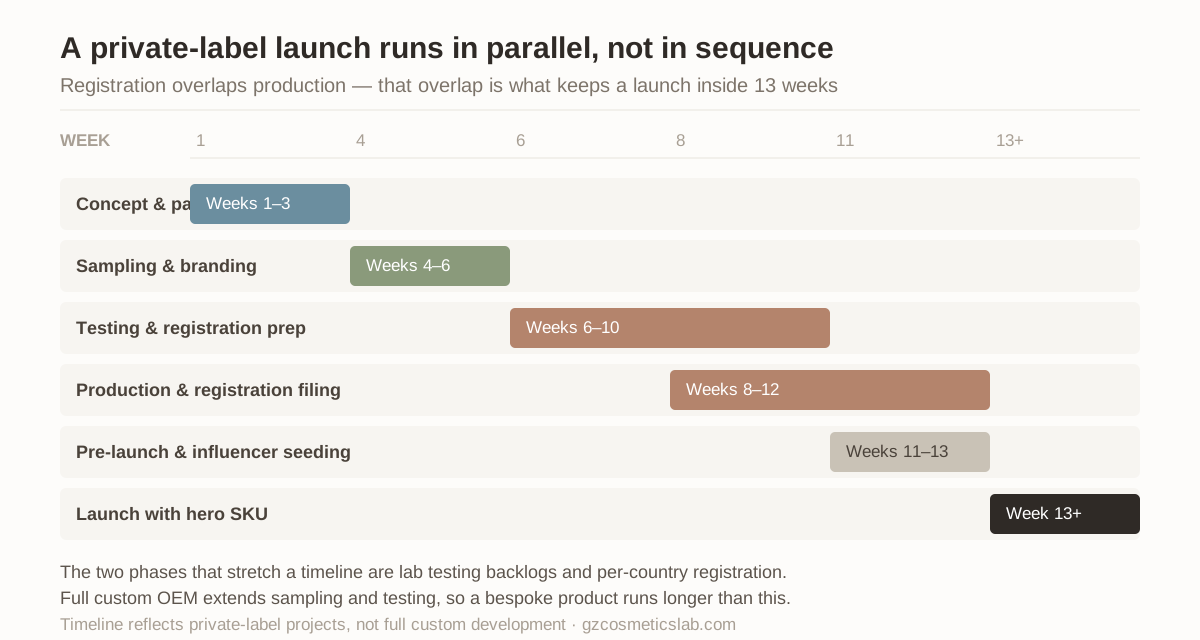
Chart by GZ Cosmetics Lab · Free to reuse with a link back to this page.
While every brand moves at its own pace, this rough timeline helps set expectations for a private-label launch, where development is faster than full custom OEM.
| Phase | Weeks | Key Activities |
|---|---|---|
| Concept & partner selection | 1-3 | Define market, product, and positioning; shortlist and vet manufacturers |
| Sampling & branding | 4-6 | Approve formula samples; finalize brand identity and packaging design |
| Testing & registration prep | 6-10 | Stability/safety testing; assemble registration dossier per market |
| Production & registration | 8-12 | First production run; file country notifications in parallel |
| Pre-launch & seeding | 11-13 | Seed influencers, prepare content, set up marketplace listings |
| Launch | 13+ | Go live with hero SKU, drive reviews, monitor and iterate |
Custom OEM development extends the sampling and testing phases, so a fully bespoke product typically takes longer. The two activities most likely to stretch the timeline are testing (labs can have backlogs) and per-country registration - which is exactly why an experienced manufacturer who runs these in parallel with production is so valuable.
Why Manufacturing Partner Choice Makes or Breaks Your Launch
A brand is only as good as the product behind it. For skincare brands entering Southeast Asia, the ideal manufacturing partner brings:
- Tropical formulation expertise - lightweight, humidity-resistant, no-white-cast formulas
- Regulatory support across BPOM, TFDA, NPRA, DAV, FDA PH, and HSA
- Halal certification capability for Indonesia and Malaysia
- Low-MOQ flexibility so new brands can launch without oversized first orders
- Certifications - ISO 22716 / GMPC for quality assurance
- Differentiating technology - such as our proprietary delivery technology, backed by multiple patents, which improves active ingredient performance in demanding tropical conditions (see our technology page)
As a Guangzhou-based OEM/ODM manufacturer operating since 2010, we help brands go from concept to shelf across Southeast Asia - covering formulation, testing, certification, and per-country registration support.
Ready to Launch Your Southeast Asia Skincare Brand?
The opportunity in Southeast Asia is real, but success comes from getting the fundamentals right: the right market, a focused product, proper compliance, and a manufacturing partner who understands the region. Move deliberately through each step and you can launch a brand that not only enters the market but builds lasting loyalty.
Request a quote or contact our team to discuss your brand. Start with our related guides on OEM skincare manufacturing and sunscreen OEM for Southeast Asia.
Frequently Asked Questions
How much does it cost to start a skincare brand in Southeast Asia? It varies widely with your manufacturing model and order size. A private-label launch with stock formulas and packaging can start relatively lean, while fully custom OEM development costs more upfront. The biggest single cost is usually your first production order, driven by MOQ. Choosing a low-MOQ partner keeps the entry point accessible.
Which Southeast Asian market should I launch in first? Start with one or two markets that fit your product and budget. Halal-focused brightening and sun care suit Indonesia and Malaysia; premium science-led products suit Thailand and Singapore; affordable social-driven products suit the Philippines and Vietnam. Expand once you have proof of demand.
Do I need Halal certification? For Indonesia and Malaysia, Halal is effectively essential and a major purchase driver. If those markets are in your plan, formulate Halal-compliant from the start rather than retrofitting later.
How long does it take to launch? With a private-label route, a few months is realistic; custom OEM development takes longer. Registration and testing run in parallel with production and are usually the main timeline variables.
Can I sell across all ASEAN countries with one product? A formula compliant with the ASEAN Cosmetic Directive is broadly acceptable region-wide, but each country requires its own notification or registration, and labeling must meet local language and claim rules. Plan registration market by market.
Do I need my own factory? No. Nearly all new brands use OEM/ODM or private-label manufacturing partners, which lets you launch a compliant, high-quality product without capital-intensive facilities.
How do I choose between private label and custom OEM for my first product? Private label gets you to market fastest and cheapest by using proven stock formulas with your branding — ideal for testing demand or launching on a tight budget. Custom OEM lets you develop a differentiated formula around a specific active, texture, or claim, which builds a defensible brand but costs more and takes longer. A common path is to launch with one or two private-label heroes to validate the market, then reinvest in custom development once you see traction and repeat purchases.
What is the most common reason new skincare brands fail in Southeast Asia? Usually it is skipping market and compliance groundwork: launching a formula that ignores tropical skin needs, underestimating per-country registration timelines, or setting prices without accounting for marketplace fees and marketing costs. Brands that research one target market deeply, formulate for local conditions and Halal requirements, and budget realistically for launch marketing consistently outperform those that spread thin across too many markets too soon.
Related Products
Explore ready-to-customize formulations you can private label under your own brand.
Ready to Start Your Project?
Tell us your product requirements. Within 24 hours, our technical team will reply with a quotation or the questions needed to prepare one.