
Cosmetic Product Registration Thailand: Steps & Fees
Quick answer
Cosmetic product registration in Thailand is what brands call it; the Thai FDA calls it notification. Cosmetics in Thailand are notified, not pre-approved. You file with the Thai FDA (TFDA) through its e-submission portal, receive a notification number, and that number is valid for three years. A Thai legal entity or an appointed local importer must hold the notification — a foreign brand cannot file in its own name.
- Who files: a Thai company or your appointed Thai importer of record
- Total timeline: 7–19 weeks for general cosmetics; 10–28 weeks for controlled cosmetics. Budget 3–5 months and 5–7 months respectively from document prep to notification number
- TFDA notification fee: USD 15–30 per product. Consultant fees, GMP audit, stability and safety testing are separate line items
- Validity: three years from date of issue, and the clock runs whether or not you have shipped
- What your factory must supply: the Product Information File — raw material specs, batch records, stability data, safety assessment. Ask for the PIF pack in writing before your first order
Full step-by-step process, document checklist and cost table below.
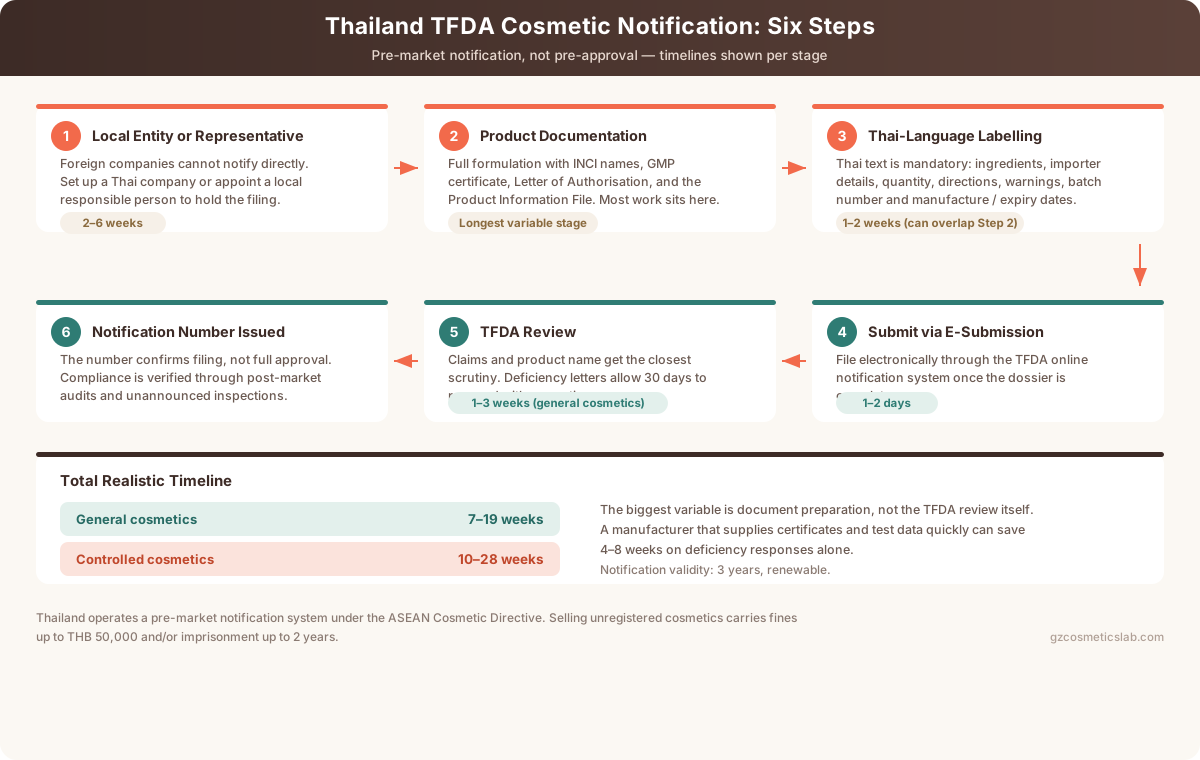
Chart by GZ Cosmetics Lab · Free to reuse with a link back to this page.
Thailand's beauty and personal care market reached USD 7.2 billion in 2023 (Euromonitor) and is projected to grow at 6.8% CAGR through 2028. For international brands eyeing Southeast Asia, Thailand represents the second-largest cosmetics market in ASEAN - right behind Indonesia but far more accessible in terms of regulatory infrastructure.
But here's the catch: you cannot sell cosmetics in Thailand without registering your products with the Thai Food and Drug Administration (TFDA). No registration, no market access. Period.
This guide breaks down the entire TFDA cosmetics registration process - from classification to final approval - so you know exactly what to expect before committing resources. Whether you're a brand owner planning Thailand market entry or working with an OEM/ODM manufacturing partner to develop products specifically for Thai consumers, this is your roadmap.
Why Thailand? Understanding the Market Opportunity
Before diving into regulations, let's look at why so many brands are rushing into this market.
Thailand has 72 million consumers, with a median age of 40 and rising disposable income in urban centers like Bangkok, Chiang Mai, and Pattaya. The country's beauty culture runs deep - skincare routines are a daily norm across all demographics, not just young women.
A few trends shaping the market right now:
K-beauty influence remains strong. Korean skincare philosophy - multi-step routines, glass skin, gentle formulations - has reshaped Thai consumer expectations. Products positioned with Korean-inspired ingredients (centella asiatica, snail mucin, rice ferment) perform well, but Thai consumers increasingly demand these in formulations suited to tropical, humid climates.
Local brands are rising fast. Thai indie brands like Srichand, Beauty Buffet, and Cathy Doll have built massive followings. They understand local skin concerns (oil control, UV protection, brightening) and price aggressively. Foreign brands need a clear value proposition to compete.
E-commerce is the growth engine. Shopee and Lazada dominate online beauty sales, with TikTok Shop growing rapidly since 2022. Cross-border selling is possible but limited - most successful brands establish local entities or work through authorized importers, which requires TFDA registration regardless.
Halal cosmetics matter. Thailand's southern provinces have significant Muslim populations, and halal-certified beauty products are a growing niche. Brands targeting the broader ASEAN market often use Thailand as a hub for halal-compliant production.
The bottom line: Thailand is not a market you can test casually through cross-border e-commerce. Regulatory compliance is the price of entry, and TFDA registration is non-negotiable.
TFDA Cosmetics Registration: The Regulatory Framework
The Thai FDA operates under the Ministry of Public Health and regulates cosmetics through the Cosmetics Act B.E. 2558 (2015). This legislation replaced the older 1992 act and modernized Thailand's approach to cosmetics regulation.
Under this framework, all cosmetic products manufactured in or imported into Thailand must be notified to the TFDA before they can be sold. The system is a product notification model - meaning you register the product (not just the brand), and each SKU requires its own notification number.
Product Classification
Classification drives your timeline more than any other single factor, and TFDA works with three tiers rather than two:
General cosmetics cover everything without regulated actives - moisturizers, cleansers, serums, lip products, color cosmetics, hair care, body care, and fragrances. Filing is the fastest route, and in clean cases a notification receipt is issued within a few working days.
Controlled cosmetics contain substances that ASEAN and TFDA permit only within set concentration limits - certain preservatives, colorants, UV filters above threshold concentrations, and specific whitening actives. Same notification system, heavier scrutiny: the formulation gets checked against the concentration annexes, which adds weeks rather than days.
Specially controlled cosmetics are the highest-risk tier, designated by ministerial notification. Hair dyes and bleaching agents are the common examples. This tier requires a full technical file reviewed before market entry, and you should budget roughly six weeks of review rather than days.
Two practical cautions. First, the tier is set by your formula and your claims together, not by the product category alone - an anti-acne or whitening claim can move a product up a tier even when the base formula looks routine. Second, a notification number issued quickly does not always mean you are clear: filings are frequently pulled for post-audit review by officers, and a pending post-audit can hold up customs clearance even though you hold a number. Confirm your tier before you finalise packaging artwork, because a reclassification after print is an expensive reprint.
Who Can Register?
Only a Thai-registered entity can submit product notifications to TFDA. This means:
- A Thai company (registered with the Department of Business Development)
- With a physical business address in Thailand
- With a designated responsible person who holds Thai citizenship or permanent residency
Foreign brands cannot register directly. You need either:
- Your own Thai subsidiary
- A licensed importer/distributor acting on your behalf
- A local agent or regulatory consultant with proper authorization
This requirement is why many brands entering Thailand work with established distributors or OEM partners who already have local entities and regulatory experience.
Registration or Notification: Why the Word Matters
Almost every brand searching for cosmetic product registration in Thailand is looking for the right thing under the wrong name. Thailand does not register cosmetics in the sense most people mean. It notifies them. The difference is not semantic, and it changes what you are allowed to say and who carries the risk.
A registration system implies a reviewer. Someone at the authority reads your file, forms a judgement, and grants permission. A notification system implies a filing clerk. You declare the product, the system issues a number, and nobody has assessed whether your formula is safe or your claims are defensible. The number proves you filed. It does not prove anyone agreed with you.
What This Changes in Practice
Three consequences follow, and each one catches brands out:
- You cannot call the product TFDA approved. No approval was given. Distributors and marketplace listings sometimes ask for wording like this, and supplying it is a claims violation, not a favour.
- Liability sits with the notification holder, not the authority. Because nobody vetted the file, the holder is the one who defends it when a complaint or an inspection arrives. That is your Thai entity or your appointed importer, whose name is on the notification.
- The burden of proof is the Product Information File, not the number. The filing takes weeks. Building a file that survives being read takes as long as your factory takes to produce the raw material specifications, stability data and safety assessment behind it.
This is a regional pattern rather than a Thai quirk. The Philippine route issues a certificate of product notification, and the ASEAN framework the member states harmonised around is built on notification by design. If you sell into more than one of these markets, expect to keep explaining to colleagues that the number in hand is a receipt, not a clearance.
Where the Distinction Bites: Reformulation and Renewal
Under a review system, a change to your formula gets re-examined. Under a notification system nothing stops you filing again, which sounds easier and is exactly where brands get careless. Because no reviewer will catch the mistake, an ingredient that has moved onto a restricted list, or a claim that has drifted past what the evidence supports, travels straight through the filing and only surfaces during post-market surveillance, when the product is already on shelves and the recall is yours to fund.
Step-by-Step TFDA Registration Process
Here's the actual workflow from start to finish:
Step 1: Establish a Local Entity or Appoint an Authorized Representative
If you don't already have a Thai company, you'll need to either register one or partner with a local importer. Setting up a Thai company takes 2-4 weeks through the Department of Business Development and requires minimum registered capital of THB 2 million (approximately USD 57,000) for foreign-majority ownership.
Most brands choose to work through authorized Thai importers or distributors, which is faster and avoids the complexity of foreign business licensing.
Timeline: 2-6 weeks (depending on your approach)
Step 2: Prepare Product Documentation
This is where most of the work happens. You'll need to compile:
- Full ingredient list (INCI names, concentrations of all ingredients)
- Certificate of Free Sale (CFS) from the country of manufacture
- Good Manufacturing Practice (GMP) certificate - ISO 22716 or equivalent
- Product safety assessment/report
- Stability test data (minimum 6 months accelerated or 12 months real-time)
- Microbiological test results (total plate count, yeast/mold, pathogens)
- Heavy metals analysis (lead, arsenic, mercury, cadmium)
- Product labels in Thai language (front, back, and any inserts)
- Letter of Authorization (LOA) from the brand owner to the Thai registrant
- Power of Attorney if using a regulatory agent
For controlled cosmetics, add:
- Efficacy test data for claimed active ingredients
- Clinical safety data if applicable
- Detailed formulation rationale
All documents from overseas must be notarized and, in most cases, legalized through the Thai embassy in the country of origin.
Timeline: 3-8 weeks (depending on how prepared your manufacturer is)
Step 3: Thai Language Labeling Compliance
TFDA mandates that all cosmetic labels include:
- Product name
- Product category/type
- Net weight/volume
- Complete ingredient list (INCI or Thai common names)
- Directions for use
- Warnings and precautions
- Manufacturing date and expiry date (or PAO symbol)
- Manufacturer/importer name and address
- Country of origin
- Notification number (added after approval)
All mandatory information must appear in Thai. You can include other languages alongside Thai text, but Thai is required. Work with a qualified translator - TFDA reviewers will reject applications with translation errors.
Timeline: 1-2 weeks (can overlap with Step 2)
Step 4: Submit Online Notification via TFDA E-Submission System
Thailand's TFDA uses an electronic submission portal. The process:
- Register for an account on the TFDA e-submission system
- Select "Cosmetics Notification" and choose product type
- Fill in all product details (formulation, claims, manufacturer info)
- Upload supporting documents (all documents from Step 2)
- Pay the notification fee
- Submit for review
The system generates a receipt number immediately upon submission. This is not the same as approval - it's confirmation that your application is in the queue.
Timeline: 1-2 days (for actual submission, assuming all documents are ready)
Step 5: TFDA Review and Approval
Once submitted, TFDA reviews the notification. Review times vary:
- General cosmetics: 3-15 business days (often within one week if documentation is complete)
- Controlled cosmetics: 30-90 business days (more thorough review, possible requests for additional data)
If TFDA has questions or finds documentation gaps, they'll issue a deficiency notice. You typically have 30 days to respond with corrections or additional information. Failure to respond within the deadline means restarting the process.
Common reasons for deficiency notices:
- Incomplete ingredient declarations
- Missing or incorrect CFS
- Label non-compliance (Thai language issues)
- Claims that imply drug-like efficacy
- Controlled substance concentrations not properly documented
Step 6: Receive Notification Number
Upon approval, TFDA issues a cosmetics notification number (เลขที่จดแจ้ง). This number must appear on all product labels sold in Thailand. Format: XX-X-XXXXXXXX
The notification is valid indefinitely as long as:
- The product formulation remains unchanged
- The manufacturer maintains GMP compliance
- Annual license fees are paid
- No safety issues arise during post-market surveillance
If you change the formulation (even a minor fragrance adjustment), you may need to submit a new notification or amendment.
Total Timeline and Cost Breakdown
Realistic Timeline
| Phase | Duration |
|---|---|
| Entity setup / importer agreement | 2-6 weeks |
| Document preparation | 3-8 weeks |
| Label design and translation | 1-2 weeks |
| Submission and review (general) | 1-3 weeks |
| Submission and review (controlled) | 4-12 weeks |
| Total (general cosmetics) | 7-19 weeks |
| Total (controlled cosmetics) | 10-28 weeks |
Most brands should budget 3-5 months for general cosmetics and 5-7 months for controlled cosmetics from initial document preparation to final notification number.
Cost Estimates
| Item | Cost Range (USD) |
|---|---|
| TFDA notification fee (per product) | $15-30 |
| Regulatory consultant/agent fees | $800-2,500 per SKU |
| GMP audit (if not already certified) | $3,000-8,000 |
| Stability testing | $500-1,500 per product |
| Safety assessment | $300-800 per product |
| Lab testing (micro + heavy metals) | $200-500 per product |
| Document legalization/notarization | $100-300 per document |
| Thai label translation and design | $150-400 per SKU |
| Total per SKU (general) | $2,000-5,500 |
| Total per SKU (controlled) | $3,500-9,000 |
These figures assume you're working with a regulatory agent. If you have your own Thai entity with in-house regulatory staff, costs drop significantly on the consultancy side but increase on overhead.
For brands registering multiple SKUs simultaneously, per-unit costs decrease because many documents (GMP certificate, CFS, company authorization) are shared across products.
Common Challenges and How to Avoid Them
Claims That Cross the Line
TFDA draws a strict line between cosmetic claims and drug/medical device claims. You cannot claim your product:
- Treats, cures, or prevents any disease
- Changes body structure or function permanently
- Penetrates beyond the epidermis
- Has therapeutic effects
"Anti-aging" is borderline acceptable; "removes wrinkles" is not. "Brightening" is fine; "treats hyperpigmentation" crosses into drug territory. Positioning a formula on radiance rather than correction keeps it inside the cosmetic boundary, which is how our ginseng radiance renewal face cream is claimed for this market. Work with your regulatory agent to review all product claims before submission.
Ingredient Restrictions Specific to Thailand
TFDA maintains its own list of prohibited and restricted substances, which largely mirrors the EU Cosmetics Regulation but has some Thailand-specific additions. A few to watch:
- Mercury compounds - completely banned (some Asian markets still allow trace amounts)
- Hydroquinone - restricted to 2% and classified as controlled
- Retinol/retinoids - specific concentration limits apply
- CBD/hemp derivatives - regulatory status is evolving; check current rules before formulating
The Product Information File: What You Must Keep on Hand
The single most commonly missed obligation in Thailand is the Product Information File, or PIF. Getting a notification number is not the finish line. Under ASEAN harmonisation, the notification holder must keep a PIF at their registered office and produce it on request when a TFDA post-market officer walks in. There is no grace period for assembling it after the fact.
The PIF follows the ASEAN structure and is organised in parts:
- Part I - Administrative documents and product summary. Product identity, the notification holder, manufacturer details, and the finished product summary. This is the part that must be physically available at the office.
- Part II - Raw material data. Specifications and safety information for each ingredient.
- Part III - Finished product data. Finished product specifications, manufacturing method, and quality control results.
- Part IV - Safety assessment. Toxicological profile and exposure assessment for the formula.
- Part V - Efficacy data. Substantiation for any claim you make on the label or in advertising.
Part I is the minimum that must be kept ready for on-the-spot inspection. Failure to have it available carries penalties under the Cosmetics Act B.E. 2558, including fines and, for serious cases, imprisonment. In practice the risk is less about the maximum penalty and more about what an incomplete PIF signals to an inspector: it invites a deeper look at everything else.
This is one area where your manufacturer does most of the heavy lifting. Parts II, III, and IV are built from factory documentation - raw material specifications, batch records, stability data, and safety assessments. A factory that already exports to ASEAN markets will have these compiled. Ask for the PIF pack in writing before you place a first order, not after your notification lands.
Notification Validity and Renewal: The Three-Year Clock
Thai cosmetic notifications are not permanent. Each notification is valid for three years from the date of issue, and the clock starts whether or not you have shipped a single unit. This changed from the older open-ended system specifically to strengthen post-market accountability, and it catches brands who assume a notification number is a one-time cost.
Practical points on renewal:
- Renew before expiry. Renewal applications can be filed in advance of the expiry date through the same channels used for the original filing - the TFDA e-submission system, TFDA directly, or a Provincial Public Health Office.
- An expired notification means you cannot legally sell. Not a paperwork problem - a stop-ship problem. Distributors will pull product rather than carry the risk.
- Late renewal may still be possible within a short window after expiry, with an explanation and a fine, but this is a recovery path and not a plan.
- Track renewal dates per SKU, not per brand. If you notified twelve products across three filing dates, you have three separate clocks running.
Build the renewal date into your product calendar the day the notification number arrives. For brands running a multi-market ASEAN rollout, this is where a simple registration tracker stops being optional; see our ASEAN Cosmetic Directive guide for how the six markets differ on validity and renewal.
Post-Market Obligations
Registration isn't the end. TFDA conducts post-market surveillance through:
- Random product sampling at retail
- Consumer complaint investigation
- Annual GMP compliance verification
- Advertising claim monitoring
Non-compliance can result in product recall, notification cancellation, fines up to THB 100,000, or criminal prosecution for serious violations.
How Chinese OEM Partners Help Brands Navigate TFDA Registration
Here's where working with an experienced OEM/ODM manufacturer becomes a strategic advantage rather than just a production decision.
Chinese cosmetics manufacturers that regularly export to Thailand have already solved many of the pain points that trip up first-time registrants:
GMP compliance is already in place. Established OEM factories operate under ISO 22716 and China's NMPA GMP standards, both recognized by TFDA. You don't need a separate GMP audit - the existing certificate works.
Stability and safety testing is routine. Manufacturers running production for multiple international markets already conduct accelerated stability testing, preservative efficacy testing, and heavy metals screening as standard practice. The data exists; it just needs to be compiled in TFDA's preferred format.
Certificate of Free Sale is straightforward. For products manufactured in China, the CFS is issued by local commerce authorities or CCPIT. Experienced exporters know the exact process and timeline.
Formulation expertise for tropical markets. OEM labs that serve Southeast Asian clients understand the technical requirements - higher SPF stability in humid conditions, oil-control formulations, lightweight textures that work in 35°C heat. This isn't just about compliance; it's about making products that actually sell in Thailand.
Documentation packages are pre-structured. If your OEM partner has registered products in Thailand before, they already know what TFDA reviewers look for. The difference between a first-time registrant fumbling through requirements and an experienced partner who prepares a clean, complete package can be 4-8 weeks saved on deficiency responses alone.
For brands that want to enter both Thailand and neighboring markets, the same manufacturer can prepare documentation packages for Malaysia and Singapore registration or Vietnam market entry and registration simultaneously - since many of the core documents (GMP cert, stability data, safety assessment) overlap across ASEAN regulatory frameworks.
Frequently Asked Questions
How long does TFDA cosmetics registration take?
For general cosmetics with complete documentation, expect 7-19 weeks total. Controlled cosmetics take 10-28 weeks. The biggest variable is document preparation - if your manufacturer can provide all required certificates and test data quickly, the TFDA review itself is relatively fast (1-3 weeks for general cosmetics).
Can I sell cosmetics in Thailand without TFDA registration?
No. All cosmetics sold in Thailand - whether manufactured domestically or imported - must have a valid TFDA notification number. Selling unregistered cosmetics is illegal and carries fines up to THB 50,000 and/or imprisonment up to 2 years.
Do I need a Thai company to register cosmetics?
Yes. Only Thai-registered entities can submit TFDA notifications. Foreign brands must work through a Thai subsidiary, authorized importer, or registered regulatory agent.
Is ASEAN Cosmetic Directive harmonization real?
Partially. ASEAN member states share the ASEAN Cosmetic Directive framework, which harmonizes ingredient lists and labeling requirements to some degree. However, each country maintains its own registration process, fees, and timelines. Registration in one ASEAN country does not automatically grant market access in others. The Philippines adds a company-level License to Operate before any product filing, and Indonesia layers a mandatory halal requirement on top of BPOM notification - the ingredient science travels across borders, the paperwork does not.
What happens if I change my product formula after registration?
Any change to the product formulation - including fragrance changes, colorant adjustments, or concentration modifications - requires either a new notification or an amendment to the existing one. Minor changes (packaging only, no formula change) typically don't require re-notification but must still comply with labeling requirements.
Can I use the same product registration for online and offline sales?
Yes. The TFDA notification covers the product regardless of sales channel. Whether you sell through department stores, pharmacies, convenience stores, Shopee, Lazada, or TikTok Shop, the same notification number applies.
How much does it cost to register one cosmetic product in Thailand?
Budget USD 2,000-5,500 per SKU for general cosmetics, including regulatory agent fees, testing, and documentation. The TFDA notification fee itself is minimal (around USD 15-30), but preparation costs are the main expense.
Do I need animal testing data for Thailand?
No. Thailand does not require animal testing for cosmetics and has been moving toward cruelty-free alignment with global standards. In vitro safety data and human patch test results are acceptable.
Ready to Enter Thailand's Beauty Market?
Thailand offers genuine opportunity for cosmetics brands willing to invest in proper market entry. The regulatory process is structured and predictable - not fast, but not unreasonably slow compared to other regulated markets. The key is preparation: have your documentation complete, your formulations compliant, and your local partners in place before you start the clock.
If you're looking for an OEM manufacturing partner who can handle both product development and regulatory documentation for Thailand market entry, we can help. Our team has supported brands through TFDA registration across skincare, color cosmetics, and personal care categories - from formulation optimization for tropical climates to complete export documentation packages.
Get a quote for your Thailand market entry project →
We'll walk you through what's needed for your specific product line, provide realistic timelines, and make sure your documentation package is complete before submission - so you don't lose weeks to avoidable deficiency notices.
Related Products
Explore ready-to-customize formulations you can private label under your own brand.
Ready to Start Your Project?
Tell us your product requirements. Within 24 hours, our technical team will reply with a quotation or the questions needed to prepare one.