
ASEAN Cosmetics Directive: Regulations for All 6 Markets
Quick answer
The ASEAN Cosmetic Directive harmonises the rulebook, not the paperwork. One well-designed base formula can be compliant across all six markets, but each country still needs its own notification and its own label. Design once, submit six times.
- What the ACD harmonises: the cosmetic-versus-drug definition and the shared ingredient annexes
- What stays national: the notification filing itself, label language, the local-entity requirement and enforcement intensity
- All six use notification, not pre-approval — faster than drug-style registration, but still requires a complete dossier
- Almost all require a local entity to hold the notification: Indonesia (BPOM), Thailand (TFDA), Malaysia (NPRA), Vietnam (DAV), Philippines (FDA, via a License to Operate holder), Singapore (HSA)
- Speed order: Singapore is the lightest touch, Malaysia fast, Vietnam fast to moderate, Thailand and the Philippines moderate, Indonesia the longest and most strictly enforced
- Label language: Bahasa Indonesia and Thai and Vietnamese are mandatory in their markets; English is accepted in Singapore and the Philippines, English or Malay in Malaysia
Full six-market comparison table, per-country notes and the document pack your factory must supply are below.
Southeast Asia is not one market. It is six regulators, six sets of paperwork, and six labeling regimes sitting on top of one shared rulebook. Brands that treat the region as a single entry often stall when a formula cleared in one country fails notification in the next. This guide maps the ASEAN Cosmetic Directive and the six national systems side by side, so you can plan cosmetics regulation across Southeast Asia as one coordinated rollout instead of six disconnected fire drills. It is the strategic overview that ties together our country-specific guides for Indonesia (BPOM), Thailand (TFDA), and Vietnam (DAV).
The Shared Rulebook: What the ASEAN Cosmetic Directive Actually Harmonizes
The ASEAN Cosmetic Directive (ACD) was created to align cosmetic regulation across member states. Understanding what it standardizes - and what it deliberately leaves to each country - is the key to planning a multi-market launch.
What Is Genuinely Harmonized
- Product definition - a common definition of what counts as a cosmetic versus a drug
- Ingredient lists - shared annexes of prohibited substances, restricted substances with limits, and permitted colorants, preservatives, and UV filters
- Notification principle - most markets use a notification system (declare before selling) rather than pre-market approval
- Product Information File (PIF) - a common technical dossier structure the manufacturer must hold and produce on request
- Labeling fundamentals - a shared baseline for mandatory label information and claims substantiation
- GMP reference - ASEAN Cosmetic GMP, aligned with ISO 22716, as the manufacturing standard
What Each Country Still Controls
This is where brands get caught. The ACD harmonizes the science; it does not remove national administration. Each country keeps control of:
- Its own notification portal, fees, and processing timelines
- Language requirements on labels
- Whether a local license holder or importer of record is mandatory
- Additional national restrictions layered on top of the ASEAN annexes
- Enforcement intensity, market surveillance, and recall practices
The practical takeaway: a single, well-designed base formula can be compliant region-wide, but every country needs its own notification and label. Design once, submit six times.
Six Markets at a Glance: The Master Comparison
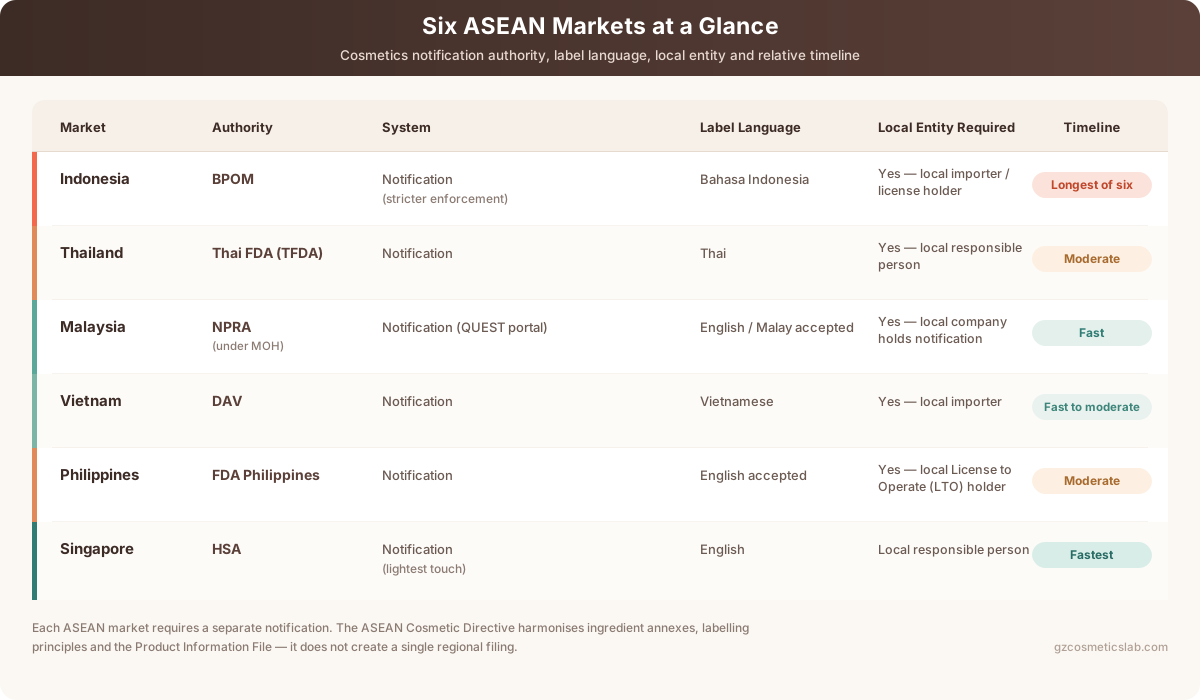
Chart by GZ Cosmetics Lab · Free to reuse with a link back to this page.
This master table is the fastest way to see how the six markets differ on the factors that actually affect your launch plan. Deeper procedural detail for the three largest markets lives in our dedicated country guides.
| Market | Authority | System | Label Language | Local Entity Required | Typical Timeline |
|---|---|---|---|---|---|
| Indonesia | BPOM | Notification (stricter enforcement) | Bahasa Indonesia | Yes - local importer/license holder | Longest of the six |
| Thailand | Thai FDA (TFDA) | Notification | Thai | Yes - local responsible person | Moderate |
| Malaysia | NPRA (under MOH) | Notification (QUEST portal) | English/Malay accepted | Yes - local company holds notification | Fast |
| Vietnam | DAV | Notification | Vietnamese | Yes - local importer | Fast to moderate |
| Philippines | FDA Philippines | Notification | English accepted | Yes - local License to Operate holder | Moderate |
| Singapore | HSA | Notification (lightest touch) | English | Local responsible person | Fastest |
Two patterns stand out. First, every market uses notification rather than pre-approval, which is faster than a drug-style registration but still demands a complete dossier. Second, almost all require a local entity to hold the notification - so your route to market includes either a distributor partner or a local presence, not just a compliant product.
Not sure which route fits your product?
Send us your brief and our formulators will tell you what is realistic on formula, MOQ, and timeline before you commit to anything.
Country Notes: What Makes Each Market Different
The master table shows the structure; these notes capture the one or two things that genuinely differ in each market and catch brands off guard. For full step-by-step procedures, follow the linked country guides.
Indonesia: Strictest Enforcement, Halal Expectation
Indonesia has the largest population in ASEAN and the most demanding regulator. Beyond the standard notification, the practical differentiators are aggressive market surveillance (zero tolerance on mercury, with real product seizures) and a strong, increasingly formalized halal expectation from consumers and retailers. Budget the longest timeline of the six and build halal into your plan early. Full detail is in our BPOM registration guide.
Thailand: Claims Scrutiny and Thai-Language Labels
Thailand is a sophisticated beauty market where the Thai FDA pays close attention to claims. "Whitening" language draws scrutiny, so "brightening" and "radiance" are safer positioning. Thai-language labeling is mandatory, and performance claims such as SPF require supporting test data. See our TFDA registration guide for the process.
Malaysia: Fast Notification, Halal as Differentiator
Malaysia's NPRA runs an efficient online notification through the QUEST portal, making it one of the quicker entries. English and Malay labeling are workable. Halal certification (JAKIM) is not legally mandatory for cosmetics but is a strong market differentiator given the consumer base, and enforcement against non-compliant or mercury-containing products is active.
Vietnam: Fast-Growing, Vietnamese Labeling
Vietnam is the region's fastest-rising beauty market, with a modernized notification system through the DAV. The system is relatively quick, but Vietnamese-language labeling and INCI ingredient declaration are required, and a local importer must hold the notification. Our Vietnam market and registration guide covers the commercial opportunity alongside the paperwork.
Philippines: English-Friendly, LTO Requirement
The Philippines FDA accepts English labeling, which lowers the localization burden, but it requires a valid License to Operate (LTO) holder as the local responsible entity before products can be notified. Adverse-event reporting obligations and active anti-mercury enforcement are notable features of this market.
Singapore: Lightest Touch, Regional Springboard
Singapore's HSA runs the simplest, fastest notification of the six, entirely in English. Low friction and high consumer trust make it an ideal validation market and a credible regional springboard before tackling the larger, more document-heavy neighbors.
The Ingredient Annexes: Formulate for the Strictest, Sell Everywhere
Because the ACD shares ingredient annexes, a formula built to the toughest national interpretation generally clears the rest. The strategic move is to formulate to the strictest common denominator from day one.
Prohibited and Heavily Restricted
- Mercury and mercury compounds - banned region-wide, with zero-tolerance enforcement in several markets
- Hydroquinone - not permitted in cosmetics (treated as a drug ingredient)
- Certain corticosteroids and prohibited actives - flagged in market surveillance across the region
Restricted with Limits
- Alpha-arbutin, AHAs, and other actives permitted up to defined concentrations with pH conditions - our glutathione brightening serum and niacinamide dark-spot serum are both specified within these annex limits
- Preservatives and UV filters allowed only from the approved annex lists at set maximums - relevant to any SPF product in the range
- Colorants restricted to the permitted list
For the pigmentation category specifically - the region's top skincare demand - our whitening and brightening OEM guide breaks down the safe, compliant actives in detail. The principle applies across every category: build the base formula to Indonesia-level strictness and you rarely need to reformulate for the others - the approach behind bases such as our glutathione brightening body lotion, specified to the strictest annex limits of the six.
Labeling: One Design System, Six Language Layers
Labeling is where multi-market launches most often trip up, because the ACD sets a shared baseline of required information but each country enforces its own language. Plan a modular label system rather than a single fixed artwork.
Shared Baseline Requirements
- Product name and function
- Full ingredient list in INCI nomenclature
- Net content, batch number, and manufacturing/expiry information
- Name and address of the company responsible for placing the product on the market
- Country of manufacture and any required warnings or directions
The Language Divide
English is workable for Singapore, Malaysia, and the Philippines. Indonesia requires Bahasa Indonesia, Thailand requires Thai, and Vietnam requires Vietnamese. The efficient approach is a common master label with swappable localized panels or country-specific stickers, designed at the packaging stage rather than retrofitted after production.
GMP and the Product Information File: Your Passport Across All Six
ASEAN Cosmetic GMP - aligned with ISO 22716 - is the manufacturing standard underpinning the whole framework. Two things travel with your product into every market:
- GMP-certified manufacturing - notifications and importer due diligence increasingly expect ISO 22716 compliance. Our ISO 22716 and GMPC guide explains what that certification actually covers.
- The Product Information File - a complete technical dossier (formula, specifications, safety assessment, manufacturing details, claims support) that the responsible person must hold and produce on request in any market. A well-built PIF is what lets you notify in six countries from one source of truth.
This is why manufacturer choice matters for multi-market brands: a partner already operating to ISO 22716 with a complete PIF removes the single biggest source of cross-border delay.
Inside the Product Information File
The Product Information File (PIF) is the technical dossier that makes multi-market notification possible. Every responsible person or importer must be able to produce it on request, and a complete PIF is what lets you notify in six countries from one source of truth. A properly built PIF contains:
- Product description and formula - qualitative and quantitative composition with INCI names
- Raw material specifications - technical data sheets and safety data for each ingredient
- Finished product specifications - physical, chemical, and microbiological parameters
- Manufacturing method and GMP evidence - process description and ISO 22716 compliance
- Safety assessment - a qualified safety assessor's evaluation of the finished product
- Stability and preservative efficacy data - proof the product stays safe and stable through its shelf life, ideally under tropical conditions
- Claims support - evidence for every marketing claim on the label
- Undesirable effects data - any adverse-event records where applicable
The reason this matters commercially: a manufacturer who hands you an audit-ready PIF has effectively pre-cleared your product for every ASEAN notification at once. A manufacturer who cannot is a source of delay in each market you enter.
Claims Compliance: Say It the Same Way Everywhere
A subtle multi-market risk is claims inconsistency. What you can say on a label - and how - varies by market, and a claim that is fine in one country may draw scrutiny in another. The pigmentation category is the clearest example:
- "Whitening" is commercially normal in parts of the region but attracts regulatory attention in others; "brightening," "even tone," and "radiance" are the safer cross-market defaults
- Performance claims (SPF values, clinical percentages) require supporting test data wherever they appear
- Drug-adjacent claims (treating, curing, altering structure) can push a cosmetic into drug classification and must be avoided
The efficient discipline is to write one compliant claims set to the strictest market's standard and use it everywhere, so your brand never contradicts itself across borders. For the brightening category specifically, our whitening and brightening OEM guide details compliant claim language.
Cost and Timeline: Planning a Multi-Market Rollout
Because notification cost and speed differ by market, sequencing affects both your cash flow and your speed to revenue. This planning view helps you order your entries deliberately.
| Market | Relative Speed | Localization Effort | Best Role in Rollout |
|---|---|---|---|
| Singapore | Fastest | Low (English) | Validation and launch pad |
| Malaysia | Fast | Low (English/Malay; halal optional) | Early scale, Muslim-majority reach |
| Philippines | Moderate | Low (English; LTO needed) | Early scale, large population |
| Vietnam | Fast to moderate | Medium (Vietnamese label) | High-growth volume market |
| Thailand | Moderate | Medium (Thai label, claims care) | Premium beauty demand |
| Indonesia | Longest | High (Bahasa, halal, strict enforcement) | Largest prize, plan earliest |
A common and effective pattern: launch in Singapore or Malaysia to prove the product, run the Indonesia notification in parallel because it takes longest, and layer in Vietnam, Thailand, and the Philippines as the base documentation and formula are already in place. Every market after the first reuses the same PIF and base formula, so the marginal effort per country drops sharply.
Safety Assessment and Testing Expectations
Underpinning every notification is a safety assessment signed by a qualified assessor, supported by the testing that proves your product is safe and stable in real tropical conditions. Across the six markets you should expect to hold:
- Microbiological and preservative efficacy testing - proof the product resists contamination through its shelf life in a hot, humid supply chain
- Stability testing - accelerated and real-time data, ideally under elevated temperature and humidity representative of the region
- Heavy-metal and contaminant screening - critical given zero-tolerance mercury enforcement in several markets
- Claims-support testing - efficacy or SPF data wherever a performance claim appears on the label
A manufacturer with in-house or accredited-lab testing folds this into the PIF automatically, so the same evidence package satisfies all six regulators without repeat work.
A Practical Multi-Market Sequencing Strategy
You do not have to enter all six at once. A staged rollout controls cost and risk while building the documentation base that makes each subsequent market faster.
- Start with a fast, English-label market - Singapore, Malaysia, or the Philippines to validate demand with the lightest regulatory lift
- Add the high-volume markets - Indonesia and Vietnam, where demand is large but paperwork and language requirements are heavier (see our BPOM and Vietnam guides)
- Layer in Thailand - a strong beauty market with moderate requirements; details in our TFDA guide
- Reuse the PIF and base formula throughout - each new market becomes a notification-and-label exercise, not a reformulation
Planning your first market? Our guide to starting a skincare brand in Southeast Asia covers the commercial side that runs in parallel with compliance.
Common Multi-Market Compliance Pitfalls
The mistakes that stall ASEAN rollouts are rarely about the science of the formula. They are about the administration and coordination across borders. These are the ones that cost brands the most time and money.
- Treating notification as a single regional step - assuming one filing covers the bloc, then discovering each country needs its own submission and local holder. Plan six workstreams from the start.
- Retrofitting labels after production - printing artwork before confirming each market's language and mandatory-information rules, then paying to relabel. Design a modular label system up front.
- Inconsistent formulas across markets - tweaking a formula for one country and creating a version-control problem that breaks your single-PIF advantage. Lock one base formula built to the strictest standard.
- Contradictory claims - marketing that says "whitening" in one market and something incompatible in another, undermining brand credibility and inviting regulatory questions.
- No local responsible entity lined up - a compliant product with nowhere to file because no distributor or license holder is in place. Secure the local partner before you plan the launch date.
- Incomplete or outdated PIF - missing safety assessments or stability data that hold up notification in every market simultaneously.
Each of these is avoidable with upfront planning and a manufacturer who has run the six-market process before. The pattern that works is consistent: one formula, one PIF, one master claims set, and a country-by-country plan for labels, local holders, and sequencing.
Why the Manufacturer Choice Drives the Outcome
For multi-market brands, the factory decision is a compliance decision as much as a product decision. A partner already producing to ISO 22716 GMP, holding audit-ready PIFs, and experienced across all six ASEAN systems compresses your timeline in every market at once. The wrong choice multiplies delay by six. This is why how you choose a cosmetics manufacturer matters more for ASEAN expansion than for a single-market launch.
How an OEM Partner Handles ASEAN Compliance for You
A full-service manufacturer turns this six-market maze into a managed workstream. In practice that means:
- Formulating to the strictest ASEAN annex so one base formula clears all six markets
- Manufacturing under ISO 22716 GMP and maintaining a complete, audit-ready PIF
- Preparing country-specific labels and notification documents in the required languages
- Supporting your local distributors or responsible persons through each notification
- Keeping formula, documentation, and claims consistent so you never contradict yourself across markets
Learn more about our OEM services, or if you are still selecting a factory, our guide on how to choose a cosmetics manufacturer covers what to verify before you commit.
Frequently Asked Questions
Does one ASEAN notification cover all six countries?
No. The ASEAN Cosmetic Directive harmonizes the ingredient rules, product definition, and dossier structure, but each country runs its own notification through its own authority. You submit separately in each market, using the same base formula and Product Information File. Think of it as design once, submit six times.
Which ASEAN market is the easiest to enter first?
Singapore is generally the lightest-touch, with an English-language notification through the HSA. Malaysia and the Philippines are also relatively fast and accept English labeling. Many brands validate demand in one of these before tackling the larger but more document-heavy Indonesian and Vietnamese markets.
Can I use one formula across all of Southeast Asia?
Usually yes, if you formulate to the strictest common standard. Because the ingredient annexes are shared, a formula built to satisfy the toughest national interpretation - typically Indonesia's - will generally comply everywhere else. What changes market to market is labeling and notification, not the core formula.
Do I need a local company in each ASEAN country?
In most markets, yes. Indonesia, Thailand, Vietnam, Malaysia, and the Philippines each require a local entity - an importer, license holder, or responsible person - to hold the notification. This is typically your distributor. Your OEM partner supplies the product, PIF, and documentation; the local entity holds the market authorization.
Is ISO 22716 mandatory for selling cosmetics in ASEAN?
ASEAN Cosmetic GMP is aligned with ISO 22716, and while enforcement varies, notifications and importer due diligence increasingly expect it. Manufacturing with an ISO 22716-certified partner is the safest route and removes a common source of cross-border delay. See our ISO 22716 guide for what the standard covers.
Plan Your ASEAN Rollout with a Partner Who Knows the Six Markets
Entering Southeast Asia is less about a single approval and more about running one compliant formula through six national systems without contradictions or reformulation. The brands that scale fastest are the ones that design for region-wide compliance from the first formulation, hold a complete PIF, and sequence their market entries deliberately.
Our team manufactures under ISO 22716 GMP, formulates to the strictest ASEAN standard, and maintains audit-ready documentation for every market. From your first Singapore or Malaysia launch through full six-market coverage, we handle formulation, PIF, labeling, and notification support so you can focus on selling.
Get started:
- Share your product concept and target ASEAN markets
- Receive a compliance and sequencing plan for your rollout
- Get a detailed project timeline and quotation
Request a quote → or contact our OEM team to plan your Southeast Asian market entry.
Ready to Start Your Project?
Tell us your product requirements. Within 24 hours, our technical team will reply with a quotation or the questions needed to prepare one.