
Sunscreen OEM for Southeast Asia: SPF50+ Tropical Formulas
Sunscreen is not a seasonal category in Southeast Asia - it is a daily necessity 365 days a year. If you are sourcing a sunscreen manufacturer for tropical markets, the formulation challenge is fundamentally different from what works in temperate climates. High UV index, relentless humidity, sweat, and consumers who reapply throughout a hot day all demand a product engineered specifically for the region. This guide breaks down SPF50 sunscreen OEM for Southeast Asia from formulation types and testing to ASEAN regulations and how to bring a market-ready product to shelf.
The Southeast Asian sun care market is projected to grow at over 8% annually through 2028, driven by rising skin-consciousness, aggressive social media education, and the plain physical reality of living near the equator. UV index readings of 10-12 are routine across Indonesia, Thailand, Malaysia, the Philippines, and Vietnam. For OEM brands, sunscreen is one of the highest-repeat-purchase, highest-loyalty categories available - get the formula right and customers rebuy every 4-6 weeks.
Why Tropical Sunscreen Is a Different Product
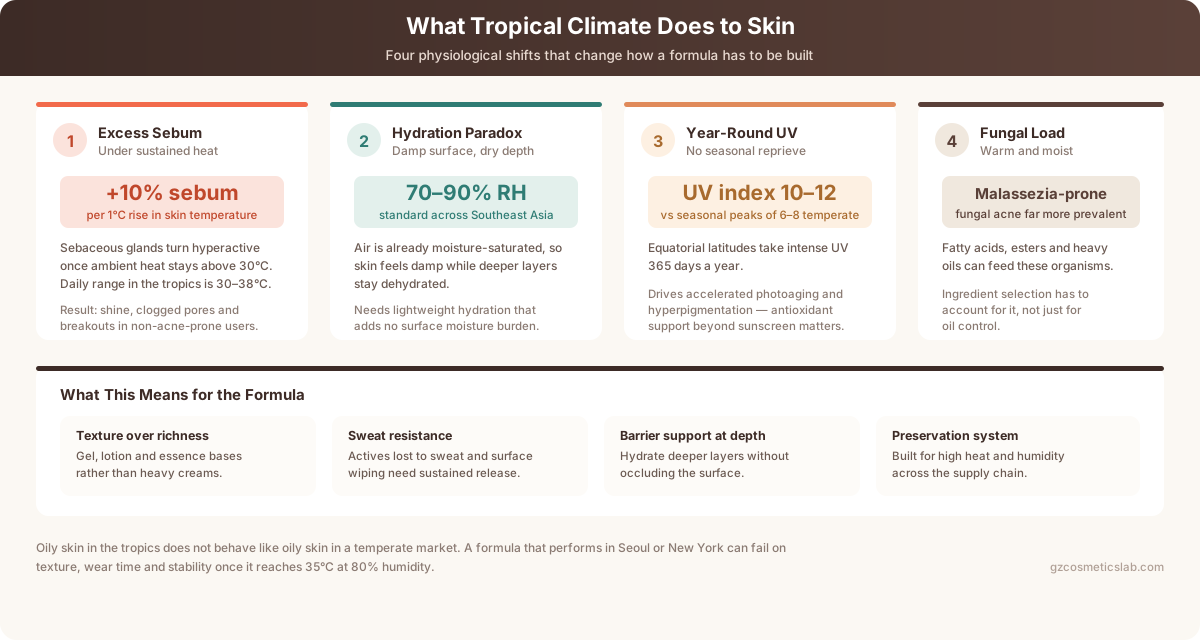
Chart by GZ Cosmetics Lab · Free to reuse with a link back to this page.
Before selecting a formulation route, brands need to understand what tropical conditions do to a sunscreen film on the skin. Many brands entering Southeast Asia fail here first - they license a European formula and discover it feels greasy, pills under humidity, or washes off in sweat within an hour.
Year-Round High UV Load
Countries near the equator receive intense UV radiation every single day with no winter reprieve. This means UVA-driven photoaging and UVB-driven burning and pigmentation happen continuously. Broad-spectrum protection is non-negotiable, and consumers increasingly check for PA ratings (PA++++) alongside SPF numbers.
Humidity and the Pilling Problem
At 75-90% relative humidity, sunscreen films that rely on heavy silicones or high wax loads tend to pill, roll, or feel tacky. Tropical formulations need fast-drying, non-sticky finishes that sit invisibly under makeup or bare skin.
Sweat and Water Resistance
A tropical consumer sweats through a product within hours. Water resistance is not a premium feature in this market - it is a baseline expectation. Formulations must pass 40-minute or 80-minute water resistance testing to make any water-resistant claim.
White Cast Rejection
A large share of Southeast Asian consumers have medium-to-deep skin tones and actively reject sunscreens that leave a white cast. This single factor eliminates many high-load physical (mineral) formulas unless they are carefully micronized or tinted. In markets like the Philippines, Indonesia, and Malaysia, product reviews and social feeds are dominated by "no white cast" as a make-or-break criterion - a product can have flawless protection and still fail commercially if it ghosts the skin.
Air-Conditioning and the Dry-Sweat Cycle
Urban consumers move constantly between 35°C humid streets and heavily air-conditioned offices, malls, and transit. This cycle stresses both the skin barrier and the sunscreen film, causing dry patches on otherwise oily skin. Formulations that pair UV protection with lightweight hydration (hyaluronic acid, glycerin, panthenol) perform better in real daily wear than pure-protection formulas.
Sunscreen Formulation Types: Chemical vs Physical vs Hybrid
Choosing your filter system is the most important early decision. Each route has trade-offs in feel, protection, regulatory acceptance, and consumer perception.
| Filter Type | How It Works | Pros | Cons | Best For |
|---|---|---|---|---|
| Chemical (organic) | Absorbs UV and converts to heat | Lightweight, no white cast, easy high SPF | Some filters restricted in certain markets, potential sensitivity | Everyday cosmetic sunscreens, deeper skin tones |
| Physical (mineral) | Reflects/scatters UV (zinc oxide, titanium dioxide) | Gentle, reef-friendlier, immediate protection | White cast risk, thicker texture | Sensitive skin, baby/kids, "clean" positioning |
| Hybrid | Combines chemical + mineral filters | Balanced feel + broad protection | More complex formulation | Premium daily-wear products |
Chemical Filters
Chemical sunscreens dominate the mass Southeast Asian market because they achieve high SPF with elegant, lightweight textures and no white cast. Common filters include avobenzone (UVA), octinoxate, octocrylene, and newer-generation filters like Tinosorb S and M and Uvinul A Plus, which offer superior photostability. Filter availability differs by market - some regions restrict certain older filters, so your OEM partner must formulate to the target country's approved list. The approved list sits downstream of a larger difference: sunscreen is a cosmetic in some markets and a drug or therapeutic good in others, which changes the testing, the registration and the launch date rather than just the filter choice. How six markets classify sunscreen sets out which is which.
A key formulation consideration is photostability: avobenzone degrades under UV exposure unless it is stabilized by partners like octocrylene or Tinosorb S. A poorly stabilized formula loses meaningful UVA protection within an hour of sun exposure - a critical failure in a market where consumers spend long stretches outdoors. This is exactly why sunscreen formulation is a specialist discipline, not a task for a generalist lab. Encapsulation of filters can further improve stability, reduce skin penetration, and lower sensitivity risk.
Physical (Mineral) Filters
Zinc oxide and titanium dioxide are favored for sensitive-skin, baby, and "clean beauty" positioning. Modern micronized and coated grades reduce (but do not fully eliminate) white cast. Tinted mineral sunscreens are a strong growth sub-category in the region because the tint neutralizes cast while adding light coverage. Mineral formulas also carry a "reef-friendly" positioning advantage that resonates in tourism-heavy markets like Thailand, the Philippines, and Indonesia, where some marine parks restrict certain chemical filters. The trade-off is texture: mineral formulas are inherently harder to make weightless, so achieving a comfortable tropical feel requires skilled dispersion and rheology work.
Hybrid Systems
Hybrid formulas combine the broad, photostable protection of chemical filters with the immediate, gentle coverage of minerals. This is often the sweet spot for premium daily-wear products targeting educated urban consumers in Bangkok, Jakarta, Manila, and Kuala Lumpur.
SPF and PA Testing: What the Numbers Mean
SPF and PA claims must be backed by validated testing before a product can legally carry them. Cutting corners here creates regulatory and liability risk.
SPF (UVB Protection)
SPF measures protection against UVB, the burning and pigment-triggering rays. Testing is done via in-vivo methods (ISO 24444) on human volunteers, measuring the minimal erythema dose with and without product. For tropical markets, SPF50 and SPF50+ are the commercial standard - anything below SPF30 is a hard sell.
PA and UVA Protection
The PA rating (PA+ to PA++++) reflects UVA protection, measured through persistent pigment darkening (ISO 24442) or in-vitro methods (ISO 24443). UVA drives photoaging and penetrates glass and clouds, so PA++++ is increasingly expected on premium products.
Water Resistance Testing
To claim "water resistant (40 minutes)" or "very water resistant (80 minutes)," a product must retain its SPF after standardized immersion cycles. This testing is essential for the beach, sport, and daily-sweat positioning that resonates in tropical markets.
Broad-Spectrum Verification
Broad-spectrum claims require demonstrating a critical wavelength of at least 370nm, confirming meaningful UVA coverage alongside UVB. Reputable OEM partners coordinate this testing as part of the development timeline.
Why Testing Cannot Be Skipped
SPF and PA numbers are the single most-checked spec on a sunscreen label, and they are also the most legally sensitive. An unsubstantiated SPF50 claim can trigger product recalls, fines, and reputational damage in any ASEAN market. Beyond compliance, testing protects the brand: consumers who burn while wearing a product that claims SPF50 will not rebuy, and negative reviews spread fast on regional social platforms. Budget for testing from day one and treat it as a core cost of the product, not an optional add-on. A trustworthy OEM partner will build testing milestones into the project timeline and flag any claim that the formula cannot support.
ASEAN Sunscreen Regulations Overview
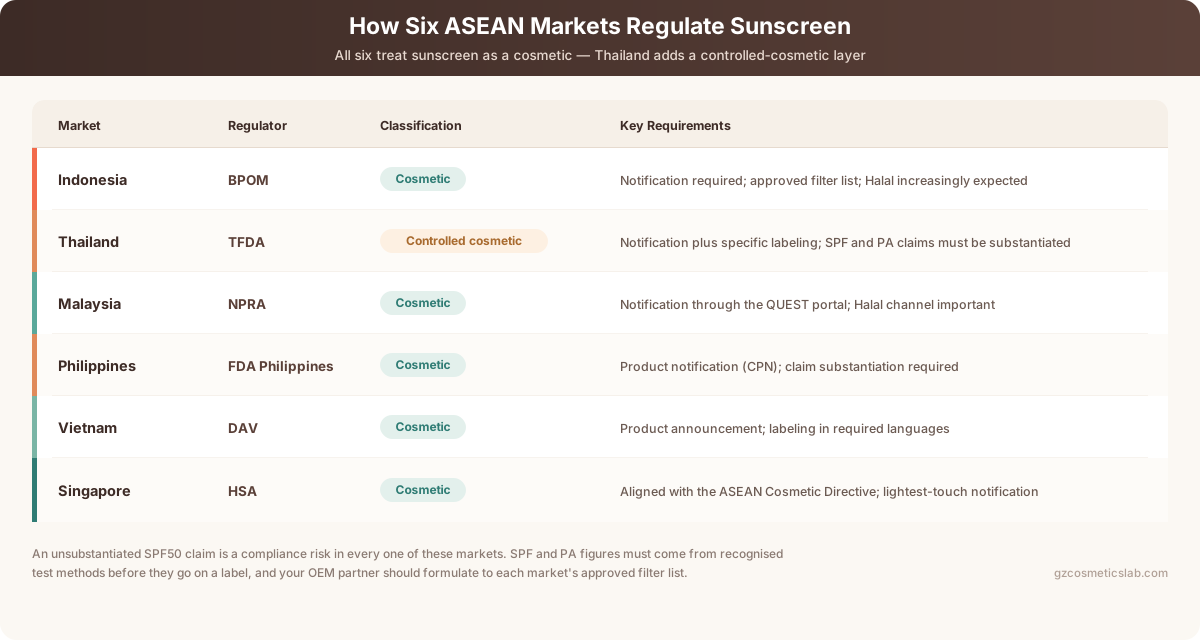
Chart by GZ Cosmetics Lab · Free to reuse with a link back to this page.
Sunscreens are treated differently across markets - some as cosmetics, some with additional oversight. Your OEM partner should formulate to the approved UV filter list and labeling rules of each target country.
| Country | Regulator | Sunscreen Classification | Key Notes |
|---|---|---|---|
| Indonesia | BPOM | Cosmetic | Notification required; approved filter list; Halal increasingly expected |
| Thailand | TFDA | Controlled cosmetic | Notification + specific labeling; SPF/PA claims must be substantiated |
| Malaysia | NPRA | Cosmetic (notification) | CPNP-style notification; Halal channel important |
| Philippines | FDA PH | Cosmetic | Product notification; claim substantiation |
| Vietnam | DAV | Cosmetic | Product announcement; labeling in required languages |
| Singapore | HSA | Cosmetic | ASEAN Cosmetic Directive aligned |
All six markets broadly follow the ASEAN Cosmetic Directive framework, which harmonizes ingredient lists and labeling principles across member states - though each country layers its own notification process on top. For a deeper breakdown of registration by country, see our guides on BPOM registration in Indonesia and TFDA registration in Thailand.
Tropical Sunscreen Format and Texture Options
Format drives consumer experience and reapplication behavior. Southeast Asian consumers reapply often, so easy-to-carry, easy-to-layer formats win.
- Lightweight lotions and fluids - the everyday workhorse; fast-absorbing, non-greasy finishes are essential
- Sunscreen gels and water-based - extremely popular for oily/combination skin in humid climates
- Sunscreen sticks - mess-free reapplication over makeup; growing in urban markets
- Sunscreen sprays and mists - convenient reapplication, popular for body and outdoor use
- Tinted sunscreens / sun-and-tone products - neutralize white cast and add light coverage; strong growth category
- Sunscreen-serum hybrids - combine SPF with niacinamide, vitamin C, or hydration claims for skincare-savvy buyers
Choosing the Right Format for Your Market
Format is not just a texture decision - it shapes reapplication behavior, which is the single biggest gap between how sunscreen is tested and how it actually protects in real life. Consumers almost never apply the full amount used in SPF testing, and in tropical heat they sweat much of it off within hours. A format that encourages easy, frequent reapplication therefore delivers more real-world protection than a technically superior formula that people apply once and forget. Sticks and sprays win here for on-the-go touch-ups, while lightweight fluids and gels win for daily base layers under makeup. Many successful regional brands offer a two-format system - a daily fluid plus a portable stick or spray for reapplication - which also increases the average order value.
Skincare-First Positioning
A major trend across the region is the "skincare sunscreen" - SPF products that double as brightening or hydrating serums. Pairing SPF50+ with niacinamide or vitamin C aligns with the strong regional demand for brightening. For more on brightening formulation, see our guide on whitening and brightening products for OEM.
Southeast Asia Sun Care Market: What the Data Says
Understanding the demand landscape helps brands position a sunscreen line for growth rather than crowding into saturated segments.
| Market signal | Implication for OEM brands |
|---|---|
| Sun care growing 8%+ annually region-wide | Category expansion, room for new entrants |
| SPF50 / SPF50+ is the mass standard | Do not launch below SPF30; SPF50+ is safest default |
| PA++++ increasingly expected | UVA protection is a marketing differentiator, not just SPF |
| Strong demand for "no white cast" | Chemical/hybrid or tinted mineral wins on medium-deep tones |
| Rising tinted and skincare-hybrid sub-categories | Combine SPF with tone/serum benefits for premium margins |
| Halal expectation in Indonesia/Malaysia | Halal-certified filters and supply chain unlock the biggest markets |
| Social-media-driven discovery | Texture and finish must be "review-proof" for TikTok/Shopee |
The strategic takeaway: the winning tropical sunscreen is not just high-SPF. It is high-SPF plus an elegant, cast-free finish plus a secondary skincare benefit plus the right certifications for the target country. Brands that nail all four command loyalty and premium pricing; brands that only chase the SPF number compete on price alone.
Where the Opportunity Is
For new brands, the strongest entry points are: skincare-hybrid sunscreens (SPF + brightening) targeting urban 20-35 women; tinted daily sunscreens that replace foundation for medium-deep tones; and reef-friendly mineral options for tourism markets. Kids' and sensitive-skin sunscreens are a smaller but loyal niche where mineral positioning and gentle claims justify premium pricing.
If you already have a target market and positioning in mind, you can request a quote to discuss a specific SPF, format, and filter system for your brand.
Common Tropical Sunscreen Formulation Mistakes
Brands repeatedly stumble on the same issues when developing sunscreen for humid, high-UV markets. Avoiding these saves both development cost and post-launch reputation:
- Licensing a temperate-climate formula unchanged - European or North American reference formulas often feel heavy, pill under humidity, or leave cast on regional skin tones
- Chasing SPF without photostability - a high SPF that degrades within an hour under sun is worse than an honest, stable SPF30
- Ignoring water and sweat resistance - a non-water-resistant sunscreen is effectively useless for a consumer who sweats through it by mid-morning
- Underestimating white cast - even a faint cast tanks reviews on medium-to-deep skin; test on the actual target demographic
- Skipping Halal for Indonesia/Malaysia - locks the brand out of the region's two largest Muslim-majority markets
- Overloading heavy oils and waxes - feeds Malassezia and worsens fungal acne common in humid climates
- Treating testing and registration as an afterthought - leads to launch delays and unsubstantiated-claim risk
A capable OEM partner steers you away from these traps during the briefing stage, before a single sample is made.
How Advanced Delivery Technology Enhances Tropical Sunscreens
Our proprietary delivery technology, backed by multiple granted patents, gives sunscreen formulas an edge in tropical conditions. By improving the even distribution and skin-adhesion of active ingredients, it supports:
- More uniform filter films for consistent, gap-free protection
- Better delivery of paired actives (niacinamide, antioxidants) alongside UV filters
- Lightweight, fast-absorbing textures that resist humidity pilling
This lets brands offer a genuinely differentiated sunscreen rather than a generic private-label lotion. Learn more on our technology page.
This matters commercially, not just technically. In a market where hundreds of sunscreens compete on the same SPF number, a formula that visibly outperforms on even application and paired-active delivery gives your brand a reason-to-believe that reviewers and influencers can actually feel and describe. That translates into stronger content, better reviews, and a defensible position that generic private-label competitors cannot easily copy.
From Concept to Shelf: The Sunscreen OEM Process
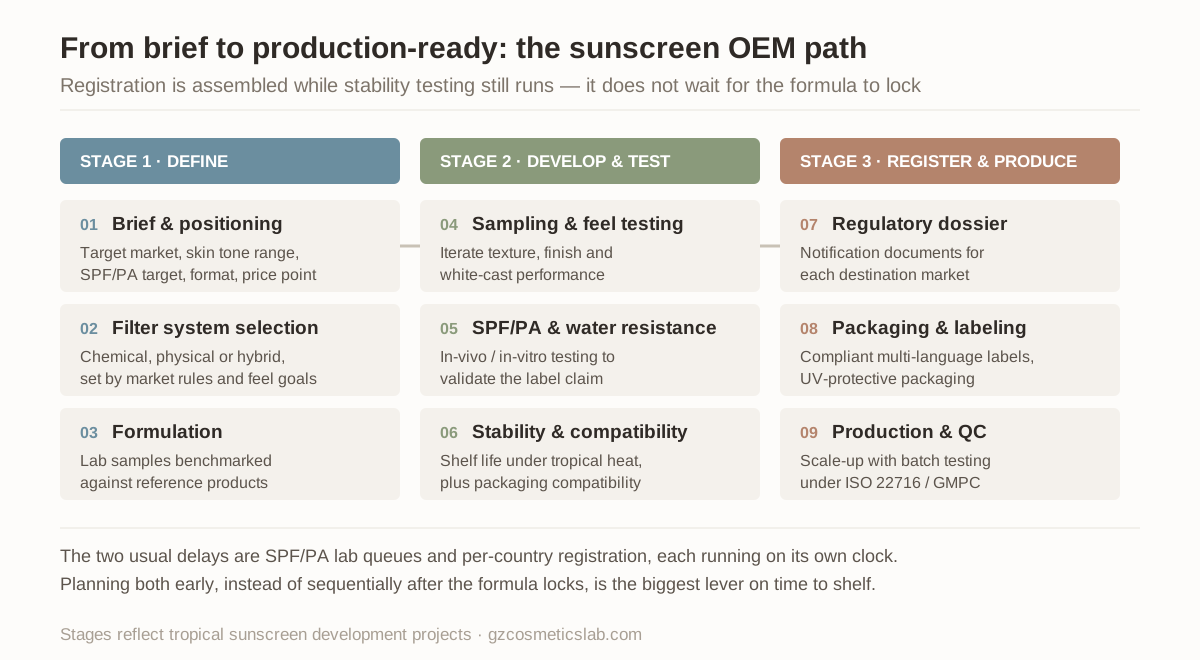
Chart by GZ Cosmetics Lab · Free to reuse with a link back to this page.
Bringing a tropical sunscreen to market follows a clear, testable path:
- Brief and positioning - target market, skin tone range, SPF/PA targets, format, price point
- Filter system selection - chemical, physical, or hybrid based on market rules and feel goals
- Formulation and benchmarking - lab develops samples, benchmarked against reference products
- Sampling and feel testing - iterate texture, finish, and white-cast performance
- SPF/PA and water-resistance testing - validated in-vivo/in-vitro testing for claims
- Stability and compatibility testing - confirm shelf life in tropical heat and packaging compatibility
- Regulatory dossier and registration - assemble notification documents for each target market
- Packaging and labeling - compliant multi-language labels, UV-protective packaging
- Production and QC - scale-up with batch testing under ISO 22716 / GMPC standards
Timelines vary, but a well-scoped tropical sunscreen typically moves from brief to production-ready in a few months, depending on testing and registration lead times per country.
The two most common timeline surprises are testing queues (SPF/PA labs can have multi-week backlogs) and per-country registration, which runs in parallel but on its own clock. Planning both early, rather than sequentially after the formula is locked, is the single biggest lever for getting to shelf faster. An experienced partner will start assembling the regulatory dossier while stability testing is still running.
Choosing the Right Sunscreen OEM Partner
Not every cosmetics manufacturer can formulate a competitive tropical sunscreen. When evaluating partners, prioritize:
- Sunscreen-specific formulation experience - filter chemistry and photostability are specialized skills
- Access to modern UV filters - newer photostable filters make better products
- In-house or coordinated SPF/PA testing - avoids delays and controls claims risk
- ASEAN regulatory support - help assembling BPOM, TFDA, NPRA, FDA PH, DAV notifications
- Certifications - ISO 22716 / GMPC, and Halal capability for Indonesia and Malaysia
- Tropical texture expertise - proven ability to hit no-white-cast, non-greasy finishes
For a broader framework on vetting factories, see our guide on how to choose a cosmetics manufacturer in China. You can also review our full OEM and ODM services to see how formulation, testing, and regulatory support fit together under one roof.
Ready to Develop Your Tropical Sunscreen Line?
Sunscreen is one of the smartest categories to build a Southeast Asian skincare brand around - high repeat purchase, strong loyalty, and year-round demand. The key is a formula engineered for the region's real conditions, backed by proper testing and country-specific compliance.
As a Guangzhou-based OEM/ODM manufacturer operating since 2010, with ISO 22716 / GMPC certification, Halal capability, and proprietary delivery technology, we develop tropical sunscreens from concept to shelf - including SPF/PA testing coordination and ASEAN registration support.
Request a quote or contact our team to discuss your sunscreen project. Explore related guides on tropical skincare ingredients and private label in Malaysia and Singapore.
Frequently Asked Questions
What SPF should I choose for a Southeast Asian sunscreen brand? SPF50 or SPF50+ is the commercial standard for the region. Consumers associate higher SPF with better value and daily protection, and the intense year-round UV justifies it. Launching below SPF30 is not recommended for tropical markets.
Do I need Halal certification for my sunscreen? If Indonesia or Malaysia is a target market, Halal certification is effectively essential - it is a purchase driver for the majority of consumers there. We can formulate with Halal-compliant filters and support the certification process.
How long does it take to develop a tropical sunscreen? A well-scoped project typically runs a few months from brief to production, with SPF/PA testing and per-country registration being the main timeline variables. Starting registration in parallel with stability testing shortens the path to shelf.
Can you make a sunscreen with no white cast for deeper skin tones? Yes. Chemical and hybrid filter systems, or carefully tinted mineral formulas, deliver cast-free finishes suited to medium and deep skin tones common across Southeast Asia.
Do you handle SPF and PA testing? We coordinate validated in-vivo/in-vitro SPF, PA, water-resistance, and broad-spectrum testing so your label claims are fully substantiated for each target market.
What is the minimum order quantity for a private-label sunscreen? MOQs depend on the formula complexity, packaging, and filter system, but we work with growing brands at accessible volumes rather than the large minimums many factories impose. Chemical and hybrid formulas typically carry lower MOQs than fully custom mineral systems, because the base can be adapted rather than developed from scratch. We can quote exact minimums once your target SPF, format, and packaging are defined.
Chemical or mineral sunscreen - which sells better in Southeast Asia? For mass and mid-market brands, chemical and hybrid formulas dominate because they deliver the lightweight, no-white-cast finish tropical consumers demand. Pure mineral sunscreens hold a growing niche among sensitive-skin, baby-care, and reef-friendly tourism positioning, but they require tinting or advanced dispersion to avoid the white cast that gets a product rejected in this region. Many successful brands run a chemical hero product plus a mineral variant for the sensitive-skin segment.
Related Products
Explore ready-to-customize formulations you can private label under your own brand.
Ready to Start Your Project?
Tell us your product requirements. Within 24 hours, our technical team will reply with a quotation or the questions needed to prepare one.