CDMO Solutions
A scoped cosmetics CDMO programme can combine formulation development, a project-specific testing plan, regulatory documentation support, production scale-up and commercial manufacturing. External laboratories, patent advisers and market filing parties are defined before work begins.
- Full engagement
- Several months to over a year
- Lyophilized single-dose
- 50–70 days per straightforward project
- IP
- Patent-filing support with external advisers
What Is a Cosmetics CDMO?
A cosmetics CDMO (Contract Development and Manufacturing Organization) combines development work and manufacturing in one coordinated programme. Depending on the project, that can include formulation development, ingredient registration support, patent-filing support, a testing plan, regulatory documentation, production scale-up and commercial manufacturing. Some of those steps are carried out in our facility and some by external laboratories, patent advisers or market filing parties; who does what is defined before work begins.
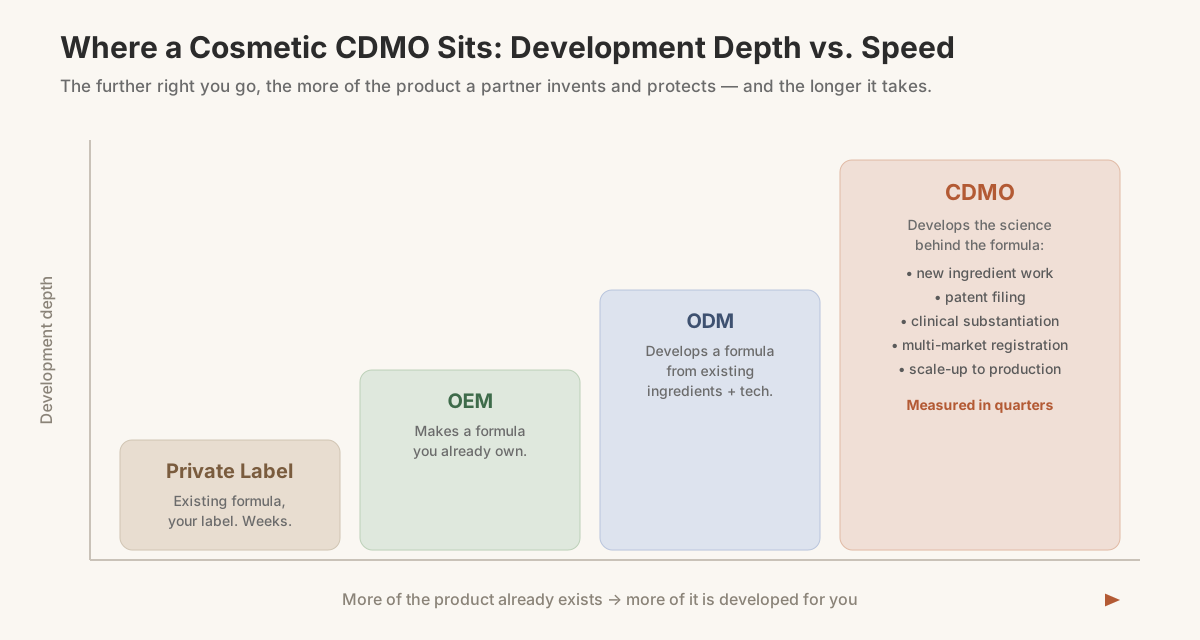
This model suits brands, ingredient developers, and investors whose product depends on more than manufacturing. Where OEM manufactures a formula you own and ODM develops a formula from existing technology, a CDMO programme adds ingredient documentation, IP planning and regulatory work on top. It is the right choice when the project needs development and evidence work, not only speed.
At GZ Cosmetics Lab, a CDMO programme combines formulation development and production on our 13 production lines with the external specialists the project needs. Delivery-system options, including supramolecular carriers, are assessed where they suit the formula. Ownership, permitted use and each party’s responsibilities are agreed in writing before development starts, so you work with one project lead rather than coordinating every party yourself.
What Makes CDMO Different from ODM?
ODM develops a formula. A CDMO programme can also cover the work around it: ingredient documentation, delivery-system assessment, IP planning, a testing plan and multi-market regulatory documentation.
Ingredient Registration Support
For projects involving a new ingredient, we can coordinate technical documentation, safety data and market-specific regulatory assessment. China registration or filing support is scoped separately from EU ingredient and finished-product compliance.
Patent-Filing Support
IP and patent-filing support can be scoped with qualified external advisers. Ownership, permitted use, filing territories, costs and disclosure rights are agreed in writing before development starts.
Raw Material Sourcing Options
Sourcing for each active is assessed per project: established suppliers, supplier technical documentation, or a joint-development option where one exists. Grade, origin and documents are confirmed for each formula.
Testing Plan & Claim Substantiation
Once the final formula, intended claims and target markets are confirmed, we can define a substantiation plan and coordinate the agreed testing through qualified laboratories. Methods, samples, timelines and report ownership are confirmed per project.
Regulatory Documentation
Market-specific documentation and filing coordination for China (NMPA), EU (CPNP), ASEAN and Middle East routes, with US support available. Outcomes rest with the authority, and the local responsible person or filing party is defined for each market.
Commercial Scale Production
Production scale-up from lab batch to commercial manufacturing on our 13 production lines under ISO 22716 and GMPC. Stated total-site capacity is 200,000 units a day; actual output depends on formula, pack and schedule.
CDMO Platform Capabilities
Supramolecular Delivery Options
Delivery-system options are assessed against the formula, target claim and available technical documentation. Any licensed technology, patent reference or performance claim is confirmed for the specific project before it is quoted or published.
- ✓ Encapsulation approach for the chosen actives
- ✓ Batch-to-batch uniformity checks
- ✓ Stability data for the final formula
- ✓ Release or performance claims only with supporting data
Suppliers and External Specialists
We source materials from established suppliers. The exact grade, origin, specification and supporting documents are confirmed for each formula. Independent specialists and laboratories may be included where the agreed project requires them.
- ✓ Materials from established specialty-ingredient suppliers
- ✓ Grade and documentation confirmed per formula
- ✓ Qualified external laboratories per agreed test plan
- ✓ ISO 22716 and GMPC certified by Intertek; SGS testing on request
Lyophilized Single-Dose Development
Freeze-drying is one of the harder parts of a CDMO programme to source well. Lyophilisation is easy to claim, and some suppliers offering freeze-dried serum OEM subcontract the drying step without saying so. For each lyophilized single-dose project we confirm in writing which steps run in our facility and which at a qualified partner, who holds the cycle data, and how timeline decisions are made.
We will also question a brief when the format is wrong for the product. A liquid ampoule is the cheapest of the single-dose formats and often the right answer; freeze-drying earns its cost only when the active cannot survive in solution for the whole shelf life.
Four formats, four different constraints
“Single-dose” covers at least four products, and a supplier quoting the phrase without asking which one is quoting from a template. A lyophilized bead or pellet has to hold its shape after drying and dissolve cleanly, so fill volume per cavity and survival in shipping decide feasibility. A lyophilized cake in a vial is simpler because the container carries the dose, but the neck and closure must suit both the freeze dryer and the filling line. A liquid ampoule skips drying entirely and shifts the burden onto the formula and its preservative system. A sachet or stick pack is the cheapest packaging and the weakest barrier against moisture ingress.
The pattern worth carrying into a brief: the formats differ mainly in who carries the burden of keeping the active intact. Whichever you pick, that is where the technical work and the cost concentrate.
A dry dose is two formulas, not one
Any dry single dose that needs reconstituting is two products plus the mechanism that keeps them apart until use. The solvent needs its own specification, its own stability data and, in a regulated market, its own place in the product file, so a quote that prices only the dry dose is incomplete. The stability programme has to test the reconstituted mixture rather than the two halves separately. And reconstitution has to work in a bathroom, not a lab — dissolution time, whether it needs shaking, whether residue is left in the cap. Those are consumer-experience failures no specification sheet catches, which is why a physical sample matters more here than for a conventional serum.
Minimum order moves from kilograms to cavities
This is the part that surprises people most. A conventional serum MOQ is driven by batch size, because the constraint is how little product a mixing vessel can process sensibly. A single-dose MOQ is driven by unit count, because the constraints are freeze dryer shelf area, the number of cavities in the tooling, and changeover time on the filling and sealing line. Two effects follow: a partly loaded dryer runs the same cycle hours as a full one, so cutting your order in half may not cut the price much; and a small quantity of a single-dose product can cost more per unit than a much larger quantity of a conventional one.
What we confirm in writing, and what we refuse to guess
A lyophilization programme typically characterises collapse temperature, for example by freeze-drying microscopy, and Tg′ by DSC, with the heating rate reported alongside Tg′ because a bare number is not a specification. Primary drying endpoint is best determined by measurement, such as comparative pressure, rather than by borrowing someone else’s validated cycle time, and residual moisture is commonly measured by Karl Fischer titration. Which of these methods apply, the equipment used, and whether each runs in our facility or at a qualified external laboratory are confirmed in writing for the project. What we will not do is commit to a moisture limit before seeing your formula, because the tolerable limit depends on which actives are present and how they degrade. A peptide system and an ascorbic acid system do not share a threshold. The specification is set during development against your actives and target shelf life, then tested at release.
Go deeper before you brief us
- Cosmetic CDMO: what it is, when you need one, and who owns the IP — the four single-dose formats compared side by side, plus how to brief a CDMO so the first conversation is useful.
- Freeze-dried serum OEM: collapse temperature decides your cost — why a lyophilised quote is really a quote for machine hours, and five questions that tell you whether a supplier actually runs the equipment.
Who Needs CDMO?
Frequently Asked Questions About CDMO
Common questions from brands and innovators using cosmetics CDMO services.
What is a cosmetics CDMO?+
A cosmetics CDMO (Contract Development and Manufacturing Organization) combines development and manufacturing in one coordinated programme. Depending on scope, it can include formulation development, ingredient registration support, patent-filing support, a testing plan, regulatory documentation, production scale-up and commercial manufacturing. Some steps involve external laboratories, patent advisers or market filing parties, and those responsibilities are defined before work begins.
How is CDMO different from OEM and ODM?+
OEM manufactures a formula you own. ODM develops a formula for you from existing ingredients and technology. A CDMO programme can add ingredient documentation and registration support, IP planning with external advisers, a testing plan and regulatory documentation on top of formulation and production. Choose a CDMO when the project needs development and evidence work, not just manufacturing.
Can you support new cosmetic ingredient registration?+
We can support it as part of a scoped project. For a new ingredient, we can coordinate technical documentation, safety data and market-specific regulatory assessment. In China that means registration or filing support; in the EU it means ingredient and finished-product compliance assessment, which is a different process. The outcome rests with the authority, and the applicant or responsible party is defined for each market.
Do you offer patent-filing support and IP protection?+
IP and patent-filing support can be scoped with qualified external advisers. Ownership, permitted use, filing territories, costs and disclosure rights are agreed in writing before development starts. Whether a patent is granted is decided by the patent office, not by us or the adviser.
What does a typical CDMO engagement timeline look like?+
CDMO projects are longer-term than standard manufacturing because they include research and registration. A full engagement, from new ingredient or formulation development through regulatory filing to commercial production, generally spans several months to over a year depending on scope. We propose a detailed development roadmap after assessing your requirements.
Is CDMO suitable for a small or emerging brand?+
CDMO is best suited to brands, ingredient companies, and investors pursuing a differentiated formula or new technology, where the investment in development, evidence and IP planning is justified by long-term differentiation. Emerging brands seeking speed and low cost are usually better served by our private label or ODM services.
Do you develop lyophilized single-dose formats such as beads and pellets?+
Yes, as a scoped project; which steps run in our facility and which at a qualified partner is confirmed in writing. Single-dose covers at least four distinct products — a lyophilized bead or pellet reconstituted with a companion solvent, a lyophilized cake dried in its final vial, a sealed liquid ampoule, and a sachet or stick pack — and they differ in tooling, packaging and unit economics rather than in marketing language. A dry dose that needs reconstituting is really two formulas plus the mechanism keeping them apart, so the solvent carries its own specification and stability data, and the stability programme has to test the reconstituted system rather than the two halves separately.
What sets the MOQ and lead time for a lyophilized single-dose project?+
Unit count, not batch size. A conventional serum MOQ is limited by how little product a mixing vessel can process; a single-dose MOQ is limited by freeze dryer shelf area, the number of cavities in the tooling, and changeover time on the filling and sealing line. A partly loaded dryer runs the same cycle hours as a full one, so halving an order may not move the price much. For a freeze-dried serum set the practical floor is 3,000 to 5,000 sets per SKU, driven by the packaging component minimums on the active vial, the solvent vial and the set carton. A straightforward project runs 50 to 70 days including thermal characterisation of a first-time formula.
Ready to Scope a CDMO Programme?
Describe your product concept and technical requirements. Once we have a complete brief, our CDMO team will reply with an initial scope, the external parties likely to be involved and the questions still open.
Response within 24 hours · WhatsApp available · Factory visits welcome