
Face Serum Manufacturer: OEM & Contract Manufacturing Guide
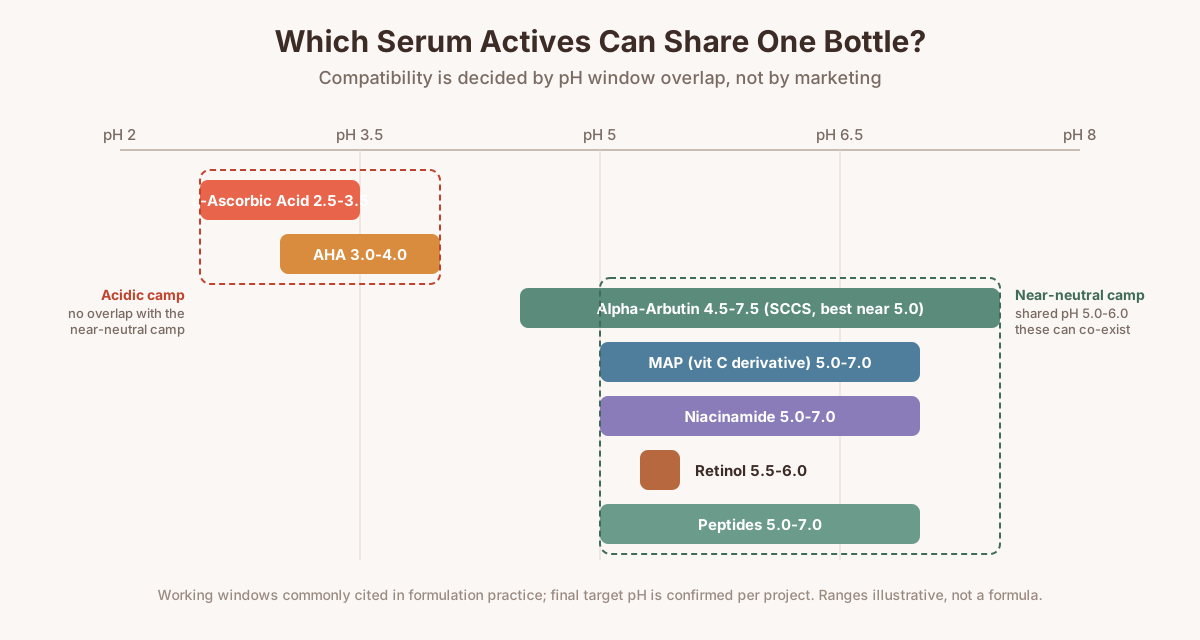
Chart by GZ Cosmetics Lab · Free to reuse with a link back to this page.
Most serum briefs arrive with a list of hero ingredients and a target price, and most of them ask for at least two actives that cannot physically live in the same bottle. That is the real work a face serum manufacturer does before anything is mixed: not saying yes to the ingredient list, but telling you which parts of it can share one formula and which need to become separate products. This guide covers what a brand owner should settle before briefing a manufacturer, so the conversation starts at the decisions that actually matter instead of the ones that sound good in a pitch deck.
It is written from the manufacturing side. If you are still deciding whether to develop a custom formula or start from a proven base, the cost and quantity logic in our MOQ and cost guide is a useful companion, and the broader difference between build-to-order and buy-the-formula is covered in OEM vs ODM. Our serum range and its published specifications are on the skincare manufacturing page.
Stock Formula or Custom: Decide This First
Every other decision downstream depends on this one, so it is worth being honest about which you actually need rather than which sounds more impressive.
A stock or white-label serum is a formula the factory has already developed, tested and stabilised. You choose it from a menu, add your branding, and launch in weeks rather than months. It carries lower risk because the stability data already exists, and it is the sensible route for a first SKU or a market test. The trade-off is that the same base is available to other brands, so it does not differentiate you on formula alone. If this is the route you are weighing, our guide to white label skincare sets out how the model works across categories.
A custom formula is developed to your brief: your actives, your texture, your claim direction. It gives you a product that is genuinely yours and, with most manufacturers, a formula registered under your brand. The trade-off is a longer development cycle, sample rounds, and a higher commitment before you see a finished product.
A pattern worth naming: a large share of successful launches start on a stock formula to prove the market responds, then move to custom once volume justifies the development spend. There is no prize for developing a custom formula for a product that has not yet found a buyer. A capable manufacturer will help you sequence this rather than push the more expensive route on day one.
The pH Window Decides Whether Your Actives Can Share a Bottle
This is the single most common reason a serum brief has to be restructured, and it is almost never in the brief itself. Actives are stable and effective inside a specific pH range, and those ranges do not all overlap. If two hero ingredients want incompatible environments, no amount of clever formulating fixes it. You either compromise both by meeting in the middle where neither performs, or you split them into two products.
The chart above shows the practical picture. Ingredients fall into roughly two camps:
The acidic camp. L-ascorbic acid (pure vitamin C) is genuinely effective only in a low-pH environment, commonly cited around 2.5–3.5, and it degrades as pH rises. AHAs such as glycolic and lactic acid are pH-dependent in the same direction: too high and they simply stop working as exfoliants. These ingredients want an acidic serum, and they do not sit comfortably with anything that needs to be near-neutral.
The near-neutral camp. Niacinamide, peptides, retinol and most vitamin C derivatives prefer a mildly acidic to neutral range, roughly pH 5–7. Alpha-arbutin, a widely used brightening ingredient, has a stability window the SCCS describes as pH 4.5–7.5, with best stability near pH 5.0, held below 40°C. Because these windows overlap around pH 5.0–6.0, several of them can genuinely co-exist in one well-designed formula.
The consequence for your brief is concrete. If you want pure vitamin C and niacinamide as co-heroes, you are asking for a formula that has to bridge pH 3 and pH 6 at once, and the honest answer is two serums, not one. If you want alpha-arbutin brightening alongside hyaluronic hydration and a peptide, those can share a bottle because their windows overlap. A serum manufacturer earning its fee will run this pH-intersection check on your ingredient list and tell you where the real fault lines are before you have committed to packaging.
The other route around an unstable active is to take the water out. A freeze-dried serum set holds the active as a dry cake and reconstitutes it at the moment of use, which sidesteps the pH and shelf-life argument entirely — at the cost of a longer, more expensive production cycle, as our freeze-dried serum OEM guide sets out.
There is a formulation route around some conflicts: swapping an unstable form for a derivative that lives in a friendlier range. Where pure L-ascorbic acid cannot co-exist with a near-neutral active, a stable vitamin C derivative such as magnesium ascorbyl phosphate sits comfortably in the pH 5–7 band and can share a formula that L-ascorbic acid could not. That is a real trade-off, not a free lunch, because derivatives behave differently on skin, but it is the kind of option a technical manufacturer should put on the table rather than quietly meeting in a middle that serves neither ingredient.
There is a second route, and it changes the question rather than answering it: take the water out. A pH conflict only exists in solution, so a two-part set that holds the active as a dried cake and pairs it with a separate solvent keeps an acidic active away from a near-neutral one until the moment of use. That is the reasoning behind our Brightening Anti-Spot Freeze-Dried Serum Set, where a high-strength brightening load would not hold up for months in an aqueous base at the pH the rest of the formula needs. It costs more and runs longer than a conventional serum, so it earns consideration only when the pH intersection genuinely has no answer.
Not sure which route fits your product?
Send us your brief and our formulators will tell you what is realistic on formula, MOQ, and timeline before you commit to anything.
Texture and Viscosity Are a Specification, Not an Afterthought
Buyers describe the serum they want with words like "lightweight" or "luxurious," and those words have to be translated into a viscosity that actually dispenses. A serum that is too thin leaks past a dropper and reads as cheap; one that is too thick clogs a pump and refuses to layer under other products. The current market pull is toward weightless, water-like textures that absorb fast and layer well, but that is a formulation target with its own constraints, not a default setting.
Texture also interacts with the packaging decision below. A watery essence behaves differently in a dropper than a cushioned gel-serum does in an airless pump, and locking a texture before choosing a dispenser is how brands end up with a product that performs on a lab bench but frustrates a customer at the sink.
Stability Testing Is Non-Negotiable
A serum is a chemistry problem held stable over time, and the testing that proves it holds is where a serious manufacturer separates itself from an order-taker. Any factory that skips or rushes this step is handing you the risk. The testing you should expect to see named in a quote:
Accelerated stability. The formula is stressed with heat and light over roughly one to three months to predict how it will age. This is the early warning system for separation, discolouration and active degradation.
Packaging compatibility. The formula is tested inside the actual packaging it will ship in, because a serum can interact with its own bottle: leaching, discolouration, or a preservative being absorbed by the plastic. This runs alongside stability, not instead of it.
Microbial challenge. The preservative system is deliberately challenged to prove it protects the product through real use. This is a safety requirement, not a nicety.
Real-time stability. The formula is held under normal conditions to confirm its actual shelf life, typically six to twelve months or longer. Accelerated testing predicts; real-time confirms.
For serums going into hot, humid markets, this matters more, not less. The heat and moisture load in Southeast Asia stresses both the formula and the preservative system harder than a temperate climate does, which is the same reason we treat tropical conditions as a design input rather than an edge case across our tropical-climate formulation work.
Packaging Protects the Formula You Paid For
Packaging is often treated as a branding decision, but for an active serum it is a preservation decision first. The wrong container can undo the formulation work before the product reaches a shelf.
Airless pumps matter most for oxidation-sensitive actives such as vitamin C and retinol, because they keep air away from the formula through the life of the bottle and dispense cleanly to the last dose. They cost more, and for the right active they are worth it.
Glass dropper bottles give a premium feel and precise dosing, but light-sensitive formulas need amber or UV-protective glass, and glass carries a breakage risk in transit that has to be planned for.
PET or PP bottles are cost-effective and light, but compatibility with the specific formula has to be checked rather than assumed. This is exactly what packaging-compatibility testing is for.
The point is that texture, active, and packaging are one connected decision. Choosing a dropper for a vitamin C serum that needs an airless pump is not a style choice, it is a formulation error with a nice lid on it.
MOQ, Lead Time and Sampling: Real Numbers to Plan Around
Numbers a brand owner can plan around, based on how we quote serum projects:
| Planning item | Serum | What sets it |
|---|---|---|
| MOQ | 2,000–3,000 bottles / SKU | Whichever input has the highest minimum — usually a packaging component, not the formula. Ask for it broken down by component. |
| Production lead time | 45–55 days | Serums sit in the stability-tested tier. Basic formats such as cleansers and toners run 35–45 days; sunscreens and freeze-dried sets run longer again. |
| Sample round | 2–3 weeks each | A custom formula usually needs more than one round to settle texture and performance. |
| Stock vs custom | Stock launches in weeks | A stock base skips most development time. Custom buys formula-level differentiation at the cost of sample rounds. |
MOQ is typically 2,000–3,000 bottles per SKU for a bottled serum. That figure is driven by the minimum viable production batch, the minimum order on your chosen packaging components, and the cost of a filling-line changeover, so it moves with the format and packaging you pick rather than being a single fixed wall. Simpler stock-based projects sit at the lower end; fully custom packaging with dedicated tooling pushes it up.
Lead time is 45–55 days for a serum after the formula and artwork are signed off. Serums sit in our stability-tested tier rather than the 35–45 day window we quote for basic formats such as cleansers and toners, because the actives need time on test before the batch is released. Sourcing higher-purity raw materials for premium actives extends it further.
Custom sample rounds take roughly 2–3 weeks each, and a custom formula usually needs more than one round to get texture and performance right. Build this into your launch timeline rather than discovering it after you have announced a date.
When you request a quote, ask for the MOQ broken down by component rather than a single headline number. A serum's minimum is usually set by whichever input has the highest minimum order, and that is frequently a packaging component, not the formula. Knowing which one is the binding constraint tells you exactly where you can negotiate and where you cannot. If you are early enough that even these quantities feel steep, our MOQ and cost guide lays out the levers for keeping a first order manageable.
Regulatory Fit Belongs in the Formula, Not After It
Where a serum will be sold shapes what can go in it and what has to be documented, and the cheapest time to handle that is during formulation, not after a batch is made. A serum built for one market can need reformulation to enter another if an ingredient or a concentration is treated differently there.
For brands targeting Southeast Asia, each market runs its own notification or registration route, and building the formula and documentation to fit from the start is far cheaper than retrofitting. The registration logic across the region is set out in our ASEAN Cosmetic Directive guide. A manufacturer that formulates for multi-market compliance from day one saves you a reformulation cycle later, which is worth asking about explicitly rather than assuming.
How to Evaluate a Serum Manufacturer
The best signal is not a glossy catalogue, it is whether the factory reasons about your product or just agrees with you. A few questions separate the two:
Can they explain why an ingredient sits at a specific concentration? A technical partner talks in baselines and ranges tied to a reason, and adjusts to your target market and price point. An order-taker just says yes to whatever percentage you name. Our own brightening serum and multi-HA hydrating serum pages are built around exactly this: what each active does, the working level, and the pH conditions it needs.
Do they run stability and compatibility testing, and will they show it? Named tests and timelines are a good sign. Vague reassurance is not.
What certifications does the facility hold? ISO 22716 and GMP are the baseline for cosmetics manufacturing, and they indicate documented batch records and quality systems rather than a marketing badge. What GMPC and ISO 22716 actually mean for a new brand is covered in our explainer.
Do you own the formula, and is it exclusive to you? For a custom serum this is a commercial question worth settling in writing before development starts, not after.
What is the path from a first order to scale? A partner who can take you from a first batch to ten times that volume without changing the formula is worth more than one offering the lowest MOQ and nothing beyond it. The broader criteria for this decision are in how to choose a skincare manufacturer.
Where a Serum Fits in a Launch Range
A serum rarely launches alone, and the safest first serum is a hydration-led one. A well-built hyaluronic serum carries no actives that trigger irritation complaints and has no pH conflicts with the rest of a line, which makes it the widest-appeal, lowest-risk entry into the serum category and the natural anchor for a starter set. Treatment serums with stronger actives sit on top of that foundation once the range is established.
This is also where the pH logic pays off commercially. Because a hydration serum conflicts with nothing, it bundles cleanly with a treatment serum or a cleanser, which is how a two or three SKU launch becomes a routine a customer actually uses rather than a shelf of products that compete with each other. Cleanser plus serum remains the most common two-SKU first launch, and both can be produced under one certified roof with matched packaging.
Frequently Asked Questions
What is the MOQ for a private label face serum?
Typically 2,000–3,000 bottles per SKU. The exact figure depends on your packaging choice and whether the formula is stock or custom, because the minimum is usually set by a packaging component rather than the formula itself. Ask for the MOQ broken down by component when you request a quote.
Can I put vitamin C and niacinamide in the same serum?
Pure L-ascorbic acid and niacinamide want different pH environments, so combining them at meaningful levels usually means compromising both. The common solutions are to split them into two products, or to use a stable vitamin C derivative such as magnesium ascorbyl phosphate that sits in the same near-neutral range as niacinamide. Which route is right depends on your claim and price target.
How long does it take to develop a custom serum?
Plan for 2–3 weeks per custom sample round, usually more than one round, then 45–55 days production after formula and artwork sign-off. Serums fall in the stability-tested tier, so they run longer than the 35–45 days quoted for basic formats. A stock formula skips most of the development time and can launch in weeks.
Should I start with a stock formula or go custom?
If you are testing a market or launching a first SKU, a stock formula lowers risk and speeds launch. Move to custom once volume justifies the development spend and you need formula-level differentiation. Many brands do exactly that in sequence.
Do you formulate serums for hot and humid markets?
Yes. Tropical conditions stress both the formula and the preservative system harder than temperate climates, so we treat heat and humidity as a design input from the start rather than testing for them at the end.
If you are planning a serum or a serum-led range, share your ingredient list and target markets and we will run the pH-intersection check, flag where actives need to become separate products, and quote MOQ, lead time and testing for your specific brief. Start with our serum range to see how we specify actives, or request a quote with your brief.
Ready to Start Your Project?
Tell us your product requirements. Our technical team responds within 24 hours with a detailed quotation.