
Freeze-Dried Serum OEM: Collapse Temperature Decides Your Cost
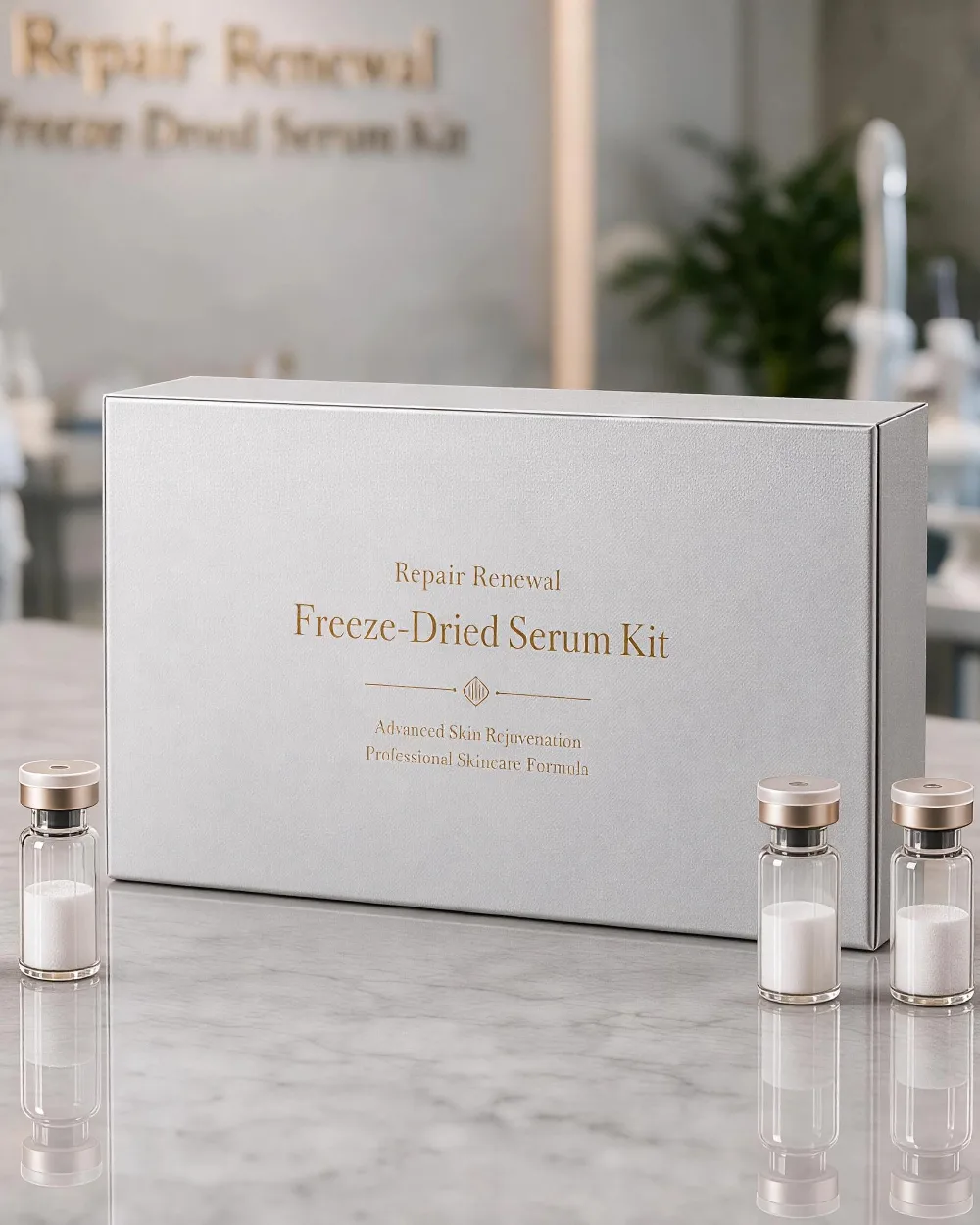
A freeze-dried serum OEM brief usually arrives with the format already decided. The brand has seen the single-dose ampoule sets — a small puck of dried actives, a companion solvent vial, mixed in the palm at the moment of use — and wants one. What the brief almost never contains is the number that decides whether the project is buildable: the temperature at which that particular formula collapses.
That number is not a marketing detail. It sets the shelf temperature, which sets the drying time, which sets your unit cost and your lead time. Get it wrong and you do not get a slightly worse product. You get a puck that has slumped into a dense glassy disc, takes forty seconds to redissolve instead of ten, and holds more residual water than the actives can tolerate over a two-year shelf life.
This article covers what actually governs a freeze-dried delivery project: the two critical temperatures, why the published figures for common excipients are not fixed constants, how residual moisture is measured against pharmacopoeial method, and what all of it does to MOQ and lead time. The engineering here is borrowed wholesale from pharmaceutical lyophilisation, so the reference standards are pharmacopoeial and the literature is peer-reviewed. Where a value depends on your specific formula, we say so rather than quoting a number that would not survive the first development batch. The single-dose sets we run on this process are on our skincare manufacturing page, and the development-stage scope is on the cosmetics CDMO page.
Why Freeze-Drying at All: The Water Problem
Every stability problem in a conventional serum traces back to one thing. Water is the reaction medium. Hydrolysis, oxidation and microbial growth all need it. Remove it and the actives that are difficult in solution — ascorbic acid, some peptides, growth-factor-like proteins, certain botanical extracts — become tractable.
Freeze-drying, or lyophilisation, removes water by sublimation rather than evaporation. The product is frozen, then held under vacuum so the ice converts directly to vapour without passing through liquid. Because the material never warms up and never sits in concentrated solution, actives that would degrade in a conventional aqueous process survive.
The commercial consequence matters more than the chemistry: freeze-drying lets a brand make claims about active concentration that a stable aqueous serum cannot support. A 20% vitamin C solution that browns in three months is a returns problem. The same 20% held dry until the moment of use is a product. This is the real reason the format commands its price, and it is worth saying plainly in a brief rather than treating the format as an aesthetic choice.
Two costs come attached. Lyophilisation equipment is capital-intensive and cycles are measured in days, not hours — which is why MOQ and lead time for these sets sit well above a standard serum. And the format is a two-part system, so every unit needs two primary containers plus a set carton, roughly doubling the packaging engineering.
The Two Temperatures That Decide Everything
Cycle development starts with two values, and confusing them is the most common technical error in briefs we receive.
Tg′ — the glass transition temperature of the maximally freeze-concentrated solution. As ice forms, the remaining solutes concentrate into an unfrozen phase. Tg′ is the temperature at which that concentrated phase shifts from a rigid glass to a mobile rubber. It is measured by differential scanning calorimetry, and it is a thermodynamic property.
Tc — the collapse temperature. This is the temperature at which the dried matrix loses enough mechanical strength that its porous structure fails during sublimation. It is measured by freeze-drying microscopy, which reproduces the process in miniature under a microscope. Tc is a mechanical and operational threshold, not a thermodynamic one.
The relationship is close but not identical: Tc typically runs 1–3°C above Tg′ (Frontiers in Chemistry, 2018). DSC gives you Tg′ cheaply and reproducibly; only FDM tells you where the structure actually fails. A development programme that measures Tg′ and assumes Tc is doing half the work.
The hard constraint during primary drying is that product temperature must stay below Tc. Not shelf temperature — product temperature, which is a function of shelf temperature, chamber pressure and the resistance of the drying cake itself. Standard practice is to target 2–3°C below Tc: close enough to dry efficiently, far enough to survive the normal variation between vials at the edge of a shelf and vials in the centre.
What Happens When You Exceed Tc
Collapse is not a soft failure. Above Tc the matrix softens, viscosity drops sharply, and capillary forces pull the pore walls inward. Then it compounds: collapsed pores raise resistance to vapour flow, which slows drying, which lets the product warm further, which drives more collapse. The literature describes exactly this feedback loop, and it is why conservative cycle design is not timidity.
What the brand sees at the end is some combination of a shrunken or glassy puck instead of a white porous cake, longer reconstitution time, higher and less uniform residual moisture, and prolonged secondary drying. Worth noting honestly: collapse does not automatically ruin a product. The published position is that macrocollapse can correlate with higher residual moisture, active destabilisation and longer reconstitution, but does not necessarily do so. For a cosmetic set where the consumer sees the puck through glass, however, cake appearance is part of the product, so we treat collapse as a reject condition regardless.
Published Tg′ Values Are Not Constants — Read the Heating Rate
Search for the glass transition of sucrose and you will be told −32°C. For trehalose, −29.5°C. These numbers circulate as though they were physical constants like a melting point. They are not. Tg′ measured by DSC shifts with heating rate, and the commonly quoted figures correspond to one particular rate.
The peer-reviewed measurements make this unambiguous:
| DSC heating rate | Sucrose 20% — Tg′ | Trehalose 20% — Tg′ | Trehalose 10% — Tg′ |
|---|---|---|---|
| 10°C/min | −30.6 ± 0.04°C | −26.4 ± 0.9°C | −27.2 ± 0.3°C |
| 2.5°C/min | −32.3 ± 0.02°C | −28.5 ± 0.6°C | −29.0 ± 0.2°C |
| 1°C/min | −33.1 ± 0.1°C | −29.4 ± 0.6°C | −29.9 ± 0.3°C |
| 0.5°C/min | −34.0 ± 0.4°C | −30.3 ± 0.9°C | −30.5 ± 0.4°C |
Source: Frontiers in Chemistry, 2018, DOI 10.3389/fchem.2018.00004 (open access). Values are DSC midpoint, mean ± SD.
Read down the sucrose column: −30.6°C at a fast scan, −34.0°C at a slow one. That is a 3.4°C spread on the same material. The familiar "−32°C" sits near the 2.5°C/min row and nowhere else.
This matters commercially because a production freeze-dryer does not heat at 10°C/min. Typical shelf ramps in lyophilisation are 0.5–1°C/min, which is precisely where the measured Tg′ is lowest. A cycle designed against a literature value obtained at a fast laboratory scan rate is designed against a number 2–3°C warmer than the material will actually tolerate at production ramp rates — and the whole safety margin in this process is 2–3°C. If a supplier quotes you a Tg′ without a heating rate attached, the figure is not yet usable.
Two further findings from the same work are worth carrying into a brief. Tg′ is independent of starting solute concentration — 10% and 20% trehalose measure the same value, because freeze-concentration drives the unfrozen phase to the same composition regardless of where it started. What changes with concentration is signal strength, not the transition itself. And among the sugars, the tetrasaccharide stachyose sits markedly higher at −23.8 ± 0.2°C, which is why it appears in formulations that need a warmer permissible shelf temperature.
Why Excipient Choice Is a Cost Decision
Trehalose runs about 3.7–4.2°C above sucrose at every heating rate in the table. That gap is not a quality difference in the finished product; it is permission to run the cycle warmer. And warmer means faster, by a factor that has been quantified: a 1°C increase in product temperature shortens primary drying by approximately 13% (Pikal, 1990, as cited in Frontiers in Chemistry, 2018).
Follow that through. Swapping to a higher-Tg′ excipient system to gain 3°C of headroom works out at roughly 39% off primary drying time on that relationship, and the measured gap between the two sugars is wider than 3°C, so that is the conservative end of it. On a cycle measured in days, across a capital-intensive machine, that is the difference between a viable unit cost and a quote the brand walks away from. This is the single most useful thing to understand about lyophilised project economics: you are not buying a formula, you are buying machine hours, and the formula determines how many hours you need.
There is a further option that experienced formulators use deliberately. Because Tc sits above Tg′, it is possible to dry above Tg′ but still below Tc — accepting some molecular mobility in the frozen matrix in exchange for a higher product temperature and a materially shorter cycle, without losing cake structure. The published work notes this approach for highly concentrated protein formulations. Whether it is available for a given cosmetic formula depends entirely on whether the actives tolerate that mobility, which is a development-batch question, not a specification-sheet question.
Crystalline Bulking Agents Behave Differently
Not every excipient forms an amorphous glass. Mannitol crystallises during freezing and builds a rigid crystalline scaffold, which produces a robust, visually clean cake. The trade-off is that a crystalline scaffold does not stabilise sensitive actives the way an amorphous sugar matrix does — the protective mechanism is different.
For crystalline systems the governing parameter is not Tc but the eutectic temperature (Teu), above which melting occurs. Applying an amorphous-system framework to a crystalline formula, or the reverse, produces a cycle designed against the wrong limit.
Mannitol also carries a specific process requirement. Crystallisation must be driven to completion during the cycle, normally via an annealing hold above Tg′. Incomplete crystallisation leaves an amorphous fraction that can crystallise later during storage — which changes the matrix under the actives months after the product shipped. That is a stability failure that will not appear in a release test.
Does the Tg′ figure you were given have a heating rate attached?
Send us your active list and the excipient system you have in mind. We will tell you which characterisation is still missing before a cycle can be designed — DSC for Tg′, FDM for Tc — and whether your formula is a candidate for drying above Tg′ to shorten the cycle.
Residual Moisture: Which Pharmacopoeial Method Applies
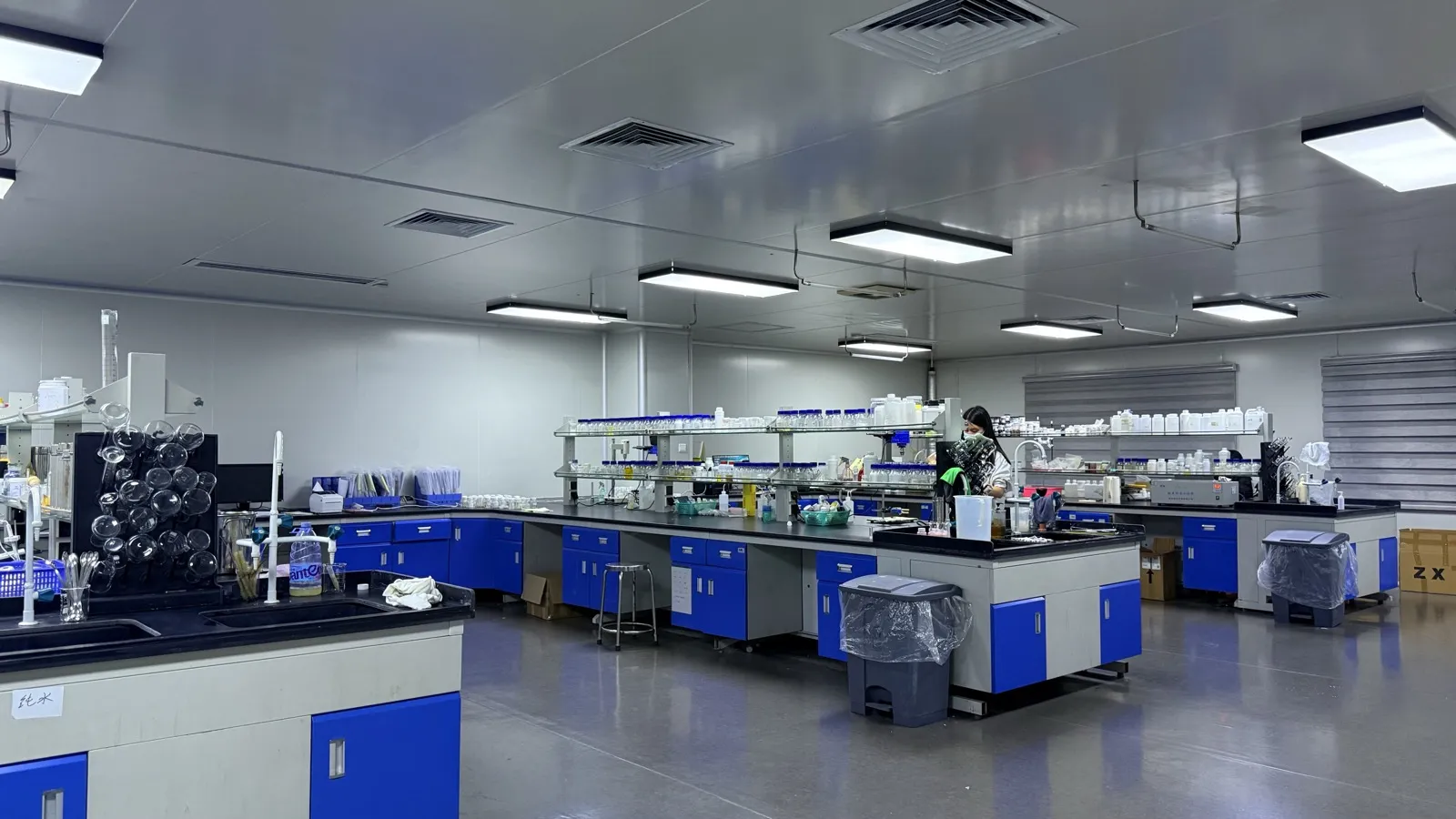
Residual moisture is the number that decides whether the shelf life you printed on the carton is real. Too much water left in the cake and the actives you went to the trouble of drying begin degrading anyway, just more slowly.
The reference method is the Karl Fischer titration, standardised in USP <921> Water Determination. The chapter defines three approaches, and the distinction between them is a practical one rather than a formality:
| Method | Principle | Water content per injection | Where it fits |
|---|---|---|---|
| Ia — Direct titration | Specimen titrated directly against Karl Fischer reagent | 2–250 mg water | Default method unless a monograph specifies otherwise |
| Ib — Residual titration | Excess reagent added, then back-titrated | 2–250 mg water | Materials that release bound water slowly |
| Ic — Coulometric titration | Iodine generated in situ by anodic oxidation | 0.5–5 mg water | Low-moisture samples; a micro-method by comparison |
Source: USP <921> Water Determination.
For a freeze-dried cake the relevant method is normally Ic, coulometric. A well-dried puck contains very little water in absolute terms, and Method Ic operates two orders of magnitude lower than the volumetric methods. The chapter adds two separate points worth carrying into a supplier conversation. For trace determinations — water below 1% — it is preferable to use a reagent with a water equivalency factor of no more than 2.0. Separately, for standardising the reagent, Purified Water, sodium tartrate dihydrate, a USP Reference Standard, or a commercial standard with a certificate of analysis traceable to a national standard may all be used. Reagent standardisation is where this measurement most often goes wrong, so it is a fair thing to ask a laboratory about directly.
One caution the chapter makes explicitly: precision in Karl Fischer work is governed largely by how well atmospheric moisture is excluded, and introducing solids directly into a coulometric cell is not recommended without elaborate precautions such as working in a dry glove-box. For a hygroscopic freeze-dried cake this is not a minor procedural note. It is the difference between a moisture figure that means something and one that mostly measured the room.
On specification limits: we do not publish a residual moisture limit for our lyophilised sets, and you should be sceptical of any factory that publishes one before seeing your formula. The tolerable limit depends on which actives are present and how they fail — a peptide system and an ascorbic acid system do not share a threshold. The limit is set during development against your actives and your target shelf life, then written into the specification and tested at release. What we will commit to in advance is the method, not the number.
How Cycle Design Shows Up in Your Quote

A lyophilisation cycle has three stages, and each one costs money in a different way.
Freezing. The product is cooled below Tg′ and held. Ramp rate and hold time affect ice crystal size, which affects the pore structure of the finished cake, which affects both drying resistance and reconstitution time. Published cosmetic-relevant work uses ramps in the region of 1°C/min down to −50°C with a hold of about 1.5 hours; your formula may need an annealing step on top of that if a crystallising excipient is present.
Primary drying. Bulk ice removal by sublimation, under the constraint that product temperature stays below Tc. This is the longest stage and the one where the Tg′/Tc work pays for itself. It is also where the 13%-per-degree relationship applies directly.
Secondary drying. Removal of the bound water that sublimation does not reach, by raising shelf temperature under continued vacuum. This is what brings residual moisture down to the level the actives need.
The endpoint of primary drying is not guessed. Standard practice is comparative pressure measurement — running a capacitance manometer against a Pirani gauge and treating the run as complete when the difference falls to ≤5 mTorr. The two sensors respond differently to water vapour, so their readings converge only when sublimation has essentially stopped. If a supplier cannot describe how they determine this endpoint, they are running the cycle on a timer, which means either wasted machine hours or under-dried product.
What we specify per project rather than in advance: shelf temperature profile, chamber pressure, ramp rates, hold times, annealing conditions and total cycle duration. These follow from your formula's measured Tg′ and Tc and cannot be copied from another project. What is fixed and quotable up front is the format, the analytical methods, the MOQ and the lead time.
MOQ, Lead Time and Why Both Are Higher Than a Standard Serum
Our freeze-dried serum sets run at 3,000–5,000 sets per SKU with a lead time of 50–70 days. For comparison, a conventional aqueous serum in our range follows the standard minimum of 3,000 bottles and a 35–60 day bulk-production window. The freeze-dried format runs longer for reasons worth understanding before you negotiate it.
The MOQ is driven by packaging, not by formula. A set is a two-part system: the vial holding the dried puck, the companion vial holding the solvent, and a carton engineered to hold both plus instructions. Each component has its own tooling and its own supplier minimum. Three separate minimums stacked on one SKU is what puts the floor at 3,000 sets rather than 2,000 units.
The lead time is driven by the machine. A lyophilisation cycle is measured in days per batch, and it cannot be compressed by adding labour or running a second shift — the physics sets the pace. On top of the cycle itself, a first-time formula needs its Tg′ and Tc characterised before a production cycle can be designed at all, and that development work sits inside the 50–70 day window for a straightforward project. A formula with an unusual active load, or one where the first FDM run shows a collapse temperature low enough to force a cycle redesign, will exceed it. We would rather flag that possibility during quoting than discover it in week six.
Where Freeze-Drying Is Worth It, and Where It Is Not
The format earns its cost premium when the active genuinely cannot survive in solution. Vitamin C at a concentration high enough to matter, peptide systems where hydrolysis is the limiting factor, protein-adjacent ingredients, and certain botanical extracts all qualify. Our Brightening Anti-Spot Freeze-Dried Serum Set and Skin Repair Freeze-Dried Serum Set exist because those actives were the constraint.
It is not worth it when the actives are already stable in water. Niacinamide, most humectants and the majority of surfactant systems are perfectly happy in a conventional aqueous product. Freeze-drying them adds cost and lead time in exchange for a format story rather than a stability benefit. If the honest reason for the format is that the packaging looks clinical and justifies a higher retail price, that is a legitimate commercial decision — but it should be made knowingly, and there are cheaper ways to buy a premium presentation. For a straightforward high-concentration hydrating brief, a conventional multi-HA serum delivers the same consumer outcome at a fraction of the cost.
Between those poles sit the sets designed around a treatment course rather than a single active — our Multi-Effect Treatment Freeze-Dried Set and Firming Anti-Aging Freeze-Dried Serum Set are built that way, where the format carries both a stability function and a usage ritual. The Professional Repair Freeze-Dried Set is the version most often specified for professional and post-procedure channels, where single-dose sterility of presentation matters as much as the actives.
Claim Language: What the Format Does and Does Not License
Freeze-drying supports claims about concentration and freshness at point of use. It does not license therapeutic language. A dried format does not make an active a drug ingredient, and it equally does not exempt a claim from the rules that would apply to the same claim on a conventional serum.
The distinction that catches brands out is between describing the format and describing an outcome. "Actives held dry until the moment you use them" is a factual statement about the product. "Clinically proven to regenerate" is a claim requiring substantiation you may not have, in a category where several markets treat regeneration language as medicinal. If a claim would need a functional-efficacy filing in China, or would read as therapeutic in the EU, the freeze-dried format changes nothing about that assessment. We confirm claim wording against your destination market during development, the same as for any other dosage form — see our guide to cosmetic CDMO engagements for how development-stage projects are scoped when the format itself is novel.
One further note specific to this format. Because the consumer performs the final mixing step, usage instructions are part of the product's safety documentation, not just its marketing. Reconstitution volume, mixing time and the window for use after mixing all need to be specified and printed. A set that reconstitutes inconsistently in the consumer's hand will generate complaints that look like formula failures but are instruction failures.
Want these numbers against your actual formula?
Tell us your actives, target fill volume and destination market. We will come back with the MOQ by component, a lead time that states what characterisation work is included, and an honest read on whether your actives need freeze-drying at all — if a conventional serum does the job, that is a lower MOQ and a shorter timeline for you.
Five Questions That Tell You Whether a Supplier Actually Runs Lyophilisation
Freeze-drying is easy to claim and expensive to own. A number of suppliers offering "freeze-dried serum OEM" are subcontracting the lyophilisation step, which is not disqualifying but changes who controls your timeline and your data. These five questions separate operators from resellers, and none of them require you to be an engineer.
- "How do you determine Tc for a new formula, and at what heating rate do you report Tg′?" The answer you want names freeze-drying microscopy for Tc and DSC for Tg′, and attaches a heating rate to the Tg′ figure. A supplier who quotes Tg′ as a bare number, or who uses Tg′ and Tc interchangeably, has not done this work in-house.
- "How do you determine the primary drying endpoint?" Comparative pressure measurement between a capacitance manometer and a Pirani gauge is the expected answer. "We run the validated cycle time" means they are following someone else's recipe.
- "Which USP <921> method do you use for residual moisture, and how do you handle the sample?" Method Ic for a dried cake, with a credible answer about excluding atmospheric moisture during sample introduction. Vagueness here means the moisture number on your COA is decorative.
- "Can I see the cycle chart for a comparable batch?" Not your formula — any formula. An operator has shelf temperature, chamber pressure and product temperature traces for every batch and can show a redacted one. A reseller has a certificate.
- "What happens if FDM shows a collapse temperature lower than expected?" The right answer describes options — lower the shelf temperature and accept a longer cycle, adjust the excipient system toward a higher Tg′, or reformulate — and is candid that all three affect cost or timeline. An answer that treats this as impossible is a supplier who has not hit the problem yet.
For the broader vetting process beyond this format, our guide to verifying formulation capability covers the documentation and site-visit questions that apply to any dosage form.
Frequently Asked Questions
What is the MOQ for a freeze-dried serum set?
3,000–5,000 sets per SKU. The floor is set by packaging component minimums — the active vial, the solvent vial and the set carton each carry their own supplier minimum — rather than by the formula or the lyophilisation cycle.
How long does a freeze-dried serum project take?
50–70 days for a straightforward project, which includes characterising Tg′ and Tc for a first-time formula. A cycle is measured in days per batch and cannot be shortened by adding shifts. Formulas that require cycle redesign after initial thermal characterisation will run longer, and we flag that risk at quoting rather than mid-project.
Is Tg′ the same as the collapse temperature?
No. Tg′ is the glass transition temperature of the maximally freeze-concentrated solution, measured by DSC, and is a thermodynamic property. Tc is the collapse temperature, measured by freeze-drying microscopy, and is a mechanical threshold. Tc typically sits 1–3°C above Tg′. Cycle design constrains product temperature below Tc, normally targeting 2–3°C beneath it.
Why do published Tg′ values for sucrose and trehalose vary between sources?
Because DSC-measured Tg′ shifts with heating rate. Sucrose 20% measures −30.6°C at 10°C/min and −34.0°C at 0.5°C/min. The widely quoted "−32°C" corresponds to roughly 2.5°C/min. Production shelf ramps are slower than laboratory scan rates, so a cycle designed against a fast-scan literature value is designed against a figure warmer than the material tolerates in practice.
What residual moisture level do you guarantee?
We commit to the analytical method — Karl Fischer coulometric titration per USP <921> Method Ic — rather than to a number before seeing your formula. The tolerable limit depends on which actives are present and their degradation pathways; a peptide system and an ascorbic acid system do not share a threshold. The specification is set during development against your actives and target shelf life, then tested at release.
Can you freeze-dry any formula?
No. Formulas built on crystallising excipients behave differently from amorphous systems and are governed by eutectic temperature rather than collapse temperature. Some active loads produce a collapse temperature low enough that the cycle becomes commercially impractical. Thermal characterisation early in development is how this gets established, which is why we run it before quoting a production cycle rather than after.
Does the freeze-dried format let us make stronger efficacy claims?
It supports factual claims about active concentration and freshness at point of use, because the actives are not sitting in water degrading on shelf. It does not license therapeutic or medicinal language, and it does not exempt a claim from the rules of your destination market. Claim wording is confirmed against your target market during development.
Getting a Usable Quote
A freeze-dried brief that gets a firm quote on the first pass contains four things: the actives and their target concentrations, the destination markets, the intended retail positioning, and whether you need a single-active set or a multi-step treatment course. With those we can tell you whether the format is the right answer, and if it is, what thermal characterisation the formula will need before a cycle can be designed.
What we will not do is quote a cycle before measuring the formula. Any supplier who does is quoting someone else's cycle and will renegotiate later.
Request a quote with your active list and target markets, or contact our formulation team if you want to talk through whether lyophilisation is the right call before committing to it. If the actives turn out to be stable in solution, we will tell you that — a conventional serum on our standard 35–60 day production window is a simpler, lower-complexity outcome for both of us than a freeze-dried set built for a format story.
Sources
- USP <921> Water Determination — Karl Fischer titrimetric, residual and coulometric methods, reagent standardisation and sample handling.
- Detection of Collapse and Crystallization of Saccharide, Protein, and Mannitol Formulations by Optical Fibers in Lyophilization. Frontiers in Chemistry, 2018, DOI 10.3389/fchem.2018.00004 (open access) — Tg′ and Tc measurements by DSC and FDM, heating-rate dependence, cycle parameters, endpoint determination.
- Sacha GA, Nail SL. Thermal Analysis of Frozen Solutions: Multiple Glass Transitions in Amorphous Systems. J Pharm Sci 2009;98(9):3397–3405, DOI 10.1002/jps.21737.
- Pikal MJ, 1990, on the relationship between product temperature and primary drying time, as cited in Frontiers in Chemistry, 2018.
Ready to Start Your Project?
Tell us your product requirements. Within 24 hours, our technical team will reply with a quotation or the questions needed to prepare one.