
Hydrating & Barrier Repair OEM: Ceramide Ratio Over Percentage
The most common brief we get for a hydrating and barrier repair OEM project asks for one thing: a higher ceramide percentage than the competitor. It is the wrong lever, and it is an expensive one to pull.
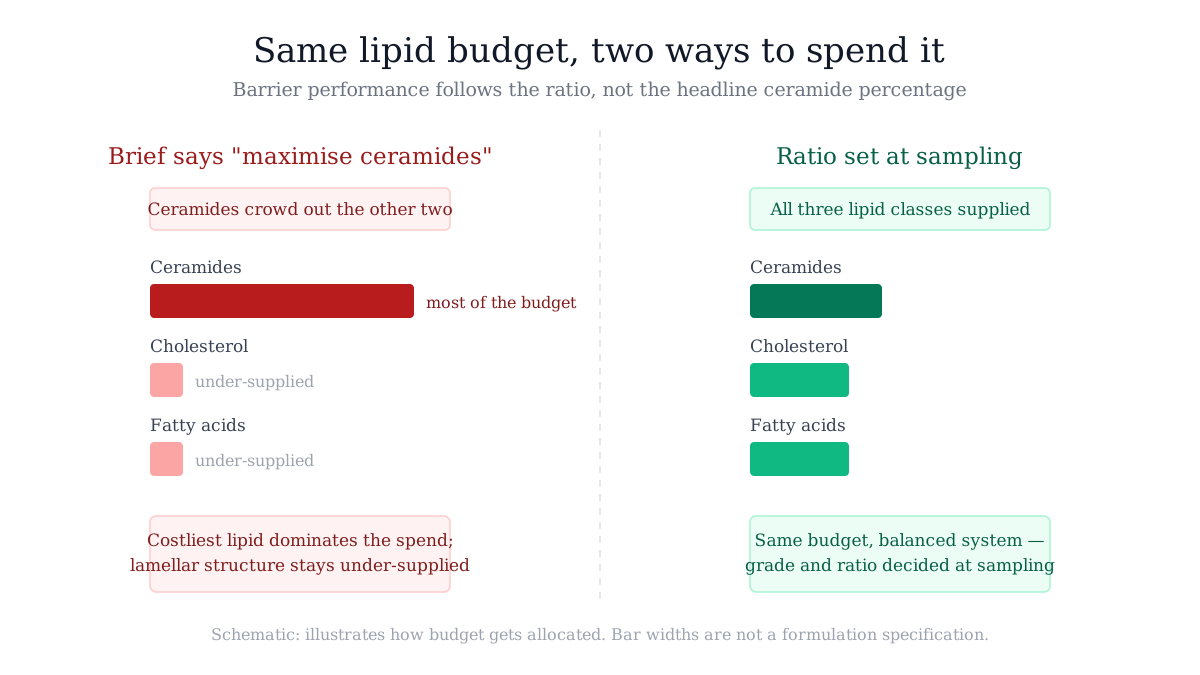
Barrier performance follows the ratio of ceramides to cholesterol to fatty acids far more closely than it follows the absolute ceramide load. Raising ceramides alone can leave you paying more for a formula that performs no better. That single sentence decides most of what follows in this article, and it is the part that spec-sheet comparisons between factories are structurally unable to show you.
There is a second problem sitting behind the first. Barrier products are unusually easy to formulate and unusually easy to over-claim, and the wording that sells the product to a consumer is often wording that a regulator will read as a medical statement. So this article covers both halves: how we actually build these formulas across our hydrating and barrier lines, and where the claim ceiling sits before you commit label copy to print.
If you take one thing away: on a barrier product, the number you should be negotiating is not the ceramide percentage, it is the lipid ratio and the grade behind it.
Why a Higher Ceramide Percentage Usually Buys You Nothing
Ceramides are structural lipids of the stratum corneum. A compromised barrier is short of them, which is the logic behind putting them in a leave-on product in the first place. That logic is sound. What does not follow is the assumption that more ceramide equals more repair.
Skin barrier lipids do not work as a single ingredient. Ceramides, cholesterol and free fatty acids occupy the same lamellar structure, and a formula that loads one of the three heavily while under-supplying the others is not a stronger barrier product than a balanced one. It is a more expensive one. Ceramides are among the costlier raw materials in a barrier formula, so a brief written around a headline ceramide number tends to move budget away from the parts of the system that carry the performance.
This is why our ceramide and cholesterol essence lotion quotes the lipid phase as a blend with the ratio set at sampling, rather than publishing a single ceramide percentage. It is not evasiveness. A fixed ceramide number is not a meaningful specification unless you also fix the cholesterol and fatty acid levels alongside it, and those are decisions that belong in a sampling round against your texture and cost targets.
Ceramide NP is our default grade. It is the best-characterised of the group and comes with the clearest supplier documentation, which matters more than it sounds when you reach a market that asks for material-level paperwork. Multi-ceramide blends are available where the positioning justifies the cost.
What to ask instead of "how much ceramide"
Three questions that will tell you more about a factory's barrier capability than any percentage:
- Which ceramide, and on what basis? Ceramide NP, AP and EOP are different materials at different price points. A quote that says only "ceramides" has not been specified yet.
- What is the ratio to cholesterol and fatty acids, and is it fixed or set at sampling? A factory that has never been asked this will usually say so by the quality of the answer.
- What claim will you support in writing? Covered below, and the answer separates suppliers faster than any technical question.

The Hydration Half: Humectants Are Not Interchangeable
Hydration and barrier support get bundled into one brief because consumers experience them as one benefit. Formulating them is not the same job. Humectants hold water; barrier lipids reduce the rate at which it leaves. A product that does the first and not the second feels good on application and stops feeling good a few hours later, which is the single most common complaint pattern on hydrating ranges.
On hyaluronic acid specifically, the practical constraint is texture rather than regulation. Our multi-weight hyaluronic acid serum runs a total use level of 0.1–0.5% sodium hyaluronate, and that upper bound is a formulation ceiling, not a legal one. Above roughly 0.5% total the texture turns tacky and stringy, and a hydrating product that feels tacky gets abandoned before any claim has time to demonstrate itself. The number of molecular weight fractions and the ratio between them are both adjustable; adding fractions adds cost, and on a product where HA is not the hero it usually adds cost without changing what the customer notices.
Two supporting points worth knowing before you write a brief around HA alone:
- Hyaluronic acid on its own can work against you in dry air. In low-humidity conditions a humectant film can draw moisture from skin rather than from the air. Glycerin buffers that, which is why our hydrating bases are glycerin-led rather than HA-led even when HA is the marketing story.
- Glycerin is the most evidence-supported humectant available and among the cheapest. We use it at a functional level rather than a token one. If a competitor's ingredient list has glycerin far down the order and a long tail of exotic humectants above it, that is a formulation built for the label rather than for the skin.
Which humectant balance is right depends heavily on where the product is sold; we cover the humidity side of that in our guide to skincare ingredients for tropical climates.
Sodium PCA and trehalose sit in our hydrating bases as NMF-type support. They bind water through different mechanisms than HA, which is what makes hydration read as lasting rather than surface-only, and trehalose in particular gives a cleaner skin-feel than raising the HA level would.
Not sure which route fits your product?
Send us your brief and our formulators will tell you what is realistic on formula, MOQ, and timeline before you commit to anything.
Claim Limits: Where "Barrier Repair" Stops Being Sayable
This is the section most likely to save you a re-print, so it is worth being blunt about our position: we support "barrier support" and "helping strengthen the look and feel of the skin barrier". We stop short of "repairs the skin barrier".
The reasoning is that repair and restoration describe a physiological change to the skin's structure. In most markets that framing reads as a medical claim rather than a cosmetic one, and the risk is not evenly distributed across your markets: the same label that passes unchallenged in one jurisdiction can require substantiation you do not have in another. Barrier support, by contrast, is one of the few skincare claims that holds up across the EU, ASEAN and US frameworks without special filings, which makes it a safer foundation than brightening or anti-ageing for a brand launching into several markets at once.
Note what this does and does not restrict. Product naming in the repair category is normal and we use it across our own range, from the Centella Soothing Repair Cream to the snail secretion filtrate repair cream. What we control is the functional claim sentence on the label and in your marketing copy, not the category vocabulary.
Two related boundaries that come up on nearly every barrier brief:
- Rinse-off products. Some ceramide deposition happens from a cleanser, and that is why they are in the formula. We would not claim barrier repair from a wash. Contact time is short by design and most of the product goes down the drain. What ceramides realistically contribute in our amino acid repair cleansing cream is a less stripped after-feel on skin that is being washed repeatedly. If barrier work is the goal, it belongs in the leave-on step.
- Soothing and redness. Centella earns a soothing and comfort claim. It does not earn an anti-inflammatory claim, which is drug territory in every market we ship to. In this category the claim wording constrains the formula more tightly than the centella level does, which is why we scope soothing and sensitive skin projects from the verb backwards.
Centella: Three Materials Sold Under One Name
Centella asiatica appears on most barrier and soothing briefs, and it is the ingredient where quotes most often turn out to be incomparable. Three quite different materials trade under the same name:
| Material form | What it is | Our working level | When we use it |
|---|---|---|---|
| Solvent extract Centella Asiatica Extract |
Active content is low and varies between suppliers | Baseline 0.5% range 0.1–0.5%, extract basis |
Assist tier, where centella is soothing support and the lipids carry the story. CIR records use rather than a numeric limit for the extract. |
| Standardised glycosides titrated powders |
80–90% titre; asiaticoside or madecassoside at 90% | 0.05–0.3% final level per supplier TDS |
Where a specific glycoside needs to appear on the label or in a dossier. |
| TECA titrated extract |
Roughly 40% asiaticoside plus 60% triterpene acids | Baseline 0.3% | Hero tier, when centella is the headline ingredient rather than support. Used in our Centella Repair Serum. |
The practical consequence: a "1% centella" quote and a "0.3% centella" quote can describe the same active load, or differ by an order of magnitude. The percentage is meaningless until the basis is stated. When you compare factory quotes on a centella product, the first thing to normalise is which of these three materials each one priced.
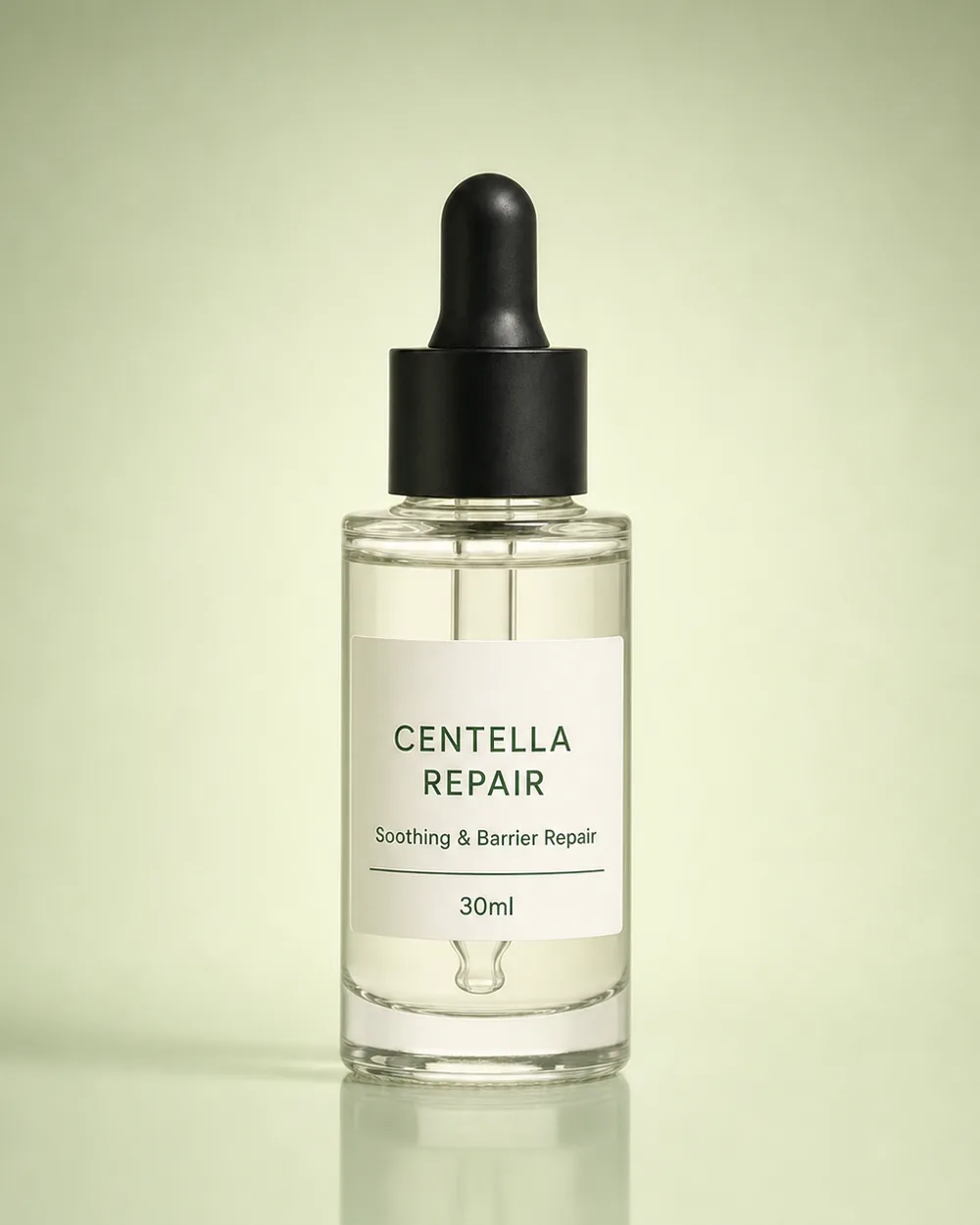
On a barrier-led product we deliberately keep centella in the assist tier and let the lipids carry the performance. Putting TECA into a formula whose story is lipids raises cost without strengthening the claim you are actually making.
Format Decides More Than Buyers Expect
The same barrier system behaves differently across dosage forms, and picking the format after locking the formula is a common sequencing error.
- Cream is where ceramides make the most sense, because the oil phase carries them properly. Our ceramide night cream uses the overnight window deliberately: uninterrupted contact time, nothing layered over the top, no washing off after two hours.
- Essence lotion exists because customers in Korea, Japan and increasingly Southeast Asia apply a lightweight step before cream. If your market does not layer, a single richer cream is the better product and we will say so rather than sell you a step nobody uses.
- Toner and watery formats can carry a supporting barrier story, as in our Centella Soothing Repair Toner, but the lipid load a watery base can hold is limited. Treat it as routine support, not as the barrier anchor.
- Sheet masks and patches work under occlusion, which already reduces water loss during wear. Ceramides support the barrier in that context; the occlusion is doing part of the work.
Occlusives deserve a specific warning. Shea butter at a high load gives the rich sensation that signals a premium night product, and it also brings heavier residue on the pillow and a greasier morning feel. That is the single most common complaint on this category, which is why we control the shea ratio rather than maximising it. A formula that reviews badly on after-feel does not get a second order regardless of how good the lipid system is.
Building a Barrier Range Rather Than One SKU
Barrier positioning suits a routine better than a single product, because the claim depends on consistent use across steps. A workable first range, drawn from bases we already run:
| Step | Product | MOQ | Lead time |
|---|---|---|---|
| Cleanse | Amino Acid Repair Cleansing Cream | 3,000 bottles / SKU | 35–60 days |
| Hydrate | Multi-HA Hydrating Serum | 3,000 bottles / SKU | 35–60 days |
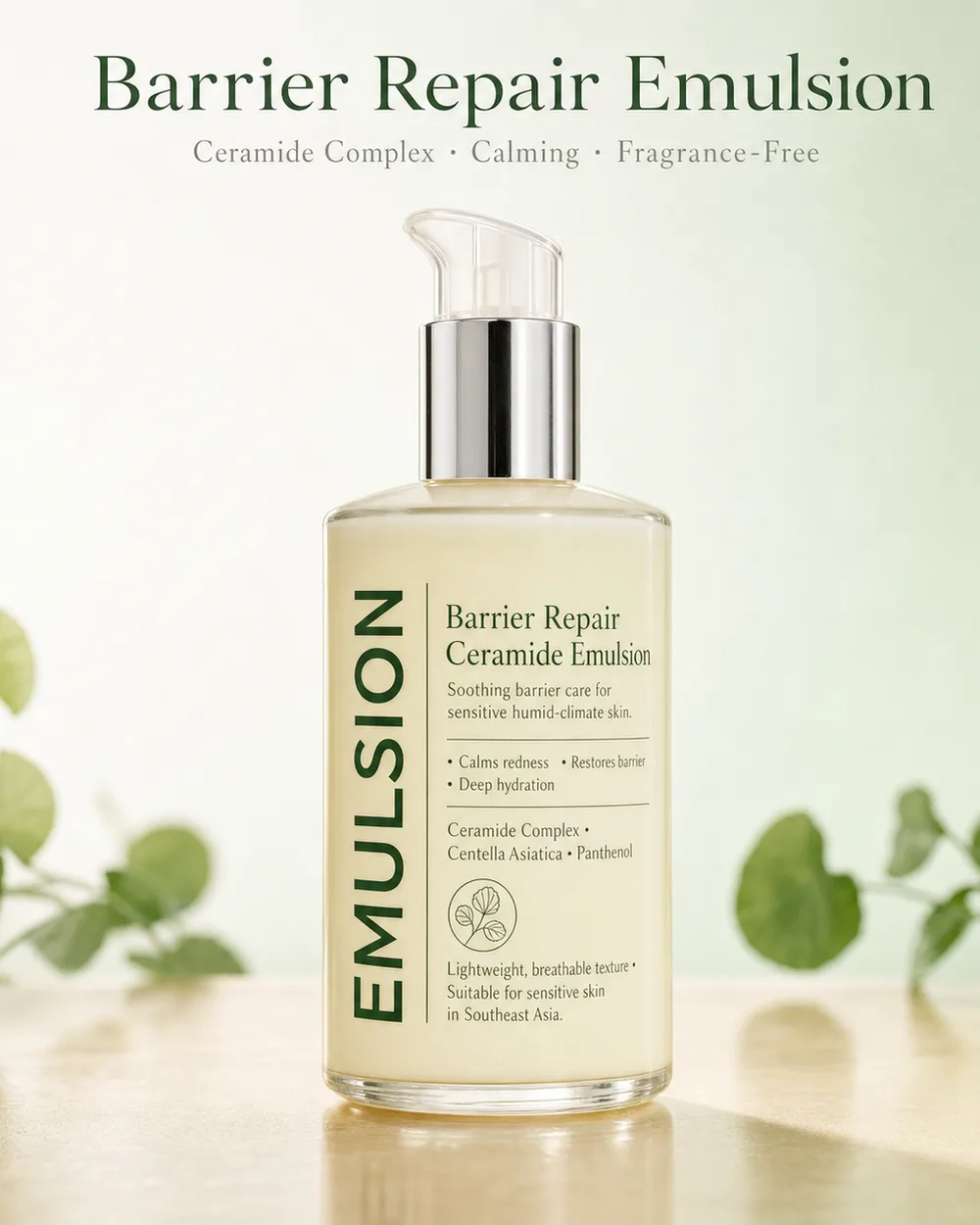
| Barrier anchor | Ceramide & Cholesterol Essence Lotion | 3,000 bottles / SKU | 35–60 days |
| Seal | Ceramide Night Cream | 3,000 jars / SKU | 35–60 days |
| Body extension | Centella Soothing Body Lotion | 3,000 bottles / SKU | 35–60 days |
Most barrier projects run as ODM against a base we already hold, since the lipid system is the slow part to develop from scratch. Sample preparation, dispatch, and revision timing is confirmed after the lipid system, references, and evaluation criteria are clear; the applicable sample fee and any production-order credit are stated in the quotation. Accelerated stability testing on the finished formula runs inside the production window above. Where a registration dossier calls for real-time studies, those are quoted and scheduled separately, because they cannot be compressed into a production lead time. What that testing actually covers is set out in our guide to cosmetic stability testing.
How those levers add up across a whole formula is broken down in our skincare formulation cost guide.
Cost levers on a barrier line, roughly in order of impact: ceramide grade and lipid ratio, centella material form, pack format (airless protects the lipid phase and signals a higher tier, at higher tooling cost), and order volume. We will move concentrations within the tiers above to hit a cost target. What we will not do is keep a hero-tier claim on a supporting-tier formula. If you are still sizing a first order, our MOQ and unit cost guide explains how volume moves the per-unit number.
Questions Worth Asking Any Barrier OEM
- Which ceramide grade, and what is the ratio to cholesterol and fatty acids?
- Is the centella figure quoted on an extract, standardised glycoside, or TECA basis?
- What exact claim sentence will you put in writing for my destination markets?
- What total sodium hyaluronate level, and what does the texture do at the top of that range?
- Is stability testing inside the quoted lead time or additional to it?
- If I ask for a higher ceramide percentage, will you tell me when it stops helping?
The last one is the tell. A factory that says yes to every percentage increase is selling you material, not formulation.
Frequently Asked Questions
Can you increase the ceramide percentage?
We can, but it is usually the wrong lever. Barrier performance follows the ratio of ceramides to cholesterol and fatty acids more than the absolute ceramide load, so raising ceramides alone often means paying more for a formula that performs no better. If your brief is competing against a published competitor number we will match it, and we will tell you what the money buys.
Can we claim our product repairs the skin barrier?
We support barrier support and helping strengthen the look and feel of the skin barrier, and we stop there. Repair and restoration describe a physiological change and read as medical claims in most markets. Barrier support holds up across the EU, ASEAN and US frameworks without special filings, which is part of why it is a good positioning for a multi-market launch.
Do the ceramides in a cleanser do anything?
Some deposition happens, which is why they are there. What they realistically contribute is a less stripped after-feel on skin that is washed frequently. We would not claim barrier repair from a rinse-off product; contact time is short and most of it goes down the drain.
How much hyaluronic acid should a hydrating serum contain?
Total sodium hyaluronate at 0.1–0.5% covers most hydrating serums. That ceiling is about texture rather than regulation: above it the product turns tacky and stringy. Whether to use multiple molecular weight fractions is a cost and positioning decision, not a performance requirement.
Is a multi-weight hyaluronic acid complex worth the extra cost?
When HA is the hero of the product and the marketing story, yes. On a barrier product where lipids carry the performance, a multi-weight complex adds cost without changing what the customer notices, so we default to high molecular weight in the assist tier.
Can one barrier formula run across a serum, a lotion and a cream?
Not as a single formula. The lipid load a watery base can carry is much lower than a cream's, so the same ingredient story has to be rebuilt per format. What does carry across is the ingredient logic, which is how a range reads as coherent rather than assembled.
How long does a barrier product take to produce?
Standard bulk production runs 35–60 days after sample, artwork, and packaging approval. Sampling is scheduled per project before that. Accelerated stability testing runs inside the production window; real-time studies for registration dossiers are quoted separately.
Do you adjust concentrations for cost targets?
Yes, within the tiers described above and provided the result still complies with your destination market's rules. Moving an ingredient from hero to assist tier is a legitimate cost lever and we will name it as one rather than hide it. What we will not do is leave a hero-tier claim on the label.
Ready to Start Your Project?
Tell us your product requirements. Within 24 hours, our technical team will reply with a quotation or the questions needed to prepare one.