
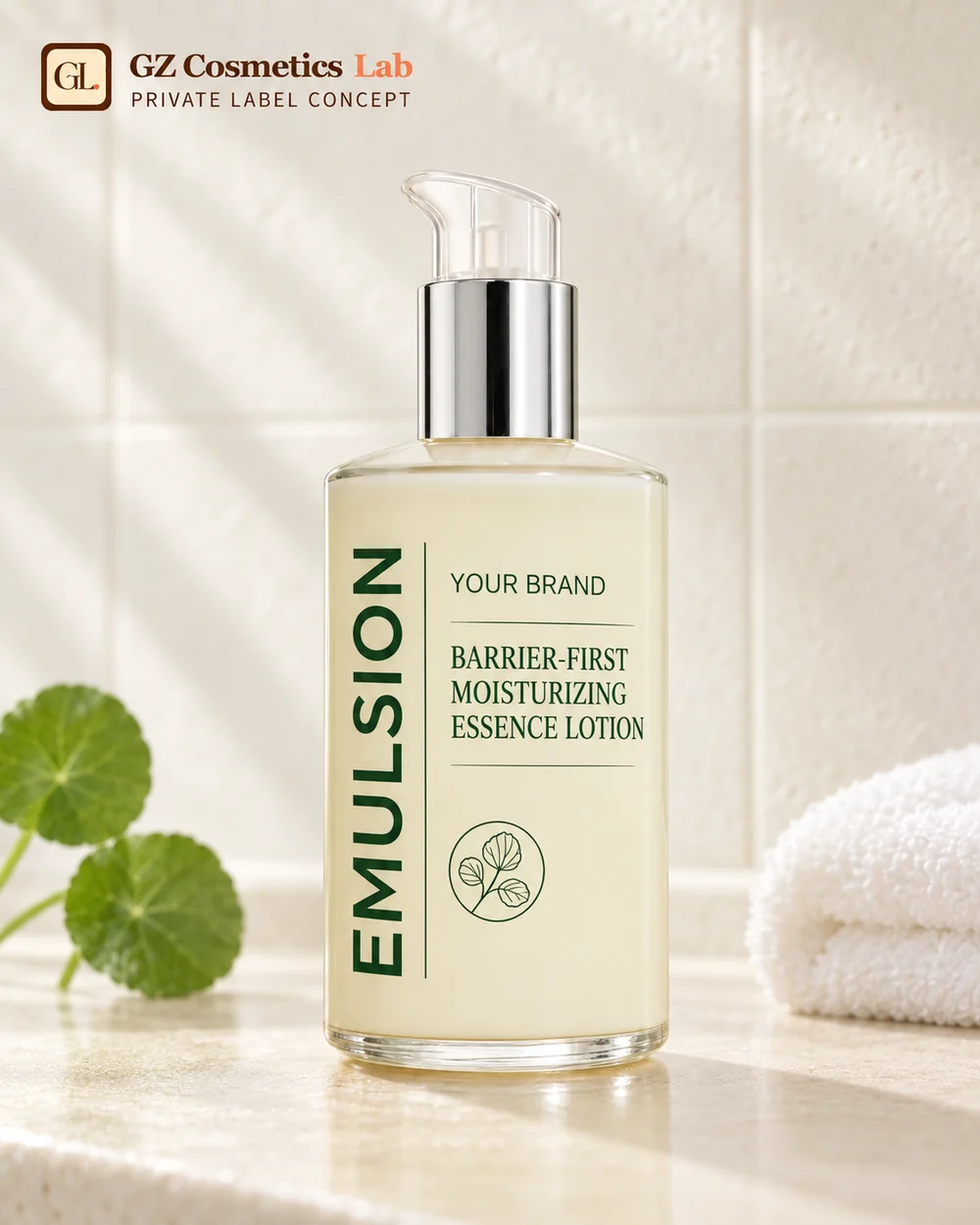
Value Repair
Barrier-First Moisturizing Essence Lotion
A barrier-led essence lotion built on the lipid ratio rather than on a headline active, which is an unusual thing to sell and worth understanding before you brief it. The ceramide, cholesterol and fatty acid proportions do more for a barrier claim than pushing any single ingredient higher would, and the centella here is a supporting soother rather than the hero. Two decisions carry most of the cost: which ceramide grade you use, and whether the centella is a solvent extract or a titrated material. Both are settled at sampling.
Product Overview
| MOQ | 3,000 bottles / SKU |
| Lead Time | 45–55 days |
| Sampling | Sample lead time 2–3 weeks. Sample fee is refundable against the first bulk order. |
| Sizes | 30ml / 50ml |
| Packaging | Serum/lotion pump bottle or airless bottle |
| Mini Pack | No - Not suitable for mini packs |
| Suitable For | Dull, fatigued skin, early-aging skin, normal to dry skin types |
| Pricing | Unit cost is quoted per project: ceramide grade and ratio, centella material form, airless versus pump pack and order volume are the main levers. |
Quote response within 24 hours · Sample terms confirmed by project
Key Active Ingredients
How the Active Ingredients Work
Levels below are our standard ODM starting point, expressed as a share of the total formula on an as-supplied basis, and adjustable for your target market and price point.
Ceramide complex with Cholesterol lipid blend, ratio set at sampling
The reason the product works, and the part most briefs get wrong by asking for a higher ceramide percentage. Barrier performance follows the ratio of ceramides to cholesterol to fatty acids far more than the absolute ceramide load, so raising ceramides alone can leave you paying more for a formula that performs no better. Ceramide NP is our default since it is the best-characterised of the group and has the clearest supplier documentation. Supportable wording is supporting and helping strengthen the look and feel of the skin barrier; we stop short of barrier repair, which reads as a medical claim in most markets.
Centella Asiatica assist tier · baseline 0.5% · range 0.1–0.5% on the solvent-extract basis
Present as the soothing support rather than the hero, which is why we use the extract tier rather than a titrated material. Worth knowing that centella comes in three quite different forms: a solvent extract where active content is low and varies between suppliers, standardised glycoside powders at 80–90% titre, and TECA at roughly 40% asiaticoside plus 60% triterpene acids. If you want centella as the headline we would switch to TECA at baseline 0.3%, but on a barrier product the lipids should carry the story and the centella should stay in support. CIR records use rather than a numeric limit for the extract.
Panthenol (Provitamin B5) baseline 2% · range 1–5%
One of the few ingredients where the evidence for comfort and hydration is solid and the cost is low enough to use at a level people can actually feel. It converts to pantothenic acid on skin and holds water well, which suits an essence lotion that has to feel substantial without an oil-heavy base. Above about 5% it starts to feel tacky, which is the practical ceiling rather than a regulatory one.
Hyaluronic acid assist tier · range 0.1–0.5% total sodium hyaluronate
High molecular weight by default and deliberately in the assist tier, because on this product HA is not the selling point and multi-weight complexes add cost without changing what a customer notices. Where HA is the hero we would build a different formula around it. Capped at 0.5% total, since a barrier product that feels tacky gets abandoned before the barrier claim has time to show.
Humectant and emollient base glycerin-led humectant system
Glycerin at a functional level rather than a token one, paired with light emollients that carry the lipids without pushing the texture toward a cream. The format matters here: an essence lotion has to layer under a cream without pilling, which constrains the polymer and emollient choices more than a standalone moisturiser would. This is the part we tune to your local routine habits, since layering expectations differ between markets.
Formulation & Customization Options
| Ceramide grade | Ceramide NP as standard, with multi-ceramide blends available; the ratio to cholesterol and fatty acids is set at sampling and matters more than the headline percentage |
| Centella form | Solvent extract at baseline 0.5% for the assist tier, or TECA at baseline 0.3% if centella is to be the headline ingredient on the label |
| Adjustable elements | Panthenol within 1–5%; hyaluronic acid within 0.1–0.5%; glycerin level; optional squalane addition for drier markets |
| Texture | Light milk or slightly richer lotion; layering behaviour under a cream is checked at sampling because it is the most common complaint on this format |
| Pack | 30ml or 50ml in a pump bottle, or airless where you want to protect the lipid phase and signal a higher tier |
Launch-fit guide
Who This Product Is Built For
Sensitive-skin and barrier ranges
This is the anchor SKU for a barrier line, and it pairs naturally with a soothing cleanser and cream rather than competing with them. The Centella Soothing Cleanser and Centella Soothing Repair Cream run the same ingredient logic across the routine.
Brands whose customers layer products
The essence lotion format exists because customers in Korea, Japan and increasingly Southeast Asia apply a lightweight step before cream. If your market does not layer, a single richer cream is honestly the better product and we would say so rather than sell you a step nobody uses.
Ranges needing a claim that is defensible
Barrier support is one of the few skincare claims that holds up across the EU, ASEAN and US frameworks without special filings, which makes it a safer positioning than brightening or anti-ageing for a brand entering several markets at once.
Planning Your Barrier-First Moisturizing Essence Lotion Project
What to prepare before quotation and sampling, which checks are part of routine manufacturing, and which items are confirmed separately for this product type.
What to include in your brief
- Share the cream and sunscreen normally layered over this step, and describe acceptable milk-like slip, absorption and residual tack in sample comparisons.
- Request a comparable description of the ceramide blend, supporting lipids and Centella material form, rather than judging alternatives by ingredient names alone.
Quality and testing plan
Set methods and acceptance limits for lipid dispersion, separation, pump delivery and pilling with the supplied routine products.
Agree any hydration or barrier-related evaluation on the final lotion, identifying the participant criteria, responsible party, report and quotation coverage alongside release checks.
Market and claims checkpoints
- Match the proposed barrier wording to the endpoint actually evaluated on the finished lotion.
- Review sensitive-skin and recurring-redness language against relevant target-user evidence; ingredient documentation alone does not establish suitability.
Pricing and testing scope depend on the final formula, packaging, quantity and destination market.
Frequently Asked Questions
Can you increase the ceramide percentage?
We can, but it is usually the wrong lever and we would rather explain why than just quote it. Barrier performance tracks the ratio of ceramides to cholesterol to fatty acids rather than the ceramide load on its own, so raising ceramides alone tends to raise your cost without changing the result. If the concern is that the label needs to look stronger, moving the ceramide higher in the INCI order is a different and cheaper conversation than reformulating.
Which centella form should we use?
Solvent extract at baseline 0.5% if centella is a supporting ingredient, which is how we build it here. TECA at baseline 0.3% if centella is the headline, since it is a titrated material at roughly 40% asiaticoside and the claim is easier to substantiate. Standardised 90% glycoside powders sit around 0.05–0.3% and the final figure follows the supplier TDS. The three are not interchangeable at the same percentage, which is the trap in comparing quotes between suppliers.
Can we claim it repairs the skin barrier?
We write barrier support and helping strengthen the look and feel of the barrier, and we stop there. Repair implies restoring damaged tissue, which crosses into a medical claim in the EU and invites scrutiny in the US. The distinction sounds pedantic until a regulator or a marketplace compliance team reads your label, and support is the wording that ships everywhere.
How does this differ from your centella cream?
Format and role in the routine. This is a lightweight step designed to layer under a cream, with the lipids present at a level that will not pill under a second product. The cream is the occlusive step and carries a higher lipid load. Selling both is a genuine two-step routine rather than a duplicated product, but if your customers only buy one item, the cream is the one to lead with.
What is the MOQ and lead time?
MOQ is 3,000 bottles per SKU and lead time is 45–55 days after sample approval. Sampling runs 2–3 weeks. The longer lead time compared with a simple lotion reflects the lipid phase, which needs stability confirmation before we release a production batch.
What certifications come with it?
Manufacturing is ISO 22716 and GMPC compliant, with SGS testing on request. Halal, COSMOS and Vegan are arranged per your target market rather than held as standing certifications, and on a lipid-based formula the constraint usually lands on the ceramide and cholesterol sourcing, so raise it before we start formulation work.
Customization
OEM/ODM supported
Target Markets
Certifications
ISO 22716 & GMPC certified; SGS testing supported upon request
Related Skincare Products

Need a Custom Barrier-First Moisturizing Essence Lotion Formula?
Tell us your requirements — target actives, texture, packaging, quantity, and target market. Within 24 hours, we will reply with a quotation or the questions needed to prepare one.
Response within 24 hours · WhatsApp available · Factory visits welcome