
Oil Control Shampoo Manufacturer: OEM Formulation Guide
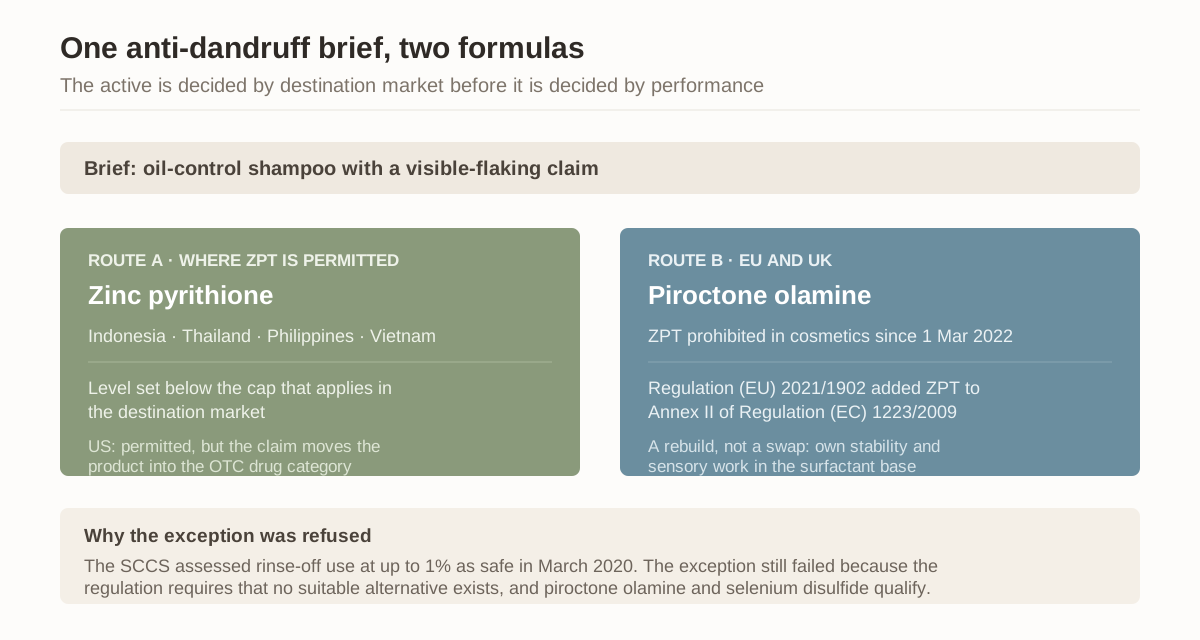
Chart by GZ Cosmetics Lab · Free to reuse with a link back to this page.
Oil-control shampoo is one of the few hair categories where the brief is genuinely simple to state and genuinely hard to execute. The buyer wants hair that still looks clean on day two. Everything else in the formulation brief is downstream of that one sentence.
It is also the category where the largest number of first-time brands get the brief wrong in the same way. They ask for stronger cleansing, get it, and launch a product that strips the scalp, triggers rebound oil production, and produces exactly the day-two greasiness the product was meant to solve. The reviews say the shampoo "stopped working after a week." The formula never worked in the first place.
This guide covers what we actually adjust when a brand asks us to manufacture an oil-control shampoo, why surfactant choice matters more than surfactant strength, how the anti-dandruff variant changes your regulatory position depending on where you sell, and what a realistic minimum order and timeline look like. The formats and specifications those runs come from are on our hair care manufacturing page.
Why "Stronger Cleansing" Is the Wrong Specification
Sebum production on the scalp is regulated by sebaceous glands that respond to what is removed from the skin surface. A harsh surfactant system removes sebum efficiently, and it also removes the intercellular lipids that signal to the scalp that its barrier is intact. The result is a scalp that produces more oil, faster, than it did before the wash.
This is why the practical goal in oil-control formulation is not maximum sebum removal. It is selective sebum removal at a rate the scalp does not treat as damage. In our experience, brands that specify "as strong as possible" and brands that specify "day-two clean" end up with two completely different formulations, and only the second one produces repeat purchase.
The measurable version of the brief is time-to-regreasing. If your target market washes daily, day-two performance is a bonus. If your target market washes every two to three days, which is common in the Philippines and Indonesia among consumers managing water costs, day-two performance is the entire product.
The Surfactant System Is Where the Product Is Decided
Most of what a consumer perceives as "oil control" is set by the primary and secondary surfactant pairing, not by the actives you list on the front of the bottle.
A conventional sulfate-based system cleans aggressively and cheaply. It also raises the barrier-disruption risk described above. An amino-acid or glucoside-forward system cleans more selectively, costs more per kilo, and needs more formulation work to hit an acceptable foam profile, because consumers in most Southeast Asian markets read dense foam as evidence that the product is working.
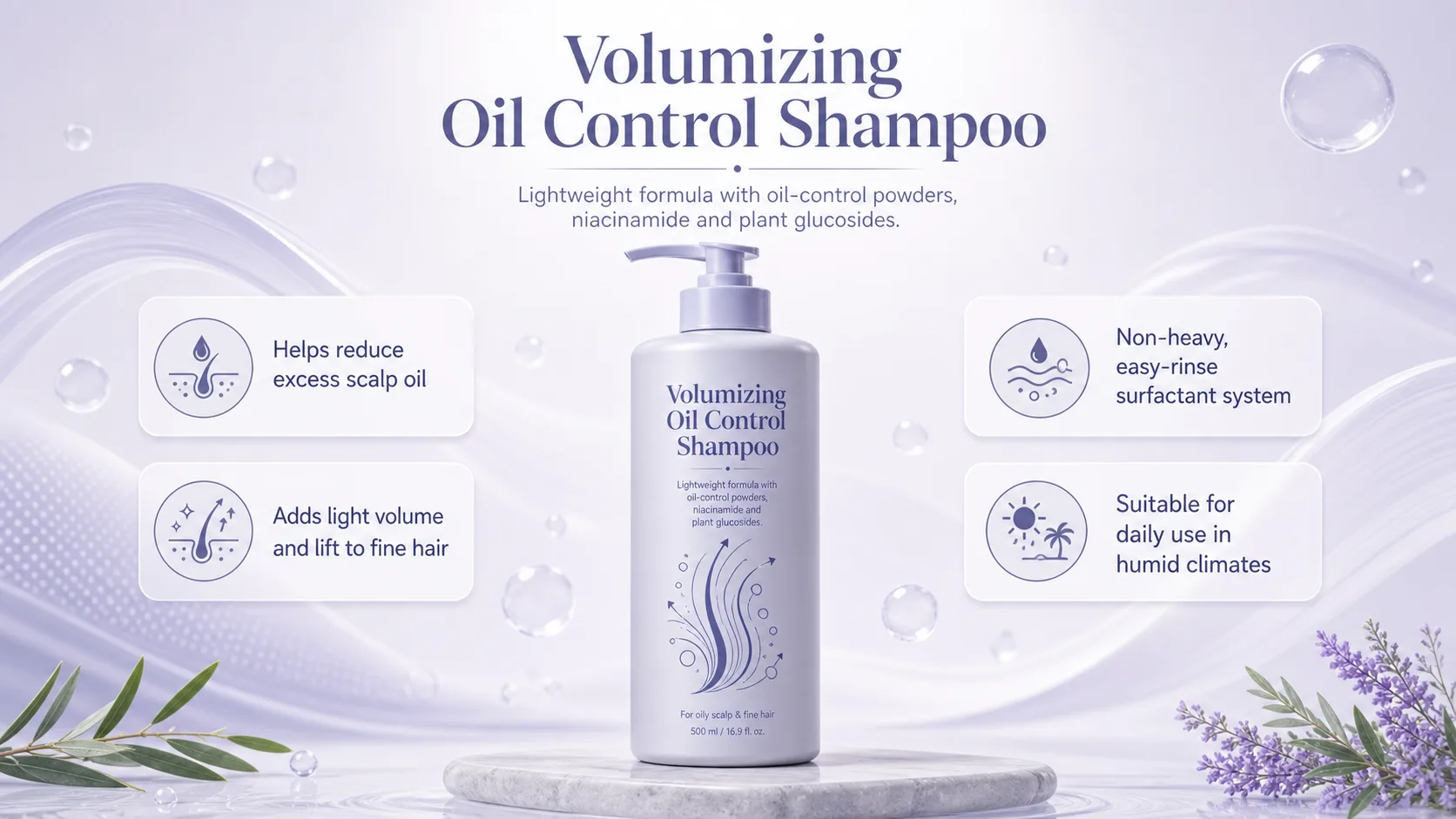
Our volumizing oil control shampoo uses a lightweight surfactant system paired with oil-control powders and a low level of niacinamide, and it exists specifically for fine hair that goes flat when weighed down. That combination is a deliberate trade: lighter conditioning agents mean less day-one softness and better day-two volume. A brand that wants both has to pick which one the product leads with.
The three variables worth settling before we quote are the surfactant class, the target foam density, and whether the formula needs to be sulfate-free as a labelling claim or merely mild in practice. Those are different requirements with different costs.
The Sulfate Question Has a Regulatory Dimension, Not Just a Marketing One
Most brands treat sulfate-free as a positioning choice. If the United States is in your distribution plan, there is a compliance layer underneath it that is worth understanding before you lock the surfactant system.
Ethoxylated surfactants, sodium laureth sulfate being the most widely used example, can carry 1,4-dioxane as a process by-product. It is not an added ingredient; it forms during ethoxylation and during the sulfation of ethoxylated alcohols. Untreated material has historically carried it at the tens of parts per million level. Vacuum steam stripping brings that down substantially, and purpose-built low-dioxane processes bring it lower still.
New York State legislated hard limits on this. Under the law enacted in December 2019, personal care products sold in the state had to meet 2 ppm by 31 December 2022 and 1 ppm by 31 December 2023, with a separate 10 ppm threshold applying to cosmetic products from 31 December 2022. The limits apply on the basis of where the product is sold, not where it is made, which is the part exporters most often miss. California's SB258 separately requires disclosure for products above 10 ppm.
The practical consequence for an oil-control shampoo is that "we will use SLES because it is cheaper" is an incomplete specification if New York is in scope. The question becomes which grade of SLES, from which supplier, with what stripping process and what documentation. That is a raw material sourcing decision with a cost attached, and it is a different conversation from choosing an amino-acid system for mildness reasons.
For brands selling only into Southeast Asian markets this constraint does not currently apply, and a conventional sulfate system remains a legitimate cost decision. We raise it at the brief stage because roadmaps change, and requalifying a raw material after launch is more expensive than specifying it correctly at the start.
Oil-Control Powders and What They Actually Do
Silica, starch derivatives, and similar particulates absorb sebum at the scalp surface and are the most direct lever on day-two feel. They are also the fastest way to ruin a shampoo's rinse-out profile if overloaded, leaving a residue that fine hair reads as dullness.
The load is a genuine optimisation rather than a fixed number. More powder buys you longer time-to-regreasing and costs you rinse-clean feel and clarity in transparent packaging. We normally run two or three powder loads at sample stage and let the brand choose against their own hair type panel, because the acceptable ceiling varies with hair thickness in the target market.
Niacinamide in Scalp Care: A Support Active, Not the Hero
Niacinamide appears in several of our scalp formulas at low levels as a sebum-modulating and barrier-supporting ingredient. It is worth being precise about its role, because it is easy to oversell.
In a rinse-off shampoo, contact time is measured in tens of seconds and most of the applied dose goes down the drain. That limits what any water-soluble active can contribute compared with a leave-on scalp serum, where the same ingredient has hours of contact. Niacinamide in a shampoo is a reasonable supporting claim and a reasonable part of the formulation story. It is not the mechanism that delivers oil control, and a brand that builds its entire positioning on it will find the performance story hard to defend.
If a brand wants niacinamide to do real work on scalp sebum, the honest answer is that the format needs to change. A leave-on scalp treatment gives the ingredient the contact time it needs. We would rather say that at the brief stage than let a client discover it after their first production run.
The Anti-Dandruff Variant Changes Your Regulatory Position
Oily scalp and flaking arrive together often enough that most brands eventually ask for an anti-dandruff variant alongside the oil-control core. This is the point where a single product decision splits into different products for different markets, and it is worth understanding before you commit to artwork.
Zinc pyrithione is the best-known anti-dandruff active and the one most brands name first. It is prohibited in cosmetics in the European Union. Commission Regulation (EU) 2021/1902 added it to Annex II of Regulation (EC) No 1223/2009, effective 1 March 2022, following its classification as toxic for reproduction category 1B under CLP. Industry had requested an exception for rinse-off hair products at up to 1%, and the SCCS assessed that specific use as safe in March 2020, but the exception was refused because the regulation requires that no suitable alternatives exist, and piroctone olamine and selenium disulfide were judged to be suitable alternatives. The former Annex V preservative entries and the Annex III restricted entry were deleted at the same time.
In the United States the same ingredient remains permitted under the FDA OTC monograph for anti-dandruff products. Note that this also means an anti-dandruff claim in the US puts the product in the OTC drug category with the labelling consequences that follow, which is a separate question from whether the ingredient is allowed.
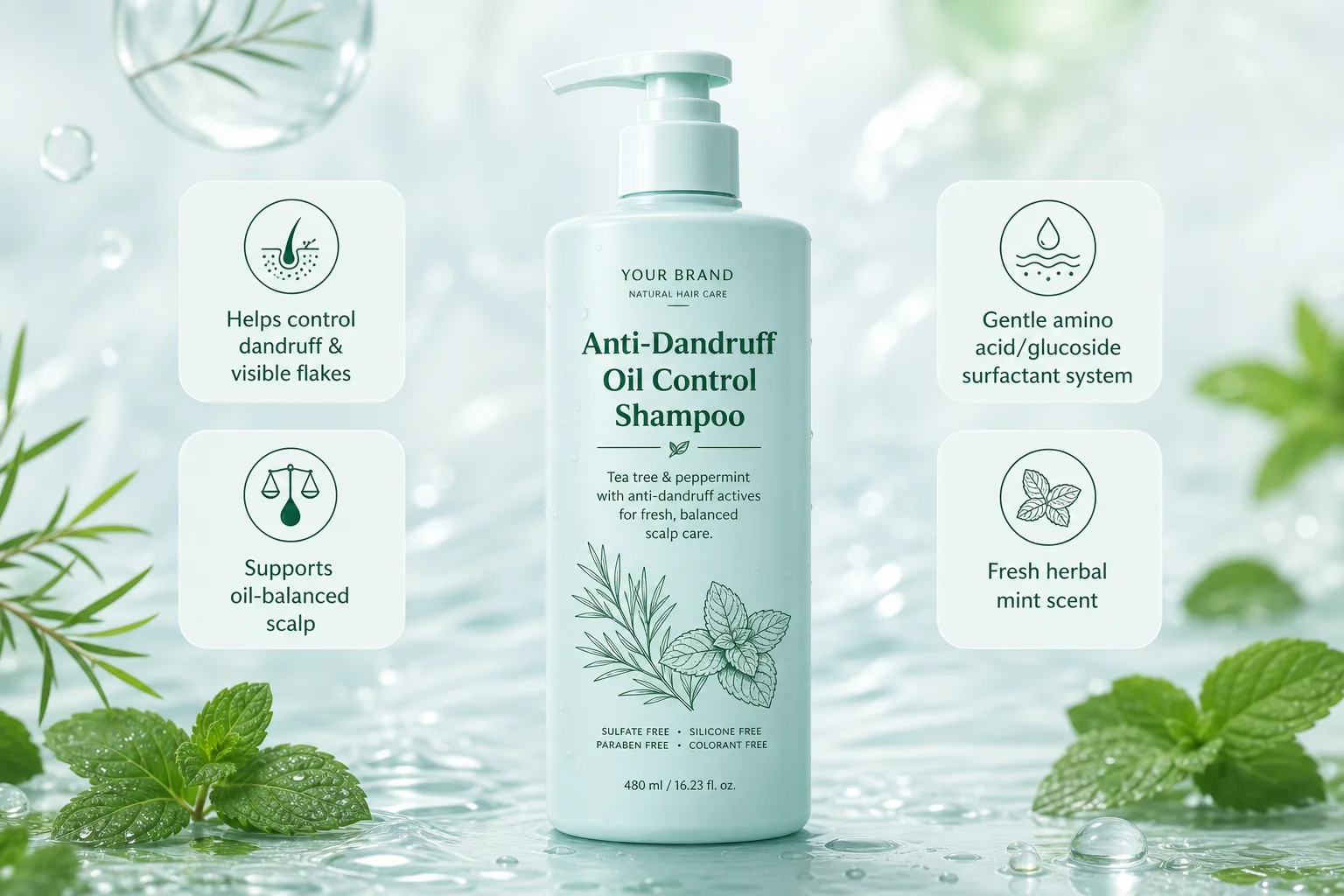
The practical consequence for a brand selling across regions is that one formula cannot carry one anti-dandruff active everywhere. Our anti-dandruff shampoo is built on zinc pyrithione and is offered for markets where that active remains permitted in cosmetics. It is not available for the EU or the UK. For those markets the formula is rebuilt around piroctone olamine, which is a reformulation rather than a substitution, because the two actives behave differently in the surfactant base and need their own stability and sensory work.
If your roadmap includes Europe, tell us at the brief stage rather than after the first production run. Building the EU-compliant version first and then adding the zinc pyrithione version for other markets is cheaper than the reverse.
Where Oily Scalp Overlaps With Scalp Care and Body Care
Consumers who buy oil-control shampoo frequently have adjacent concerns, and the range decision is often more valuable than perfecting a single SKU. If you are deciding how many SKUs to launch and in what order rather than how to specify this one, our guide to building a hair care range works through that sequence.
Conditioner is the most common second product and the most commonly mishandled. A rich conditioner applied by someone with a fine, oily scalp undoes the shampoo. Our volumizing lightweight conditioner exists for that pairing and shares the oil-control powder approach, which also means it shares raw materials with the shampoo and reduces the cost penalty of adding a second SKU.
A scalp treatment mask is the margin format in this category, sitting at a higher price point than shampoo because consumers treat it as a weekly intervention rather than a daily consumable. Tea tree with low levels of menthol and salicylic acid is the usual route. The formulation variables you can change across each hair format, and the ones that are fixed by the base, are covered in our private label shampoo and conditioner guide.
Body care is the overlap brands most often miss. The same consumer profile — sweat-prone, humid climate, oily skin — also buys products for back and chest breakouts. Our oil control back acne body lotion shares the niacinamide and low-level salicylic acid logic with the scalp mask. If you are already producing two hair SKUs with us, adding this one is a smaller increment than starting a body line from scratch. Where that consumer profile is the whole market rather than a segment of it, our tropical hair and body OEM guide covers the humidity and heat constraints that change these formulas.
Men's Oil Control Is a Separate Product, Not a Relabel
Men's oil-control shampoo comes up as its own request often enough to be worth treating separately, and the common assumption behind it is wrong. Brands frequently expect the men's version to be the same formula in a darker bottle.
Three things genuinely differ. Fragrance direction is the obvious one, and it is not a cosmetic change to the brief because the fragrance load interacts with the surfactant system and needs its own stability check. Wash frequency assumptions differ, with men's products in this category more often built around daily use, which shifts how mild the base needs to be. And scalp coverage differs, because shorter hair means the product contacts the scalp more directly and a formula that felt acceptable on long hair can read as tight or itchy.
The efficient route is a shared base with a separate fragrance and a modest adjustment to the conditioning level, which keeps you on one formula development cycle rather than two. The inefficient route is treating it as a pure packaging exercise and discovering the sensory mismatch after production.
Bundling Shampoo With a Treatment: How the Combined Order Works
Requests for a shampoo and mask pair, usually keratin-led, arrive regularly and the commercial logic is sound. The pair sells better than either product alone because the mask carries the margin and the shampoo carries the repeat purchase.
What brands should know is that the minimum applies per SKU, not per order. Two products at our minimum means two lots of 2,000 to 3,000 units, not a shared floor. That surprises brands who expect a volume discount for ordering two items, and it is better known before budgeting than after.
What does get cheaper is everything upstream of filling. Shared actives across the pair reduce raw material minimums. Shared fragrance means one fragrance qualification rather than two. Shared packaging suppliers reduce component lead time risk. In practice a shampoo-and-mask pair costs meaningfully less than two unrelated SKUs, just not less than the sum of two minimums.
Masks also run on a longer cycle than shampoo, typically 40 to 50 days against 35 to 45, because jar filling and the thicker emulsion add steps. If you are launching both together, the mask sets your ship date.
Minimum Order, Lead Time and What Drives Both
| Format | Minimum order | Lead time | What sets the floor |
|---|---|---|---|
| Bottles typically 500ml |
2,000–3,000 bottles / SKU | 35–45 days | Pump bottles, caps and printed labels each carry their own supplier minimum. Bulk shampoo is not the constraint; components are. |
| Sachets 5–10ml |
Separate line, its own minimum | Quoted separately | A primary retail format in Indonesia and the Philippines, not a sample. Belongs in the first conversation, not added later. |
| Second fragrance, same base | Far lower incremental cost | No development gate | Shares the bulk formula. Adding a second formula costs considerably more per unit than adding a second scent. |
Lead time assumes stable packaging decisions. In practice the most common cause of a project running past 45 days is late artwork revision or a packaging component change after the sample is approved, not production. Detailed cost mechanics are in our MOQ and cost guide.
The Four Things That Decide Your Quote
A quote we can stand behind needs four things. Which markets you are selling into, because that determines the anti-dandruff active and the claim set. Your hair-type target, because fine and coarse hair need different powder loads and conditioning levels. Your retail price point, which sets the surfactant class we can work within. And your format list, including whether sachets are in scope.
What we do not need at the first email is a finished formula. Brands that arrive with a fixed ingredient list copied from a competitor usually spend the sample round discovering that the list was built for a different market's regulations or a different price point.
We manufacture under ISO 22716 and GMPC, with SGS testing available on request. For how to evaluate a factory beyond the certificate, our checklist for choosing a manufacturer in China covers the questions worth asking. If you are still deciding between manufacturing models, OEM versus ODM sets out the difference, and our complete guide to private label cosmetics covers the wider process of launching a brand.
What Happens Between Your Brief and Your First Pallet
Brands evaluating manufacturers are usually shown certificates and a product list. What is more useful is knowing what the development sequence actually looks like, because that is where a project either stays on schedule or does not.
A first sample round on an existing base takes roughly one to two weeks. For oil-control shampoo we normally build two or three variants rather than one, differing in powder load and conditioning level, because the acceptable ceiling on both is a judgement call that depends on the hair type in your market and it is faster to let you choose against samples than to describe it in email.
Stability testing runs in parallel and is the step most often compressed by brands under launch pressure. Accelerated testing in a climate chamber at elevated temperature, alongside cycled freeze-thaw and a room temperature control, is what tells you whether the powder load stays suspended, whether the fragrance holds, and whether the pH drifts. For a shampoo destined for Indonesia or the Philippines, elevated temperature and humidity conditions matter more than they would for a European launch, because the product will sit in an un-airconditioned warehouse and then an un-airconditioned bathroom.
Compatibility testing with your chosen packaging is separate from formula stability and is frequently skipped. A formula that is stable in a lab jar can interact with a particular pump liner or a printed label adhesive. Running the formula in the actual component you intend to ship is the only way to find that before your customers do.
We manufacture under ISO 22716, the international GMP standard for cosmetics, which governs premises, equipment, documentation and batch traceability rather than making claims about the product itself. Our facility is GMPC certified and third-party SGS testing is available on request. Our explainer on what GMPC certification actually covers is worth reading if you are comparing factories on paper, because the certificate says less about formulation capability than most buyers assume.
Once a formula and packaging are approved, production is the predictable part. The 35 to 45 day window is dominated by component lead time and filling scheduling, not by mixing. This is also the stage where changes get expensive, which is the practical argument for settling artwork before the sample is signed off rather than after.
Frequently Asked Questions
What is the MOQ for a private label oil-control shampoo?
2,000 to 3,000 bottles per SKU. The floor comes from packaging component minimums rather than bulk formula, which is why a second fragrance on the same base is much cheaper per unit than a second formula.
How long does production take?
35 to 45 days for an existing formula, from approved sample to shipment. Projects that need formulation from zero add a sample round. The most common delay is late artwork change, not manufacturing.
Can I sell the same anti-dandruff shampoo in Europe and Southeast Asia?
Not with the same formula if it uses zinc pyrithione. That active has been prohibited in EU cosmetics since 1 March 2022 under Regulation (EU) 2021/1902. The EU version is rebuilt around piroctone olamine, which requires its own stability and sensory work rather than a straight swap.
Does sulfate-free mean better oil control?
No. Sulfate-free describes the surfactant class, not the cleansing outcome. A well-built sulfate-free formula can deliver better day-two performance because it disrupts the scalp barrier less, but the claim itself guarantees nothing about oil control.
Will a stronger shampoo solve fast regreasing?
Usually the opposite. Aggressive cleansing removes barrier lipids alongside sebum and can accelerate rebound oil production. Selective cleansing plus surface sebum absorption is the approach that holds up over a wash cycle.
Do you supply sachets?
Yes, at 5 to 10ml. Sachets run on a separate line with their own minimum, so include them in the initial brief if they are part of your launch rather than adding them later.
Can the niacinamide level be adjusted?
Yes. Surfactant system, oil-control powder load and niacinamide level are all adjustable within the constraints of your destination market's rules and your price point.
Is sulfate-free necessary for the US market?
Not as such, but if New York is in scope the 1,4-dioxane limits on personal care products apply, and that constrains which grade of ethoxylated surfactant you can use rather than banning the class. It is a raw material sourcing and documentation question.
Can the men's version use the same formula?
Shared base, separate fragrance, and usually a small change to conditioning level. Fragrance affects stability so it needs its own check. Treating it as packaging-only is where the sensory mismatch comes from.
If I order shampoo and a mask together, is the MOQ shared?
No. The minimum applies per SKU, so two products means two lots. What does get cheaper is shared actives, one fragrance qualification, and shared packaging suppliers. Note the mask runs 40 to 50 days against the shampoo's 35 to 45, so it sets your ship date.
Should the conditioner match the shampoo?
For oily fine hair it needs to be lighter than a standard conditioner or it cancels the shampoo. Matching the fragrance across both is straightforward and worth doing; matching the richness is not.
What This Comes Down To
Oil-control shampoo is won on the surfactant system and the sebum-absorbing powder load, not on how strongly the product cleans. Day-two performance is the metric that drives repeat purchase. The anti-dandruff variant is a regional decision before it is a formulation decision, because zinc pyrithione is not an option for the EU or UK. Minimums are 2,000 to 3,000 bottles per SKU at 35 to 45 days, set by packaging rather than bulk, and sachets belong in the first conversation if Indonesia or the Philippines are in scope.
Send us your target markets, hair-type focus, price point and format list, and we will come back with a formulation route and a quote you can plan against.
Start with the market list, not the texture brief
The anti-dandruff decision and the sachet question are both regional. Give us the countries and formats and we will quote the surfactant route that actually ships there.
Ready to Start Your Project?
Tell us your product requirements. Our technical team responds within 24 hours with a detailed quotation.