
Private Label Hair Cosmetics: Building Your OEM Range
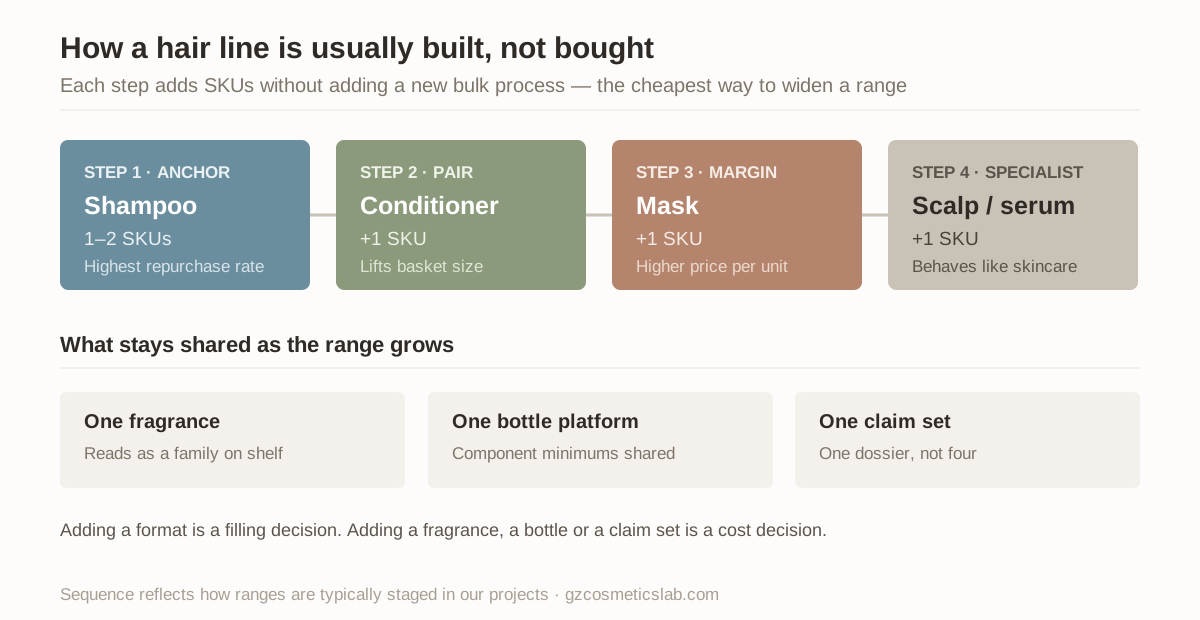
Chart by GZ Cosmetics Lab · Free to reuse with a link back to this page.
Most enquiries about private label hair cosmetics arrive as a shopping list. Six products, sometimes eight, usually copied from a brand the founder admires. The list is the wrong starting point, because it decides the hardest commercial questions by accident: how much capital sits in inventory before your first reorder, how many separate compliance dossiers you are paying for, and whether your range reads as a family or as four unrelated bottles that happen to share a logo.
This guide is about those decisions rather than the formulas. It assumes you have already worked out roughly what you want to sell and now need to decide what to actually launch. If you want the formulation variables inside each format, our breakdown of what you can change in each hair care format covers that ground; if your market is hot and humid, the tropical hair and body OEM guide deals with stability and scalp load. What follows is the layer above both: sequencing.
Hair Is a Range Category, Not a Hero Category
Skincare rewards a hero product. A single serum can carry a brand for two years because customers accept that a serum is a standalone purchase. Hair does not behave that way. Shoppers expect a shampoo to have a matching conditioner, and they expect a mask to belong to a system. A lone shampoo on a shelf or a marketplace listing reads as incomplete, and it competes only on price.
That expectation has a direct commercial consequence. In hair, your unit economics improve mainly through basket size rather than through margin on one product. Two bottles bought together beat one bottle bought twice, because you paid the same acquisition cost either way. This is why range structure deserves more of your attention than the fifth ingredient on your wish list.
It also changes what "starting small" means. In skincare, starting small means one product. In hair, starting small means one system with the fewest SKUs that still looks complete. For most brands that is two or three, not one and not six.
Anchor First: Why Shampoo Usually Goes on the Line First
Shampoo earns the anchor position for a practical reason: consumption frequency. It is used more often than any other hair product and finishes fastest, which makes it your reorder engine and your best source of repeat-purchase data. Whatever else you launch, the shampoo is the SKU that tells you whether the brand has demand.
Anchoring also means accepting a constraint. Your shampoo defines the fragrance, the visual identity and the price tier that everything else has to live with. Choosing it casually and then trying to build a premium mask on top of a value shampoo produces a range that argues with itself. Decide the tier at the anchor, not at the extension.
Where brands most often go wrong is anchoring on a specialist instead. A scalp serum or a bond-repair treatment is exciting to launch and slow to reorder. It generates content but not consumption, which is a difficult combination when your cash is tied up in a first production run.
Choosing between broad and narrow at the anchor
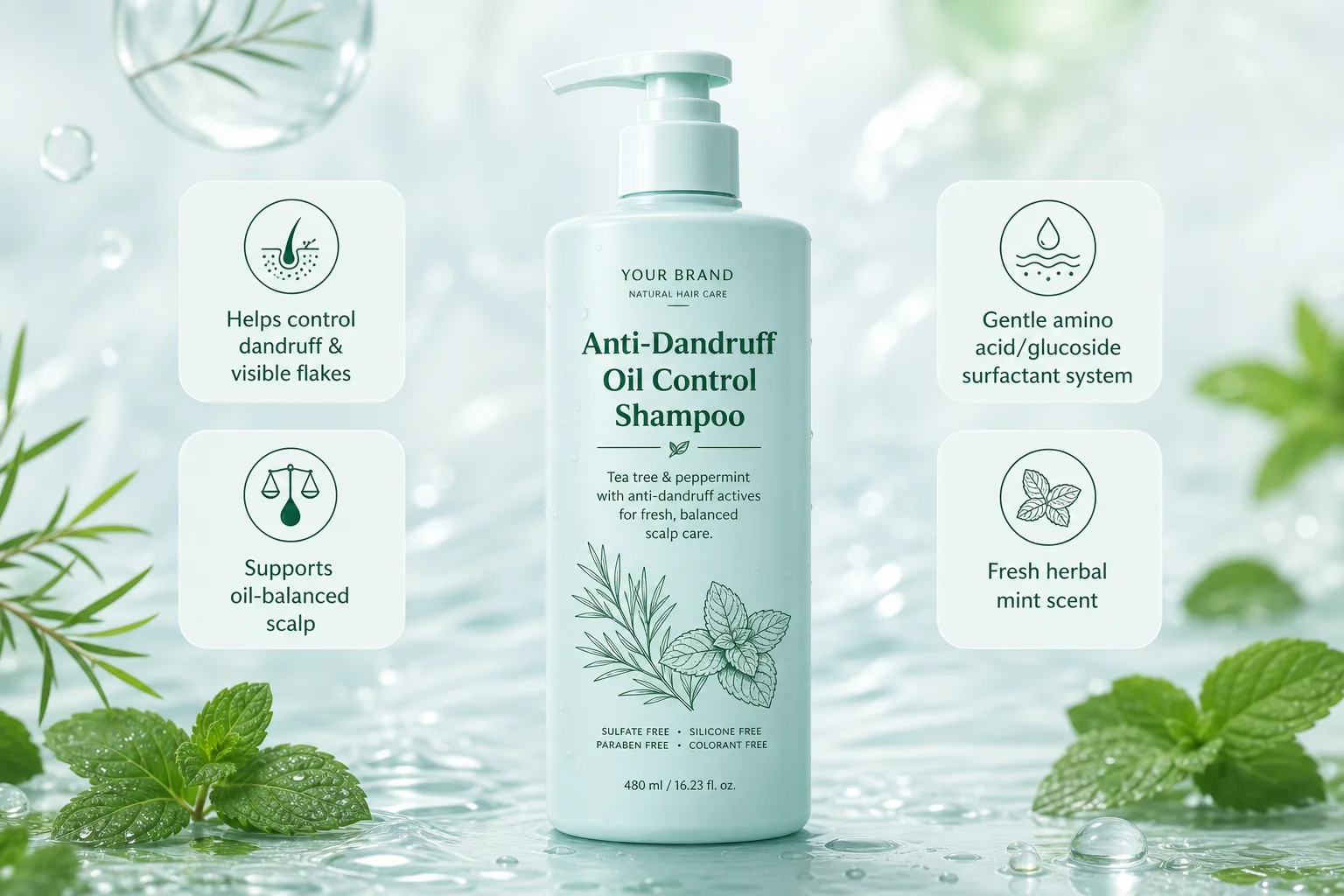
A broad anchor, such as a general nourishing or smoothing shampoo, is easier to sell to anyone and harder to make memorable. A narrow anchor, such as an oil-control or anti-dandruff position, sells to fewer people but gives you something specific to say and a clearer keyword to own. In crowded markets the narrow anchor usually travels further, because a broad shampoo has to beat established brands at their own game.
Narrow does not mean niche formulation work. Our production range includes positions such as an anti-dandruff oil-control shampoo and a rosemary and lemongrass natural shampoo, both of which are specific enough to market clearly while remaining standard private label work.
Not sure which route fits your product?
Send us your brief and our formulators will tell you what is realistic on formula, MOQ, and timeline before you commit to anything.
The Second SKU Is a Cost Decision, Not a Product Decision
Once the anchor is chosen, the second SKU determines how expensive your range is going to be to run. Adding a conditioner to a shampoo is close to the cheapest expansion available: the same fragrance, often the same bottle platform, the same claim set, the same market registration logic, one extra bulk process. Adding a hair oil in a glass dropper bottle with a separate scent story is a much larger commitment for the same "one more product".
This is the practical rule worth carrying into your planning: a new format is a filling decision, but a new fragrance, a new bottle platform or a new claim set is a cost decision. Formats are relatively cheap to add. The things that surround formats are not.
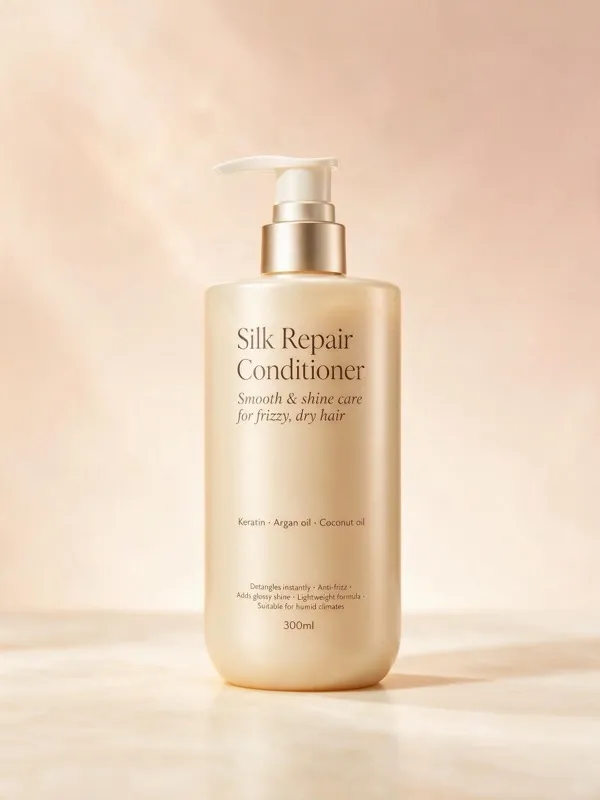
Conditioner is the usual second SKU because it converts an existing customer into a larger basket with almost no new infrastructure. A matched repair conditioner beside a repair shampoo is a complete proposition; the same conditioner beside an unrelated clarifying shampoo is two products sharing a shelf.
Where the Third and Fourth SKUs Should Go
The third SKU is where margin enters the range. Masks and treatments carry a higher price per unit than the wash-and-rinse pair and are the natural place to express whatever your brand claims to be good at. They are also lower frequency, which is exactly why they work better as an extension than as an anchor: the pair drives repeat purchase, the mask lifts average order value.
The fourth step, scalp care and hair serums, behaves like skincare rather than hair care. Customers evaluate it on ingredient stories and expect visible results over weeks, and it usually carries the highest price point in a hair range. It rewards a brand that has already earned some trust, which is another argument for placing it late rather than early.
Stopping earlier than four is entirely legitimate. A three-SKU range that is fully stocked, consistently in supply and properly photographed outperforms a six-SKU range where two products are permanently out of stock and two never sold. Breadth is only an asset if you can keep it available.
What a staged range looks like in practice
- Launch: anchor shampoo plus matched conditioner, one fragrance, one bottle platform, one claim set
- First extension: a mask or treatment in the same story, added once the pair shows reorder demand
- Second extension: a scalp or serum product priced above the rest of the range
- Variant expansion: a second fragrance or a second concern only after one system has proven itself
The sequence matters more than the timeline. Brands that add SKUs before the previous step has produced reorder data tend to accumulate slow-moving inventory, which is the most common way a promising hair brand runs out of cash while apparently growing.
What Should Stay Shared Across the Range
Three things are worth deliberately sharing across every SKU you launch, because each one multiplies cost when it is not shared.
One fragrance. A shared scent is the cheapest thing that makes a range feel like a family, and it is the single most noticeable signal of coherence to a customer who picks up two bottles. It also means one fragrance approval cycle rather than four.
One bottle platform. Sharing a bottle across formats lets your packaging minimums work across the whole range rather than being duplicated per SKU, and packaging components are frequently the binding constraint on a first order rather than the formula.
One claim set. Every distinct claim carries its own substantiation and documentation burden in each destination market. A range built on one coherent claim set needs one dossier logic; a range where each product makes a different promise needs several.
Diverging on any of the three can be the right call, but it should be a decision you priced rather than an outcome you drifted into.
How Range Structure Interacts With Your Minimums
Brands often ask what the minimum order is before asking how their range structure affects it, which is the wrong order. Your minimum is not a single number a factory grants or withholds. It is the combination of a bulk mixing batch, a packaging component minimum and a filling line setup, and range structure changes each of those. Four SKUs on one shared bottle sit in a very different position from four SKUs on four bespoke bottles, even at identical unit counts.
Because of that, the useful question is not "how low can the minimum go" but "which of my choices is driving it". We cover how those three minimums combine in the hair care format guide, and the wider cost components in our MOQ and cost guide. Confirmed figures for a specific brief depend on formats, packaging and destination markets, so they belong in a quote rather than in a published price list.
Decisions to Settle Before Artwork
Artwork tends to be the point of no return, because label files encode decisions that are expensive to unwind once printed. Four things are worth locking first.
- Destination markets. Labelling requirements, ingredient restrictions and registration routes differ by market, and they shape the label rather than merely accompanying it. Our ASEAN Cosmetic Directive guide sets out how the regional framework applies.
- Claim set. Which claims you are making, and therefore what substantiation you need, in each of those markets.
- Fill sizes. Volume affects the bottle, the label dimensions, the shipping cost per unit and the shelf price you can defend.
- Range scope. How many SKUs at launch, because a range designed for two products often does not extend gracefully to five.
Settling these before design is unglamorous and saves the most money of anything on this page.
Adding Hair to an Existing Skincare Brand
For brands that already sell skincare, hair is one of the more efficient adjacent categories: your customer already trusts you, hair units are consumed faster than facial products, and the category tolerates a lower price per unit while still building basket size. The main risk is treating it as a bolt-on rather than a system, which produces a shampoo that looks like a giveaway beside a considered skincare line.
The transferable asset is your positioning, not your formulas. If your skincare brand is built on gentleness, a sulphate-free wash system is the coherent expression of that; if it is built on actives and results, scalp care is the more natural entry point. Our hair care production range shows the formats available, and our OEM and ODM comparison explains which development route fits an extension of this kind.
Manufacturing Route: OEM, Private Label or Bulk
The market uses three terms loosely, but they correspond to distinct commercial arrangements that affect your control, your cost, and your time to market. Knowing which one you are actually asking for avoids confusion in the first factory meeting.
| Route | What you get | Speed & cost | Where differentiation comes from | Use it when |
|---|---|---|---|---|
| Ready-formula private label | An existing portfolio formula with your brand on it. Stability already documented. | Fastest, cheapest — no development cycle | Positioning, packaging, marketing | You want to test demand before investing in bespoke work |
| OEM / ODM custom development | A formula built to your brief. You own the resulting product specification. | Longer and higher per SKU — formulation, stability testing and scale-up are sequential gates | The formula itself: actives, texture, performance targets | Your brand depends on a claim no existing base can meet |
| Bulk purchase | Finished product in bulk containers, no packaging | Lowest unit cost, but you carry the filling operation | Entirely yours downstream | You already fill and pack, or you repackage under another brand locally |
Hair ranges lend themselves to a hybrid: launching with ready-formula private label for the wash pair and reserving custom development for the premium SKU such as a mask or scalp treatment. This sequence lets you start selling early while the higher-margin custom product moves through its development cycle. Our OEM and ODM comparison unpacks the two custom routes in detail.
Certifications and Compliance in Hair Cosmetics Manufacturing
Factory certifications and destination-market compliance are separate concerns that brands often conflate. The factory side is about manufacturing standards. The market side is about whether your finished product can legally be sold where you intend to sell it.
Factory certifications that matter for hair cosmetics
ISO 22716 is the international standard for good manufacturing practice in cosmetics, covering personnel, premises, equipment, raw materials, production, quality control, storage, and documentation. GMPC is a closely related framework that predates ISO 22716 and remains the dominant reference in Southeast Asian markets. Both confirm that the facility operates under documented quality systems rather than ad-hoc production. A factory holding both is auditable by major retailers and brand owners without needing a separate third-party audit each time.
ISO 9001 is a broader quality management standard that covers business processes rather than cosmetics specifically, and ISO 14001 covers environmental management. They are useful signals of operational maturity but do not replace the cosmetics-specific certifications.
Destination-market notifications and registrations
Most cosmetics markets require product notification or registration before you can sell, and the requirements vary. EU and UK require CPNP notification with a product information file including safety assessment. ASEAN member states require notification under the ASEAN Cosmetic Directive, with country-level portals for each member. The United States does not require pre-market approval for cosmetics but does require facility registration and product listing under MoCRA, mandatory since the December 2023 statutory deadline and enforced by the FDA since July 2024.
Hair products containing certain actives or making certain claims may trigger additional requirements. Anti-dandruff shampoos containing zinc pyrithione or ketoconazole are regulated as OTC drugs in the US, which means they require a Drug Facts panel and compliance with an OTC monograph rather than simple cosmetic notification. Knowing your destination market early, as discussed in the pre-artwork decisions section, prevents discovering these classification issues after artwork is locked.
The factory's role in compliance varies. We provide technical documentation including formulation disclosure, stability data, and manufacturing records that your regulatory consultant or local distributor needs to file notifications. We do not file on your behalf, because the notifier is the brand or its authorised representative in each jurisdiction, not the manufacturer. If this is your first cross-border launch, our ASEAN registration guide and the country-specific guides for Indonesia and Thailand walk through the process from the brand side.
Frequently Asked Questions
How many SKUs should I launch a private label hair range with?
Two or three is the usual sensible answer: an anchor shampoo, a matched conditioner, and optionally a mask. Hair is a range category, so a single product reads as incomplete, but launching six SKUs before you have reorder data ties up capital in inventory that may not move.
Should my first hair product be a shampoo?
Usually yes. Shampoo has the highest consumption frequency in the category, which makes it your reorder engine and your fastest source of real demand data. Specialist products such as scalp serums generate interest but reorder slowly, which makes them better as extensions than as anchors.
Is it cheaper to add a format or to add a fragrance?
Adding a format is generally cheaper. A new format on a shared fragrance, bottle platform and claim set adds a bulk process. A new fragrance or bottle platform duplicates approval cycles and component minimums across the range, which is why format extensions usually cost less than variant extensions.
Can I use one fragrance across shampoo, conditioner and mask?
Yes, and it is usually the right choice. A shared scent is what makes a range read as a family, and it consolidates fragrance approval into one cycle. Perceived intensity can differ between a rinse-off wash and a leave-in product, so the dosing is adjusted per format rather than being identical.
What decides my minimum order quantity for a hair range?
Three minimums combined: the bulk mixing batch, the packaging component minimum and the filling line setup. Range structure affects all three, and packaging is frequently the binding one. Sharing a bottle platform across SKUs is generally the most effective way to keep a multi-SKU launch achievable.
Can I add hair care to an existing skincare brand without a separate identity?
Yes, provided the positioning carries over rather than just the logo. Brands built on gentleness extend naturally into mild wash systems; brands built on actives extend naturally into scalp care. Problems arise when hair is treated as a bolt-on and ends up looking cheaper than the skincare it sits beside.
What do GMPC and ISO 22716 actually mean for my hair brand?
Both are manufacturing-practice standards that confirm the factory documents and controls every step from raw material receipt through filling and storage. For your brand, it means the production records exist for a retailer audit or a regulatory inquiry without you needing to commission a separate factory inspection. It also means batch-to-batch consistency is managed by system rather than by individuals, which matters more in hair than in skincare because fill volumes are larger and a viscosity drift in a 300ml bottle is visible to the customer. The practical benefit is that major marketplace platforms and retail chains accept GMPC or ISO 22716 as a baseline qualification without asking for additional factory verification each time you submit a new listing.
How long does it take from first contact to shipping the first order?
For a ready-formula private label project with standard packaging, you are typically looking at six to eight weeks from confirmed order to shipment because no formulation development is needed. For custom development with bespoke packaging, the timeline stretches to roughly ten to sixteen weeks depending on how many sample rounds are needed and whether stability testing runs concurrently with packaging production. The variable that most often extends timelines is not the formula or the filling but artwork revisions and packaging tooling, which is why settling those pre-artwork decisions saves calendar time as well as money.
Where to Start
Decide the anchor and the tier first, then add the cheapest coherent second SKU, then extend into margin once reorders prove the system works. Keep fragrance, bottle platform and claim set shared unless you have priced the alternative, and settle destination markets, claims, fill sizes and range scope before anyone opens a design file. A range built in that order stays affordable to expand.
If you want to see where production would actually happen before committing, our GMPC-certified facility and process is documented in full and client audits are welcome. If you would rather work backwards from a specific range plan, request a quote with your intended SKU list, fill sizes and destination markets, and we will build the costing around that structure rather than a generic list.
Ready to Start Your Project?
Tell us your product requirements. Our technical team responds within 24 hours with a detailed quotation.