

Value (Fine Hair)
Volumizing Lightweight Conditioner
A rinse-off conditioner for fine and limp hair, which is the hardest brief in this category because it contains a contradiction: conditioning works by depositing material onto the fibre, and deposited material adds weight, and weight is exactly what fine hair cannot carry. Volume is not created by adding a volumising ingredient. It is what remains when conditioning is delivered with the least possible deposit, placed on the lengths rather than at the root. That constraint drives every choice in the formula below.
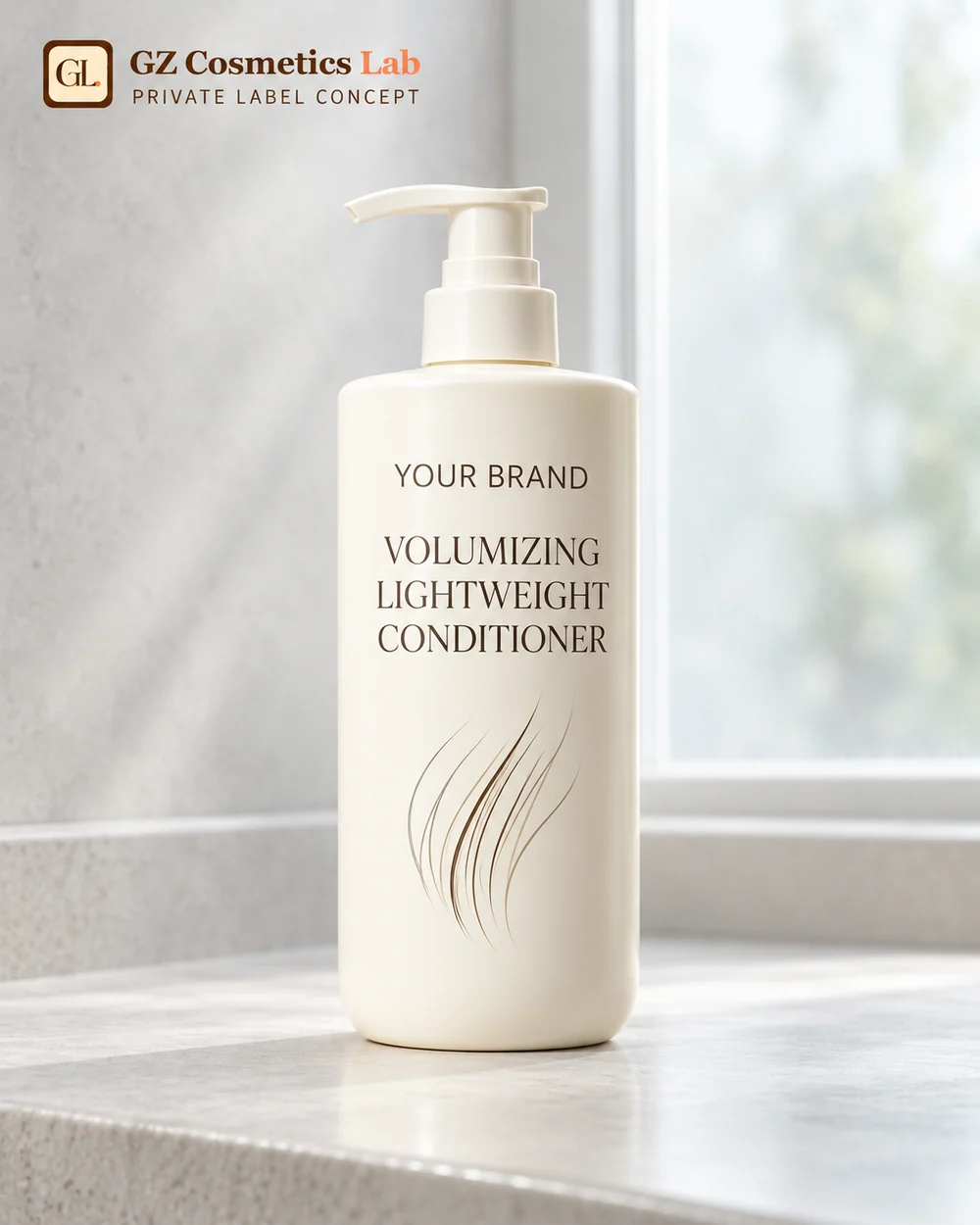
Product Overview
| MOQ | 3,000 bottles / SKU |
| Lead Time | 35–45 days |
| Sampling | 2–3 weeks for a custom sample round |
| Sizes | 300ml |
| Packaging | Pump bottle |
| Mini Pack | Yes - Sachet 5-10ml. Same as shampoo. Matching set |
| Suitable For | Fine, limp, oily hair |
| Pricing | Quote-based — depends on cationic selection, oil-control powder load, protein choice, and order volume. |
Quote response within 24 hours · Sample terms confirmed by project
Key Active Ingredients
How the Active Ingredients Work
A deliberately restrained conditioning system, with oil-absorbing powders and protein carrying the work that a heavier cationic load would otherwise do. The baseline below is our standard ODM starting point, adjustable for your target market and price point.
Lightweight cationic conditioning agents baseline 2.5% · range 2–3% (BTMS-50 basis)
Run at the bottom of the working range rather than the middle, which is the single most important decision on this page. The cationic mechanism is unchanged — hair keratin carries a net negative surface charge and the positively charged quat adsorbs onto it — but on fine hair the perceived weight of that deposit arrives well before the smoothness plateaus, so more is straightforwardly worse. We also avoid the heavier cationic polymers that suit thick hair, because they are the ingredients most likely to leave weight at the root. Behentrimonium methosulfate is not listed in Annex III of Regulation (EC) No 1223/2009, so the level is a performance decision; grade percentages refer to active content, so conversions run on active basis.
Oil-absorbing powders controlled powder pair
Starch and silica-type powders at a controlled load. Their function is not conditioning at all: they take up a small amount of surface oil and add friction between fibres, and friction between fibres is what reads as body. This is the part of the formula doing what consumers call volume. Load is tightly bounded, because too much powder gives a dry, rough after-feel and a dulled appearance, which loses the sale faster than a lack of volume does.
Hydrolysed protein protein support agent
A low-molecular-weight hydrolysed protein that deposits into the cuticle surface and adds a small amount of stiffness to each fibre. On fine hair that stiffness is useful, since a fibre with slightly more bending resistance holds its own shape rather than collapsing under its neighbours. We write this as fuller-feeling and thicker-feeling hair rather than as increased hair thickness, which would be a claim we cannot support. Plant protein is our default here, which also keeps a vegan route open. Added in the cool-down phase, since protein hydrolysates degrade with prolonged heat.
Panthenol supporting conditioning agent
Provitamin B5, chosen for this position specifically because it conditions through water-binding rather than through an oily or cationic deposit. It improves flexibility and reduces the brittle feel that fine hair develops with frequent washing, without the weight that would defeat the brief. Water-soluble and heat-sensitive, so it goes in during cool-down.
Formulation & Customization Options
| Service model | ODM (adjust our existing base) or full OEM custom development |
| Adjustable elements | Cationic level and choice; oil-absorbing powder load; protein type and level; silicone or silicone-free route |
| Target pH | Formulated in the mildly acidic range that is industry practice for conditioners, which helps the cuticle lie flatter. Final target pH confirmed per project. |
| Silicone route | Available with or without silicone. Where silicone is specified for this position we favour lighter, more volatile straight-chain grades to limit residual weight. All silicone routes use straight-chain grades such as dimethicone, which fall outside the cyclic siloxane restrictions — D5 has been restricted below 0.1% in rinse-off cosmetics since 31 January 2020 under entry 70 of Annex XVII to REACH, and D4 is prohibited under Annex II of Regulation (EC) No 1223/2009. |
| Texture and base | Light, thin cream that rinses fast; deliberately lower in viscosity than our other conditioners, since a thick texture encourages over-application on hair that cannot carry it |
| Fragrance | Fresh, citrus and light floral profiles standard; fragrance-free available |
| Certification support | ISO 22716 and GMPC production, with SGS testing on request. Halal, COSMOS and vegan-positioned formulations can be scoped to your requirement — tell us the destination market and we will confirm what is achievable for your specification. Plant protein is the default in this formula, so a vegan route does not require changing the protein. |
| Packaging | Industry-standard formats supported — 300ml pump bottle standard, with 5–10ml sachet for trial. A pump is worth specifying here, since it controls dose better than a flip cap on a product where over-application is the main failure mode |
| Regulatory alignment | Cationic level, silicone route and claim wording confirmed against your destination market rules per order |
Launch-fit guide
Who This Product Is Built For
Fine and limp hair positioning
An underserved segment in most Southeast Asian ranges, where conditioners are usually built for dry or damaged hair. Fine-hair consumers frequently skip conditioner altogether because past products flattened their hair, which makes this a conversion opportunity rather than a share-shift one.
Daily washing with scalp oiliness
Fine hair and an oily scalp often occur together, and that consumer washes frequently. A conditioner that is light enough to use every day on the lengths, while leaving the root alone, fits that routine in a way a repair formula cannot.
Second-day appearance
The commercial test for this category is not how hair looks after blow-drying but how it looks the next morning. The restrained deposit is aimed at that, which is also the claim most worth testing on your own panel before launch.
Matching sets for fine hair routines
Pairs naturally with the Volumizing Oil Control Shampoo, which handles scalp oil while this step conditions the lengths, and with the Strengthening Coconut Keratin Shampoo where thinning is part of the consumer concern.
Planning Your Volumizing Lightweight Conditioner Project
What to prepare before quotation and sampling, which checks are part of routine manufacturing, and which items are confirmed separately for this product type.
What to include in your brief
- Describe fine-hair density, oily-root concerns and the normal drying or styling routine.
- Specify use on mid-lengths and ends, intended pump dose and an acceptable detangling level.
- Choose the trade-off between dry grip, shine and soft feel, using a named benchmark.
Quality and testing plan
Agree a controlled comparison that records dried-hair body and next-morning flattening alongside powder residue and combing.
Check dose consistency with the chosen pump; assign routine release criteria and any separate fuller-looking claim study, including the comparison conditions and report owner.
Market and claims checkpoints
- Keep volume wording about appearance or feel; do not infer more hair, growth or increased fibre thickness from ingredient choices.
Pricing and testing scope depend on the final formula, packaging, quantity and destination market.
Frequently Asked Questions
What is the minimum order quantity and lead time?
Minimum is 3,000 bottles per SKU, produced in 35–45 days once you approve the sample. Custom sample rounds take 2–3 weeks, and sachets are filled at their own minimum.
Can a conditioner actually add volume?
Not by adding anything, and this is worth understanding before you write the claim. Conditioning works by depositing material on the fibre, and any deposit adds weight, which is the opposite of volume. What this formula does is deliver adequate conditioning with the smallest workable deposit, then use oil-absorbing powders and a protein to add inter-fibre friction and a little fibre stiffness. The result is hair that feels and looks fuller. It is not more hair, and it is not thicker hair, and we would not support either claim.
Why is the conditioning level lower than your other conditioners?
Because on fine hair, more conditioning makes the product worse rather than better. We run the cationic system at the bottom of the practical range and avoid the heavier cationic polymers that suit thick or curly hair. If your panel reports insufficient detangling we would rather adjust the protein and slip system than raise the cationic load, since that is what protects the second-day appearance.
Can it be used on the roots?
It is formulated to tolerate that better than a rich conditioner would, but we still recommend positioning it as a mid-length-to-ends product in your usage copy. Root application is the fastest way for a fine-hair consumer to conclude that a conditioner flattened their hair, and usage instructions are cheaper than reformulation.
Will the powders leave hair feeling dry or look dull?
That is the risk this formula manages, and it is why the powder load is tightly bounded rather than pushed for maximum body. Beyond a fairly low level, powders trade shine and smoothness for volume, and consumers notice the loss before they notice the gain. This is a balance point we would specifically want your panel to check, because tolerance for it varies by market and by hair density.
Is the conditioning level capped by regulation?
Regulation is not the binding constraint here, hair feel is. This formula runs at roughly half the cationic level that Annex III of Regulation (EC) No 1223/2009 would permit even on the strictest route, because fine hair objects to the deposit long before any legal ceiling comes into view. For reference, our standard behentrimonium methosulfate is unlisted in Annex III, while chloride-based quats are capped at 5.0% (entry 287) and 2.5% (entry 286) for rinse-off hair products, with both entries requiring a conditioning rather than preservative purpose. On a volumising brief we would never approach those figures.
Customization
OEM/ODM supported
Target Markets
Certifications
ISO 22716 & GMPC certified; SGS testing supported upon request

Need a Custom Volumizing Lightweight Conditioner Formula?
Tell us your requirements — target actives, texture, packaging, quantity, and target market. Within 24 hours, we will reply with a quotation or the questions needed to prepare one.
Response within 24 hours · WhatsApp available · Factory visits welcome