
Body Care Manufacturer Philippines: The CPN Reality

Most brands looking for a body care manufacturer for the Philippines start by comparing factories. That is the wrong first question. In the Philippine system the factory is not what stands between your product and the shelf, and it is not the entity whose name goes on the paperwork. A brand owner outside the Philippines cannot hold the notification for their own product. Someone with a local licence has to hold it for you, and that single rule reshapes your supplier shortlist, your SKU count and your launch sequence more than any factory comparison will.
The other half of the problem is arithmetic. Philippine notification is counted per product variant, and body care is the category that generates variants faster than any other. A body range that looks like three products in your brand deck can be twelve notifications by the time it reaches the FDA. Nobody warns you about this, because the multiplication happens after you have already chosen your formats.
The Rule That Decides Everything: You Cannot File Alone
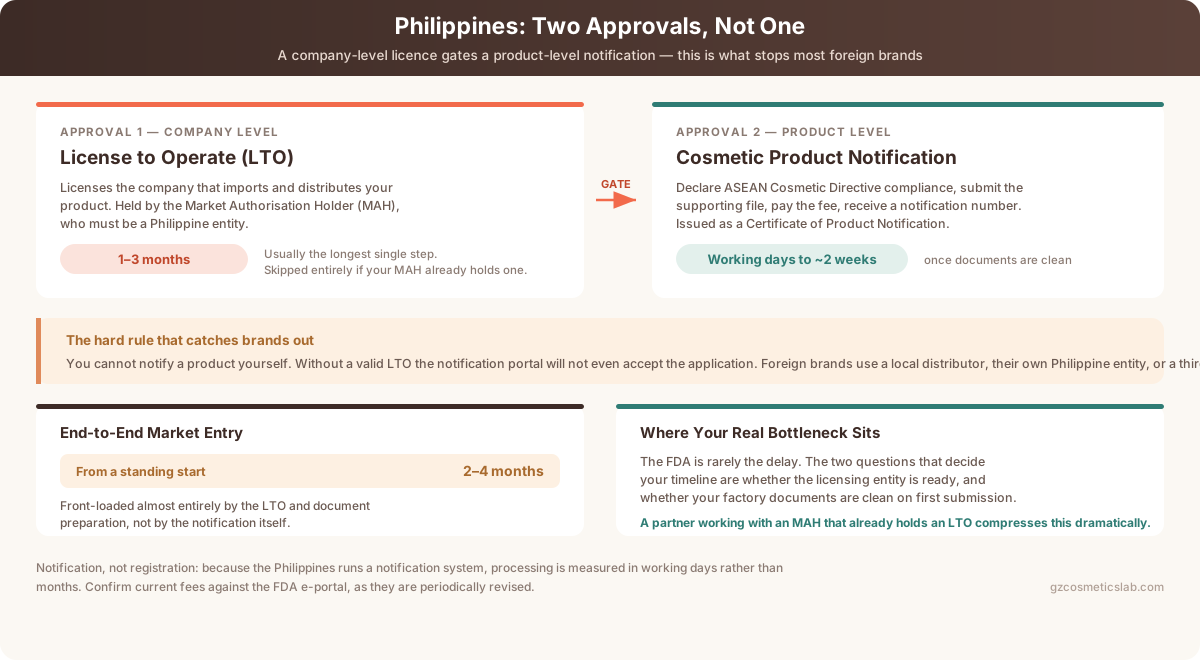
Two separate approvals sit behind every compliant product in the Philippines, and they are routinely confused. The License to Operate (LTO) licenses a company. It is issued to a Philippine entity, not to your brand and not to your factory in China. The Certificate of Product Notification (CPN) covers a product, and it can only be filed by a company that already holds a valid LTO.
The consequence is blunt: a foreign brand owner or a foreign manufacturer cannot be the notification holder, the role often referred to as the Market Authorization Holder (MAH). Whoever holds your LTO becomes the responsible party in the eyes of the FDA, and that party controls your market access. We cover the mechanics of this in detail in our guide to Philippines FDA cosmetics registration. What matters at the sourcing stage is that you have three practical routes, and they carry very different risks.
Route one: your local distributor holds it. This is the most common arrangement and the fastest to set up, because established importers already have an LTO. The cost is control. Your notification lives inside a company whose commercial interests are not identical to yours. If the relationship ends, the notification does not automatically follow you, and rebuilding it under a new holder takes time you had not budgeted.
Route two: you set up your own Philippine entity. This gives you a notification you actually own, and it is the only route where changing distributors does not put your market access at risk. It is also the slowest and the most expensive to start, and it only makes sense if the Philippines is a market you intend to hold for years rather than test.
Route three: a local agent holds it on your behalf. A middle path, where a service provider with an LTO acts as holder without being your distributor. This separates market access from sales performance, which is usually the point. Read the termination and transfer terms carefully before signing, because the value of this route depends entirely on how easily you can move the notification later.
None of these three routes is something a factory can do for you. Any manufacturer that implies it will "handle your FDA registration" is describing document support, not holdership, and it is worth asking exactly which one they mean before you rely on it.
Where Body Care Multiplies: Notification Is Counted Per Variant
Notification in the Philippines is per product variant, not per formula. That distinction is inexpensive in skincare and expensive in body care, because body ranges are built out of exactly the axes that create variants.
Consider a body wash launched in three fragrances and two fill sizes. One formula, one factory, one production run family, and six notifications. Add a lotion in the same three fragrances and you are at twelve. The formula development work barely moved; the compliance workload doubled twice.
This is why fragrance strategy in body care is a regulatory decision and not only a marketing one. Fragrance is the main loyalty lever in this category and the cheapest way to make a range feel complete, which is precisely why brands over-extend on it before they have checked what each extension costs downstream. The same logic applies to fill sizes: a 250ml and a 400ml of the same lotion are two variants, so a "value size" launched alongside the core size doubles that SKU's notification count for a fairly modest revenue increment.
The practical planning rule we give clients is to launch narrow and deepen later. Two fragrances across three formats will reach the market faster and cost less to notify than four fragrances across two formats, even though both look like similar range sizes on a slide. You can add fragrances once the range has proven itself; unwinding a bloated first launch is harder than extending a lean one.
Not sure which route fits your product?
Send us your brief and our formulators will tell you what is realistic on formula, MOQ, and timeline before you commit to anything.
The Ingredient Trap: Body Formats Have Their Own Limits
The Philippines regulates cosmetic ingredients through the ASEAN Cosmetic Directive, which means annex limits are shared with Vietnam, Thailand, Indonesia, Malaysia and Singapore. Brands generally know this. What catches them out is that ingredient limits are frequently written per product type rather than per ingredient, and leave-on body formats often sit in a stricter bracket than the facial products the formula was built for.
Salicylic acid is the clearest example of how wide that gap gets. Across the major regulated markets it is capped around 2.0% for general skin products and up to 3.0% in rinse-off hair products, while leave-on body lotion is held far lower — 0.5% under EU Regulation 2021/850. Two details make this stricter than it first looks. The cap applies to total content in the product as sold, so where salicylic acid serves both a functional and a preservative role the levels count together rather than separately. And it is restricted in products intended for children under three, which matters if your range has any family positioning.
So a clarifying formula that is compliant as a facial product cannot be poured into a body lotion base at the same level. It has to be reformulated for the format, with the exfoliating load rebuilt around a lower ceiling and often part of it carried by other chemistries — PHAs, for instance, do not count against the salicylic acid limit. Our own clarifying body base, the oil control clarifying body lotion, is specified inside leave-on body limits from the start rather than adapted down from a facial formula, and we confirm the level against your destination market rules rather than assuming one number travels.
The practical consequence: "we already have this formula approved for face" does not transfer to a body launch, and a timeline built on that assumption will slip. Japan is the sharpest reminder that these caps are not harmonised globally — it allows only 0.2% — so if your roadmap runs past ASEAN, specify to the strictest market you intend to enter rather than to the Philippine limit alone.
Claims sit on top of the ingredient question and follow their own rules. Brightening is the most heavily scrutinised claim area in the Philippine market, and glutathione products attract particular attention because of the injectable products the FDA has warned against. If you are building a brightening body line, the topical positioning has to be unambiguous on pack. We keep our glutathione brightening body lotion and niacinamide brightening body lotion specified to ASEAN annex levels with claim language that stays at the appearance level, because a claim that reads as treating a medical condition is a notification problem rather than a copywriting one. Our ASEAN Cosmetics Directive guide covers how the annexes work across all six markets.
What Goes Into the Product Information File for a Body Range
Every notified product needs a Product Information File behind it — the dossier the FDA can ask to see at any point after your product is on the market. Notification is a declaration, not an approval, so the burden of proof stays with the holder for the life of the product. That much is common to all cosmetics. What is specific to body care is how the file scales.
Because the file is built per notified product, a range assembled out of fragrance and size variants generates a file per variant, not one file for the base formula. Most of the content repeats: the same manufacturing method, the same GMP certificate, the same safety assessment framework. The parts that change are the ones that matter — the full quantitative formula including the specific fragrance compound, its allergen declaration, and the stability and compatibility data for that particular fill size and pack.
Fragrance allergen declaration is where body care gets caught. The ASEAN labelling rules require the 26 recognised fragrance allergens to be declared once they exceed the threshold for the product type, and leave-on products carry a lower threshold than rinse-off. A body lotion and a body wash carrying the identical fragrance compound at the same dose can therefore end up with different allergen lists on pack. Brands who assume one label layout can be reused across a range discover this at artwork stage, which is late.
The other file item worth settling early is the pack compatibility data. A lotion that is stable in the bottle you sampled is not automatically stable in a larger bottle from a different supplier, because the closure, the headspace and the resin can all change the result. Where a range spans two fill sizes, that is two compatibility studies, and where a size uses a pump rather than a flip cap, the pump material becomes part of the test rather than a detail.
Practically, this is why we ask for the full variant list rather than the formula count when scoping a project. The formula work scales with formulas; the documentation, the stability matrix and the notification count all scale with variants.
Freight Is Part of Your Landed Cost, Not a Footnote

Body care ships badly relative to its value. A 30ml serum and a 400ml lotion occupy very different volumes for a per-unit price gap that is nowhere near proportional, so freight and duty make up a materially larger share of your landed cost in this category than in facial skincare. For an archipelago market with onward domestic distribution, that share matters more again.
We break down why fill volume drives body care economics in our private label body care guide, and the pricing logic there applies regardless of destination. What is specific to the Philippines is how it interacts with the variant question above: multiple fill sizes do not only multiply notifications, they also fragment your freight consolidation. Two sizes of the same lotion mean two cartons specs, two pallet patterns and a less efficient container.
The planning consequence is that fill size decisions should be made against landed cost per use rather than ex-works unit price. A brand comparing quotes on unit price alone will pick the format that loses money once it reaches Manila.
Distribution Is Not Just Import: The Archipelago Problem
Most market entry planning stops at the port. For the Philippines that leaves out the part that decides whether your unit economics survive, because the country is roughly 7,600 islands and the population centres that matter are not all served by the same route.
A container landing in Manila reaches Metro Manila cheaply. Reaching Cebu, Davao or the secondary cities means a second domestic leg — inter-island shipping or trucking with a ferry segment — and that leg is priced on volume, not on the value of what is in the carton. Body care is exactly the wrong cargo profile for it: large fill sizes, low value density, and a category where consumers expect supermarket pricing rather than a premium.
Two consequences follow for the sourcing decision. First, fill size choices should be evaluated on landed cost at the point of sale rather than on ex-works price, and for a brand distributing beyond Metro Manila the gap between those two numbers is wider than most first-time importers model. A 400ml value size that improves your margin on paper can erode it once the second leg is priced in.
Second, this is where e-commerce changes the calculation rather than removing it. Shopee and Lazada shift the last mile onto the platform's logistics, which makes national reach possible without building distribution, but the cost reappears as shipping weight in the listing economics. Heavy body formats are penalised by exactly the same physics; it just moves line items.
The practical planning move is to decide your distribution footprint before your fill sizes, not after. A Metro-Manila-first launch can carry larger formats comfortably. A national launch from day one usually wants the smaller size of any pair, and that decision feeds straight back into how many variants you notify.
Why Body Scrubs Are the Hardest Format to Get Through Compliance
Scrubs look like the simplest format in a body range and behave like the most difficult one. The reason is contamination risk, and it runs opposite to the intuition most brands bring from skincare.
A serum in a pump is a closed system. A 230g scrub in a wide-mouth jar is used with wet hands, in a shower, repeatedly over weeks. Every use introduces water and skin flora into the product. A sugar or salt scrub also sits at a high dissolved-solids level, which suppresses water activity and makes the product look self-preserving on paper, but the moment a wet hand raises the local water content near the surface the protection is thinner than the number suggests.
The consequence is that a scrub's preservative system has to be validated against in-use conditions rather than against shelf storage alone. Challenge testing exists for exactly this reason, and for a scrub it is not an optional extra — it is the evidence your safety assessment leans on. This is also the argument against launching a scrub as a fourth variant late in a project: the format needs its own preservation work, not a copy of the lotion's.
The preservation logic in this format runs opposite to the rest of the range, which is why we treat it as separate formulation work rather than a variant of the lotion. What is worth adding for a Philippine launch specifically is the climate interaction. Bathroom storage in a hot, humid market runs warmer and wetter than the conditions a temperate-market formula was validated for, which is a real argument for specifying the preservative system to tropical in-use conditions from the start rather than to the milder case.
Our scrub line runs seven variants across sugar and coffee bases, all in jars at the standard 3,000 units per SKU. Bulk production follows the same 35-to-60-day window as the rest of the body range, but the formulation stage is where a scrub consumes more calendar than a lotion, and building the project plan as though the two are interchangeable is the mistake we see most often.
What Our Body Care Line Actually Runs
Our body care range covers 24 SKUs across four format families: body lotions, body washes, body scrubs and firming creams. The commercial parameters are consistent enough to plan against.
Our standard minimum is 3,000 pieces per SKU across the category, whether that is bottles for lotions and washes, jars for scrubs, or tubes for firming creams. Bulk production runs 35 to 60 days after formula, artwork, and packaging approvals. Active-heavy firming creams can sit toward the longer end because they need more stability work before a production run is committed. Accelerated stability testing runs inside that window; where a destination registration calls for real-time data, that study is scoped and quoted separately.
Two points about MOQ in a Philippine context. It is per SKU, and a SKU here means a variant, so the same fragmentation that multiplies your notifications also multiplies your minimum commitment. A three-fragrance, two-size body wash launch is six SKUs, which means a standard minimum commitment of 18,000 units before any higher packaging requirement. That is the number to test your launch plan against, not the per-SKU figure in isolation.
Second, packaging is usually where an unexpectedly high minimum comes from rather than the formula. Stock bottles and jars keep you at the bottom of the range; bespoke packaging on a first order pushes the minimum up because the component supplier has its own tooling and run minimums.
A Launch Sequence That Does Not Stall
The order of operations matters here, because the slow steps are not the ones brands expect. Formula work and notification are largely parallel; licensing is the gate that everything else waits behind.
Settle your holdership route first, before samples. This is the step that takes longest to unwind if you get it wrong, and it determines who can file anything at all. Lock your variant list second, because every fragrance and fill size you add from here multiplies both notification count and minimum commitment. Then run formulation and format-specific compliance together, checking annex limits against the body format rather than against your existing facial formulas. Notification documents come from the factory in parallel with stability work. Only then does artwork finalise, because label content is shaped by the claims your notification will actually support.
Brands that reverse the first two steps, choosing a range and then looking for someone to file it, generally lose a quarter. The range gets designed without knowing what each variant costs to notify, and then gets cut back after the numbers land.
Exit Planning: What Happens When You Change Holder or Factory
This is the section brands skip and later wish they had not. Because the notification sits with a Philippine entity rather than with you, two fairly ordinary commercial events — changing distributor, or changing factory — both touch your regulatory position.
Changing holder. Moving a notification to a new holder is a transfer process, not an update. The incoming entity has to have its own valid LTO, and the product has to be re-notified under it. Your market access during that gap depends entirely on what your original agreement says, which is why the termination and cooperation clauses matter more than the commercial terms most brands negotiate hardest. The question to ask before signing is simple: on termination, will the holder cooperate with a transfer, and is that written down? The same clause matters on the manufacturing side, which we cover in cosmetics technology transfer.
Changing factory. The manufacturer is named in the notification and in the Product Information File, so a factory change is a documentation change on every affected variant. The formula travels only if the new manufacturer can reproduce it and re-document it, which in practice means a fresh safety assessment package, new stability data and new GMP evidence. For a range with a dozen variants that is a dozen document sets, and this is the point where the variant count you chose at launch stops being an abstract number.
Neither of these is a reason to avoid the market. They are reasons to keep your first launch narrow, hold your own documentation copies rather than relying on the holder's files, and pick a manufacturer that will hand over a complete dossier rather than a partial one. We supply the full technical file to the client as well as to the notifying entity for exactly this reason — if your documentation only exists inside your distributor's filing cabinet, your leverage in any renegotiation is weaker than it should be.
Where the Philippines Fits in an ASEAN Rollout
Because the ingredient annexes are shared, a formula built to the strictest limit across the six ASEAN markets can be notified in all of them without reformulation. That makes the Philippines a reasonable entry point for a body range, provided you specify to the strictest bracket at the start rather than to the Philippine limit alone.
The differences between the six are procedural rather than chemical. Indonesia adds a halal dimension on a defined timetable, Vietnam and Thailand each run their own notification mechanics, and the holder requirements are not identical. Our guides to Vietnam cosmetics registration and Thailand TFDA registration cover those, and if you are sequencing several markets, how to start a skincare brand in Southeast Asia deals with the order.
For tropical markets generally there is also a formulation layer that has nothing to do with paperwork: heat and humidity change preservative load, viscosity targets and packaging specs for body formats more than they do for facial products, since body products are used in larger amounts in warmer conditions.
Frequently Asked Questions
Can our factory hold the CPN for us?
No. The notification holder must be a Philippine entity with a valid LTO. A factory outside the Philippines cannot hold it regardless of its certifications. What we can do is supply the technical documentation the holder needs to file, which is a different service and worth distinguishing clearly in any supplier conversation.
Is one notification enough for a body wash sold in three fragrances?
No. Notification is per variant, so three fragrances are three notifications even with an identical base formula. Adding a second fill size doubles that again.
Does our existing facial formula transfer to a body version?
Not automatically. Several ASEAN annex limits are set per product type, and body formats often sit in a stricter bracket. Salicylic acid is the clearest case, capped at 0.5% in body lotion against 2.0% for other skin products, so a facial formula usually needs reformulating rather than rebasing.
What is the MOQ for a Philippine body care launch?
Our standard minimum is 3,000 pieces per SKU, and a variant counts as a SKU. Multiply by your fragrance and fill size count to get the real commitment for the launch.
How long from brief to shipment?
Bulk production runs 35 to 60 days after formula, artwork, and packaging approvals, on top of whatever your licensing and notification route takes. Active-heavy firming creams can sit toward the longer end; holdership remains the less predictable variable.
Can we change notification holders later?
Yes, but it is a transfer process rather than an automatic move, and the terms of your original agreement determine how painful it is. This is the reason to read termination clauses before signing rather than after.
Start With Holdership, Then Choose Formats
The factory question in a Philippine body care launch is the easy one. The decisions that determine whether the launch works are who holds your notification, how many variants you commit to before the range has proven itself, and whether your formulas were specified to body-format limits or adapted down from facial ones.
If you are scoping a body range for the Philippines, send us your intended variant list — formats, fragrances and fill sizes — along with your holdership route if you have settled one. Request a quote on that basis and we will come back with real minimums per variant, flag any format where the annex limits will force a reformulation, and tell you which parts of the range we would cut for a first launch.
Ready to Start Your Project?
Tell us your product requirements. Within 24 hours, our technical team will reply with a quotation or the questions needed to prepare one.