
Private Label Body Care: Body Wash, Lotion & Scrub OEM
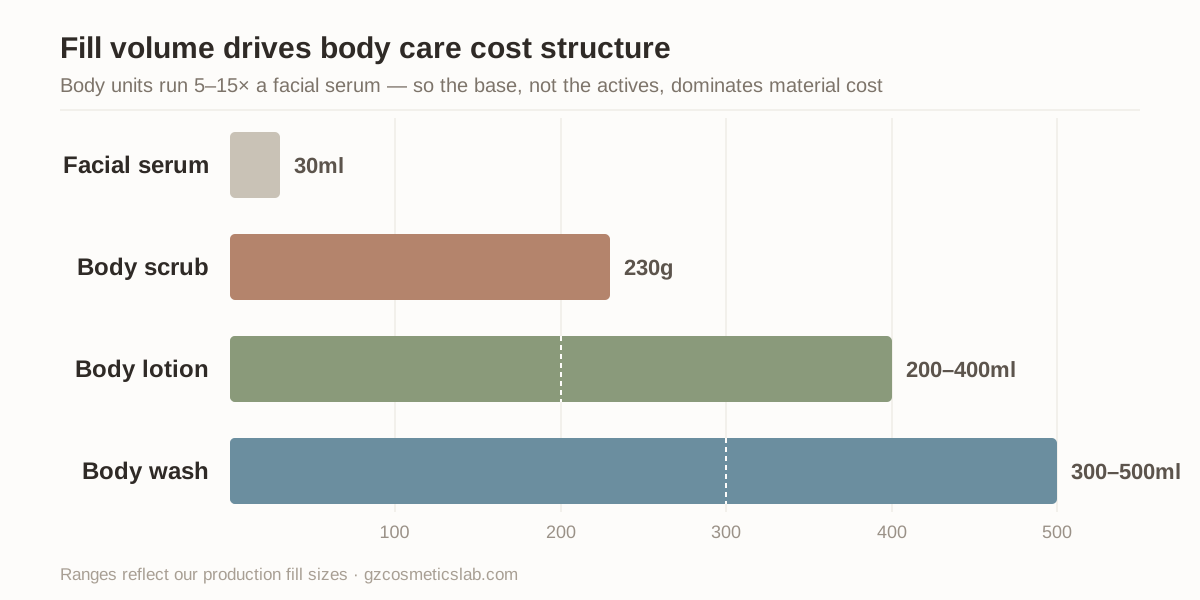
Chart by GZ Cosmetics Lab · Free to reuse with a link back to this page.
Most brands come to a private label body care manufacturer with a mental price list borrowed from skincare. They know roughly what a 30ml serum costs to make, so they assume a 300ml body lotion costs ten times as much. It does not. It usually costs far less than ten times, and the reasons why explain almost every commercial decision you will face in this category: which formats to launch, where your money actually goes, why your minimum order quantity is higher than it was for your face products, and which claims are worth paying for.
This guide is written around one idea: in body care, fill volume drives the economics. A body product is typically five to fifteen times the size of its facial equivalent, and that single fact reorganises the cost structure, the production constraints, and the formulation priorities. If you understand that, you can read a body care quote properly instead of comparing it to the wrong benchmark.
Why Body Care Costs Behave Differently From Skincare
In a facial serum, the expensive part is usually what is dissolved in it. Actives at meaningful concentrations, in a 30ml bottle, can dominate the formula cost. Packaging matters, but the active system is frequently the single largest line.
Body care inverts this. Our body lotions fill at 200-400ml and our body washes at 300-500ml, so the base itself becomes the dominant material cost simply because there is so much of it. Water, emulsifiers, thickeners, humectants, and fatty materials are individually inexpensive, but at 300ml per unit they add up to more than a small dose of a premium active would.
Three practical consequences follow:
- Actives are cheaper to include than brands expect. Raising niacinamide in a 300ml lotion adds less to your unit cost than most brands assume, because the percentage applies to a base that is already the main expense. A claims-supporting level of a mainstream active is often affordable in body care when the same gesture would be painful in a 30ml serum.
- Packaging becomes a decision with real weight. A 400ml bottle with a lotion pump costs meaningfully more than a 30ml dropper bottle, and it is heavier and bulkier to ship. In body care, packaging choices frequently move your landed cost more than formula choices do.
- Freight stops being an afterthought. Body products are mostly water in large containers. Volumetric weight, carton configuration, and pallet efficiency start to matter to your margin in a way they rarely do for facial skincare.
The useful mental model: in skincare you are largely buying a formula, and in body care you are buying a formula, a container, and a shipping problem, in roughly that order of surprise.
| Cost driver | Facial skincare | Body care | What it means for your brief |
|---|---|---|---|
| Typical fill size | 30ml serum | 200-400ml lotion, 300-500ml wash, 230g scrub | Ten times the volume changes every calculation below |
| Largest material cost | The active system dissolved in it | The base itself — water, emulsifiers, thickeners, humectants, fatty materials | Individually cheap ingredients dominate once there is 300ml of them |
| Cost of adding actives | Painful; a small dose of a premium active can dominate the formula | Cheaper than brands expect; the percentage applies to a base that is already the main expense | A claims-supporting level of a mainstream active is often affordable here |
| Packaging weight in the decision | Secondary to the formula | A 400ml bottle with a lotion pump costs meaningfully more than a 30ml dropper | Packaging choices frequently move landed cost more than formula choices do |
| Freight | Rarely decisive | Volumetric weight, carton configuration and pallet efficiency hit margin directly | Mostly water in large containers; plan it in from the start |
Where Your MOQ Actually Comes From
Our body care minimums run 2,000-3,000 pieces per SKU, against lower minimums on many facial products. Brands often read this as a factory being difficult. It is not a negotiating position, it is arithmetic, and it comes from three separate minimums that have to be satisfied at once.
The batch minimum. An emulsion has to be made in a vessel large enough to shear and cool properly. A tank that produces a homogeneous lotion has a working volume below which the batch simply does not process correctly. That minimum is expressed in kilograms, not units, so it converts into far fewer finished pieces when each piece takes 300ml instead of 30ml. The same tank that yields a large run of serum yields a modest run of body lotion.
The packaging minimum. This is usually the binding constraint. Bottles, caps, pumps, and printed labels each carry their own supplier minimums, and those are set by the component maker rather than by us. Custom bottle tooling or a bespoke closure raises the floor further. In most body care projects, the packaging minimum is the number that decides your MOQ.
The raw material minimum. Individually mild, but a distinctive fragrance or a specialty active bought in the smallest available drum can leave you holding material that only makes sense across a certain volume.
Because the packaging minimum usually dominates, MOQ scales with fill volume and with how bespoke your components are. A 200ml lotion in a stock bottle sits at the lower end of our range. A 400ml lotion in a custom bottle with a bespoke pump sits at the upper end or above it. This is also why the most effective way to reduce a first-order commitment is rarely to argue about the formula. It is to share a bottle body across several SKUs and differentiate with labels, or to start at a smaller fill size and scale up once the product sells.
Our body care lead times run 35–45 days across formats. Scrubs and other products carrying suspended granules fill more slowly on the line, so we plan those toward the upper end of that window rather than quoting a separate tier. Development timelines for a new formula sit outside that production window.
Not sure which route fits your product?
Send us your brief and our formulators will tell you what is realistic on formula, MOQ, and timeline before you commit to anything.
Body Wash: High Frequency, Thin Margin, Fragrance-Led
Body wash is the highest-repurchase format in the category and the one where consumers most readily switch. We fill body wash at 300-500ml, which puts it at the extreme end of the volume logic above: the surfactant system is a modest cost per gram, but there is a great deal of it, and the bottle is large.
The adjustable levers that matter commercially:
- Surfactant selection. A mild amino-acid-based system feels different in use from a conventional sulfate system and reads differently on an ingredient list. Our body wash line includes both minimalist systems built for sensitive skin and conventional systems where cost and foam volume lead, such as our Lavender Bloom natural body wash at 500ml.
- Foam character. Volume, density, and how quickly foam collapses are formulation outcomes you can specify. Consumers read dense, slow-collapsing foam as richness, which is why this is worth deciding deliberately rather than accepting a default.
- Fragrance. In body wash, fragrance is doing more selling than any active. It is also, at 400ml per unit, a real cost line rather than a rounding error, which is why fragrance choice and body wash pricing are the same conversation.
- pH positioning. A pH-balanced wash is a straightforward formulation decision with a defensible rationale behind it.
Where brands lose money here is launching four fragrance variants at once. Each variant multiplies your packaging minimum and your inventory risk before you know which scent sells. Two variants on a shared bottle is a more survivable start.
Body Lotion: Where Actives Are Affordable and Texture Decides Repeat Purchase
Body lotion is where the volume economics work in your favour. Because the base dominates the cost, adding a mainstream active at a level that supports a claim is comparatively affordable, which is why functional body care has grown so quickly. Our body lotion line runs 200-400ml and already spans this range: niacinamide with low-level salicylic acid and zinc PCA for body acne (see our Niacinamide Whitening body lotion), centella with ceramides and panthenol for soothing, a rose and shea butter formula for fragrance-led positioning, and an SPF30 PA+++ daily UV lotion.
Two things decide whether a body lotion is repurchased, and neither is the active.
Absorption and finish. A lotion applied over a large area has to disappear at a rate the user accepts. Too light and it reads as ineffective. Too rich and it feels greasy, marks clothing, and gets abandoned. This is an emulsion design question and it is the single most common reason a technically sound body lotion fails in market.
Fragrance longevity. Body lotion is applied to a large surface area, so fragrance is more prominent than in a facial cream and is often the reason a consumer stays with a product.
One structural caution: an SPF body lotion is not simply a lotion with a sunscreen system added. Sunscreen sits in a different regulatory category in many markets, with its own testing and registration burden and, in some jurisdictions, treatment as an over-the-counter drug rather than a cosmetic. If an SPF body product is in your plan, settle its regulatory pathway for each destination market before artwork, not after; our sunscreen OEM guide sets out how those pathways differ across Southeast Asia. Our guide to OEM and ODM models covers who carries which responsibility in that process.
Body Scrub: The Format Where Preservation Logic Reverses
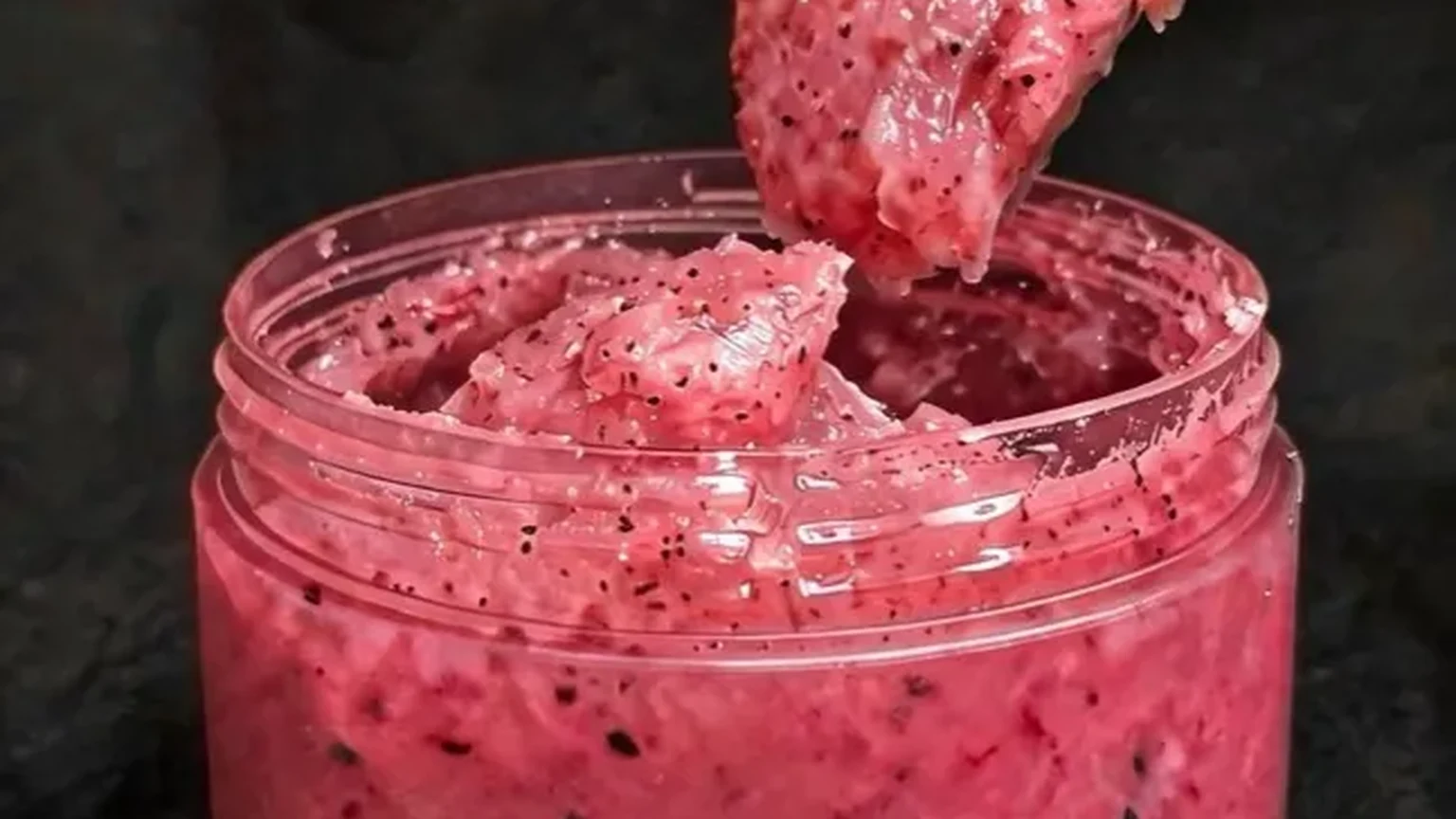
Body scrub is the most technically distinctive format in body care, and the one where the standard rules stop applying. Our seven scrubs fill at 230g and are built on sugar or fine salt granules — raspberry, kiwi, grapefruit, honey, milk, coffee with coconut, and a Turmeric Brightening scrub with lactic acid and rice powder.
What makes scrubs different:
- Many scrubs are low-water or anhydrous systems. A sugar or salt scrub suspended in an oil phase has very little free water. Microbial growth needs water, so the preservation challenge is not the same one you solve in a lotion. Instead, the stability questions become oil oxidation over shelf life and whether the granules stay evenly suspended rather than settling into a hard layer at the bottom of the jar.
- Salt and sugar behave differently. Salt is harder and more angular, so it gives a more aggressive scrub and is less forgiving on sensitive skin. Sugar dissolves as it is used, so the exfoliation softens during application. Sugar also dissolves if water gets into the jar, which is a real in-use consideration for a shower product.
- Granule size is a specification, not a detail. It determines whether the product reads as a gentle polish or a vigorous scrub, and it is one of the clearest levers you have for positioning.
- Filling is slower. A viscous product carrying suspended solids does not run through a filling line at the speed of a body wash. This is why we schedule scrubs toward the upper end of our standard 35–45 day window rather than at its floor.
Scrubs also carry a packaging constraint worth planning around early: a jar with a wide opening is required for a product this thick, and wide-mouth jars are heavier and less freight-efficient than bottles. Two SKUs of scrub can occupy the shipping volume of considerably more units of a slimmer format.
Where a scrub includes an acid, as our turmeric version does with lactic acid, the concentration is set within the limits of your destination market. Exfoliating acid levels and permitted claims vary between jurisdictions, and the two questions are separate: a concentration can be legal in a market where a particular claim is not.
What to Send Us to Get a Usable Quote
A body care quote is only as good as the brief behind it. Because volume drives cost in this category, the items that change your price most are the ones brands most often leave out.
- Fill volume per SKU. The single most important number in the brief. Without it, no quote means anything.
- Packaging intent. Stock components or custom tooling, and whether SKUs can share a bottle body. This usually decides your MOQ.
- Destination markets. This determines the regulatory file, permitted claims, and label requirements, and it is what tells us whether an ingredient or claim in your brief is viable there.
- Claim set. Which claims you intend to make in marketing, not just which ingredients you want present. The claim is what drives testing requirements.
- SKU count and variant plan. Whether you are launching one product or a coordinated range changes what we can share across components.
- Fragrance direction. Whether you need one scent matched across formats, which is a formulation exercise in its own right because the same fragrance behaves differently in a surfactant system and an emulsion.
Building a Range Instead of a Product
Body care rewards range thinking more than facial skincare does, because usage is sequential. A consumer who buys your body wash is already in position to buy your matching lotion. Wash, lotion, and one scrub is a coherent starting set: three SKUs, one fragrance story, one shelf presence.
Matching fragrance across a wash and a lotion is worth requesting explicitly, and worth understanding as real formulation work. A fragrance is developed and evaluated in a specific base. Moved from a surfactant system into an emulsion, its character shifts, and bringing the two into alignment takes deliberate adjustment during development.
One direction worth flagging early is the professional channel. If you supply spas, hotels or therapist chains rather than only retail shelves, a massage oil sits naturally alongside a body range and follows a different buying logic - covered in our guide to private label massage oil for spa and hospitality clients.
The counter-argument to a wide launch is inventory risk. Every additional SKU carries its own packaging minimum. Three SKUs with shared components and a matched scent is a stronger position than six SKUs where your capital is spread across variants you have no sales data for.
Widen after the market tells you what works.What a Body Care Project Looks Like From Our Side
We are a GMPC-certified Guangzhou manufacturer operating since 2010, and our body care line currently spans 19 products in production: seven body lotions, seven scrubs, and five body washes, alongside sculpting and contouring formats. That means most briefs start from an existing base we can adapt rather than a blank page, which is faster and lower-risk than developing from zero.
A typical project runs: brief and quote, formula selection or adaptation from an existing base, sampling with your feedback on texture and fragrance, stability and compatibility testing in the actual packaging you have chosen, documentation for your destination market, then production within the 35–45 day window. Packaging component lead times run alongside this and are frequently the critical path, which is why we ask about packaging intent in the first conversation rather than the fifth.
You can see the current range on our body care product page.
Frequently Asked Questions
What is a private label body care manufacturer?
A private label body care manufacturer produces body products such as washes, lotions, and scrubs on an existing or lightly adapted formula base and packages them under your brand. You get to market faster and with less development cost than custom formulation, but you remain responsible for the regulatory compliance of what you sell in each market, and the factory's certifications do not automatically transfer to your product registration. That split matters most in markets that require a local notification holder — our guide to body care manufacturing for the Philippines works through what CPN holdership means when you are filing a multi-format body range.
What is the MOQ for private label body care?
Our body care minimums run 2,000-3,000 pieces per SKU, and where you fall in that range depends mainly on fill volume and how bespoke your packaging is. A smaller fill in stock components sits at the lower end; a large fill with custom tooling sits at the upper end. The packaging component minimum is usually the binding constraint rather than the batch size, which is why sharing a bottle body across SKUs is normally the most effective way to reduce a first-order commitment.
Why is body care MOQ higher than for facial skincare?
Because each unit holds five to fifteen times more product. A production batch is sized in kilograms, so the same tank volume that yields a large run of 30ml serum yields far fewer 300ml lotions. Packaging minimums for larger bottles and pumps are also typically higher than for small facial components.
How long does body care production take?
Production runs 35–45 days across body care formats. Viscous products carrying suspended granules fill more slowly, so scrubs are planned toward the upper end of that window. New formula development and stability testing sit outside that window, and packaging component lead times often run as the critical path.
Can I put the same actives in a body product as in a face product?
Often yes, and body care is frequently the more affordable place to do it, because the percentage applies to a base that is already the main cost. The constraints to check are whether the active remains stable in the specific base, whether the sensory result is acceptable over a large application area, and whether your destination market permits the claim you intend to attach to it.
Do body scrubs need preservatives?
It depends on the water content. A largely anhydrous sugar or salt scrub in an oil phase presents a different microbial picture from a water-based lotion, and the primary stability questions shift toward oil oxidation and keeping granules evenly suspended. Any product where water can be introduced in use still needs an appropriate protection strategy, decided per formula rather than by rule of thumb.
Can you match one fragrance across my body wash and body lotion?
Yes, and it is worth asking for explicitly. A fragrance behaves differently in a surfactant system than in an emulsion, so aligning the two is deliberate development work rather than using the same fragrance code in both. Raise it at brief stage so it is built into sampling.
Should I launch a full body range or start with one product?
Three SKUs on shared components with a matched fragrance is a practical start, because body care usage is sequential and a wash naturally leads to a lotion. Splitting a first launch across many fragrance variants multiplies your packaging minimums and your inventory exposure before you have any sales data.
The Short Version
In body care, fill volume drives the economics. Because units are five to fifteen times larger than facial equivalents, the base becomes the dominant material cost, which makes mainstream actives more affordable than brands expect while making packaging and freight matter far more. Your MOQ of 2,000-3,000 pieces comes from three minimums stacked together, and the packaging minimum is usually the one that binds, so sharing components across SKUs beats negotiating the formula. Body wash sells on fragrance and foam, body lotion is repurchased on absorption and finish rather than actives, and scrubs reverse the usual preservation logic because most are low-water systems where oxidation and granule suspension are the real stability questions. Start with three SKUs on a shared bottle and a matched scent, and settle destination markets and claims before artwork. If you want to see where your batch would actually be made before committing, our GMPC-certified facility and production process is documented in full, and client audits are welcome. If you want a quote built around specific fill volumes and a claim set rather than a generic price list, request a quote with your target markets and SKU list.
Ready to Start Your Project?
Tell us your product requirements. Our technical team responds within 24 hours with a detailed quotation.