

Value Line
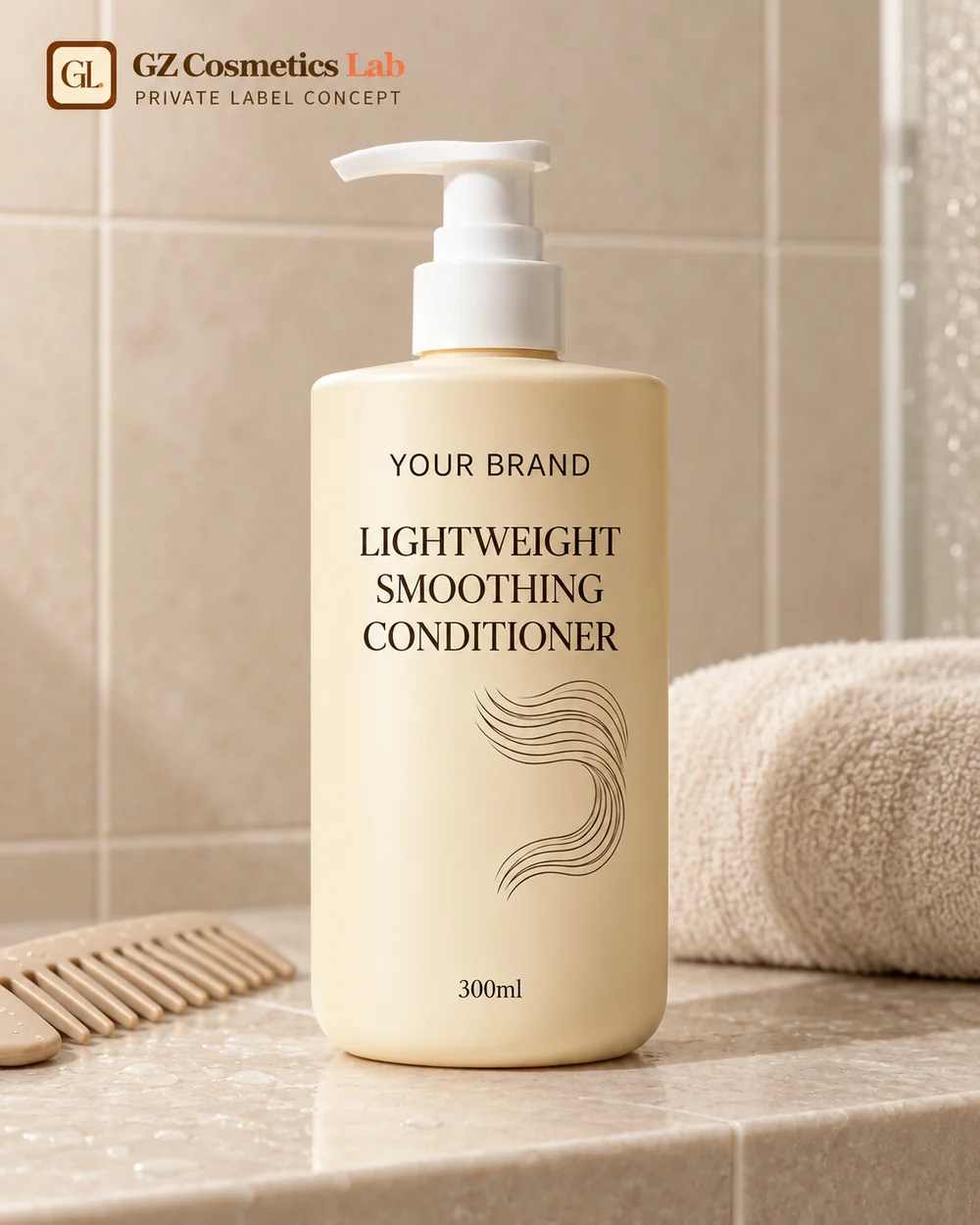
Lightweight Smoothing Conditioner
A daily-use rinse-off conditioner built for normal to slightly dry hair, where the brief is smoothing without weight. This is the highest-volume position in a hair range because it gets repurchased fastest, and the formulation problem is specific: most conditioners fail at the value end not by under-conditioning but by over-conditioning, leaving hair that looks flat by the second day. The baseline below deliberately runs a lower cationic and oil load than a repair conditioner, which is what keeps the after-feel light. Available at 300ml and 400ml for family and refill positioning.
Product Overview
| MOQ | 3,000 bottles / SKU |
| Lead Time | 35–45 days |
| Sampling | 2–3 weeks for a custom sample round |
| Sizes | 300–400ml |
| Packaging | Pump bottle or Tube |
| Mini Pack | Yes - Sachet 5-10ml. Same as shampoo. Matching set |
| Suitable For | Normal to slightly dry hair |
| Pricing | Quote-based — depends on conditioning emulsifier level, silicone or silicone-free route, bottle size, and order volume. |
Quote response within 24 hours · Sample terms confirmed by project
Key Active Ingredients
How the Active Ingredients Work
A lighter conditioning system than a repair formula carries, paired with humectants and a light slip agent. The baseline below is our standard ODM starting point, adjustable for your target market and price point.
Cationic conditioning emulsifier baseline 3.5% · range 3–4% (BTMS-50 basis)
The same cationic mechanism a premium conditioner uses, run at the lower end of the practical range. Hair keratin carries a net negative surface charge, so the positively charged quat adsorbs onto the fibre and lays down a lubricating layer that cuts comb friction and static. Running it lean is the deliberate choice here: every increment of cationic deposit adds smoothness and also adds weight, and on fine or normal hair the weight becomes noticeable before the smoothness plateaus. Behentrimonium methosulfate is self-emulsifying and is not listed in Annex III of Regulation (EC) No 1223/2009, so the level is a performance and cost decision rather than a regulatory ceiling. Grade percentages refer to active content, so conversions between grades run on active basis.
Coconut-derived conditioning agents supporting conditioning system
Coconut-derived amphoteric and cationic derivatives that add detangling and a soft after-feel at a lower cost per unit of effect than raising the primary quat. Their practical value in a value-line formula is that they broaden the conditioning without adding the heaviness that comes with a higher primary cationic load, and coconut is a recognisable label ingredient across Southeast Asian markets.
Aloe barbadensis leaf juice supporting humectant and label ingredient
Contributes polysaccharides that hold a little water at the fibre surface and add slip during application. We are straightforward about its role: at the level a value-line conditioner can carry, aloe is doing recognisable-label work and mild humectancy rather than measurable conditioning. It earns its place because consumers in this price band read the front label, not the technical file.
Panthenol supporting conditioning agent
Provitamin B5, which is water-soluble and holds moisture at the fibre surface, improving flexibility and reducing the brittle feel that comes with frequent washing. It conditions without a cationic polymer that would leave weight at the root, which is exactly why it suits a lightweight brief. Added in the cool-down phase, since it is heat-sensitive.
Formulation & Customization Options
| Service model | ODM (adjust our existing base) or full OEM custom development |
| Adjustable elements | Cationic level for weight versus smoothness; coconut derivative blend; humectant loading; silicone or silicone-free slip system |
| Target pH | Formulated in the mildly acidic range that is industry practice for conditioners, which helps the cuticle lie flatter. Final target pH confirmed per project. |
| Silicone route | Available with or without silicone. Where silicone is specified we use straight-chain grades such as dimethicone, which fall outside the cyclic siloxane restrictions — cyclopentasiloxane (D5) has been restricted below 0.1% in rinse-off cosmetics since 31 January 2020 under entry 70 of Annex XVII to REACH, and cyclotetrasiloxane (D4) is prohibited under Annex II of Regulation (EC) No 1223/2009. Raw materials declared as cyclomethicone are checked with the supplier for D4, D5 and D6 content. |
| Texture and base | Light pourable cream that rinses clean; 300ml and 400ml both standard, with 400ml suiting family and refill positioning |
| Fragrance | Fresh, clean and fruity profiles standard for daily-use positioning; fragrance-free available |
| Certification support | ISO 22716 and GMPC production, with SGS testing on request. Halal, COSMOS and vegan-positioned formulations can be scoped to your requirement — tell us the destination market and we will confirm what is achievable for your specification. This formula carries no animal-derived protein, so a vegan route is a shorter path here than on a keratin-based conditioner. |
| Packaging | Industry-standard formats supported — 300ml and 400ml pump or flip-cap bottle, with tube and 5–10ml sachet options for trial sizes |
| Regulatory alignment | Cationic level, silicone route and claim wording confirmed against your destination market rules per order |
Launch-fit guide
Who This Product Is Built For
Volume-driving value SKUs
This is usually the fastest-repurchased conditioner in a range, which makes it the volume anchor rather than the margin leader. Brands entering a new market often lead with this position because repeat rate matters more than basket value at launch.
Daily washing routines
In hot, humid markets many consumers wash daily or close to it, and a formula built for weekly repair use becomes heavy fast under that frequency. The lean cationic load is specifically a response to wash frequency rather than to hair type alone.
Family and refill formats
The 400ml size and a rinse-clean texture suit shared household use and refill programmes, where cost per wash and a fragrance that suits several users matter more than a targeted claim.
Matching sets across a range
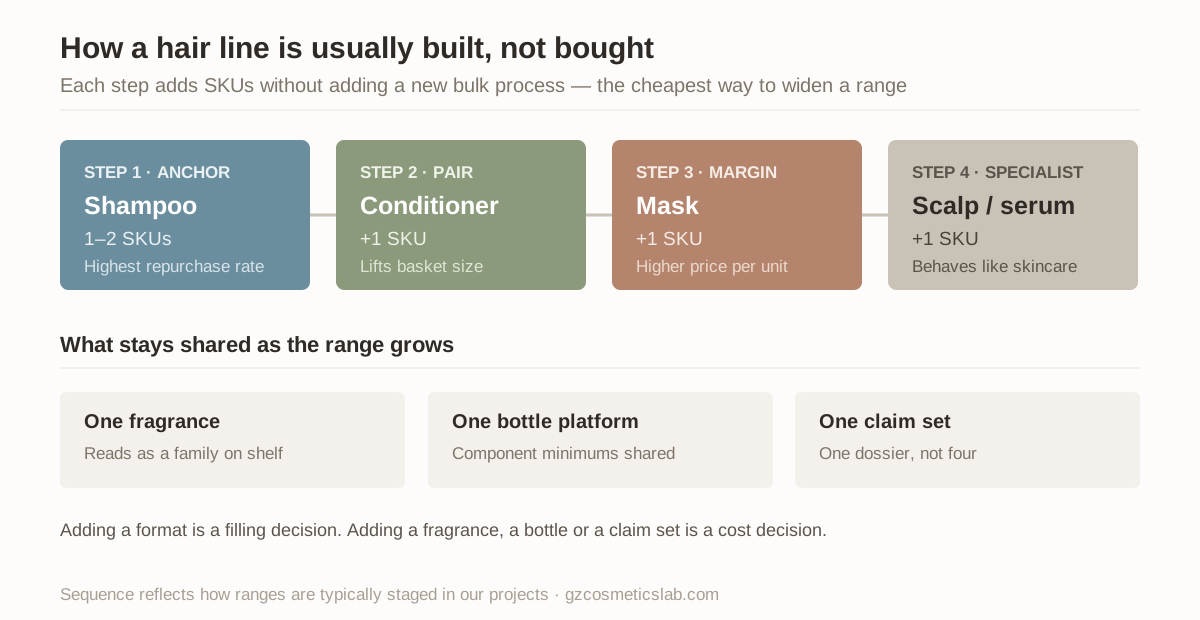
Pairs with the Rosemary Lemongrass Natural Shampoo for a botanical daily set, or with the Volumizing Oil Control Shampoo where the consumer needs oil control at the scalp and smoothing on the lengths.
Planning Your Lightweight Smoothing Conditioner Project
What to prepare before quotation and sampling, which checks are part of routine manufacturing, and which items are confirmed separately for this product type.
What to include in your brief
- Describe normal or slightly dry hair, wash frequency and whether one product serves a shared household.
- Set the acceptable balance of detangling, rinse speed and next-day lightness.
- Provide bottle, tube or refill plans, intended dose and local water conditions.
Quality and testing plan
Compare samples over an agreed repeat-wash routine, recording combing, residue and flattening rather than judging one fresh wash.
Agree dispenser output and emptying checks, routine release criteria, and whether a separate lightweight-claim comparison needs a defined protocol and report.
Market and claims checkpoints
- Treat silicone-free and vegan as formula-verification tasks; define what without build-up means before using it as a performance claim.
Pricing and testing scope depend on the final formula, packaging, quantity and destination market.
Frequently Asked Questions
What is the minimum order quantity and lead time?
Minimum is 3,000 bottles per SKU, produced in 35–45 days once you approve the sample. Custom sample rounds take 2–3 weeks. The 300ml and 400ml sizes are separate SKUs for MOQ purposes, and sachets are filled at their own minimum.
How is this different from your repair conditioner beyond price?
The difference is load, not quality of materials. This formula runs a lower cationic and oil level, which is what keeps it light on normal hair washed frequently. The Silk Repair Conditioner runs a higher load plus hydrolysed keratin and an argan-coconut pair, which is what dry or colour-treated hair needs and what would read as heavy here. Neither is a downgrade of the other; they are aimed at different wash frequencies and hair conditions.
Will it weigh hair down or leave build-up?
That is the specific failure mode this formula is built to avoid, and the lean cationic load is the reason. We would still recommend sampling on your own panel, because perceived weight depends heavily on hair density and local water hardness, and neither is something we can predict from a specification.
Can we run this silicone-free for a natural-positioned line?
Yes. The trade-off is that silicone provides immediate slip very efficiently, so a silicone-free version generally needs a higher plant oil or cationic load to match wet comb-through, which pushes against the lightweight brief. On a value formula that also moves cost. We sample both routes so you can judge whether the natural claim is worth the texture change in your market.
Can we add actives to justify a higher price?
You can, and we will tell you honestly which ones earn their cost. In a rinse-off conditioner, contact time is short and most of the product is washed away, so actives that need to remain on hair or skin deliver far less than the same ingredient in a leave-in. Ingredients that work on the fibre surface during application, such as proteins and cationic agents, are where added spend actually shows up in the hand.
Is the conditioning level capped by regulation?
Not on our standard route. Behentrimonium methosulfate is not listed in Annex III of Regulation (EC) No 1223/2009, so the level is set by performance and cost. If a project specifies a chloride-based quat, Annex III entry 287 caps behentrimonium chloride at 5.0% in rinse-off hair products and entry 286 caps cetrimonium and steartrimonium chloride at 2.5%, with the sum respecting both. Both entries require the ingredient to be present for conditioning rather than preservation. We formulate below whichever cap applies and confirm it against your destination market rules.
Customization
OEM/ODM supported
Target Markets
Certifications
ISO 22716 & GMPC certified; SGS testing supported upon request

Need a Custom Lightweight Smoothing Conditioner Formula?
Tell us your requirements — target actives, texture, packaging, quantity, and target market. Within 24 hours, we will reply with a quotation or the questions needed to prepare one.
Response within 24 hours · WhatsApp available · Factory visits welcome