
Cosmetic Labeling Requirements by Market: 9 Compared
Quick answer
One formula can clear nine markets. One label cannot. Four things change country by country, and each of them is a print-run decision rather than a paperwork decision: the language, the entity named on the pack, the dating convention, and the claim boundary.
- Language: English is workable in Singapore, Malaysia and the Philippines. Bahasa Indonesia, Thai, Vietnamese and Arabic are mandatory in their markets
- Named entity: never the overseas factory on its own — the EU needs a Responsible Person established in the EU, Vietnam a local notification holder, the Philippines a Market Authorization Holder
- Dating splits three ways: batch plus expiry, production plus expiry, or a period-after-opening symbol — and in the EU the 30-month threshold decides which one you print
- The shared core is stable: product name, net content, INCI list in descending order, batch number, country of origin, directions and warnings appear in nearly every market
- Design a master label with swappable localised panels, not nine separate artworks
The nine-market comparison table, the per-market element sets, and the seven traps that actually cause rejections are below.
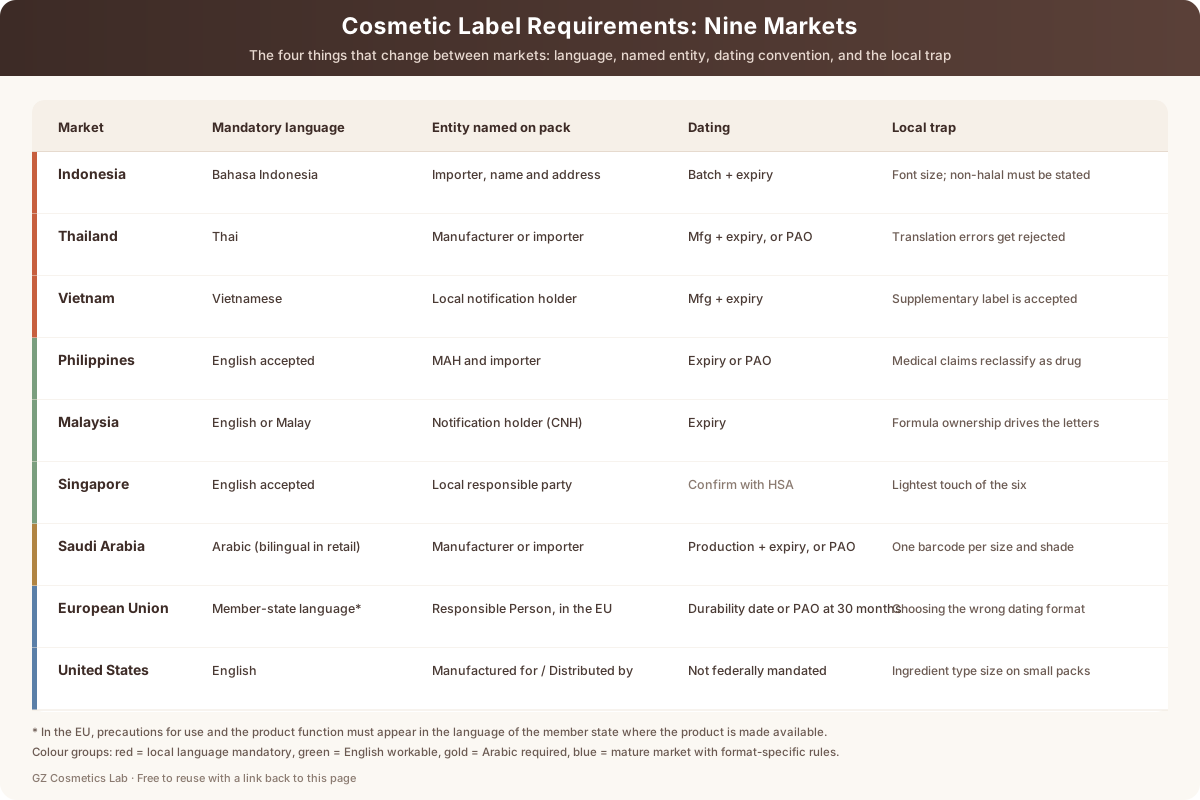
Labeling is where multi-market launches most often trip up. Not formulation, not notification — labeling. The reason is mechanical: a formula problem is caught in the lab and a document problem is fixed by refiling, but a label problem is caught after the cartons are printed. Packaging components are frequently the critical path on a project already, so a labeling revision at the wrong moment pushes a launch back by weeks and costs a second print run.
This guide puts nine markets side by side: the six ASEAN members, Saudi Arabia, the European Union and the United States. The aim is to let you design one label system at artwork stage rather than discover the differences one rejection at a time.
The Four Variables That Actually Change
Most of a cosmetic label is the same everywhere. Product name, net content, the ingredient list in INCI nomenclature, batch number, country of origin, directions for use and warnings show up in nearly every market. Build those once and they travel.
What does not travel is the set below. These are the four decisions that force either multilingual artwork planned from the start or separate print runs per market.
| Market | Mandatory language | Entity named on the pack | Dating convention |
|---|---|---|---|
| Indonesia | Bahasa Indonesia | Manufacturer and country, plus importer name and address | Batch number and expiry date |
| Thailand | Thai; other languages may sit alongside it | Manufacturer or importer name and address | Manufacturing and expiry date, or a PAO symbol |
| Vietnam | Vietnamese | Manufacturer and responsible party | Manufacturing and expiry dates |
| Philippines | English accepted | Manufacturer and importer, with a local Market Authorization Holder behind the filing | Expiry date or PAO symbol |
| Malaysia | English or Malay | Manufacturer name and address; the notification holder sits behind the filing | Expiry date |
| Singapore | English accepted | Local responsible party behind the notification | Confirm against current HSA guidance |
| Saudi Arabia | Arabic; bilingual Arabic and English is the retail norm | Manufacturer or importer name and address | Production and expiry dates, or a PAO symbol |
| European Union | Member-state language for precautions and product function | Responsible Person, established in the EU | Date of minimum durability, or PAO where durability exceeds 30 months |
| United States | English | Name and place of business; if you are not the maker, "Manufactured for" or "Distributed by" | No federal expiry requirement for cosmetics |
Language: The Divide That Decides Your Print Run
The ASEAN Cosmetic Directive harmonises the rulebook but not the language. English is workable for Singapore, Malaysia and the Philippines. Indonesia requires Bahasa Indonesia, Thailand requires Thai, and Vietnam requires Vietnamese. Saudi Arabia and the wider Gulf expect Arabic content, in practice as bilingual Arabic and English artwork rather than Arabic alone.
The efficient answer is a common master label with swappable localised panels or country-specific stickers, designed at the packaging stage rather than retrofitted after production. Three details decide whether that approach holds up.
Thailand is strict about translation quality, not just presence. All mandatory information must appear in Thai, and reviewers reject applications with translation errors. Other languages can appear alongside Thai, but the Thai text is what gets read. Budget one to two weeks for the labeling step, which can overlap with document preparation.
Vietnam accepts a supplementary label. Imported products often carry a compliant Vietnamese supplementary label applied over or alongside the original, which is a genuine cost saving if your primary artwork is already printed. It is the one market on this list where retrofitting is a designed-in option rather than a failure.
The EU is selective about which elements need translating. Not the whole label: precautions for use and the product function specifically must appear in the language of the member state where the product is made available. Multi-market European distribution therefore means multilingual packaging designed in from the start, or separate print runs. Planning for it before artwork is finalised is far cheaper than retrofitting.
Not sure which route fits your product?
Send us your brief and our formulators will tell you what is realistic on formula, MOQ, and timeline before you commit to anything.
The Entity on the Pack Is Never Just the Factory
This is the variable brands underestimate, because it is not really a labeling question — it is a legal-structure question that surfaces on the label.
In the European Union, the name and address of the Responsible Person is a mandatory label element, and the Responsible Person must be a legal entity established within the EU. No manufacturer outside the EU can hold that role, however strong its documentation. In Vietnam, the notification must be held by an entity established in Vietnam, typically the importer or distributor. In the Philippines, a Philippine-based Market Authorization Holder holds the licence and carries the regulatory responsibility. Indonesia requires importer name and address printed on the pack alongside the manufacturer.
The United States handles the same problem differently. If you are not the manufacturer or packer, the label must say "Manufactured for …" or "Distributed by …" — the name and place of business goes on an information panel with street address, city, state and zip, and the street address may be omitted only if the firm is listed in a current city or telephone directory.
Malaysia adds a wrinkle that catches white label deals specifically. NPRA defines the product owner as the company that legally owns the product formulation or process and has a contract with the notification holder. In a white label arrangement you own the brand but not the formula, which determines which letters the notification needs. Settle formula ownership in writing at quotation stage; it is genuinely hard to unwind once packaging is printed. Our Malaysia and Singapore guide works through the document chain.
Dating: Three Conventions and One Threshold
Dating looks trivial and is the single most common private label error in Europe. Three patterns cover the nine markets.
- Batch plus expiry. Indonesia and Malaysia sit here, expressed as a batch number and an expiry date
- Manufacturing plus expiry, or a PAO symbol. Thailand, Vietnam, the Philippines and Saudi Arabia accept the production-and-expiry pair, with the open-jar period-after-opening symbol as an alternative in several
- Durability logic. The EU makes it conditional: products with a minimum durability of more than 30 months carry the PAO symbol, the open jar with a number of months. Products at 30 months or less carry a date of minimum durability. Choosing the wrong one is a common error on private label projects
The United States is the outlier: there is no federal expiry-date requirement for cosmetics. That does not make it simpler, because the US front-loads its detail elsewhere, in type sizes and panel placement.
Singapore is the one market on this list where we would not put a figure in the table. It runs the lightest-touch notification of the six ASEAN members through the HSA, and English is workable, but the dating particulars are worth confirming against current HSA guidance rather than assumed from the regional pattern.
The Seven Traps That Actually Cause Rejections
Every market has a shared core you will get right by default. What follows is the market-specific detail that gets shipments detained and artwork reprinted.
1. Indonesia: font size and the halal statement. Labels get rejected for missing Bahasa Indonesia text, incorrect font size, or missing mandatory information such as batch code, expiry or importer details. Design the Indonesian label from scratch against BPOM labeling guidelines rather than adapting an English original. The halal dimension is separate and commercially decisive: products without certification must be labeled non-halal, which effectively excludes them from mainstream retail. The BPOM registration guide covers the full element list.
2. Thailand: translation errors. TFDA reviewers reject applications over translation quality, so a qualified translator is not optional. The notification number is added to the label after approval, which means artwork has to be built with space reserved for it. See the Thailand registration guide.
3. Saudi Arabia: one barcode per variant, and a phrase you cannot print. Every product needs a unique barcode, and a separate barcode is required for every size, colour or variation — a three-shade range is three barcodes, not one. And the label must not state that the product is notified with the Authority. Brands routinely want to print "SFDA registered" as a trust signal, and that is expressly not allowed. Internal and external labels plus any leaflet are all submitted as artwork in JPEG, JPG, PDF or PNG. The SFDA guide has the notification sequence.
4. The Philippines: the claim boundary. Anything that reads as medical or therapeutic can reclassify your product as a drug, which pulls it into a heavier approval track entirely. This is not abstract — it is exactly where whitening and brightening products get into trouble. Thailand applies similar scrutiny, where brightening and radiance language is safer positioning than whitening, and performance claims such as SPF require supporting test data.
5. The European Union: INCI accuracy. The ingredient list has to reflect the actual formula in correct nomenclature and correct descending order. It should be generated from the manufacturer's formulation data rather than transcribed by a design agency, because a transcription error on a printed carton is a reprint. Country of origin is mandatory for imported products.
6. The United States: ingredient type size. Not less than 1/16 inch, dropping to not less than 1/32 inch where the total package surface available to bear labeling is under 12 square inches. Small-format launches miss this more than any other rule. Two related points: descending order of predominance applies except that colour additives and ingredients present at one percent or less may be listed without regard to predominance, and imported products must state the English name of the country of origin. Worth knowing what is not a rule yet — fragrance allergen labeling is not mandatory in the US, so treat any quote listing it as a compliance line item with suspicion. Our MoCRA guide separates what MoCRA actually added from what predates it.
7. The Gulf beyond Saudi Arabia: edition drift. GSO 1943:2024 carries the labeling and packaging requirements, and because the 2024 edition is current, artwork signed off against an earlier edition should be re-checked before you commit to a print run. Ingredient nomenclature, warnings and mandatory particulars are exactly the sort of detail that shifts between editions. The Middle East manufacturing guide covers the regional picture.
What the Factory Supplies and What You Own
Being precise about this boundary saves more time than any checklist, because the two halves fail in different ways.
What we supply as the manufacturer is the input data: the full INCI listing in descending order with the sub-one-percent and colour-additive treatment already applied, the active-versus-cosmetic split where the product is also a drug, net content verified against fill records rather than nominal fill, the country of origin as the site that actually ran the batch, and raw material specifications for the technical file. We prepare Arabic-inclusive and localised artwork as part of the project.
What we cannot own is the label itself. The responsible person named on it owns the artwork and the claims. Type sizes and panel placement have to be checked against the final printed dieline, not the design file, because artwork that satisfies 1/16 inch on screen can fail it after scaling. Translated content still has to be approved by someone accountable on your side or your importer's. And in the EU specifically, we cannot hold the Responsible Person role, sign the Part B safety assessment, or make the CPNP submission — those require EU establishment.
The practical sequence that avoids reprints: lock formula and INCI output first, build the master artwork against the strictest market in your rollout, then generate localised panels from that master. Our OEM service builds labeling into the packaging design stage for exactly this reason.
Frequently Asked Questions
Can one label design work across all nine markets?
No, but one label system can. The shared core — product name, net content, INCI list, batch number, country of origin, directions and warnings — is stable across markets. What changes is the language, the entity named on the pack, and the dating convention. Design a master label with swappable localised panels or country-specific stickers rather than nine independent artworks.
Which markets accept English-only cosmetic labels?
Singapore and the Philippines accept English, and Malaysia accepts English or Malay. Indonesia requires Bahasa Indonesia, Thailand requires Thai, Vietnam requires Vietnamese, and Saudi Arabia expects Arabic content, typically as bilingual Arabic and English artwork. The EU requires member-state language for precautions for use and the product function specifically, not for the entire label.
Do I need a local company named on the label?
In most of these markets some local entity has to be named or has to stand behind the filing. The EU requires a Responsible Person established in the EU, whose name and address appear on the pack. Vietnam requires the notification to be held by a Vietnamese entity. The Philippines requires a Market Authorization Holder. Indonesia requires importer details printed on the label. In the US, if you are not the manufacturer or packer, the label must say "Manufactured for" or "Distributed by".
Can I print that my product is registered with the regulator?
Not in Saudi Arabia. The label must not state that the product is notified with the Authority, so printing "SFDA registered" as a trust signal is expressly not allowed. Thailand goes the other way: the notification number is added to the label after approval and must appear on products sold there, so reserve space for it at artwork stage.
When should labeling be decided in a private label project?
At artwork stage, alongside formulation, not after the formula is finished. Arabic label content, Thai translation and EU multilingual panels all affect the print run and the packaging lead time. Because packaging components are often the critical path already, a labeling revision late in the project can push a launch back by weeks. A reformulation mid-project also means a new ingredient list and a new plate.
What is the difference between a PAO symbol and an expiry date?
The period-after-opening symbol, the open jar with a number of months, tells the consumer how long the product lasts once opened. An expiry or minimum durability date is absolute. The EU makes the choice conditional on a 30-month threshold: above 30 months of minimum durability you print the PAO symbol, at 30 months or less you print a date of minimum durability. Several ASEAN markets and Saudi Arabia accept either a production-and-expiry pair or a PAO symbol.
Get Your Labeling Right Before the Cartons Print
Multi-market labeling is not a compliance chore you do at the end. It is a design constraint that belongs in the first artwork brief, because every market-specific detail on this page is cheaper to design in than to reprint.
We manufacture in Guangzhou under ISO 22716 and GMPC, supply the INCI output and technical data your artwork and safety file are built from, and prepare localised label content for ASEAN, Gulf, European and US launches as part of the project.
Get started:
- Tell us your product and your target markets
- Receive the label element set and the artwork sequence for each one
- Get a project timeline that puts labeling on the critical path where it belongs
Request a quote → or talk to our OEM team about a multi-market label system.
Ready to Start Your Project?
Tell us your product requirements. Our technical team responds within 24 hours with a detailed quotation.