
How to Find a Skincare Manufacturer You Can Trust
Most guides on finding a skincare manufacturer tell you to look for someone trustworthy. That advice has a problem: trust is not a property you can check. It is a conclusion you reach afterwards, usually after money has moved.
What you can check is narrower and more useful. A company either legally exists or it does not. A site either holds a production licence for your category or it does not. A certificate number either matches the issuing body's records or it does not. Retained samples are either on the shelf with dates on them or they are not.
This guide is written from inside a Chinese cosmetics manufacturing operation, which shapes what it covers. The existing guides on this subject come from factories in Florida, Switzerland and the Baltics, and they are competent on their own ground. None of them can tell you how to check a Chinese business licence against the national register, or why a trading company can show you a real ISO 22716 certificate that belongs to someone else. That is the part we can document, and it happens to be where most sourcing projects go wrong.
First, Decide Which Kind of Supplier You Are Talking To
Before verification comes a decision most brand founders make by accident. US and Canadian contract labs, European labs and Chinese factories are genuinely different businesses, not three prices for the same thing — the trade-offs are summarised in the FAQ below, and we have written a fuller comparison of the European and Chinese routes separately.
Read that table as a statement about which constraint binds hardest for you, not about which supplier is better. Every row is a trade, and the last two rows are the ones people discover late: a Chinese factory hands you a verification burden that a domestic lab does not, and it builds to whichever market you name rather than defaulting to the one it sits in. Both are workable. Neither is automatic, and the first is what the rest of this guide is for.
If your first order is small and speed matters more than a bespoke formula, a private label route built on an existing tested base removes most of the development cost. The verification work in this guide still applies to whoever fills it.
| Consideration | US / Canada contract lab | European lab | Chinese factory |
|---|---|---|---|
| What you are actually buying | Proximity and a shared legal system | Native EU regulatory alignment | Ingredient depth and unit economics |
| Minimum order | Lowest of the three — some labs quote from tens of units | Low to moderate | Higher, and the reason a second product becomes affordable |
| Unit cost | High | Highest | Lowest |
| Ingredient range | Narrower domestic supply base | Broad, EU-compliant by default | Broadest, with faster access to newer actives |
| Packaging | Usually sourced separately | Usually sourced separately | Commonly co-located, quoted with the formula |
| Import step | None for US buyers | None for EU buyers | Yes — customs, freight, transit time |
| Regulatory fit out of the box | US MoCRA | EU Regulation 1223/2009 | Depends on your destination market; the factory builds to your target |
| Verification burden on you | Low | Low | High — and the reason for the rest of this guide |
| Where it breaks down | Cost ceiling limits range expansion | Cost ceiling limits range expansion | Choosing the wrong supplier, which is a solvable problem |
One honest note on numbers: MOQ, lead time and development cost vary so widely by category and by how custom the formula is that any single figure here would mislead you. A sun care product carrying SPF testing runs materially longer than a basic moisturiser. Take your figures from a quotation on your actual product rather than from a table, and see our MOQ and cost guide for how the variables interact.
Where to Look, and What Each Channel Selects For
Sourcing channels are not neutral. Each selects for a particular type of company, and knowing the bias tells you what to expect before the first call. The ranked lists and directories these channels produce have their own mechanics, which we have taken apart in a separate piece on how lists of cosmetic manufacturing companies are built.
B2B marketplaces rank partly on advertising spend and response metrics, which selects for companies with dedicated sales teams — correlating with trading companies more than with production sites. Useful for a long list, weak as evidence. Trade shows such as Cosmoprof and in-cosmetics select for commercial commitment rather than manufacturing quality, but they let you ask a technical question and watch whether the answer comes from the person in front of you. Certification registries are one of the few channels where the bias works in your favour, because searching a certifier's own register inverts the usual information flow. Referrals from other founders are the highest-quality channel and the hardest to access — someone three production cycles in knows how a quality complaint was handled, which no document shows.
Direct approach to factories you find through their own technical content selects for companies investing in explaining their work rather than in advertising. That is a real filter, and it is worth saying plainly that you are using it right now.
Not sure which route fits your product?
Send us your brief and our formulators will tell you what is realistic on formula, MOQ, and timeline before you commit to anything.
How to Verify a Chinese Factory: The Four Layers
This is the section the other guides on this keyword cannot write, so it is where the detail goes. Work down in order. A failure at layer one ends the conversation, and no amount of strength at layer four compensates.
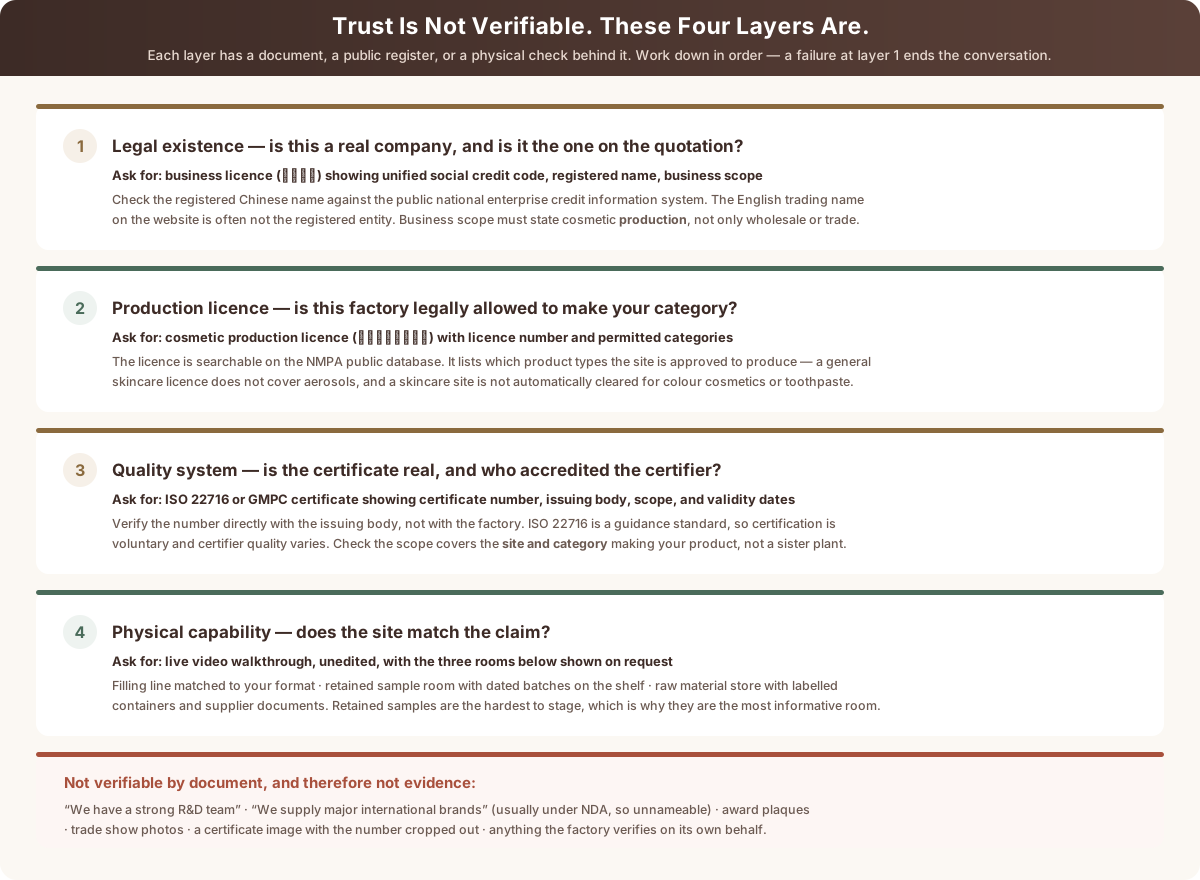
Layer 1: Legal existence — and whether it matches the quotation
Ask for the business licence, in Chinese, showing the unified social credit code, the registered company name and the business scope. Three things to do with it.
Check the registered Chinese name against China's public national enterprise credit information system. The English trading name on a website is frequently not the registered entity, and that gap is where a great deal of trouble lives. Then read the business scope: it must state cosmetic production. A scope covering wholesale, retail or trade only means you are talking to a trading company, however the website is worded. Finally, confirm the entity on the licence is the entity on the quotation and, later, on the contract and the invoice. A mismatch here is not an administrative quirk; it determines who you have recourse against.
Layer 2: Production licence — for your category specifically
China requires a cosmetic production licence for each site, and the licence specifies which product types that site may produce. The number is searchable on the NMPA public database.
The category detail is what people miss. A licence covering general skincare does not cover aerosols, and a skincare site is not automatically cleared for colour cosmetics or toothpaste. If your range spans categories, check each one rather than assuming a competent factory can make anything. This is also the fastest way to detect a trading company: it will have no production licence at all, because it has no site.
Layer 3: Quality system certification — verified with the issuer, not the factory
ISO 22716 is the international standard for cosmetics Good Manufacturing Practices, and GMPC certification is built on it. Both are worth having and neither is self-proving.
Ask for the certificate showing its number, the issuing body, the certified scope and the validity dates — then verify the number with the issuing body directly. Certificate images circulate, and a number cropped out of an image is a red flag on its own. Two further checks: ISO 22716 is a guidance standard, so certification is voluntary and the rigour of certification bodies varies, which makes the identity of the certifier part of the evidence rather than a footnote. And the certified scope must cover the site and category producing your product — a group with several plants may hold certification for only one of them.
Layer 4: Physical capability — the three rooms
Ask for an unedited live video walkthrough rather than a video file, and ask to see three specific areas.
The filling line matched to your format — a factory strong in creams may be subcontracting sachets or airless pumps, which is not automatically a problem but is something you should know. The raw material store, where you are looking for labelled containers with supplier documentation, not tidiness. And the retained sample room, the most informative of the three because it is the hardest to stage. Retained samples from past production, physically on the shelf with batch numbers and dates, are evidence of a functioning quality system in a way that a certificate is not. Ask to see samples from a batch made a year ago.
A walkthrough cannot show you formulation depth, which is a separate question from whether the site is real. If your product depends on a delivery system or an active that needs stabilising, ask what the factory has actually developed rather than what equipment it owns — our formulation technology page is an example of the specificity worth expecting in that answer.
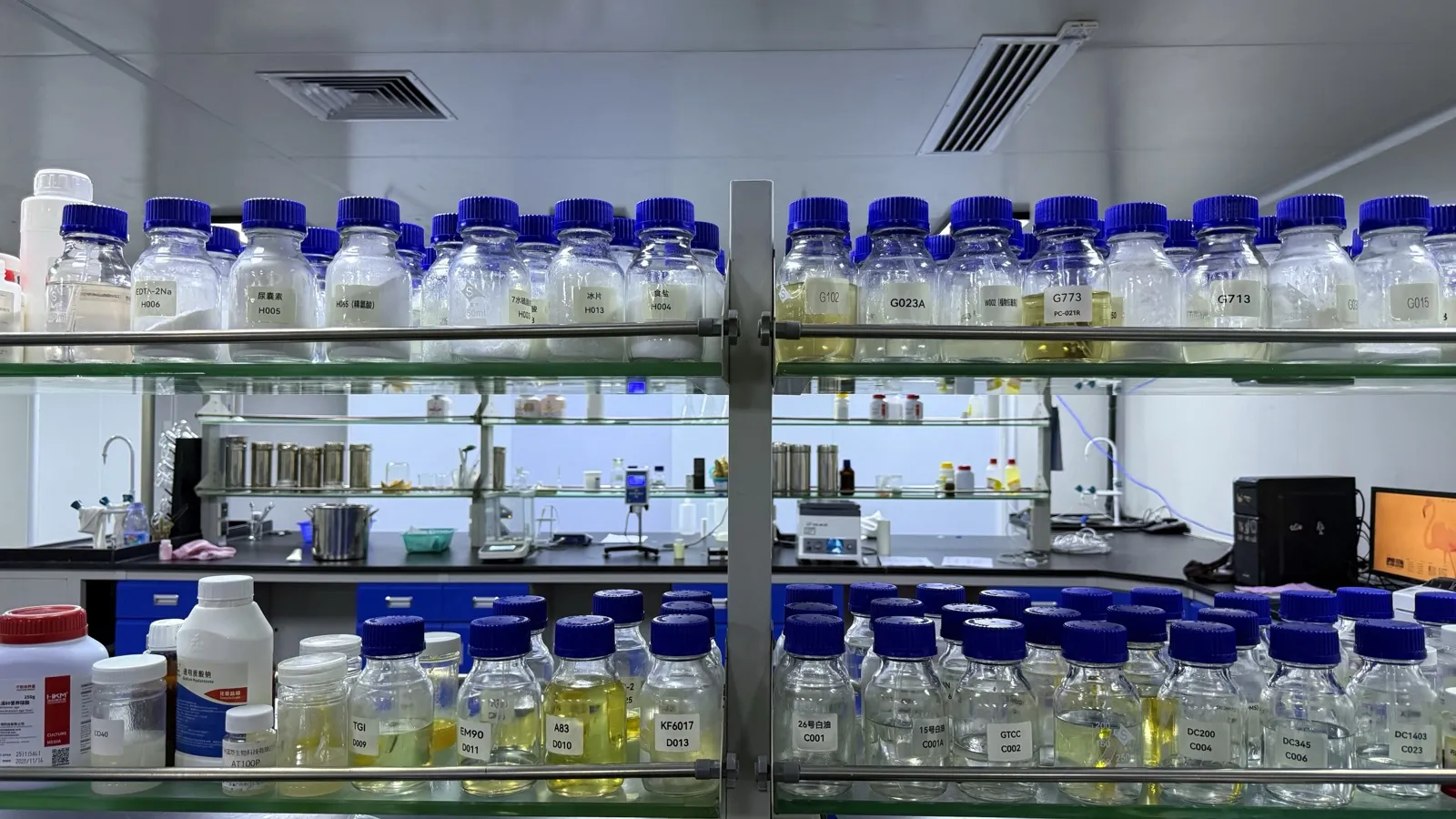
Telling a Factory From a Trading Company
Trading companies are not inherently a problem — some are useful intermediaries with real technical staff. The problem is not knowing which one you have, because it changes who controls your formula, your timeline and your quality response.
The document test settles most cases: no production licence means no production site. Beyond that, a few patterns are reliable enough to act on.
Ask a formulation question specific enough to require the person who made the decision — not "can you do a vitamin C serum" but "which vitamin C derivative would you use at this pH, and why that one." The answer you are listening for names a specific derivative and a reason: on our own glutathione brightening serum the choice is MAP rather than L-ascorbic acid, because L-AA cannot share a formula with alpha-arbutin and MAP's workable pH sits closer to it. A production site answers at that level or brings the formulator onto the call; an intermediary goes away and comes back. Ask whether the address on the business licence is the production address, since trading companies frequently operate from office buildings. Ask for the video walkthrough on short notice: a real site can show you a filling line today, whereas an intermediary needs access to someone else's.
Also watch the catalogue. A supplier offering skincare, colour cosmetics, hair care, toothpaste, aerosols and supplements from one site is describing a sourcing network, not a factory. That may be exactly what you want, but price it and plan for it accordingly. A genuine catalogue reads narrower and deeper instead — ours runs across skincare, hair care and body care because those share wet-mixing and filling lines, and the honest answer on formats outside that is that they would be developed rather than pulled off a shelf.
The First Call: Questions That Produce Evidence
Most question lists ask things that are easy to answer well and impossible to check. These are the ones where the answer either comes with evidence or reveals its absence.
On the entity. What is your registered company name in Chinese, and is it the entity that will appear on the contract? Is the licence address the production address?
On the licence and certificates. What is your production licence number, and which categories does it cover? Which body issued your ISO 22716 or GMPC certificate, what is the number, and what scope does it name?
On the formula. Is this a stock base or a new development? Who owns the formula after production — and get this in writing, because it is the most common source of dispute in private label work. If we move production later, does the formula move with us?
On testing. Which tests are included in the quotation and which are billed separately? Stability, preservative efficacy challenge testing, packaging compatibility and any market-specific testing all have their own timelines. A quotation that does not name them is not complete.
On the quotation structure. Does the unit price include packaging, labels and secondary packaging? Is development cost separate? What triggers a re-quote?
On regulatory responsibility. Which documents do you provide for my market's registration, and which are mine to produce? Be precise here — a factory supplying a full technical dossier and a factory offering to send a specification sheet are describing very different levels of support, and both may use the word "help." Our own view on where that line sits is set out in our OEM programme.
On failure. What happened the last time a batch missed specification, and what did you do? The content matters less than whether an answer exists. A factory that has never had a deviation is either very new or not telling you.
Signals That Should End the Conversation
Some of these are outright fraud indicators. Others are ordinary business behaviour that nonetheless tells you this is not a manufacturing partner.
| Signal | What it means | Your move |
|---|---|---|
| Refusing to send the business licence or production licence | These are not confidential documents | End the conversation |
| Certificate image with the number cropped out | The number is the only verifiable part | End the conversation |
| Freely naming well-known brand clients | Contract manufacturing runs under NDA — they are inventing it or breaching it | End the conversation |
| Request to change payment account details by email | Treat as fraud without exception | Stop and verify by voice |
| No questions about your destination market | Cannot be formulating for compliance | Serious concern |
| Pressure to skip stability testing for a launch date | Tells you what gets sacrificed next time a schedule slips | Serious concern |
| Price notably below every other quotation | Usually a thinner formula, cheaper preservative, or testing excluded | Ask what is different |
The payment-account item deserves expanding because it is the one that costs real money. Account details belong in the signed contract, and any request to change them — however plausible the explanation, however familiar the email address — must be confirmed by voice on a number you already hold. This pattern is common, well-documented across the industry, and it does not get less effective with time.
One clarification on named brand clients, because it reads counterintuitively: a factory that will not tell you who it produces for is behaving correctly. Ask instead for anonymised case detail — category, market, order profile, what the technical problem was and how it was solved. That gives you the same signal without asking anyone to breach an agreement.
Frequently Asked Questions
How do I verify a Chinese cosmetics manufacturer is a real factory?
Four checks, in order. Confirm the business licence against China's public national enterprise credit information system and read the business scope for cosmetic production rather than wholesale or trade. Look up the cosmetic production licence number on the NMPA public database and confirm it covers your product category. Verify any ISO 22716 or GMPC certificate number with the issuing body directly, not with the factory. Then ask for an unedited live video walkthrough showing the filling line, the raw material store and the retained sample room. A trading company fails at the second check, because it has no production site and therefore no licence. For a shortlist that has already been through this vetting, see our breakdown of private label skincare manufacturers in China by tier.
Which certifications actually matter for a skincare manufacturer?
ISO 22716 is the international standard for cosmetics Good Manufacturing Practices and is the baseline worth requiring; GMPC certification is built on it. Both are voluntary, which makes the identity of the certifying body part of the evidence rather than a detail. Beyond those, relevance depends on your market and positioning rather than being universally better: organic certification if you carry organic claims, Halal certification if you are entering Indonesia or the Gulf, cruelty-free schemes if that is your brand position. Awards, trade show photographs and membership plaques are not certifications and prove nothing about the production system.
Should I use a US, European or Chinese manufacturer?
It depends which constraint binds hardest. Choose a US or Canadian lab for very low minimums, no import step and a shared legal system, accepting higher unit cost and a narrower ingredient range. Choose a European lab if the EU is your first market and you want the Responsible Person, Product Information File and CPNP notification handled natively, accepting the highest cost of the three. Choose a Chinese factory for ingredient depth, co-located packaging and unit economics that make a multi-product range viable, accepting that you carry the verification work set out above. The comparison is not quality against price — competent and incompetent manufacturers exist in all three regions.
Who owns the formula in a private label arrangement?
It depends entirely on what your contract says, which is why this must be settled in writing before development starts. A stock base the factory already owns generally stays with the factory, and you are buying the right to sell a product made from it. A formula developed and paid for as custom work can be assigned to you, but only if the agreement says so. The question that exposes the real position is whether the formula moves with you if you change manufacturer. Ask it early. It is the most common dispute in this industry and it is entirely avoidable at contract stage.
How long does it take to find and qualify a manufacturer?
Sourcing and qualification typically run in parallel with early formulation discussions rather than finishing first. The document checks in this guide take days, not weeks, once you have asked for the right things. What takes real time is sampling and stability work, and that varies by category — a product carrying SPF testing runs materially longer than a basic moisturiser. Build your timeline from a quotation on your actual product rather than a published average, and work backwards from your intended shelf date.
Can I trust a manufacturer that will not name its brand clients?
Yes — that is the correct behaviour. Contract manufacturing operates under non-disclosure agreements, so a factory that respects confidentiality cannot name the brands it produces for. The reverse is the warning sign. A supplier freely listing well-known brands is either inventing the list or breaking agreements it has signed, and a factory that will breach someone else's confidentiality will breach yours. Ask instead for anonymised case detail: category, market, order profile, what the technical challenge was and how it was solved.
The Short Version
Trust is the wrong target because it cannot be inspected. Verification can. A business licence checked against the national register, a production licence covering your specific category, a certificate number confirmed with the body that issued it, and a live look at a retained sample room together tell you more than any amount of relationship-building in the first month.
The sequence matters more than the effort. Most sourcing failures we see are not the result of insufficient diligence but of diligence applied in the wrong order — long formulation discussions with a company whose business scope never permitted production in the first place. Layer one takes an afternoon. Do it first.
If you want to start at the top of that list, ask us for the documents before you ask us for a quotation. Our business licence, production licence and certification scope are available on request, and the video walkthrough can be arranged on short notice because the site is ours. When you are ready to talk about a specific product, send us the brief and tell us which market comes first.
Ready to Start Your Project?
Tell us your product requirements. Our technical team responds within 24 hours with a detailed quotation.