
Europe vs China Cosmetics Manufacturer: Transfer Guide
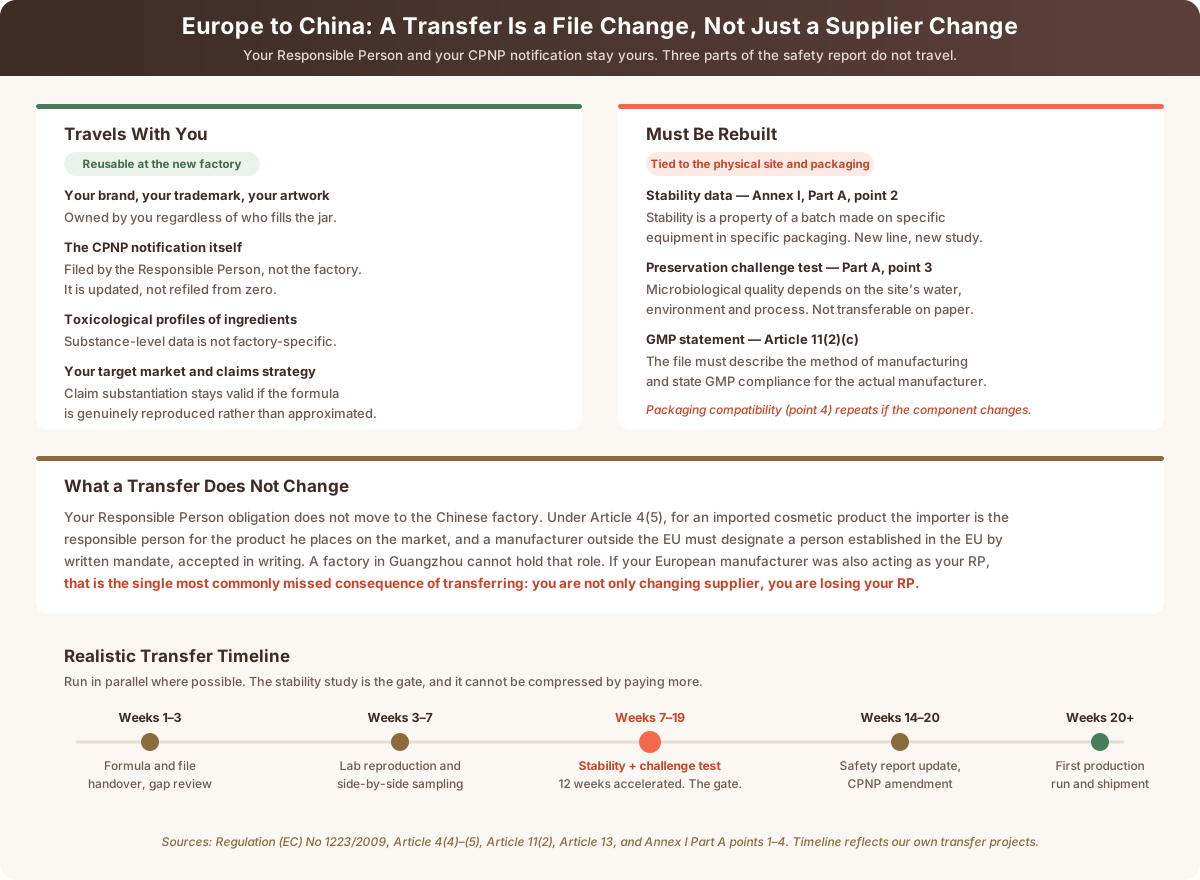
Transfer scope mapped against Regulation (EC) No 1223/2009. Timeline from our own transfer projects.
Most articles comparing a European cosmetics manufacturer with a Chinese one are written for brands that have not started yet. This one is not. It is written for the brand that already produces in Europe — an Italian or Polish private label supplier, a German contract manufacturer, a French filler — and is now working out what it would actually take to move that production to China.
That is a different question, and the honest answer is that it is harder than the comparison articles imply. A transfer is not a supplier swap. Under EU cosmetics law it is a documented change to a file you are legally required to keep, and three specific parts of that file cannot travel with you no matter how faithfully the new factory reproduces the formula. If your European manufacturer was also acting as your Responsible Person, the transfer quietly removes something you may not have realised you were buying.
We manufacture in Guangzhou and we do take transfer projects, so read our view with that in mind. But the constraints below are set by the regulation and by physics, not by us, and a supplier who tells you a transfer is straightforward is either not reading the same regulation or is planning to leave the awkward parts on your side of the table.
What a Transfer Legally Is
Start with the instrument that governs this. Cosmetics sold in the EU sit under Regulation (EC) No 1223/2009. Article 11 requires that a Responsible Person keep a product information file for every product placed on the market, retained for ten years after the last batch was placed on the market. Critically, the article specifies that the file contains information and data "which shall be updated as necessary."
That clause is where your transfer lives. You are not filing a new product. You are updating an existing file, and Article 11(2) tells you exactly which parts are in scope: the product description, the safety report required by Article 10(1), a description of the method of manufacturing and a statement on compliance with good manufacturing practice, proof of claimed effects where justified, and animal testing data.
Read point (c) again, because it is the one that decides how much work a transfer is. The file must describe the method of manufacturing and carry a GMP statement. Those attach to the facility that actually makes the product. When the facility changes, that content is no longer accurate, and an inaccurate PIF is not a paperwork inconvenience — it is the file a competent authority will ask for if a product is questioned.
So the practical framing is this: a transfer costs you a re-established manufacturing description, a re-established GMP position, and re-established evidence for anything in the safety report that depends on the physical site. Everything else you already own.
The Three Things That Do Not Travel
Annex I of the regulation sets out the minimum contents of the cosmetic product safety report. Part A is the safety information; Part B is the assessment. Working through Part A point by point shows precisely which evidence is portable and which is not.
Point 1, composition, travels. Chemical name, INCI, CAS, EINECS/ELINCS and intended function do not change because the mixing tank moved. If you own your formula, this section transfers intact.
Point 2, stability, does not travel. The annex requires stability under reasonably foreseeable storage conditions, and stability is not a property of a recipe — it is a property of a batch made on particular equipment, at a particular scale, in particular packaging. Different homogeniser shear, different cooling curve, different fill temperature, and an emulsion that held for 24 months in Lombardy can separate at month nine. This is the largest cost item in a transfer and the reason the timeline below has a hard floor.
Point 3, microbiological quality, does not travel. The annex requires microbiological specifications plus the results of a preservation challenge test. A challenge test validates a preservative system in the product as manufactured, in a given environment, with a given water system and process flow. Carrying over a European result for a product now made in Guangzhou is not a shortcut; it is an unsupported claim in a legal file.
Point 4, impurities and packaging, partly travels. Substance purity data usually holds if you keep the same raw material suppliers. The packaging half does not if the component changes, because the annex asks for the purity and stability of packaging material — a compatibility position per product-and-component pair. Change the jar, repeat the work.
Points 5 through 8 largely travel. Normal and foreseeable use, exposure to the product, exposure to the substances, and the toxicological profile of each substance are formula-and-use driven rather than site driven. A margin of safety built on a NOAEL does not change because the factory did.
Summarised: your ingredient science transfers, your product-as-made evidence does not. Internalise that before asking anyone for a transfer quote, because it tells you which line items are real and which are padding.
| Annex I Part A point | Transfers? | Why | What it costs you if it does not |
|---|---|---|---|
| 1. Composition | Yes | Chemical name, INCI, CAS, EINECS/ELINCS and function do not depend on the site | Nothing, if you own the formula |
| 2. Physical and chemical stability | No | Stability belongs to a batch on given equipment, at a given scale, in given packaging | The largest single line item; roughly 12 weeks of elapsed time |
| 3. Microbiological quality | No | The challenge test validates a preservative system as manufactured, in one water system and process flow | A re-run challenge test, in parallel with stability |
| 4. Impurities and packaging | Partly | Substance purity holds if raw material suppliers stay; compatibility is per product-and-component pair | Repeat compatibility work for every component you change |
| 5. Normal and foreseeable use | Yes | Use-driven, not site-driven | Nothing |
| 6. Exposure to the product | Yes | Use-driven, not site-driven | Nothing |
| 7. Exposure to the substances | Yes | Derived from formula and use pattern | Nothing |
| 8. Toxicological profile | Yes | A margin of safety built on a NOAEL does not change because the factory did | Nothing |
Three of eight points carry a cost, and two of those three are gated by elapsed time rather than effort. That is the structural reason the timeline in the next section has a floor that money cannot lift.
The Responsible Person Trap
This is the part brands miss most often, and it is worth being blunt about because it can strand a launch.
Article 4 requires that only cosmetic products for which a legal or natural person is designated within the Community as Responsible Person may be placed on the market. The allocation then depends on where manufacturing happens. Article 4(3): for a product manufactured within the Community and not subsequently exported and reimported, the manufacturer established within the Community is the Responsible Person. Article 4(4): where such a manufacturer is established outside the Community, it must designate, by written mandate, a person established within the Community who accepts in writing. Article 4(5): for an imported cosmetic product, each importer is the Responsible Person for the product he places on the market, and may by written mandate designate an EU-established person who accepts in writing.
Follow the consequence. While you produced in Italy, your Italian manufacturer may have been your Responsible Person by operation of Article 4(3) — possibly without either of you treating it as a separate service, because the law assigned it. The moment production moves to China, your product becomes an imported cosmetic product and Article 4(5) applies instead. Your factory in Guangzhou cannot be your Responsible Person. It is not established in the Union, and no contractual language changes that.
So a transfer creates a vacancy you have to fill, by one of three routes: your own EU entity if you have one, your EU importer or distributor accepting the role, or a specialist RP service provider under written mandate. Each has cost and control implications, and each takes time to put in place. Brands that discover this in week eighteen rather than week one are the ones whose transfers slip a quarter.
The same logic sits behind the wider set of obligations for a European private label project, which is worth reading alongside this if the RP question is new to you. The obligations do not soften because you produce in Asia; they simply attach to a different party.
Does a Transfer Make It a New Product?
Brands ask this hoping the answer is a clean no, and the useful answer is that it depends on what you keep identical.
Nothing in the regulation says a change of manufacturer creates a new product requiring a fresh CPNP notification. Article 13 lists what the Responsible Person submits before placing a product on the market: product category and name, the name and address of the Responsible Person where the PIF is accessible, the country of origin in the case of import, the member states of placing, contact details, nanomaterial and CMR information where applicable, and the frame formulation for medical treatment purposes.
Two of those change on a transfer. Country of origin now applies and becomes China. And if your RP changed, the RP name, address and PIF location all change. Those are notification amendments, not a new product launch.
Where brands do create a new product accidentally is in the formula. If the new factory cannot source an identical grade of a key raw material and substitutes something similar, or adjusts the emulsifier system to suit its equipment, you no longer have the same product. Then the composition in Part A point 1 changes, the exposure and toxicological sections may need revisiting, and Part B has to be reassessed by your safety assessor. That is a materially bigger project.
Which gives you a practical rule for briefing a transfer: demand a reproduction, not an interpretation. Ask the receiving factory to state, in writing and per raw material, whether it will use the identical grade from the identical supplier, and where it cannot, to flag it before sampling rather than after. A factory that cannot answer at that resolution is not ready to take your transfer.
The Real Timeline, and Why the Middle Is Fixed
Transfer timelines are quoted optimistically across the industry, so here is the shape we actually work to, with the constraint stated plainly.
Weeks 1 to 3, handover and gap review. Formula, raw material specifications with supplier names and grades, current stability protocol and results, current challenge test, packaging drawings and component sources, plus the existing safety report. The output is a gap list: what is missing, what has to be re-run, what raw material substitution risk exists.
Weeks 3 to 7, lab reproduction and side-by-side sampling. The receiving lab makes the product to your existing specification, and you assess it against retained samples from the incumbent. Insist on side-by-side rather than sequential assessment; sensory drift is very hard to judge from memory.
Weeks 7 to 19, stability and challenge testing. This is the gate. Accelerated stability commonly runs twelve weeks at elevated temperature, alongside the preservation challenge test. It cannot be shortened by paying more, because the evidence is generated by elapsed time. Any supplier quoting a full transfer in six weeks is either skipping this or planning to ship before it completes.
Weeks 14 to 20, file and notification work. Safety report update by your assessor, new manufacturing description and GMP statement, CPNP amendment for country of origin and any RP change. This overlaps the back half of stability.
Weeks 20 onwards, first production run. Then ocean freight on top, which for China to Europe runs roughly 25 to 35 days before port handling.
Call it five to six months from decision to landed stock for a straightforward single-SKU transfer, longer for a multi-SKU range. If that number is unwelcome, the honest conclusion may be that this is not the right time to transfer, and we would rather say so at the quote stage than at week nineteen.
What a Transfer Costs, and Where the Money Actually Goes
The reason brands transfer is unit cost, and the reason transfers stall is that the one-off cost of moving is underestimated. Both things are true at once.
The recurring saving is real and it widens with volume. The one-off cost has four components, and only one of them is the factory's line item:
- Re-testing. Stability and challenge testing per SKU. This is the unavoidable one, and it scales with how many SKUs you move at once.
- Safety assessor time. Your assessor has to revisit the report. If composition held and only the manufacturing sections changed, this is an update. If raw materials were substituted, it is closer to a reassessment.
- Responsible Person arrangements. If you lost your RP with your manufacturer, this becomes a new recurring cost, not a one-off.
- Dual inventory during changeover. Usually the largest and least discussed. You need incumbent stock covering the transfer window, which means you are carrying inventory while paying for a transfer.
Set against that, the structural differences that made you consider moving in the first place do not disappear:
Minimum order quantity runs the other way. This is the honest counterweight. European private label suppliers routinely quote minimums in the 100 to 500 unit range. Asian factories, ours included, work from 2,000 to 3,000 bottles or jars per SKU for most skincare, body and hair care, with fragrance and essential oils from 1,000 to 2,000 bottles and sheet masks from 5,000 sheets. If your European MOQ is what has been keeping your inventory risk low, a transfer increases that risk, and for a brand still testing demand that can outweigh a unit cost gain entirely.
Country of origin becomes a label element. Origin marking applies to imported product, and in some European retail channels and premium positions the origin statement affects reception. Whether that matters is a positioning judgement only you can make. We are not going to pretend it never matters.
Freight and lead time enter your planning. Sea freight sits on top of production time and has to be planned around rather than compressed. Brands moving from a two-week domestic replenishment cycle to an ocean cycle need to rebuild their forecasting before they need to rebuild their formula.
Where the move pays back most reliably is at volume, across multiple categories, and when you are also expanding beyond Europe. If you are producing skincare in Italy and later want body care and hair care under one roof, and you are also entering Southeast Asia or the Gulf, one factory assembling a single technical data set that serves several markets removes duplicated work. If Europe is your only market and you sell 400 units a month, the arithmetic probably does not favour a transfer, and a supplier who tells you otherwise is selling.
What a Transfer Actually Demands of the Receiving Factory
Everything above describes the work. This section is about who can do it, because a transfer asks a factory for something a normal private label order never does: reproduce someone else's product without the person who made it.
That is a reverse engineering problem, and it is where most transfers fail. Three capabilities decide the outcome, and they are worth checking in any factory you are considering, ours included.
Formulation headcount, because reverse engineering is not a catalogue task

Formulation lab, Guangzhou · where a transferred formula is rebuilt and compared side by side with retained incumbent samples.
A normal private label project starts from a factory's existing formula. A transfer starts from someone else's finished product plus a specification sheet, and the receiving lab has to close the gap between them — matching texture, viscosity build, scent behaviour, colour, absorption and cushion, not just the ingredient list. Two products with identical INCI declarations can feel entirely different, and your customers will notice long before your spreadsheet does.
That work is bounded by how many formulators you can put on it and how long they can iterate. We run an R&D team of more than 50 people, which is the reason we accept transfers at all. It is also, candidly, the honest argument for transferring to a larger Chinese facility rather than another mid-sized European one: many European private label suppliers run development teams in the single digits, sized for catalogue selection rather than reverse engineering. They are not being lazy; the business model simply does not carry that headcount.
The question to ask any receiving factory is not "can you make this" but "how many formulators will be assigned, and how many iteration rounds are included before we are quoting extra." A factory that cannot answer that in numbers is going to hand your transfer to whoever is free.
Raw material access, which is where transfers quietly die
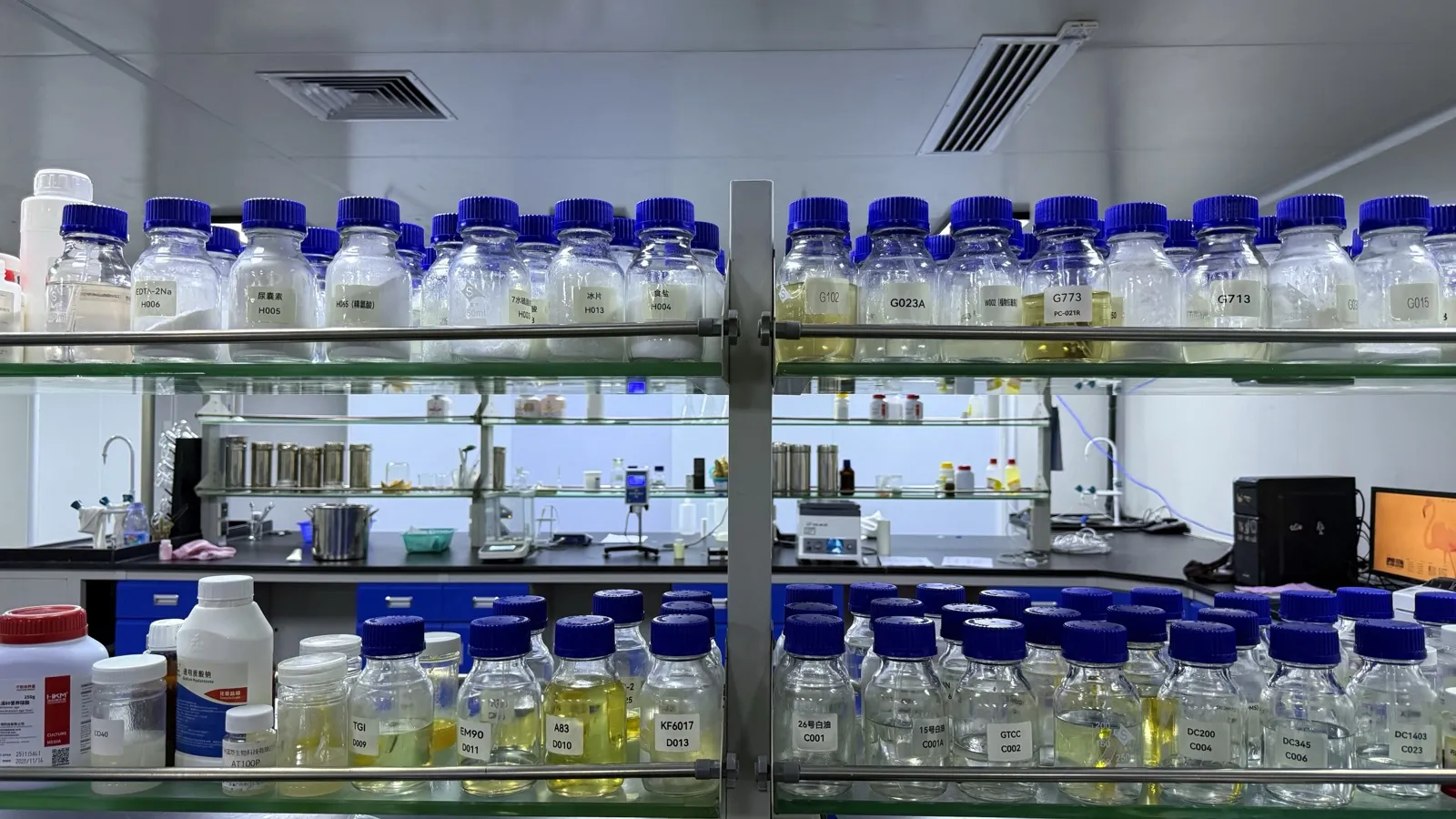
Raw material store · actives bought direct from BASF, Symrise, Croda and Dow Corning, so a transfer can keep the same grade rather than substitute.
This is the failure mode we see most often, and it is worth understanding before you sign anything.
A transfer only stays a transfer if the new factory can buy the identical grade from the identical supplier. The moment it cannot, it substitutes, and a substitution changes your composition under Annex I Part A point 1, which can pull your safety assessor back into a reassessment rather than an update. The pleasant five-month transfer becomes a reformulation project.
Whether that happens is decided by supplier relationships, not by good intentions. We buy directly from BASF, Symrise, Croda, Dow Corning, SEPPIC, Lubrizol, Shin-Etsu and DSM. Most European formulas built on premium actives are built on exactly these houses, which means in the majority of transfers we are buying the same material from the same producer rather than sourcing a local equivalent and hoping the sensory profile survives. Where we genuinely cannot match a grade, we flag it in week two with the reason, rather than at sampling when you have already committed.
Ask your candidate factory for its raw material sources by name. A factory buying premium actives through trading intermediaries cannot promise you grade continuity, because it does not control the chain.
Line matching, so your formula is not forced onto whatever equipment is free
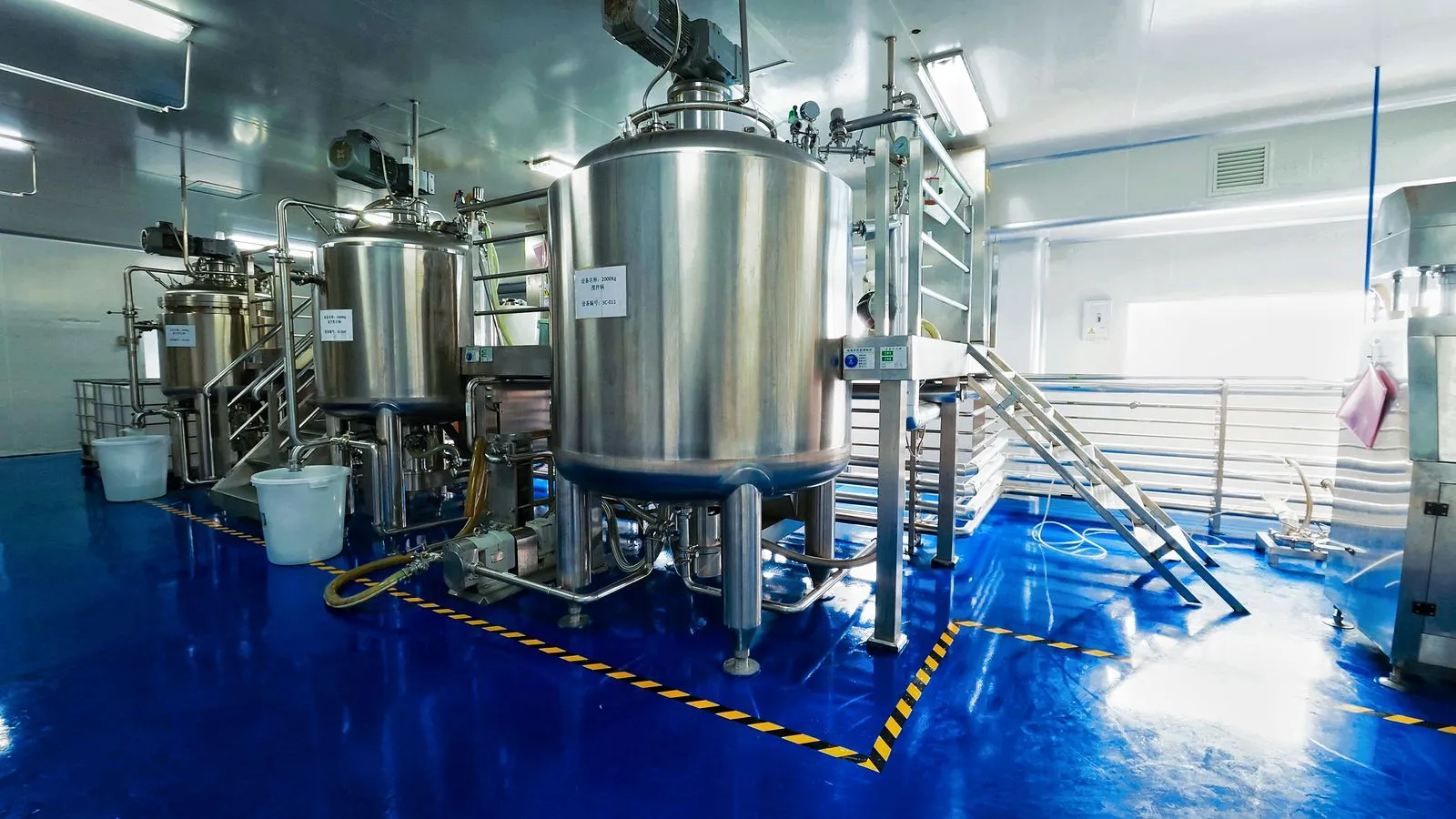
Vacuum emulsifying unit · homogeniser shear and heating and cooling curves are what a transferred emulsion has to be matched against.
Stability behaviour follows the process: homogeniser shear, heating and cooling curves, vacuum conditions, fill temperature. Reproducing an emulsion faithfully means matching that process, which requires having a line whose profile can be matched in the first place.
We run 13 production lines with capacity of over 200,000 units a day across skincare, body care, hair care and aromatherapy. The practical benefit in a transfer is choice: we select the line that fits your process rather than adapting your formula to the one line we have. A single-line facility cannot offer that, and the adaptation always lands on the formula.
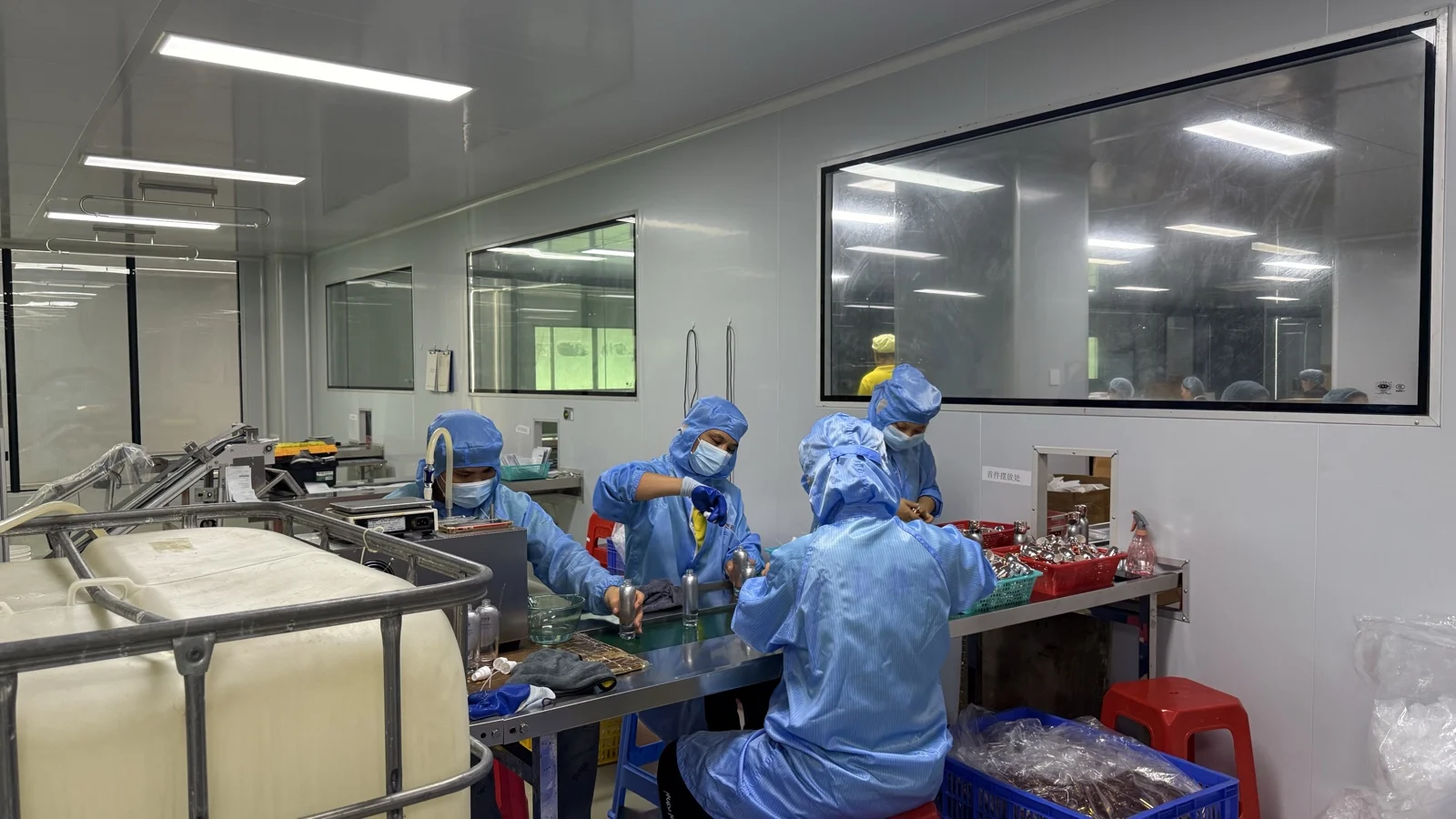
One of 13 filling and assembly lines · line choice is what lets a transferred process be matched instead of the formula being adapted.
Category breadth matters here too if you are moving a range. Skincare, body care and hair care under one roof means one transfer project, one quality baseline and one set of documentation, instead of three parallel transfers to three suppliers with three sample cycles. In practice that means an emulsion like a centella repair cream, a niacinamide body lotion and a silk repair conditioner can move on one timeline against one set of stability protocols.
Want these three answers in writing before you commit?
Send us the product you currently make in Europe and we will come back with the formulators assigned and iteration rounds included, a per-raw-material position on whether we can buy your exact grades, and which of our lines matches your process — with any grade we cannot match flagged up front rather than at sampling.
The quality system position, stated plainly
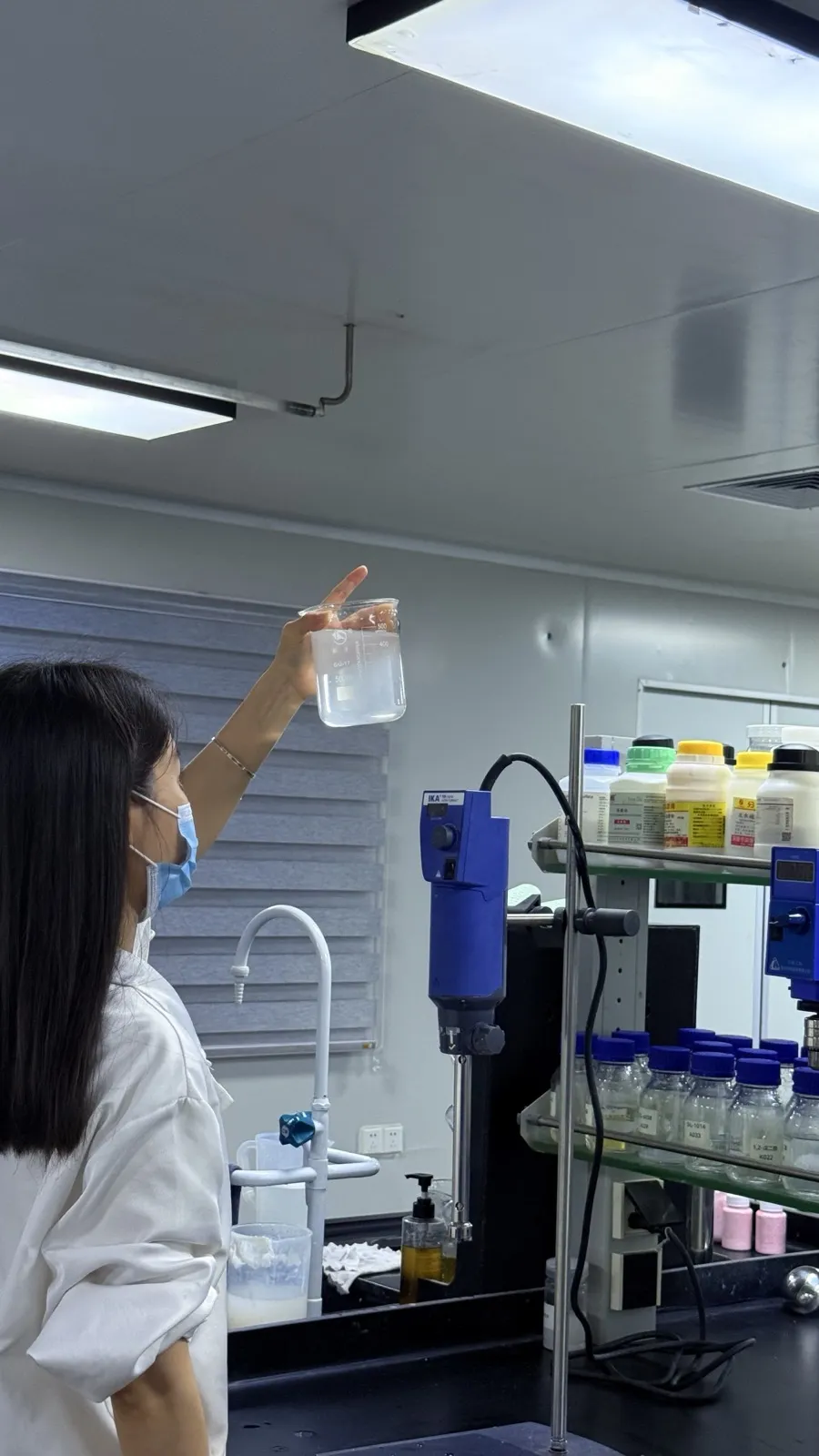
In-process quality check · the GMP position that Article 11(2)(c) requires to be stated in the file for the actual manufacturer.
Article 11(2)(c) requires the file to carry a GMP compliance statement for the actual manufacturer, so this is a document requirement rather than a marketing point. We hold ISO 22716:2007 cosmetics GMP under certificate HBPCER20260352 and GMPC under HBPCER20260353, both issued by Intertek on 16 July 2026 and valid to 15 July 2029, verifiable by anyone at certs.intertek.com.cn. Our facility is separately registered with the US FDA under MoCRA with FEI 3038966060, valid through 29 July 2028, which matters only if your transfer plan includes a later US entry.
We publish the numbers rather than describing the certificates because the check is the point. Certification is table stakes for any factory worth transferring to — it gets a supplier onto your shortlist, it does not distinguish them on it. The three capabilities above are what actually determine whether your transfer produces the same product.
The Case for Treating a Transfer as an Upgrade Window
Here is the argument most brands miss, and it changes the economics of the whole decision.
A faithful transfer requires you to re-run stability, re-run the preservation challenge test, update the safety report and amend your CPNP entry. That is the unavoidable cost of moving. But notice what it means: you are already paying for the full test and documentation cycle that a formula improvement would require.
Improving the formula during a transfer is therefore close to free on the compliance side. Doing it later, as a separate project, means paying for that same cycle a second time. Transfers are the cheapest moment in a product's life to upgrade it, and the one brands routinely spend on pure replication instead.
What that upgrade can be depends on the factory. We are authorised to apply a licensed portfolio of supramolecular delivery patents in our production, covering areas including PDRN delivery, supramolecular self-assembly carriers, Ectoin stabilisation systems, S-Pro-Xylane formulation technology, exosome encapsulation, freeze-dried active preservation, microneedle patch delivery and transdermal peptide delivery. The relevant point for a transfer is not the list; it is that a delivery-system change is exactly the kind of improvement that fits inside a re-test you are already funding. Freeze-dried preservation is the clearest example, because it changes the format rather than the declared active — our firming freeze-dried serum set keeps the active out of water until the moment of use, which is a shelf-life argument a liquid version cannot make.
Two concrete patterns from transfer projects:
- Same active, better delivery. Your existing formula's hero active stays declared as it is, but moves into a supramolecular carrier system to improve penetration of the stratum corneum. Your INCI story is undisturbed while the product performs differently on skin. This is the most common upgrade because it does not require rewriting your brand's claims.
- Reformulating for a second market while you are at it. If you are transferring partly because you are expanding beyond Europe, the same lab pass can adjust the formula for a hot and humid climate or a different regulatory annex. Producing in Europe and adapting later means a second full cycle.
We should be precise about what we are and are not claiming. These are licensed technologies we are authorised to apply in manufacturing, not efficacy guarantees, and any performance change has to be evidenced per project through the same testing as anything else. What we are claiming is narrower and more useful: the moment you are already re-testing is the cheapest moment to make the product better, and a factory with a delivery platform can act on that while a filler cannot. Our delivery technology platform sets out the areas in detail.
This is also the honest answer to "why transfer at all if unit cost is the only gain." For a brand at low volume selling only into Europe, unit cost alone probably does not justify the move. Unit cost plus a formula that performs better plus documentation that also serves ASEAN, the Gulf or the US is a different proposition, and it is the one that has made transfers worthwhile for the 25+ brands we produce for across three continents.
When We Tell Brands Not to Transfer
Four situations where we advise waiting, stated briefly because they are quick to check. You do not own your formula — some European suppliers work from their own catalogue formulations, in which case there is nothing to transfer and you are looking at a development project instead; check your agreement first, because this changes the scope completely. Your annual volume sits below the MOQ ladder — if 2,000 to 3,000 bottles is more than roughly a year of sales for that SKU, you will tie up cash and risk shelf life, so grow into it. You are mid-way through a retail listing or rebrand — continuity of supply expectations and transfer risk should not overlap. You need it in eight weeks — the stability gate is twelve weeks of accelerated testing, so either the timeline moves or someone ships product whose stability position is unsupported, and we will not be the ones to do that.
Considering a move from a European supplier?
Send us your current formula scope, SKU count, annual volume and target market. We will come back with a gap list and an honest read on whether a transfer is worth it for your volume — including if the answer is no.
Frequently Asked Questions
Can my Chinese factory be my EU Responsible Person?
No. Article 4 requires the Responsible Person to be a legal or natural person established within the Community, and Article 4(5) makes the importer the Responsible Person for an imported cosmetic product unless it designates another EU-established person by written mandate accepted in writing. A factory in Guangzhou cannot hold the role. Your options are your own EU entity, your importer or distributor, or a specialist RP provider.
Do I need a new CPNP notification when I change manufacturer?
Not a new notification, but amendments. Article 13 requires the country of origin in the case of import, which now becomes China, and the name and address of the Responsible Person where the file is accessible, which changes if your RP changed with the transfer. The product itself is not re-notified from zero, provided the formula is genuinely unchanged.
Can the new factory use the stability data from my European supplier?
No, and this is not a conservative reading. Annex I Part A point 2 requires the stability of the cosmetic product under reasonably foreseeable storage conditions, and point 3 requires the results of a preservation challenge test. Both describe the product as actually manufactured, so both are re-generated at the new site. Ingredient-level toxicological data under point 8 does carry over.
How long does a transfer really take?
Five to six months from decision to landed stock for a single straightforward SKU, driven by roughly twelve weeks of accelerated stability and challenge testing that cannot be compressed, plus file and notification work, plus 25 to 35 days of sea freight. A multi-SKU range takes longer unless you stagger it.
What if my European supplier owns the formula?
Then there is nothing to transfer and you are looking at a development project instead: a new formula built to match your product's performance and sensory profile, with its own sampling and testing timeline. Check your existing agreement before budgeting for a transfer, because this changes the scope completely.
Is it cheaper to keep one SKU in Europe and move the rest?
Sometimes, and it is an underused option. Split sourcing lets you keep a low-volume or launch-critical SKU on short domestic lead times while moving the volume lines where unit cost actually matters. The cost is two supplier relationships and two quality baselines, so it suits ranges where volume is unevenly distributed across SKUs.
The Short Version
Moving cosmetics production from Europe to China is a documented change to a legal file, not a supplier swap. Your formula, your ingredient toxicology, your claims and your CPNP entry stay yours. Your stability data, your preservation challenge test and your GMP statement do not travel, because Annex I ties them to the product as actually manufactured. And if your European manufacturer was your Responsible Person by operation of Article 4(3), the transfer removes it, because an imported product puts that obligation on an EU-established party under Article 4(5).
Plan five to six months, budget for re-testing and dual inventory rather than just the unit price difference, and get a written per-raw-material commitment before you sample. Then judge the receiving factory on the three things a transfer actually demands — formulator headcount to reverse engineer, direct access to the same raw material grades, and enough lines to match your process instead of adapting your formula to theirs.
And treat the move as an upgrade window rather than a replication exercise. You are already funding a full stability, challenge test and documentation cycle; making the product better inside that cycle costs a fraction of doing it as a separate project later. Transfer at volume, across categories, when you are expanding beyond Europe, or when your current supplier cannot develop the product further. If you sell a few hundred units a month into Europe alone and your formula is where you want it, staying put is very likely the right answer, and any factory worth transferring to will tell you so.
Ready to Start Your Project?
Tell us your product requirements. Our technical team responds within 24 hours with a detailed quotation.