
Cosmetic Manufacturing Companies: How the Lists Are Built (2026)
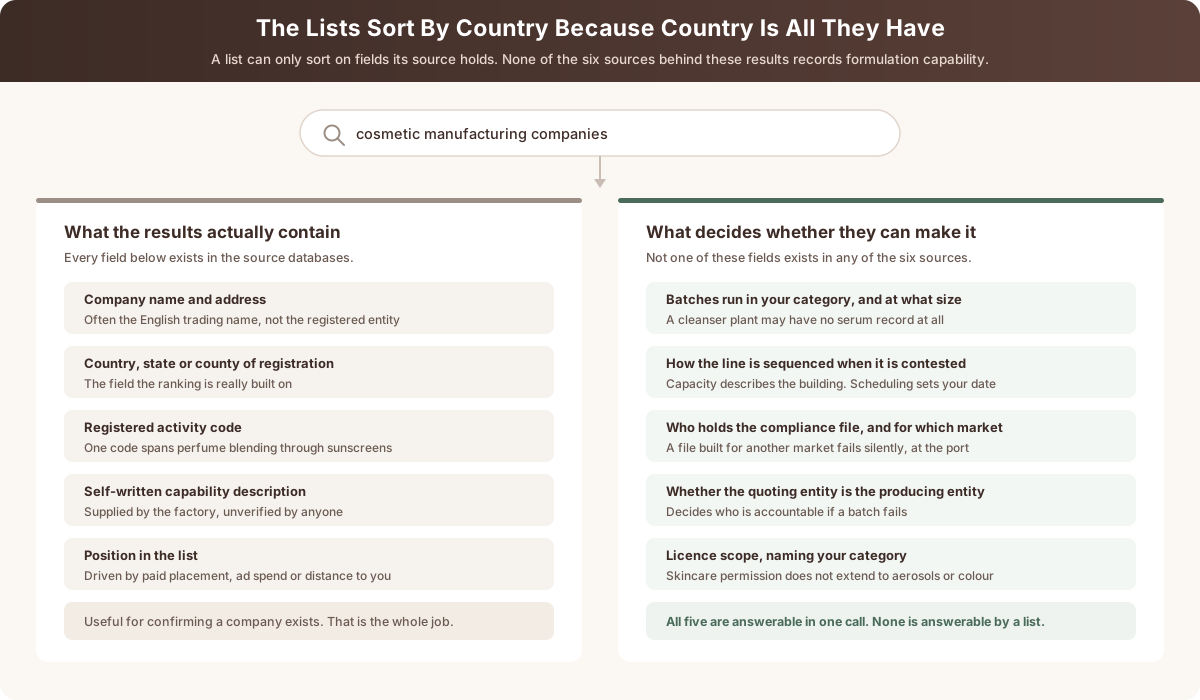
Search for cosmetic manufacturing companies and you get two kinds of results: ranked articles titled "Top 15 in the USA", and database pages listing every registered firm in a state or county. Both look like research. Both are filtering on something other than what you need.
Here is the mechanism, and it is worth understanding before you use any of these lists. A list can only sort on data its source actually holds. The six sources that produce nearly every cosmetic manufacturer list on the first page of results record company name, address, registered activity code, and contact details. Not one of them records whether a factory has ever stabilised an emulsion, held a vitamin C derivative at pH 5, or passed a preservative challenge test. So the lists sort by country of registration, because country is the one field every source has.
That is a shipping-distance filter presented as a quality filter. This article works through where the six sources come from, what each one can and cannot tell you, and the four questions that separate a factory that can make your product from one that merely appears near you in a database.
The Six Sources, and What Each One Is Actually Sorting On
Nearly every list traces back to one of six places. Once you can identify which, you know in advance what the list is blind to.
| Source | Sorts by | Records about capability | Blind to |
|---|---|---|---|
| Industry classification codes NAICS 325620, SIC 2844 | Registered activity code, then country | Nothing beyond the code itself | Category depth. Perfume blending and emulsion manufacturing share one code |
| Paid business directories | Who bought a listing, then distance to searcher | Self-submitted, self-described, unverified | Any factory that never bought a listing |
| Facility registration databases | Who filed a required declaration with a regulator | Identifier, address, contact. No lines, no output, no categories | Everything that decides whether they can take your order |
| Trade show exhibitor lists | Marketing budget and travel distance to the venue | Implies a real business actively selling to brands | Strong plants running near capacity, which often stop exhibiting |
| Editorial "Top N" articles | Whatever the publisher needed it to sort by | Compiled from each factory's own marketing copy | Anything the copy omits. Rank order rarely ties to a disclosed metric |
| B2B marketplace listings | Platform ranking, ad spend, response rate | Same catalogue template for factories and traders alike | The factory versus trading company distinction |
The rest of this article takes the two sources that mislead most often, then replaces the lists with four questions.
The Code That Puts Perfume and Face Cream in the Same Bucket
Most "how many cosmetic manufacturers are there" pages, and a good share of the directory listings behind them, trace back to a government industry classification code. In North America that code is NAICS 325620, Toilet Preparation Manufacturing. Its scope covers establishments preparing, blending, compounding and packaging toilet preparations, including perfumes, shaving preparations, hair preparations, face creams and lotions including sunscreens.

A fragrance like this one is why the code cannot be used as a filter. Producing it needs blending and alcohol handling, and no emulsification equipment whatsoever. It files under 325620 all the same, alongside the plant running jacketed emulsifying tanks with vacuum homogenisation, and alongside a company that only fills bulk cream someone else made. Here is what one code is holding.
| Grouped under the same code | What it actually needs | Can it make your moisturiser |
|---|---|---|
| Perfumes | Blending and alcohol handling. No emulsification equipment at all | No |
| Shaving preparations | Foam and gel systems, often pressurised. Aerosol lines carry separate permissions | Not without a cream line |
| Hair preparations | Surfactant systems and high-volume filling. Different tanks from a cream line | Sometimes, if it also runs emulsions |
| Creams and lotions | Jacketed emulsifying tank, vacuum homogeniser, stability testing capacity | Yes, if it has a record in your category |
| Sunscreens | Inside this code, yet a regulated drug in several markets with its own testing burden | Only with that specific registration |
| Contract fillers the one the code hides completely | Filling equipment only. Formulates nothing, and the code does not say so | No, but the listing looks identical |
Read that scope again as a sourcing problem. A company that blends fragrance concentrate into alcohol and a plant that runs a jacketed emulsifying tank with vacuum homogenisation carry the identical six-digit code. So does a firm that only fills bulk cream someone else made. The code was designed for economic statistics, where grouping similar-sounding activities is the point. It was never designed to tell a brand founder who can make their moisturiser.
The older SIC system draws the line in a different place, which is worth knowing if you are reading anything published before roughly 2000 or any dataset that still carries legacy codes. SIC 2844 is Perfumes, Cosmetics and Other Toilet Preparations. The two systems are not interchangeable groupings of the same firms, so counts quoted from one do not transfer to the other. If a page cites an industry figure without saying which system it came from, that figure cannot be reconciled with anything.
This matters because the code is upstream of a lot of what you read. Firm counts, "industry size" figures, and the underlying membership of many directory pages are all built by querying a classification. Every list inheriting from one inherits the same blind spot: it can tell you a company is in the cosmetics business, and nothing about which cosmetics.
The practical consequence is that a code-derived list is only useful as a starting universe, never as a shortlist. Treat it the way you would a phone book: fine for confirming a company exists, useless for deciding who to brief.
What a Facility Registration Number Proves, and What It Does Not
The second source is regulator-held facility data. Under the US Modernization of Cosmetics Regulation Act, facilities manufacturing cosmetics for the US market must register, and each registered site carries an FEI identifier. Similar registers exist in other jurisdictions.
We can be concrete about the limits here, because we are in that register ourselves. Our Guangzhou site holds US FDA facility registration under MoCRA with FEI 3038966060. That record establishes something real: the site has declared itself to the regulator, named a responsible contact, and accepted that it can be inspected. If a supplier quoting you for the US market cannot produce a registration, that is a genuine problem worth ending the conversation over.
But look at what the record does not contain. It does not say we run 13 production lines in 100,000-class cleanrooms, that stated capacity is over 200,000 units a day, that the site spans 16,000 m², or that we produce across 20 product categories with an in-house R&D team. Those operating facts help determine whether we can take a given order. None of them is established by the register itself, so each should be verified through the relevant facility evidence rather than inferred from the licence.
The confusion that costs brands the most is treating a registration as a quality credential. They answer different questions and are issued by different kinds of body.
| Facility registration | Quality system certification | |
|---|---|---|
| What it is | A declaration to a regulator that a site exists and manufactures | An audit finding issued after examining how the site operates |
| Who issues it | The regulator, on receipt of your filing | A certification body, against a published standard |
| Typical reference | An identifier such as an FEI number | A certificate number, issuing body, scope and validity dates |
| Is it optional | No, where the market requires it | Yes. ISO 22716 is a guidance standard, so certification is voluntary |
| What it tells you | A regulator knows the site exists and can inspect it | An auditor examined documentation, hygiene, and production control |
| How to verify | Search the regulator's public register by name or identifier | Confirm the certificate number with the issuing body, not the factory |
| Common misread | Treating an identifier as evidence of quality or approval | Accepting a certificate whose scope covers a different site or category |
So registration is a floor test, not a ranking input. Verify it, then move on to the questions that actually differentiate. What the audit behind a certificate examines is set out in our explainer on what ISO 22716 and GMPC certification cover.
Directories, Exhibitor Lists and Marketplaces: Three Different Selection Biases
The remaining sources are commercial, and each selects for a different thing that is not capability.
Paid directories select for who bought a listing, then sort by proximity to whoever is searching. Profiles are self-submitted and self-described, which means the sentence praising a supplier's "advanced formulation and flexible MOQs" originated on that supplier's own homepage. A capable factory that never bought a listing does not appear at all.
Trade show exhibitor lists are more useful than they look, because exhibiting costs real money and implies a real business. But they select for firms actively acquiring brand customers at shows. A plant running near full capacity on existing accounts has little reason to book a booth, and often stops exhibiting entirely. Selection by marketing budget is not selection by capability, and sometimes runs against it.
B2B marketplaces are where factories and trading companies are hardest to separate, because the platform gives both the same catalogue template, the same response-rate badge and the same certification upload field. Ranking reflects platform mechanics and ad spend.
None of this makes these sources worthless. It makes them a sampling frame with known biases. Use them to assemble candidates, then apply your own filter, because no source in the chain has applied one for you. The mechanics of that filter, layer by layer, are covered in our guide to verifying a skincare manufacturer against public registers.
Using the Six Sources Against Each Other
Each source is blind to something, but they are not blind to the same thing. That is the one useful property of the set, and it turns a pile of unreliable lists into a workable sequence. Run them in the order that eliminates fastest and costs least.
Start with the register, because it is the only source that can disqualify. Where your destination market requires facility registration, a supplier who is not in it cannot legally supply you, and no amount of capability makes up for that. This step is free, takes minutes, and removes candidates permanently rather than provisionally. Do it before you spend attention on anything a supplier has written about itself.
Use directories and marketplaces only to widen the name pool. Their bias is toward whoever paid, so read them as an index rather than a ranking. Ignore the order entirely; harvest the names. If a candidate appears in a directory but not in the register your market requires, you have already learned something without making contact.
Use exhibitor lists as a rough authenticity check. Booking a booth costs real money, so appearing on a recent exhibitor list makes a shell operation less likely. The inverse does not hold: absence proves nothing, because plants running near capacity often stop exhibiting. Treat presence as mild positive evidence and absence as no evidence at all.
Ignore the classification code once you are past the counting stage. It got you a universe. It cannot narrow it, and returning to it will only re-suggest firms you have already excluded on better grounds.
Notice what none of these steps did: none of them ranked anyone by whether they can make your product. Cross-referencing improves the candidate set without ever touching the question that decides the outcome. That question only gets answered in conversation, which is what the next section is for.
The Four Questions a List Cannot Answer for You
Once you have a candidate set, these four questions do the work the lists could not. All four are answerable in a first call, and all four produce evidence rather than adjectives. Ask them in order, because a failure at question one makes the rest irrelevant.

The phrasing matters more than it looks. A general question invites marketing copy back; a specific one forces either a record or an admission.
| The question that gets copy back | Ask this instead | What counts as a pass | |
|---|---|---|---|
| 1. Entity | "Are you a factory or a trading company?" | "What is your registered entity name, and will the quotation, licence and invoice all carry it?" | A registered name you can find in a public register, matching every document |
| 2. Category record | "Can you make serums?" | "How many batches of this category did you run last year, and at what batch size?" | A number, plus a licence or permit scope that names your category |
| 3. Scheduling | "What is your capacity?" | "If a larger account needs the line in my production window, what happens to my order?" | A stated sequencing rule and a minimum notice period on reschedules |
| 4. Compliance file | "Are your products compliant?" | "Which documents do you provide, which are mine, and which market was the existing file built for?" | A document-by-document split, and confirmation the file matches your market |
1. Am I talking to the entity that will make the product? The English trading name on a website is often not the registered manufacturing entity. Ask for the registered name, then confirm the quotation, the licence and the eventual invoice all carry it. A mismatch here is not paperwork pedantry; it decides who is accountable if a batch fails. A trading company can forward certificates belonging to a plant it buys from, but it cannot produce a production permission in its own name. Where the manufacturing relationship itself is being defined, settle the scope of the OEM engagement in the same conversation.
2. Which of my categories has this site actually produced, and at what scale? Not "can you make serums" but "how many serum batches have you run in the last year, at what batch size". A site strong in cleansers may have no serum record at all. The gap is real and it is specific: a plant that runs an amino acid foam cleanser every week is working with surfactant systems and a wide-mouth fill, while a multi-weight HA serum needs a different dosing accuracy and a different stability history. Ask to see the categories a site actually runs rather than the ones it lists as available. Ask for the licence or permit scope in writing and check it names your category, because a general skincare permission does not automatically cover aerosols, and a skincare site is not automatically cleared for colour cosmetics. An answer that arrives as a capability adjective rather than a batch count is itself the answer.
3. What happens to my order when a bigger account needs the line? Capacity headline figures describe the building. Scheduling describes your launch date. Ask how production is sequenced, what minimum notice you get on a reschedule, and whether your category shares equipment with a higher-volume line. This is the single most consequential question no directory has ever recorded. A factory with a real answer will describe a rule, because it has had to apply one; a factory without one will reassure you that delays do not happen, which is a claim no plant can make.
4. Who is holding the compliance file, and does it cover my market? A factory can be fully licensed at home and still hand you a dossier missing tests your destination market requires. Establish early which documents come from the factory, which are your responsibility as the party named on the label, and whether the existing file was built for a different market than yours. For the US specifically, the split is set out in our note on how MoCRA divides responsibility between brand and facility. The failure mode here is silent: nobody discovers the gap until a shipment is held.
Where This Leaves the Lists
Use them for what they are good at. A code-derived database confirms a company exists and is registered for the activity. A facility register confirms a site can legally supply your market. A directory or exhibitor list gives you names you would not otherwise have found. Those are real jobs, and doing them by hand would take days.
What none of them can do is rank factories by fit, because fit is a relationship between your product and their equipment, and no source in the chain records either side of that relationship. The ranking has to come from you, from four questions, in a call.
Put the four questions to us first
Send the product and the market you are targeting. We will answer the equipment, capacity, delay-rule and compliance-file questions in writing, including the parts where the answer is no.
Frequently Asked Questions
How many cosmetic manufacturing companies are there?
Any figure you see is a count of establishments registered under an industry classification code such as NAICS 325620, which bundles perfume blending, shaving preparations, hair preparations and creams and lotions into one category. The number therefore answers "how many firms are registered in this broad activity", not "how many could make my product". Figures quoted from the older SIC system are not interchangeable with NAICS counts, because the two systems group firms differently. Treat published counts as market-sizing context, not as a supplier universe.
Is a facility registration number the same as a certification?
No, and conflating them is a common and expensive mistake. A facility registration is a declaration to a regulator that a site exists and can be inspected; it carries an identifier such as an FEI number. A quality system certification such as ISO 22716 or GMPC is issued by a certification body after an audit against a standard, and names a scope and validity period. Registration says a regulator knows about the site. Certification says an auditor examined how it works. Ask for both, and verify certificate numbers with the issuing body rather than with the factory.
Why are these lists almost always scoped to one country?
Because country of registration is the one field every underlying source reliably holds. Classification databases are national by construction, facility registers are jurisdictional, and directories sort by proximity to the searcher. The scoping is a property of the data, not a judgement about where good factories are. A site with deep emulsion experience cannot appear on a list built from another country's register no matter how capable it is.
Should I ignore directories and marketplaces entirely?
No. They are efficient at the one task that is genuinely tedious: assembling candidate names across a wide field. The error is treating position in the list as a signal of quality when the sort is driven by paid placement, ad spend or distance. Use them to build the candidate set, then run your own verification, starting with the registered entity name and the permitted category scope.
What is the fastest way to tell a factory from a trading company?
Ask for the production licence or permit in the registered entity's own name and check that its scope names your product category. A trading company can forward certificates belonging to a plant it buys from, but it cannot produce a production permission in its own name. Follow up by asking to schedule a site visit for a specific week; the response to a concrete date is usually more informative than the answer to a general question about facilities.
Does a bigger factory mean a safer choice?
Not by itself, and size can work against you. Group-scale figures describe the organisation, not the line your product will run on, and a large plant with a full order book has more competing claims on that line than a mid-sized one. What matters is whether the specific site has a production record in your category and a stated rule for sequencing orders. Both are question two and question three above, and neither correlates reliably with headcount or revenue.
A supplier sent me certificates as image files. Is that enough?
No, because an image tells you what a document looks like, not whether it is currently valid. What you need from any certificate is four fields: the certificate number, the issuing body, the scope, and the validity dates. Then confirm those with the issuing body directly rather than with the supplier who sent them. Two failure modes are common enough to check for specifically: a certificate that is genuine but expired, and a certificate that is genuine and current but whose scope names a different site or a different product category than the one making your product. Neither shows up in a screenshot.
The list says a company is a "manufacturer". Can I rely on that label?
Not on its own. Most sources take the label from what the company entered about itself, and the underlying classification treats packaging and blending as part of the same activity as compounding. A firm that only fills bulk product formulated elsewhere is, by that definition, a manufacturer. The label is not dishonest, it is just coarser than your decision needs. The resolving test is the production licence or permit in the registered entity's own name, with a scope that names your category.
Ready to Start Your Project?
Tell us your product requirements. Within 24 hours, our technical team will reply with a quotation or the questions needed to prepare one.