
Anti-Aging & Firming Skincare OEM: Peptide Dosage Tiers
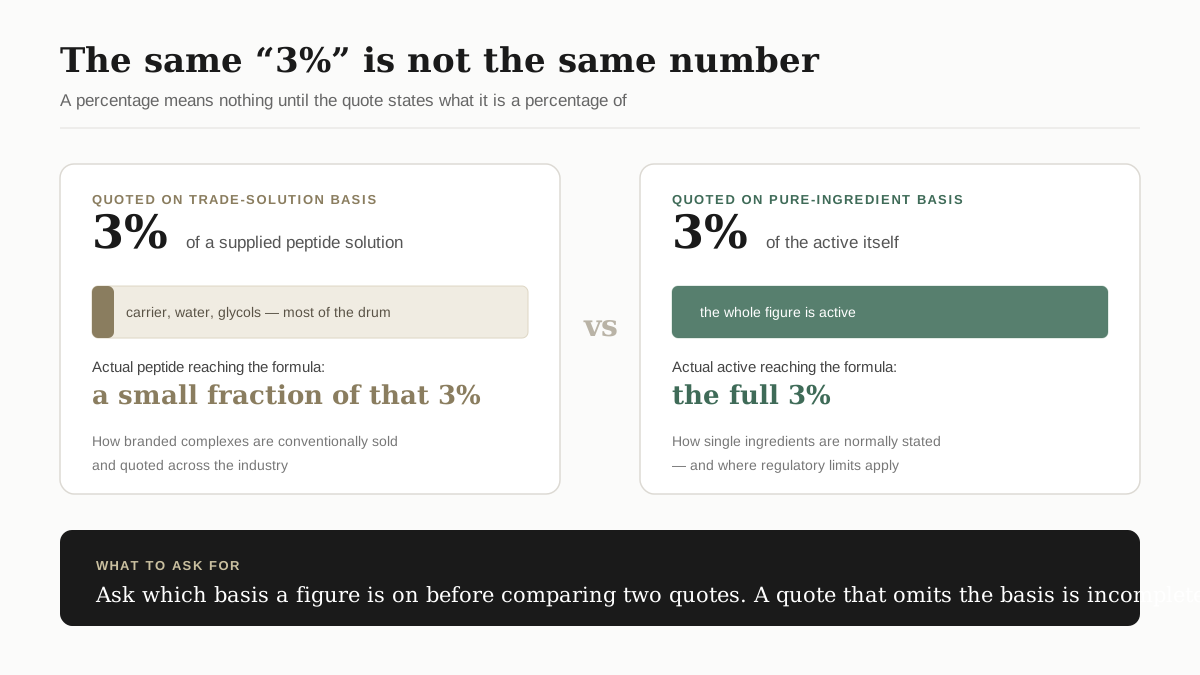
Ask three factories for an anti-aging skincare OEM quote on a 3% peptide serum and you can get prices that differ by a factor of ten. Every quote is honest. Every quote says 3%. The number means something different in each one.
This is the single most expensive misunderstanding in anti-aging sourcing, and it is not really about peptides. It is about the fact that a percentage on a spec sheet has no meaning until you know what it is a percentage of. Add two more variables that only show up later — how the claim is legally classified in your market, and how much active a given dosage form can physically carry — and the same brief produces three incompatible products.
This article works through all three, using the dosage tiers we actually formulate to across our anti-aging and firming lines. If you take one thing away: the hard part of an anti-aging line is not choosing an active, it is making sure the number in the quote, the claim on the label and the dosage form you picked are all describing the same product.
Why the Same "3% Peptide" Is Three Different Products
Peptides are almost never bought as pure powder. They arrive as trade solutions — a branded liquid where the peptide sits in a glycerin and water carrier at a very low true concentration. Matrixyl 3000 is the widely known example: the supplier product is a solution, and the palmitoyl tripeptide-1 and palmitoyl tetrapeptide-7 inside it are present at parts-per-million levels.
So "3%" can mean:
- 3% of the trade solution — the normal industry convention, and what we mean unless we say otherwise
- 3% of pure peptide — commercially unrealistic for most signal peptides, and a red flag that the person writing the brief is working from a blog post rather than a raw-material TDS
- 3% of a self-blended complex — where a factory has diluted something themselves and the true active load is unknowable from the outside
The gap between the first and second reading is where the tenfold price difference lives. This is why a quotation should state the basis explicitly, and why you should treat any anti-aging quote that does not state it as incomplete rather than cheap. The same discipline applies to how formulation cost is built up generally — the unit is as important as the number.
Industry Benchmarks and Regulatory Limits
The figures below are not our recipes. They are the reference points the industry already works from: supplier trade-solution conventions for the branded peptide complexes, and published regulatory or safety-assessment limits for the single ingredients. We formulate within them and adjust to your target market — but the numbers themselves are public knowledge, and any competent formulator will quote you against the same references. What differs between suppliers is not the benchmark; it is whether the basis is stated at all.
| Active | Customary working range | Basis | Where the limit comes from |
|---|---|---|---|
| Matrixyl 3000 Palmitoyl Tripeptide-1 + Palmitoyl Tetrapeptide-7 |
1–4% | Trade solution not pure peptide |
Supplier trade-solution convention, not a regulatory limit. No global cap applies. Cost scales almost linearly with dose, so this is the line item to model first. Used in our Matrixyl 3000 peptide serum. |
| Argireline Acetyl Hexapeptide-8 |
3–10% | Trade solution not pure peptide |
Supplier trade-solution convention, not a regulatory limit. Needs a much higher inclusion than Matrixyl for a comparable hero position — quoting "3% Matrixyl" against "3% Argireline" as if they were peers is a common briefing error. |
| Adenosine | 0.04% · up to 0.5% face · up to 1% body | Pure ingredient | Regulatory and safety-assessment based. 0.04% is the anti-wrinkle efficacy figure recognised in China and the exact level for Korea's reporting pathway. Upper end referenced to CIR use-survey data (2020): leave-on use reported up to 1% for body and hand, around 0.5% for face. See the adenosine note below. |
| Caffeine (firming / body contouring) | Form-dependent | Pure ingredient | No single figure applies across formats — a leave-on body cream, a hydrogel patch and a rinse-off scrub have physically different loading capacities. Discussed in the dosage-form section below. Used in products like our targeted lift and firm cream. |
| Oligopeptide-1 | ppm level | Pure peptide | No global concentration limit applies. The registration-critical point is identity, not dose: Oligopeptide-1 is not human oligopeptide-1 (EGF) — different materials, different regulatory treatment. Confirm which one a supplier means before you file anything. |
| Niacinamide (supporting role in anti-aging bases) | 1–5% above 5% is a different formulation problem |
Pure ingredient | Korea caps at 5%. No hard cap in EU or ASEAN, so beyond 5% the constraint becomes tolerance and compatibility rather than law: a high-niacinamide formula needs niacinamide as the sole hero active, with no AHA/BHA, retinol or pure vitamin C alongside it. |
Two things in that table do more work than the numbers. First, the Basis column: the two branded peptide complexes are quoted on a trade-solution basis, everything else on pure ingredient. Mixing those two bases in one comparison is how a quote ends up looking ten times cheaper than it is. Second, the source of the limit: Matrixyl and Argireline have no regulatory ceiling at all, so their ranges are commercial convention and can be discussed. Adenosine and niacinamide have real limits behind them, and those are not negotiable regardless of budget.
This also explains why the two peptides cannot be compared at face value. Argireline needs a substantially higher inclusion than Matrixyl to sit in a comparable hero position, so a brief that applies one multiplier across a whole line will overspend on some actives and underdose others.
The Adenosine Case: When 0.04% Is the Correct Answer
Adenosine is the clearest example of a dosage decision that is regulatory rather than technical, and it is worth understanding before you ask for "the strongest version".
0.04% is the standard tier because that is the anti-wrinkle efficacy figure recognised in China — if an anti-wrinkle claim is going onto a product bound for the Chinese market, this is the level the claim is built on. The same figure carries a second benefit: in Korea, landing exactly on 0.04% is what allows an anti-wrinkle functional cosmetic to use the reporting pathway rather than full review. One number, two market advantages.
Formulate at 0.2% instead and the product is not better positioned for either market — it has left both fast lanes. The enhanced tier of 0.1–0.5% and the top tier of 0.5–1% are real and usable: CIR survey data records leave-on use up to 1% for body and hand products, and around 0.5% for face leave-on. Because that 0.5% figure sits close to the highest reported facial value in the CIR survey, we do not advise exceeding 0.5% in a face leave-on product, and we position the top tier for body and hand applications where the survey supports it.
This is the pattern to watch for across the whole anti-aging category: a lower number is sometimes the more expensive engineering decision, because it was chosen to satisfy a market rather than to satisfy a spec sheet. It is also the kind of decision that cannot be made by the factory alone — we can tell you what each tier costs you in market access, but which market matters is yours to decide. This is one of the concrete things worth probing when you verify a factory's formulation capability.
Claim Classification Decides the Formula, Not the Reverse
Most anti-aging briefs arrive with the claim already written and the formula treated as an implementation detail. That order causes rework, because in several markets the claim determines what regulatory category the product falls into, which in turn constrains the formula.
Three boundaries come up constantly:
- Structural versus appearance claims. "Visibly reduces the look of fine lines" is a cosmetic claim. "Rebuilds collagen" is a physiological claim about tissue and belongs to a different product category in most jurisdictions. We write appearance-level throughout, and we do not write boosts collagen synthesis even on products built around collagen peptides.
- Contour versus firmness. On body firming and face-lifting products, claims that describe changing facial or body contours read as structural. Our standard wording across firming products is visibly firms and smooths the look of skin, and on our V-line lifting patch the claim stays at firming and lifting appearance — never face slimming or any change to contour, bone or fat structure.
- Functional-claim registration. In China, anti-wrinkle sits inside the functional-claim framework under the Cosmetic Supervision and Administration Regulation (effective 1 January 2021), which means efficacy evaluation filing — not simply a number on a label.
One more that catches brands importing a formula from a brightening line into an anti-aging line: in the United States, terms like lightening or claims to treat hyperpigmentation cross into drug territory. If your anti-aging serum also carries a tone-evening angle, the wording has to stay at visibly brightens, helps even the look of skin tone — the same boundary that governs a dedicated brightening product line.
Dosage Form Caps the Dose Before You Do
The third variable is physical. A dosage form has a load ceiling, and that ceiling often sits below the tier you wanted.
Caffeine makes this concrete. The same ingredient behaves as four different specifications depending on what it goes into:
| Dosage form | Relative loading capacity | Why the ceiling sits there |
|---|---|---|
| Leave-on body cream (firming, contouring) | Highest of the four | Leave-on, large surface area, no rinse step — the format that can carry the most active. This is the only caffeine format with a genuine multi-tier structure, where the level becomes a positioning decision rather than a physical constraint. |
| Hydrogel patch essence | Lowest of the four | A hydrogel matrix can only hold so much essence — this is a physical load limit, not a formulation preference, and the workable level is confirmed at sampling rather than assumed in advance. |
| Rinse-off scrub (coffee-grain form) | Not comparable | Here caffeine arrives as Coffea Arabica Seed Powder, so any percentage describes grain loading and scrub texture, not dissolved active. Comparing this figure with a body-cream figure is meaningless — and the workable loading is set by feel at sampling. |
| Rinse-off scalp product | Low | Short contact time makes higher loading pointless rather than harmful. Claims stay at scalp health and stronger-feeling hair. |
So "3% caffeine firming" is a coherent brief for a body cream and physically impossible for a hydrogel patch. If your line plan spans a cream and a patch, the two products need separate dosage decisions from the start — they cannot share one number. Our hydrogel eye patch and cool-sculpt firming cream are a useful pair to compare on this point: same active family, two entirely different loading realities.
One format sidesteps the ceiling instead of working under it. A single-dose freeze-dried delivery system is not diluted into a base at all, so the load it can carry is set by what dissolves at reconstitution rather than by what stays stable in a jar for two years. That is the practical argument for a multi-effect treatment set when the brief calls for a peptide level a leave-on cream cannot hold, and for a professional repair set where the channel is professional rather than retail. The trade is cost and timeline, covered in the lead-time table below.
What This Means for a Realistic Anti-Aging Line Plan
Putting the three variables together produces a different briefing order than most brands use. Instead of choosing actives first, work backwards:
- Fix the destination market. This decides claim classification and therefore which tiers are available — the adenosine and China functional-filing points above are both market-driven.
- Fix the dosage forms. Serum, cream, patch and body product have different ceilings. This decides which actives can carry a hero position at all.
- Then allocate active budget. Only now does the supporting-versus-hero decision become a cost question rather than a guess.
- State the basis in writing. Every percentage in the final spec should say whether it is trade solution or pure ingredient.
A practical line that follows this order tends to look like: one hero serum at the hero tier, a cream at the supporting tier sharing the same active story, and a patch or targeted product where the format itself is the selling point rather than the concentration. That structure keeps the active budget concentrated where it is visible and avoids paying hero-tier prices in a format that cannot carry the dose. A targeted repair patch is a good example of the third slot: the value sits in placement and occlusion, so it does not need to compete on active percentage. If you are still deciding on the commercial model behind the line, OEM versus ODM changes who owns those dosage decisions.
MOQ, Lead Time and Testing for Anti-Aging Products
Anti-aging and firming products tend toward the later part of our standard 35–60 day production window, and this is not padding. Peptide systems and higher-load emulsions need accelerated stability data before release, while freeze-dried formats add a separate process step and remain a specialist exception.
| Product type | MOQ per SKU | Lead time |
|---|---|---|
| Serum, essence-lotion, face cream | 3,000 bottles or jars | 35–60 days after approval |
| Firming and contouring body cream | 3,000 tubes | 35–60 days after approval |
| Collagen and hydrogel patches | 5,000–10,000 sheets | 35–60 days after approval |
| Freeze-dried serum sets | 3,000–5,000 sets | 50–70 days |
Accelerated stability testing runs inside these windows. Real-time oxidation studies, where a registration dossier requires them, are quoted separately and are not compressible into the lead times above. The freeze-dried band is longer for a structural reason rather than a scheduling one: a firming freeze-dried serum set carries the active in a dry state and pairs it with an activator, so lyophilisation and set assembly both sit inside the timeline. For the wider picture of what testing a factory should be running before production, see cosmetic stability testing.
Questions Worth Asking Any Anti-Aging OEM
- Is that percentage trade solution or pure peptide? A factory that cannot answer immediately is quoting from a price list rather than a formula.
- Which tier did you assume, and why? If the answer is "the standard one", ask what happens to the claim and the cost at the tier above and below.
- Does this dosage form actually hold that dose? Particularly for patches, gels and anything rinse-off.
- Which market did you write the claims for? Anti-wrinkle wording that passes in one market can trigger functional-claim filing or drug classification in another.
- What is quoted inside the lead time, and what is extra? Accelerated stability and real-time studies are not the same commitment.
Want a peptide quote that states the basis?
Send us the dosage form and target market and we will quote the active on a stated basis — trade solution or pure peptide, at a named tier — so the number can be compared against anyone else's.
Frequently Asked Questions
Is a higher peptide percentage always better for anti-aging results?
No, and the percentage alone does not tell you the active load. A 10% Argireline trade solution and a 3% Matrixyl 3000 trade solution are both hero-tier formulations; a 3% figure on an unnamed self-blended complex could be anything. Ask for the basis and the named raw material before comparing numbers.
Why would a factory recommend 0.04% adenosine when higher tiers exist?
Because 0.04% is the anti-wrinkle efficacy figure recognised in China, and it is also the exact level that lets an anti-wrinkle product use Korea's reporting pathway instead of full review. If either market is in the plan, the lower figure is the stronger commercial choice. If neither is, the 0.1–0.5% enhanced tier is generally more useful. Note that for face leave-on we do not advise going above 0.5%, since that is near the highest facial value in the CIR use survey.
Can we claim our product rebuilds collagen if it contains collagen peptides?
We do not write that claim. Topical collagen peptides form a film and hold moisture; they do not become your own collagen. Claims about collagen synthesis are physiological rather than cosmetic, and we keep wording at appearance level across every collagen product we make.
Can one anti-aging formula be used across a serum, a cream and a patch?
The active story can carry across all three, but the dosage numbers cannot. Each dosage form has a different load ceiling — a hydrogel patch essence tops out well below a leave-on cream — so each format needs its own specification even within one product line.
How long does an anti-aging product take to produce?
Standard serums, creams, firming body products and patches normally run 35–60 days after formula, packaging, and artwork approval. Freeze-dried serum sets remain a specialist exception at 50–70 days. Real-time oxidation studies for registration dossiers are quoted separately.
Do you adjust concentrations for cost targets?
Yes, within the tiers above and provided the result still complies with your destination market's rules. Dropping from a hero to a supporting tier is a legitimate cost lever; what we will not do is keep a hero-tier claim on a supporting-tier formula.
Ready to Start Your Project?
Tell us your product requirements. Within 24 hours, our technical team will reply with a quotation or the questions needed to prepare one.