
Value Line
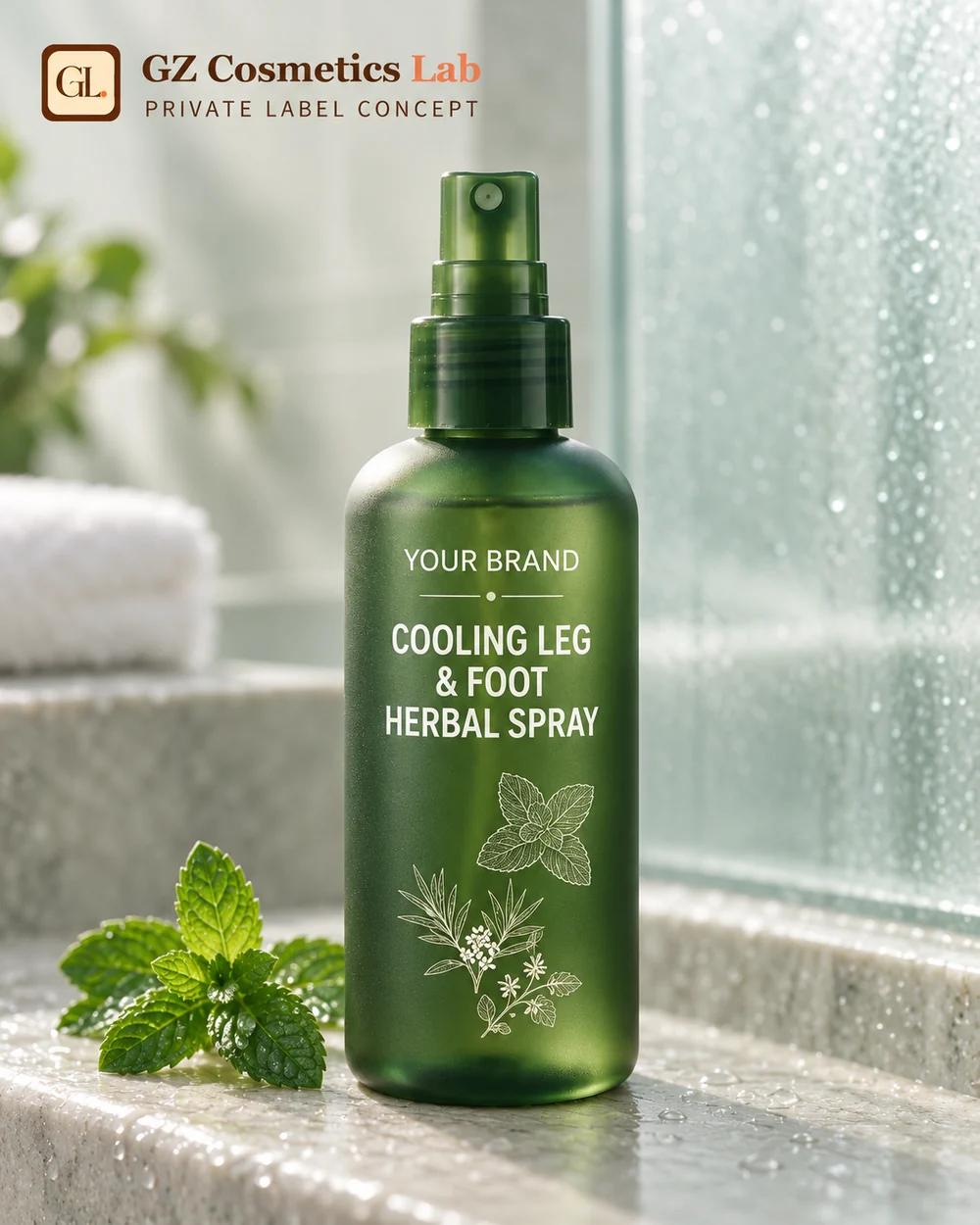
Cooling Leg & Foot Herbal Spray
Targets tired feet and calves after long periods of standing or walking, delivering a cooling, deodorizing, and mildly de-puffing effect.
Product Overview
| MOQ | 3,000 bottles / SKU |
| Lead Time | 45–55 days |
| Sampling | 3–4 weeks covering the cooling tier, spray pattern and dry-down time |
| Sizes | 100ml |
| Packaging | Spray bottle |
| Mini Pack | No - Used in SPA, No need for portable size |
| Suitable For | Retail, SPA, and nail salon clientele |
| Pricing | Quote-based — depends on menthol tier, witch hazel content and pump spec |
Quote response within 24 hours · Sample terms confirmed by project
Key Active Ingredients
How the Active Ingredients Work
A no-touch spray for legs and feet, which changes the formulation problem compared with a cream or roll-on: the product has to cover a large area from a distance, dry without leaving the feet slippery, and work inside footwear. Our menthol tiers run 0.05–0.3% baseline 0.1% light, 0.3–1% baseline 0.5% standard, and 1–3% baseline 2% for strong cold-sensation neck, shoulder and leg products. This SKU sits at the top tier with a 2% baseline, since a tired-legs spray is bought on the strength of the cold hit. The deodorising side of the brief is handled by the base rather than by an antibacterial active, which is a deliberate claim decision.
Menthol baseline 2% · range 1–3%
INCI: Menthol. The cold sensation comes from receptor activation rather than any temperature change, so the level sets the experience and nothing else. Our tiers are 0.05–0.3% baseline 0.1% light, 0.3–1% baseline 0.5% standard, and 1–3% baseline 2% for strong cold-sensation leg and foot products. Sprayed application spreads the dose over a wider area than a roll-on, so the top tier reads as refreshing rather than harsh here. In the US we describe this as a cooling sensation only: menthol positioned for anti-itch or pain relief is treated as an OTC drug active. In the EU, separate terpene restrictions cover products intended for children under three, so a family-positioned version is scoped as its own formula.
Peppermint supporting botanical
INCI: Mentha Piperita Oil. Provides the herbal lift that makes a foot product feel clean rather than medicinal, and supports the cool impression without raising the menthol. Level per project. Worth flagging for claim planning: US regulations list peppermint oil among the ingredients not recognised as effective for insect-bite and sting drug uses, so on a leg and foot product we keep it strictly sensory and never write anti-itch.
Tea tree supporting botanical
INCI: Melaleuca Alternifolia Leaf Oil. Carries the clarifying character and the ingredient-list recognition this category is bought on. The supportable claim set is soothing and oil-controlling: it helps balance surface sebum on feet and lower legs, gives a refreshing clean feel, supports pore cleansing, and helps visibly improve the look of congested, bumpy skin. What we do not write is antibacterial or antifungal, or that it treats athlete’s foot or odour-causing bacteria, because that wording moves the product toward a biocidal or drug classification depending on the market. Level is kept conservative because tea tree is a known sensitiser.
Witch hazel supporting astringent
INCI: Hamamelis Virginiana Water. Carries the astringent, tightening after-feel that makes the product read as de-puffing on tired legs, and contributes to the fast dry-down a spray needs. The claim stays at appearance and sensory level: a fresher, less tired look and feel. Level set per project against how sharp you want the after-feel.
Menthol–glycerin balance supporting humectant system
INCI: Glycerin. A high-menthol alcohol spray used daily on feet will dry skin out, and that is the predictable complaint in this format, so glycerin is in the formula as a counterweight rather than as a marketing ingredient. The level is a balance: enough to prevent tightness, little enough that the spray still dries fast and does not leave feet slippery. We set it on the approved sample.
Spray base and pump system supporting base system
The base and the pump are one decision, not two. An alcohol-forward base flashes cool and dries fastest, which suits an in-shoe product, but stings on shaved legs or broken skin; a lower-alcohol base is gentler and dries slower. Pump spec then decides whether you get a fine mist that covers a calf evenly or a wet jet that runs. Both are quoted together and confirmed on sample.
Formulation & Customization Options
| Service model | ODM (adjust our existing cooling leg and foot base) or full OEM custom development |
| Cooling intensity | Strong cold-sensation 1–3% menthol at a 2% baseline as standard; standard 0.3–1% or light 0.05–0.3% where the brief needs a gentler product |
| Base system | Alcohol-forward for fastest dry-down and sharpest cool, or reduced-alcohol for shaved legs, sensitive skin and markets where alcohol is a positioning issue |
| Spray pattern | Fine mist for even coverage on calves, or a wetter pattern for direct foot application; pump spec confirmed on the approved sample |
| Claim scope | Sensory and appearance level as standard. Antibacterial, antifungal, anti-itch and pain-relief wording is not supported and needs a drug or biocide route depending on market |
| Packaging | Spray bottle as standard in 50–100ml; a tight closure is worth specifying because menthol is volatile and this format is opened frequently |
| Certifications | ISO 22716 and GMPC certified facility; SGS testing supported on request. Halal, COSMOS and vegan scoping quoted to your requirement rather than held as a standing certificate |
Launch-fit guide
Who This Product Is Built For
Retail and hospitality staff channels
Long periods of standing is the core use occasion, and a spray wins over a cream because it can be used through tights and without touching the feet. That practical detail drives repeat purchase more than the botanical story does.
Travel and airline retail
The format suits a small pack and a use occasion people already recognise. We quote 50ml against carry-on limits and can run a smaller sampling size for the same base if you need a trial or gift-with-purchase SKU.
Foot care ranges that need the odour claim handled carefully
Deodorising is the most requested claim in foot care and also the fastest way into trouble, because an antibacterial mechanism claim is a different regulatory category. We handle freshness through the base and the botanicals, and write the claim at sensory level so it stays cosmetic in every market you ship to.
Cooling and base ranges
Top-tier 1–3% menthol at a 2% baseline by default, stepping down to 0.3–1% or 0.05–0.3% where the brief calls for less bite. Alcohol-forward or reduced-alcohol base. Fine mist or wetter spray pattern. All quotable against your price point.
Frequently Asked Questions
Can we claim it kills odour-causing bacteria?
No, and this is the claim we get asked for most in foot care. An antibacterial mechanism claim moves the product out of cosmetics and into a drug or biocidal route depending on the market, which means a registration you almost certainly have not budgeted for. What we do support is the sensory and appearance story: a fresh, clean feel and a less tired look. That sells the product without the classification problem.
What about the tea tree, can we say it is antifungal?
No. Tea tree is included as a botanical associated with freshness in foot care and we describe it at that level. Antifungal and antibacterial claims, and anything about athlete’s foot, are therapeutic claims that need a drug route. This is worth settling at briefing rather than at artwork, because tea tree on the front of pack is fine while the mechanism claim on the back is not.
Can we claim it relieves aching legs?
Not as a therapeutic claim. In the US, menthol positioned for pain relief is treated as an OTC drug active rather than a cosmetic ingredient. We write the cooling sensation and the use occasion instead: how it feels on tired legs after a long shift. That is an honest and sellable frame, and it is the one that keeps the product cosmetic.
Alcohol-forward or reduced-alcohol base?
Alcohol-forward if fast dry-down and the sharpest cool matter most, which is the usual choice for an in-shoe or post-shift product. Reduced-alcohol if the product is going onto shaved legs, if sensitive skin is in the brief, or if alcohol content is a positioning problem in your market. The trade-off is real: gentler means slower drying, and on a foot product that matters.
Will the de-puffing claim hold up?
At appearance level, yes: a fresher, less tired look and feel is what the witch hazel and the cooling deliver, and that is how we write it. What we will not write is a claim about reducing fluid or swelling, which is physiological and belongs to a different category. If your market requires substantiation for even appearance-level wording, tell us at briefing and we will scope what testing that needs.
What are the MOQ and lead time?
MOQ is 3,000 bottles per SKU and lead time is 45–55 days after sample approval, including stability testing. Sampling runs 3–4 weeks and covers the cooling tier, the spray pattern and the dry-down time together, since those three interact. This is our standard ODM baseline, adjustable for your target market and price point.
Customization
OEM/ODM supported
Target Markets
Certifications
ISO 22716 & GMPC certified; SGS testing supported upon request


Need a Custom Cooling Leg & Foot Herbal Spray Formula?
Tell us your requirements — target actives, texture, packaging, quantity, and target market. Within 24 hours, we will reply with a quotation or the questions needed to prepare one.
Response within 24 hours · WhatsApp available · Factory visits welcome