

Value Line
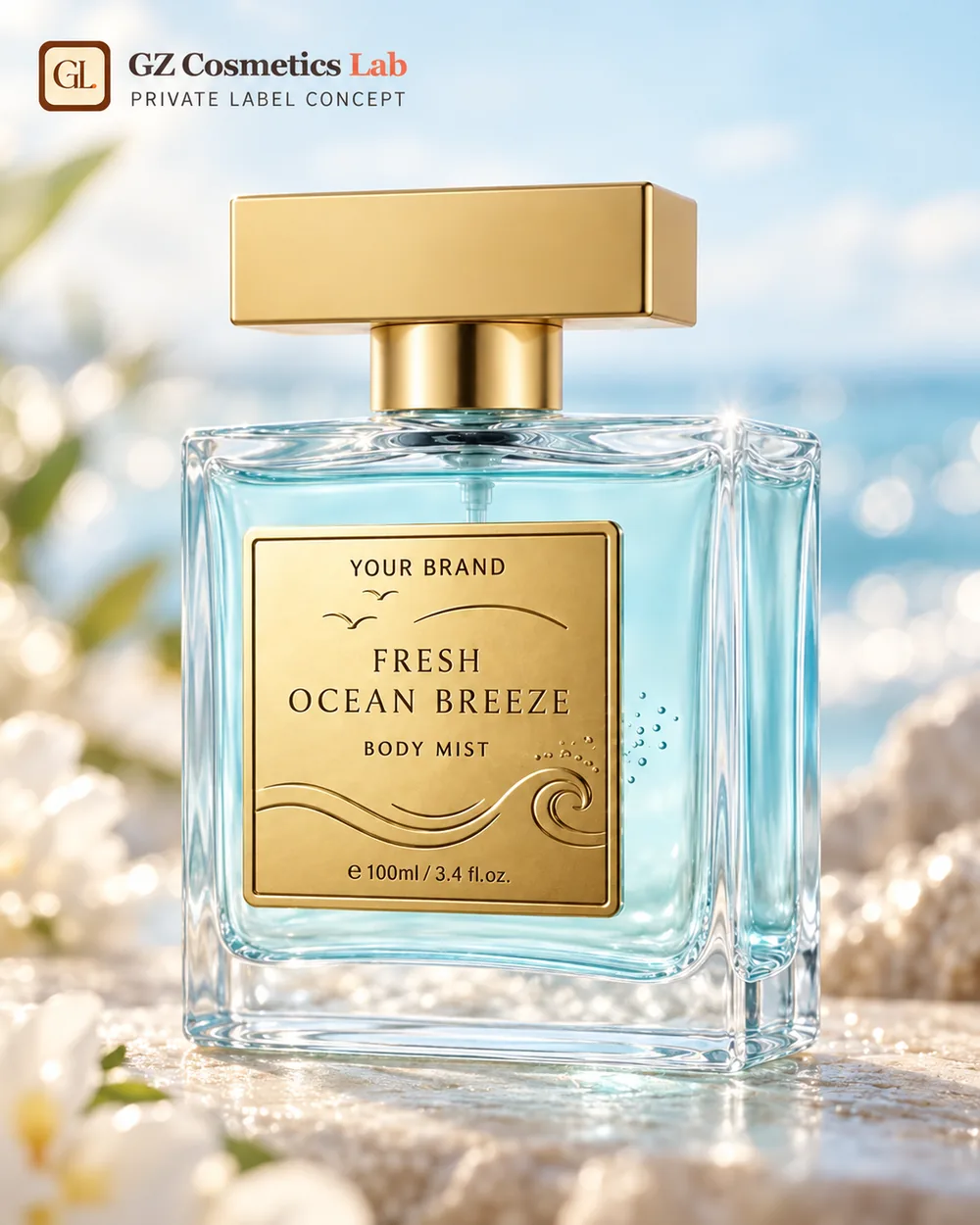
Fresh Ocean Breeze Body Mist
A light body mist with a fresh aquatic fragrance and moisturizing base for an easy, all-over scent refresh. Clean and casual, ideal for young adults who want a subtle daily fragrance between showers.
Product Overview
| MOQ | 3,000 bottles / SKU |
| Lead Time | 45–55 days |
| Sampling | Fragrance submission 2–3 weeks, then 2–3 weeks for the finished sample including the preservative efficacy and stability window |
| Sizes | 100ml |
| Packaging | Spray bottle |
| Mini Pack | Yes - Sample size1-3ml / Travel spray 10ml |
| Suitable For | Daily use for young adults |
| Pricing | Quote-based — depends on fragrance oil cost, the hydrating additives specified, bottle and sprayer, and order volume. A mist is the most accessible entry point in a fragrance range because the low oil load and the 100 ml plastic-or-glass pack both keep unit cost down. |
Quote response within 24 hours · Sample terms confirmed by project
Key Active Ingredients
How the Active Ingredients Work
A body mist is the lightest fragrance concentration tier, built here at 1–3% oil with a fresh aquatic accord and a hydrating base. Two things make this format technically different from the eau de toilettes in this range rather than just weaker: the mist carries water and humectants, which means it needs a preservative system and microbiological testing that an alcohol-dominant fragrance does not, and it is applied over the whole body at close range, which is what keeps the oil load low.
Fragrance Oil (Parfum) baseline 2% · range 1–3% (body mist tier)
INCI: Parfum. The body mist tier runs 1–3% of the finished formula with baseline 2%, against a 5–15% band for an eau de toilette. The low load is deliberate: a mist is applied generously over the whole body and often reapplied through the day, so an EDT concentration in a mist format becomes overwhelming rather than luxurious. Industry practice treats 1–2% as a light daily mist and 3–5% as body spray strength, so baseline 2% is a mist in the proper sense rather than a spray sold as one. An aquatic accord suits the tier well because the style reads clean and airy at low concentration where a heavy oriental would simply smell thin.
Alcohol and water carrier the balance of the formula
INCI: Alcohol Denat., Aqua. A mist carries substantially more water and less alcohol than an eau de toilette, which is what makes it gentler on skin and less sharp on application. The trade-off is directly technical: a formula with meaningful water content supports microbial growth, so it needs preservation and testing that a high-alcohol fragrance can do without. The alcohol-to-water ratio also determines the spray character and how quickly the mist dries.
Glycerin and hydrating additives typically 1–3% total humectant
INCI: Glycerin, with panthenol or a light humectant blend where the brief calls for it. This is what distinguishes a body mist from a diluted fragrance and it is worth being precise about the claim: a humectant at this level gives a light conditioned feel on application. It does not make the product a moisturiser, and we would not write it as one, because a leave-on mist that dries within a minute is not delivering meaningful barrier support. Positioning it as a refresh with a soft skin feel is accurate.
Preservative system to the challenge-test result
The point most often overlooked when a brand moves from an EDT to a mist. Water content plus a spray applicator plus repeated use makes preservation a genuine requirement rather than a formality, and the system is set by challenge testing rather than by a standard dose. This is a real part of why the lead time sits at 45–55 days: the preservative efficacy work and the stability window run before the formula is released to production.
Solubiliser and clarity system adjusted to the oil load
A lower alcohol proportion makes holding the oil clear harder, not easier, despite the smaller oil load, because the alcohol is doing less of the solubilising work. The solubiliser is dosed against the specific compound and the batch is filtered before filling. A hazy mist in a clear 100 ml bottle is the most common cosmetic defect in this format.
IFRA compliance and allergen declaration calculated on the finished formula
IFRA categories are set by how a product is used, and a leave-on body product applied over a large skin area sits in a different category from a face product or a fine fragrance. The limits are therefore not the same as on the eau de toilettes in this range even though the oil load is lower. We run the calculation for the correct product category and supply the certificate, with the 26-allergen declaration reported per lot.
Formulation & Customization Options
| Concentration tier | Body mist at baseline 2% within a 1–3% range as standard; the same accord can be built at body spray strength around 3–5%, at EDT strength within 5–15%, or at EDP strength within 15–20% for a tiered range |
| Hydrating base | Glycerin as standard, with panthenol or a light humectant blend where the brief wants a more conditioned finish; kept light so the mist dries without tackiness |
| Alcohol level | Adjustable for spray character and skin feel, or an alcohol-free build as a separate development where the market or the positioning requires it |
| Fragrance direction | Notes are customisable — the aquatic can lean greener and sharper or softer and more musky, and a fruity opening is a common request in this format |
| Packaging | 100 ml spray bottle as standard, from the pack formats we run in production; sprayer selection matters more here than on a fine fragrance because a mist needs a wide, soft spray rather than a concentrated jet |
| Documentation | IFRA certificate for the correct product category, 26-allergen declaration, preservative efficacy report, COA, MSDS, stability report |
Launch-fit guide
Who This Product Is Built For
Brands wanting the lowest-risk entry into fragrance
A mist is where most brands should start. The oil load is low, the pack is inexpensive, the retail price is impulse-level, and a 3,000 bottle MOQ across two or three scents costs less than a single EDT launch.
Gen Z and student-facing e-commerce
A 100 ml mist at an accessible price is the format this demographic actually buys, often several at a time and used as a scent wardrobe rather than a signature. Collectability is the commercial mechanic, which argues for launching multiple scents rather than one.
Hot-climate daily use
A light aquatic mist works as a between-showers refresh in Manila or Bangkok in a way an oriental EDP does not. The format and the accord are both matched to that use, and it is the highest-repurchase fragrance format in humid markets.
Gym, sport, and travel channels
Applied over the body, gentler than an alcoholic fragrance, and available in a 10 ml travel format. This is a range extension that fits activewear and travel retail assortments where a glass fine-fragrance bottle does not.
Frequently Asked Questions
How is a body mist different from a diluted eau de toilette?
It is a different formula rather than a weaker one. A mist runs 1–3% fragrance oil against a 5–15% band for an EDT, but it also carries significantly more water, includes humectants for skin feel, and therefore needs a preservative system and microbiological testing that a high-alcohol fragrance does not. Simply diluting an EDT with alcohol gives you a thin EDT, not a mist.
Does the hydrating base actually moisturise?
It gives a light conditioned feel on application and we would not claim more than that. A product that dries within a minute is not delivering meaningful barrier support, and positioning a mist as a moisturiser invites a comparison it will lose. If genuine moisturisation is part of the brief, a scented body lotion is the right format and the fragrance load there sits at 0.5–2%.
How long does the scent last?
Less than an EDT, which is inherent to the tier rather than a fault. A mist is designed for reapplication, which is why it comes in 100 ml rather than 50 ml and why the price point supports using it freely. If longevity is the priority, the same accord at EDT or EDP strength is the answer.
Why does a mist take as long to produce as a fine fragrance?
Because of the water content. The preservative system has to be set by challenge testing and the formula has to clear its stability window before production, which is work an alcohol-dominant fragrance largely avoids. That is why this sits in our 45–55 day bracket alongside the eau de toilettes rather than in the faster bracket we quote for a simple lotion.
Can it be used on hair as well as skin?
Many brands position mists that way and it is a reasonable extension, but it changes the brief rather than being a free claim. A hair application usually wants a lower alcohol level to avoid drying and often a conditioning agent, and the IFRA assessment covers the use you actually declare. Tell us at brief stage if hair use is intended so the formula and the assessment match the label.
Can we claim it is refreshing or cooling?
Describing it as a refresh is normal and we supply that wording. A cooling claim is different: a genuine cooling sensation comes from a functional ingredient such as menthol, which is not in this formula, so claiming it without the ingredient is unsupportable. If you want an actual cooling effect we can formulate for it, and the level then has to be checked against the rules in each market you sell into.
Customization
OEM/ODM supported
Target Markets
Certifications
ISO 22716 & GMPC certified; SGS testing supported upon request

Need a Custom Fresh Ocean Breeze Body Mist Formula?
Tell us your requirements — target actives, texture, packaging, quantity, and target market. Within 24 hours, we will reply with a quotation or the questions needed to prepare one.
Response within 24 hours · WhatsApp available · Factory visits welcome