
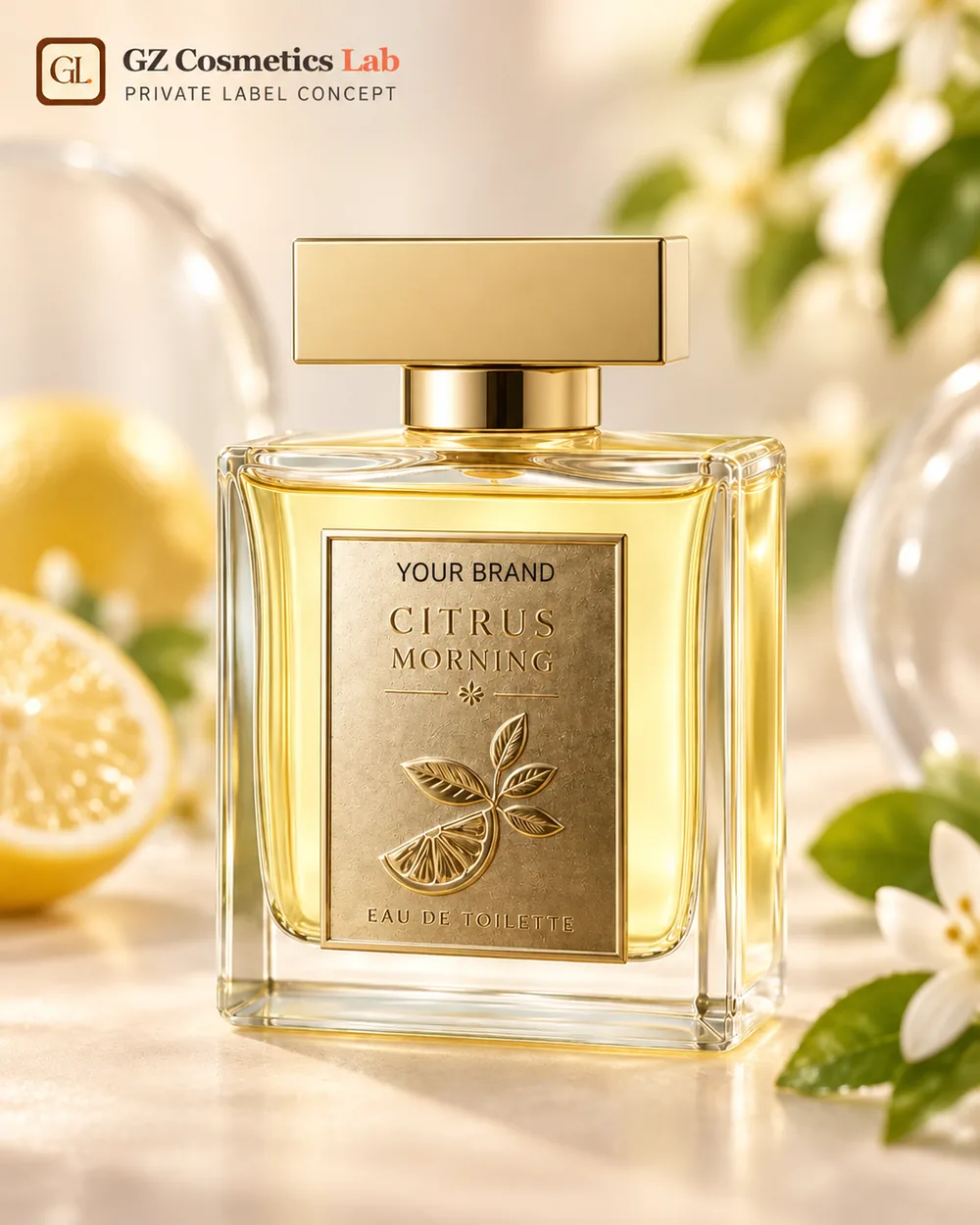
Value Line
Citrus Morning Eau de Toilette
Led by a fresh citrus top note, this eau de toilette makes an easy everyday commute fragrance, suited to men and women alike.
Product Overview
| MOQ | 3,000 bottles / SKU |
| Lead Time | 45–55 days |
| Sampling | Fragrance submission 2–3 weeks, then 2–3 weeks for the finished sample after maceration and stability |
| Sizes | 30–50ml |
| Packaging | Glass bottle |
| Mini Pack | Yes - Sample size1-3ml / Travel spray 10ml |
| Suitable For | All skin types, outdoor sports/commute/reapplication scenarios |
| Pricing | Quote-based — depends on fragrance oil cost, concentration tier, bottle and cap tooling, and order volume. Citrus-led accords are generally less expensive per kilo than oriental or amber directions. |
Quote response within 24 hours · Sample terms confirmed by project
Key Active Ingredients
How the Active Ingredients Work
A citrus-led eau de toilette, built at the EDT tier with a fresh top note over light florals and a woody base. Citrus fragrance brings one specific technical constraint that the florals on our other scents do not: the materials are volatile and prone to oxidation, and some expressed citrus oils are phototoxic. Both facts shape the formula and the packaging rather than being footnotes.
Fragrance Oil (Parfum) baseline 8% · range 5–15% (EDT tier)
INCI: Parfum. The EDT tier runs 5–15% of the finished formula and baseline 8% sits mid-band, where an everyday unisex commute fragrance is comfortable. A citrus-forward accord reads brighter than its concentration suggests on first spray, which is why pushing this direction to the top of the band often adds cost without adding much perceived strength. The compound is quoted and dosed on the finished-formula basis.
Citrus top note and phototoxicity restriction calculated on the finished product
Expressed citrus oils such as bergamot, lemon, and bitter orange contain furocoumarins and carry IFRA phototoxicity restrictions that apply to the finished product at its real concentration. Where several such oils appear together, each is expressed as a percentage of its own limit and the total must not exceed 100, which is the rule most briefs miss. Two routes exist: build within the limits, or specify furocoumarin-free grades and remove the constraint at a higher material cost. Which route suits depends on whether your channel can carry a sun-exposure instruction.
Alcohol Denat. the balance of the formula
INCI: Alcohol Denat. Cosmetic-grade ethanol with water to adjust the final strength. The denaturant permitted and the duty treatment of the alcohol both vary by destination, and both move landed cost more than most brands expect, so it is worth settling at quotation rather than at shipping. Alcohol strength also changes how sharply the citrus opens.
Antioxidant and UV absorber low level, functional
This is the additive set that matters most on a citrus fragrance. Citrus materials oxidise faster than any other group, and oxidised limonene smells flat while also being the form associated with sensitisation. An antioxidant and a UV absorber slow that in the bottle. It is a formulation measure rather than a substitute for packaging: a clear glass bottle under retail lighting is the demanding case, and light protection in the pack does more than any additive can.
Solubiliser and clarity system adjusted to the oil load
Dosed against the specific compound so the juice stays bright, then chill-filtered before filling. Citrus compounds with a high terpene content are among the harder ones to hold clear at low temperature, and haze in a transparent bottle reads as a fault on arrival even when the fragrance is sound.
IFRA compliance and allergen declaration calculated on the finished formula
Citrus accords are allergen-dense by nature — limonene, linalool, and citral appear routinely — so the 26-allergen declaration on this direction is usually longer than on a woody or musky one. That is a labelling consequence rather than a safety problem. We run the IFRA calculation on the finished formula and supply the certificate and per-lot allergen breakdown with the documentation pack.
Formulation & Customization Options
| Concentration tier | EDT at baseline 8% within the 5–15% EDT band as standard; the accord can also be built at body mist strength for a lighter range extension |
| Citrus material grade | Standard expressed oils formulated within the phototoxicity limits, or furocoumarin-free grades where a sun-exposure instruction is not workable for your channel |
| Fragrance direction | Notes are customisable — the citrus can lean sharper and greener or rounder and sweeter, and the woody base can be reduced for a cleaner finish |
| Packaging | Glass bottle as standard; light protection through tinted glass, coating, or a full carton is the point worth discussing on a citrus juice |
| Fill sizes | 30–50 ml as standard, with 1–3 ml sample vials and 10 ml travel sprays for seeding |
| Documentation | IFRA certificate, 26-allergen declaration, furocoumarin data where expressed oils are used, COA, MSDS, stability report |
Launch-fit guide
Who This Product Is Built For
Brands wanting a genuinely unisex first scent
A clean citrus opening is the least divisive fragrance direction there is, which makes it the usual choice for a brand that wants one launch SKU to serve both men and women rather than splitting a small budget across two.
Sellers in hot, humid markets
Citrus and aquatic directions hold up in heat where an oriental or heavy floral turns cloying. That is a real advantage across the Philippines, Thailand, Malaysia, and Vietnam rather than a marketing line.
Corporate and hospitality gifting programmes
A fresh, inoffensive scent in a 30 ml bottle is the practical format for volume gifting, where the recipient has not chosen the fragrance and the safest direction is the one fewest people dislike.
Brands with daytime and outdoor positioning
If the product is sold for commuting, sport, or beach use, the phototoxicity question stops being paperwork. Specifying furocoumarin-free grades removes the sun-exposure instruction from your label, and that is a decision to take before formulation rather than after artwork.
Frequently Asked Questions
What concentration is it, and how does that compare to your other fragrances?
The oil load is 8%, sitting mid-band in the 5–15% range that defines an eau de toilette. For reference across our range: a body mist runs 1–3%, an EDT 5–15% with baseline 8%, and an eau de parfum 15–20% with baseline 15%. Those tiers are what drive both the wear time and most of the cost difference between the formats.
Why does a citrus fragrance need a sun-exposure warning sometimes?
Cold-pressed citrus oils contain furocoumarins, which are phototoxic, and IFRA restricts them in the finished product. Formulating within the limits is one route. The other is to use furocoumarin-free grades, which removes the restriction and the label instruction at a higher material cost and with a slightly less vivid top note. Tell us which markets and channels you are selling into and we will build to the route that fits.
Will the scent fade faster than a floral or woody fragrance?
The top note will, because citrus materials are chemically light and volatile. That is the material behaving normally rather than a quality problem, and it is why a citrus accord is built over a woody or musky base that persists after the opening has gone. If longevity is the main requirement, the EDP tier is a more honest answer than reformulating the citrus to do something it cannot.
Why is the allergen list longer than on your other scents?
Citrus materials naturally contain limonene, citral, and linalool, which are on the EU list of 26 declarable fragrance allergens. A longer declaration reflects the composition rather than a higher risk, and it is a labelling requirement, not a warning. We provide the per-lot breakdown so your artwork can carry exactly what applies.
Can we say it energises or wakes you up?
We keep it to scent description and occasion. Wording that a fragrance energises, boosts alertness, or affects mood pushes toward a therapeutic claim in several markets and the evidence expectation that follows is not what a fragrance dossier is built for. Describing a bright citrus opening and a morning occasion does the same commercial job without taking on that exposure.
Can you supply an alcohol-free version?
Not as a substitution. Removing the ethanol changes the delivery system, so it becomes a different formula with different solubiliser levels, a different spray character, and its own preservation and stability programme. It is available as a separate development, and it is the route to look at if a Halal-certified range is the objective, since an ethanol-based fragrance will not pass those schemes.
Customization
OEM/ODM supported
Target Markets
Certifications
ISO 22716 & GMPC certified; SGS testing supported upon request
Need a Custom Citrus Morning Eau de Toilette Formula?
Tell us your requirements — target actives, texture, packaging, quantity, and target market. Within 24 hours, we will reply with a quotation or the questions needed to prepare one.
Response within 24 hours · WhatsApp available · Factory visits welcome