
Private Label Rinse-Off Hair Masks: Texture, Pack Size and Sample Acceptance
A rinse-off hair mask sample deserves attention in four settings: in the pack, during application, during rinsing and on dry hair before the next normal wash. If the review stops at how rich the jar looks or how thick the product feels in the hand, it can miss an awkward tube or a heavier feel than the brand wants alongside its conditioner.
This guide is for brand owners and buyers preparing a private label hair mask project. It turns texture, dispensing and pack size into inputs a supplier can answer: what job the mask has next to your daily conditioner, how samples are compared under each supplier's own instructions, what the rinse and dry-hair observations do and do not tell you, and how to write the pack quantity request. It ends with a fictional worked example that goes from a round of samples to a clear accept / revise / still open handoff.
The short version: approve a direction from the sample, not a finished product. Pack format, final packaging, stability, compatibility and claim support are separate confirmations, and the quote is only comparable once those items are listed.
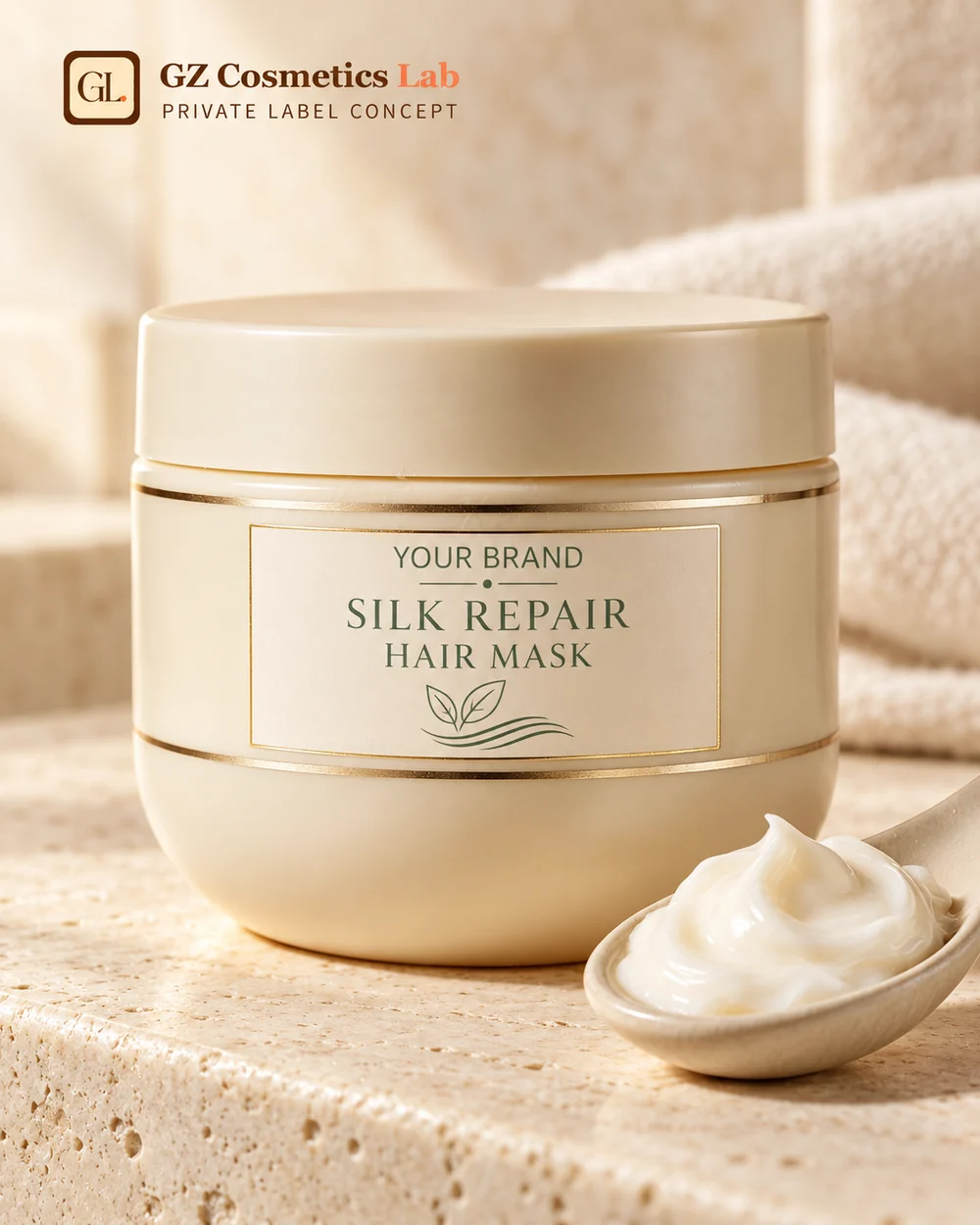
A starting point for your hair mask brief
Use the product direction as a reference, then specify the texture, dispensing and intended rinse-off use for your project.
Explore the hair mask product direction →
Product concept illustration, not a photograph of a supplied or tested batch. The pictured jar is not approval of the fictional tube or jar specifications below.
This is not a retail buying guide, a ranking of manufacturers or a review of what hair mask ingredients do to hair. For the wider category picture, our private label hair care overview covers where masks sit in a hair care range.
Give the mask a different job from the conditioner
If your range already has a daily conditioner, the first decision is not texture. It is why the consumer would buy both.
Buyers usually answer this in consumer language: "the mask is the treat step", "the conditioner is for every wash". That is a positioning, not a specification. A supplier cannot develop or compare against "treat step". What helps is a short role statement that describes what the consumer should notice from the mask that they would not expect from the conditioner, written as things you can observe in ordinary use:
- How the hair feels while the product is on and during rinsing.
- How dry hair feels after normal drying, and whether it looks or feels weighed down.
- What remains before the next normal wash, when the consumer goes back to the daily conditioner.
What the role statement should not do is invent the usage. Contact time, how often the mask is used and whether it replaces or follows the conditioner are part of each supplier's intended use and instructions for that formula. Ask for them. Do not write your own number into the brief, and do not assume that a mask always needs longer on the hair or a richer base than a conditioner. Some mask concepts are designed around a short rinse; others are not. The point of the role statement is to tell the supplier which differences matter to your range, so they can propose a formula and instructions that fit, and so you can judge samples against the same target.
It also keeps the mask from being approved for the wrong reason. A heavier texture is easy to notice in a jar and easy to mistake for "more treatment". Thickness tells you how the product handles. It does not tell you whether the mask does its job better than the conditioner, and it is not evidence of repair or any lasting effect.
Texture is a handling decision first
For a rinse-off mask, texture is really three questions, and each one connects to the pack.
Can the consumer take a controlled amount out of the intended pack, in the bathroom, with wet hands? A soft, stiff or stringy mask behaves differently in a wide jar than in a squeeze tube. A mask that feels luxurious when scooped with a dry finger may be hard to squeeze from a tube, or may come out in one large slug.
Does it spread through the hair at the amount the supplier's instructions call for? Some textures sit on the surface of the first section of hair and need working through. Some thin out quickly in wet hair. Neither is right or wrong in itself. What matters is whether it matches the role statement and whether the instructed amount is realistic for your target hair length.
Does it rinse in a way that matches the target? Buyers notice slip during rinsing, how long it seems to take for the product to feel gone, and whether any residue is felt at the ends or near the roots afterwards.
Write your texture target in those terms before samples arrive. "Rich but light" will produce samples. "Scoops cleanly from a jar, spreads through mid-length hair at the instructed amount, rinses without a coated feel at the ends" will produce samples you can compare.
Private label hair mask packaging: jar or tube is a texture decision too
The pack question for a private label hair mask is not only appearance. Jar and tube put different demands on the formula and the consumer.
A jar lets the consumer scoop and see the product. It tolerates thicker textures, but water and fingers go into the pack in the shower, and the opening, lid and any inner disc become part of the product experience. A tube controls the amount and keeps hands out of the pack, but the texture has to leave the orifice cleanly, and the tube needs to empty reasonably at the end of use.
During sampling you will often see the formula in whatever container the supplier has available: a stock jar, a plain tube or a sample pot. Those observations are useful, but they are observations of that container. They are not approval of your final pack. Record which container each sample came in, and keep "we liked how it came out of the trial tube" separate from "the final tube, cap and decoration are approved". The final component, its compatibility with the formula and its decoration are confirmed separately with the supplier.
A product reference such as the Silk Repair Hair Mask can anchor the brief; describe the texture and pack you want the supplier to assess.
When you write the packaging part of the brief, list the things that change the quote and the development work:
- Net content and the unit you will declare on pack.
- The target pack reference: the specific jar or tube, its supplier or code, and the version, if you have one.
- Opening and dispensing: screw lid, flip-top, inner disc or seal, orifice size if known.
- Decoration: print method and number of colours, labels, finish.
- Which of these you will supply and which you want the manufacturer to source.
If you do not have a pack reference yet, say so. Asking the supplier to propose options is a legitimate request, but it should appear as a request in the brief, not be left for them to guess.
Compare samples under each supplier's own instructions
A mask sample cannot be judged without its intended use. If one supplier's sample is designed for a short rinse and another's for longer contact, using both the same way is not a fair test of either.
So each sample should arrive with, or be followed by, the supplier's intended use and directions for that formula version: the amount, how and where to apply, how long before rinsing, and whether it is used instead of or after the conditioner. Use each sample only as its supplier describes, in normal rinse-off use. Record those directions next to the sample, because they are part of what you are approving.
The same discipline applies to the comparison itself. Keep the things you control as steady as you reasonably can between samples: the same evaluator, a similar hair type and length, the same shampoo before, and the same conditioner on the next normal wash if the range is planned to be used together. Then record observations at the same points for each sample.
These are ordinary sensory and handling observations by your team. They help you choose a direction. They are not safety testing, efficacy testing or a consumer study, and they should not be designed as one. Do not extend contact times, leave the mask on overnight, use it as a scalp treatment or try to provoke a reaction to "stress test" a sample. If a sample is meant for something other than normal rinse-off use, that is a different product and a different conversation with the supplier.
If your team already uses a general sample record and approval process, keep it. Our shampoo sample evaluation guide walks through one. What a mask adds is the observation points below: take-out from the pack, spread at the instructed amount, rinse, dry hair, and the next normal wash.
Worked example: comparing rinse-off hair mask samples
The following example is fictional and illustrative. The brand, sample codes, versions, observations and quantities are invented to show how a record can be filled in. They are not a real client project, shipment, test result or study, and they do not describe GZ minimums, supported pack sizes, prices or lead times.
A fictional brand plans a range with an existing daily conditioner and wants to add one rinse-off mask. Its role statement: "Noticeably softer feel during rinse and on dry mid-lengths than the conditioner, without hair feeling heavier the next day." Target pack is undecided between a jar and a tube. Three samples arrive in round 1.
| Sample / version | Supplier's intended use (as provided) | Container received | Take-out from container | Spread at instructed amount | Rinse observation | Dry hair, same day | Before next normal wash | Cannot judge from this |
|---|---|---|---|---|---|---|---|---|
| HM-A v1 | Rinse-off mask, used in place of conditioner; supplier's directions for amount and time attached | Stock wide-mouth jar | Scoops cleanly; holds shape on fingers | Needs working through at the ends; instructed amount felt short for shoulder-length hair | Strong slip; took longer to feel rinsed out than the others | Soft at the ends, some heaviness near the roots | Ends still soft; evaluator felt roots flatter than with conditioner alone | Whether root heaviness is the formula, the amount, or how it was applied |
| HM-B v1 | Rinse-off mask, used after shampoo instead of conditioner; supplier's directions attached | Plain trial tube, unknown orifice | Squeezes out in a controlled ribbon; slight tail at orifice | Spreads easily through mid-lengths at instructed amount | Rinses quickly; light slip, close to the brand's conditioner reference | Soft mid-lengths, not weighed down; no noticeable difference from the conditioner reference to this evaluator | Close to the conditioner-only feel; no residue noted | Whether the final tube and cap will dispense the same way |
| HM-C v1 | Supplier lists it as "mask or leave-in"; rinse-off directions requested, not yet received | Sample pot | Very soft; drips from fingers | Not used: rinse-off directions pending | Not used | Not used | Not used | Everything; dual-use positioning is outside this brief |
Three points about how the table was filled in. HM-C was not used, because the buyer did not have rinse-off directions for it and did not invent its own. The "cannot judge" column is filled in for every sample, because each observation has a limit. And the container column records what the sample actually came in, so nobody later treats a trial tube as the final pack.
Turning observations into supplier questions
The value of the record is the questions it produces. Each observation becomes a request the supplier can answer, and each request names the sample and version it refers to.
HM-A v1, take-out and spread: "At your instructed amount the mask did not reach the ends of shoulder-length hair. Is the instructed amount fixed for this formula, or can the directions reflect hair length? If the texture changes, what else changes?"
HM-A v1, rinse and root feel: "Our evaluator found it slower to rinse and felt the roots flatter before the next wash than with our conditioner alone. Our target is no added heaviness. Is a lighter version of this direction possible, and how would you confirm it within your normal development?" The question is about direction. It does not claim that HM-A causes buildup, because one evaluator's impression cannot separate the formula from the amount, the application or the hair.
HM-B v1, dispensing: "The sample came in a plain trial tube. Our intended pack is a tube; please tell us which tube and orifice you would recommend for this texture, and whether you have compatibility information for that component or what would be needed to obtain it." A smooth ribbon from a trial tube is a promising sign, not a packaging approval.
HM-B v1, fit with the range: "During rinsing and after normal drying, HM-B v1 felt close to our conditioner reference to this evaluator. We noted no extra heaviness before the next normal wash. Our role statement asks for a noticeable difference in the first two stages while retaining that light feel later. Can a version 2 move toward that target?" Here the request follows the rinse and dry-hair observations, while the later observation supports only the no-added-heaviness part of the target. It is a revision against the buyer's own target, not evidence of a general deficiency in the product.
HM-C v1: "Please confirm rinse-off directions or confirm this formula is intended for a different use. Our brief covers a rinse-off mask only."
Two cautions apply to all of these. First, a single sensory or dispensing observation cannot tell you the cause. Heaviness, slow rinsing or a tail at the orifice can come from the formula, the amount, the container, the water or the evaluator. Ask the supplier what they think and what they would change; do not write the diagnosis for them. Second, liking how a sample performs in normal use is not evidence of compatibility with the final pack, stability, safety or any repair or lasting-effect claim. Those come from the supplier's own data and confirmations, scoped for your market. If ingredient choices such as proteins become part of the discussion, keep that question separate from this handling comparison; our note on peptides and hydrolysed keratin explains why that comparison needs its own matched evidence.
Have a sample and a packaging reference?
Send your supplier-directed sample notes and mark the formula, pack and quantity decisions still open.
Pack quantity and size: what to put in the request
Once a direction is chosen, the pack request needs to be specific enough that two suppliers price the same thing. For a hair mask, state the pack reference, the opening and the included work explicitly.
The fictional brand writes its request like this. Every number below is the buyer's own request in this example, not a supported size, minimum, price or lead time.
| Field | Fictional buyer request | For the supplier to confirm |
|---|---|---|
| Formula direction | HM-B, version 2 when received and accepted | Version code to be quoted; directions for use for that version |
| Net content and unit | 200 ml tube; brand also asks for a 250 g jar alternative to be priced | Whether the formula is declared by volume or weight for each pack; fill tolerance |
| Target pack reference | Tube: supplier to propose. Jar: buyer's own reference J-250 rev. A | Proposed tube code and version; whether J-250 rev. A suits this texture |
| Opening and dispensing | Tube with flip-top cap; jar with screw lid and inner disc | Orifice size; whether an inner disc or seal is included |
| Decoration | Tube: 2-colour print. Jar: label on body, printed lid | Print method options, colour limits, artwork requirements |
| Requested units per SKU | Tube 200 ml: 4,000 units as the fictional planned order. Jar 250 g: 2,000 units as an alternative quotation only, not an additional order | Whether each requested quantity is feasible; minimum conditions for formula, tube, cap, print and jar, and where each applies |
| Market and channel | United Kingdom, online and salon retail, for this fictional project | Labelling and documentation the supplier can provide for that market |
| Included work | Filling, capping, coding, outer carton per unit | What is included in the unit price and what is quoted separately |
Two details matter here. First, the tube and the jar are written as two separate items, each with its own pack reference, opening and decoration. A supplier cannot quote "200 ml, tube or jar". Second, the jar line is clearly marked as a comparison price, so the supplier knows which item the brand is actually planning to order. If you leave the purpose of each line unstated, the quotes will come back on different assumptions.
The example names the United Kingdom and the intended channels because the labelling, documents and claims you can make depend on where and how the product will be sold. Ask the supplier what they can provide for your market rather than assuming a document set.
The handoff: accept, revise, still open
At the end of a sample round, write down what was decided in three groups and send it with the next request. It stops the project from drifting, and it stops a sample approval from being read later as something it was not.
The fictional brand's handoff after round 1:
Accepted
- Direction: HM-B v1 is the chosen direction for the rinse-off mask, used according to the supplier's directions for HM-B v1.
- Format: tube is the planned primary pack. The jar is kept as a comparison price only.
Revise
- HM-B v2 requested: move toward a more noticeable difference from the range conditioner during rinse and on dry mid-lengths, without added heaviness before the next wash. The buyer has not received v2. When it arrives, it will be compared with HM-B v1 under the supplier's directions for each version, using the same observation points.
- Directions: supplier to confirm whether the instructed amount for v2 reflects hair length.
- HM-A and HM-C are not progressed in this project.
Still open
- Final tube: specific tube and cap code, orifice and decoration to be proposed and confirmed. Round 1 dispensing was observed in a plain trial tube only and does not approve the final pack.
- Compatibility and stability of HM-B v2 in the final tube: what the supplier has, and what would be needed.
- Safety and documentation for the stated market, and the evidence behind any claim the brand wants to make on pack. No repair or lasting-effect claim is approved by this sample round.
- Quantities: minimum conditions for formula, tube, cap and print, and where each applies.
- Quote: a comparable quote on the pack request above, once v2 and the tube are confirmed.
The timeline in the handoff is consistent: v1 was observed, v2 is requested and not yet received, and the tube is a recommendation still to come. It would be a mistake to write "v2 approved" or "tube approved" at this point, even if the brand expects both to go well.
Bringing this to a quotation
A private label hair mask quote is only as good as the inputs behind it. If you send the role statement, the observation record with each supplier's directions, the pack request with separate lines per format, and the handoff, a supplier can tell you what they can make, what needs development and what needs confirming before a price means anything.
If you are starting from an existing concept, you can review our hair mask range for reference directions. When your project inputs are ready, request a quote for the Silk Repair Hair Mask and include your role statement, target pack reference, net content, decoration, market and requested units per SKU. We will confirm what applies to your project, including the items that are still open.
Ready to Start Your Project?
Tell us your product requirements. Within 24 hours, our technical team will reply with a quotation or the questions needed to prepare one.