
Biomimetic Peptides vs Hydrolyzed Keratin: Choosing a Hair-Repair Route
For a haircare brand, biomimetic peptides and hydrolyzed keratin are not simply the premium and budget versions of the same ingredient. They describe different aspects of a material, and the categories can overlap. The purchasing decision should compare specific grades, their evidence and their performance in the intended product, not the sophistication of their names.

Start with the problem your customer wants solved. Easier detangling, smoother-looking lengths and less breakage are different objectives. A rinse-off mask, a leave-in treatment and a short-contact salon product also create different development conditions. An ingredient selected before those decisions may be impressive on a presentation and poorly matched to the launch.
The comparison is less binary than the names suggest
“Biomimetic” describes a design inspired by a biological model. “Hydrolyzed” describes processing of a material. Neither is a complete performance specification.
Croda's KeraBio K31 illustrates the overlap: the company describes a recombinant, biomimetic hair ingredient whose INCI name itself begins with “Hydrolyzed.” Croda explains that its peptide is made through microorganisms using synthetic recombinant technology, not extracted from human tissue. It also explains that numbers in the INCI name are assigned identifiers, not measurements of peptide size. These details concern that named material, not all ingredients marketed as biomimetic. Croda's technical FAQ.
The buyer's task is therefore to establish identity before comparing benefits. Ask for the exact commercial grade, full supplied composition, source or production route, and the documentation behind any vegan claim. A marketing label such as “plant keratin” should prompt clarification of what is actually supplied, not an assumption that it is identical to a keratin ingredient of another origin.
Put both routes through the same decision table
Once the candidate grades are named, review them against the same five points. Fill each cell with documents and results for the specific grades, and leave a cell open rather than filling it with a category assumption.
On a phone, swipe the table sideways to see every column.
| Decision point | Hydrolyzed keratin grade | Biomimetic peptide grade | How to decide |
|---|---|---|---|
| Identity and source documents | INCI name, stated origin and processing route for the exact grade | INCI name, production route and identity documents for the exact grade | Do not sample until the supplied material is unambiguously identified |
| Formulation fit | Recommended level, pH range and compatibility notes for your format | The same, plus any incorporation conditions the supplier sets | Prefer the grade your formulator can work into the intended base reliably |
| Evidence type | Raw-material, model-formula or full-system data, and the endpoint measured | The same questions, including whether results depend on a supplier protocol | Weigh only evidence that addresses your primary objective |
| Claim boundary | Finished-product wording the evidence could support after review | The same, plus any conditions on trade names, logos or study citations | Choose the route whose supportable claim matches the planned headline |
| Supply continuity | Approved channel, repeat-batch documentation and alternative grades | Channel or licensing restrictions and the plan if the grade is discontinued | A route that cannot be supplied consistently is not ready for a launch commitment |
A route can win one row and lose another. A peptide with strong supporting data may fail on supply conditions for your sales channel; a familiar keratin grade may fail because its origin conflicts with a vegan position. Record the trade-off instead of averaging it away.
Choose the result before choosing the ingredient story
There are several defensible ways to build a hair-repair concept. A salon-focused brand may prioritize performance on heavily bleached lengths. A daily-care brand may prioritize detangling and softness without heaviness. A vegan range may make documented non-animal origin a non-negotiable purchasing condition.
Write those priorities in order. Then decide which result is essential and which would be a useful additional benefit. If every candidate is expected to maximize strength, softness, shine, volume, color retention and speed of use simultaneously, the sample round becomes difficult to interpret.
On a phone, swipe the table sideways to see every column.
| Product objective | What to compare first | What not to assume |
|---|---|---|
| Easier wet detangling | The full formula under a consistent washing and combing protocol | A detangling result proves a particular molecular repair mechanism |
| Reduced breakage during grooming | Breakage performance under a defined, relevant protocol | A result on one damage pattern applies to every hair type and routine |
| Softer, smoother-feeling dry lengths | Blind sensory assessment after drying and normal styling | The most expensive peptide will necessarily deliver the preferred feel |
| A differentiated non-animal repair range | Documented material origin, relevant performance and commercial access | “Biomimetic” automatically establishes vegan status or sourcing rights |
This is an evaluation framework, not a universal test specification. A qualified laboratory or development partner should select methods suited to the actual product and proposed wording.
Why the base formula must remain in the comparison
A finished conditioner contains more than its headline protein or peptide. If two samples also differ in their conditioning system, viscosity, fragrance and application instructions, the buyer cannot confidently attribute a preference to the highlighted ingredient alone.
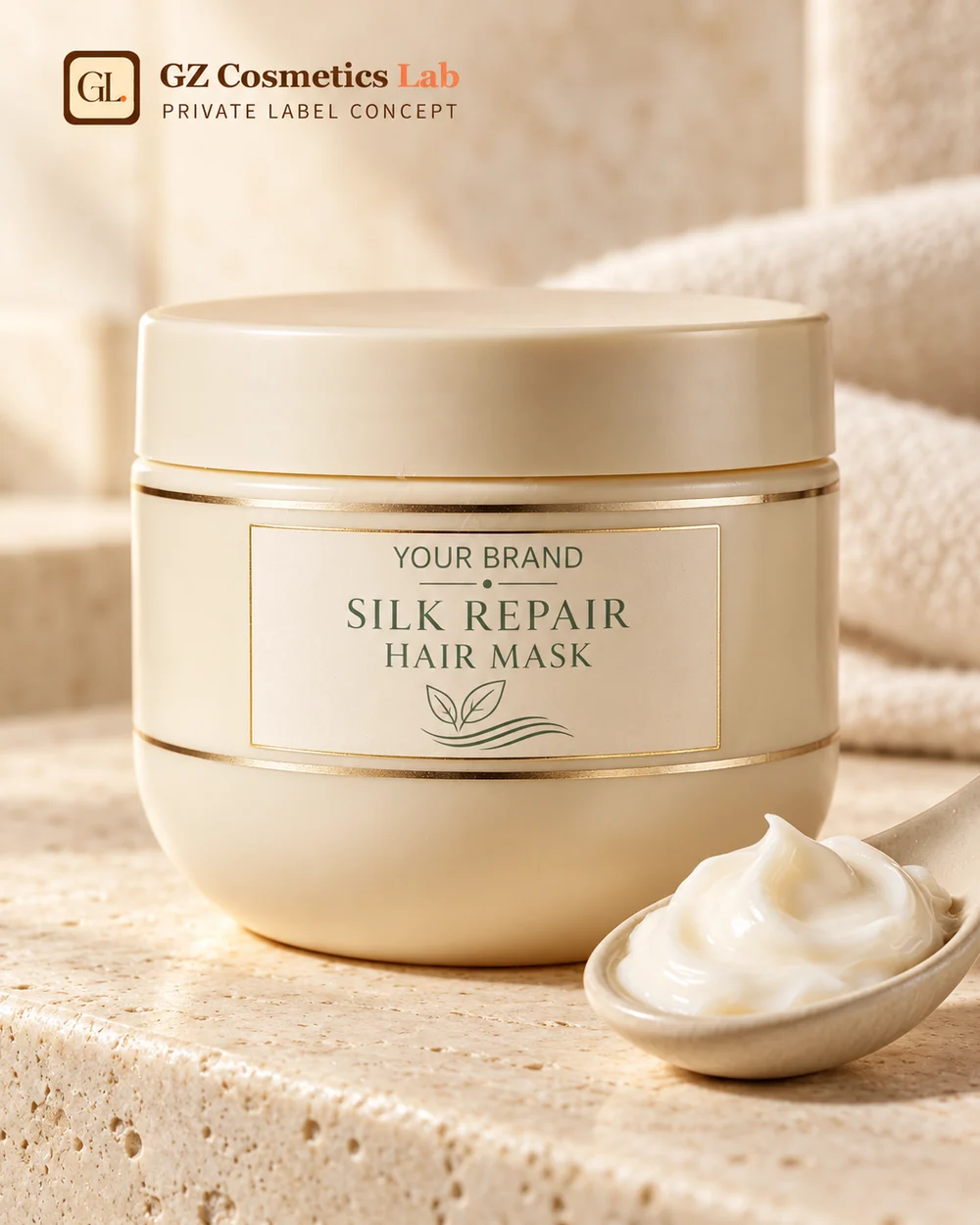 Silk Repair Hair MaskA rinse-off mask direction that currently uses hydrolysed keratin.
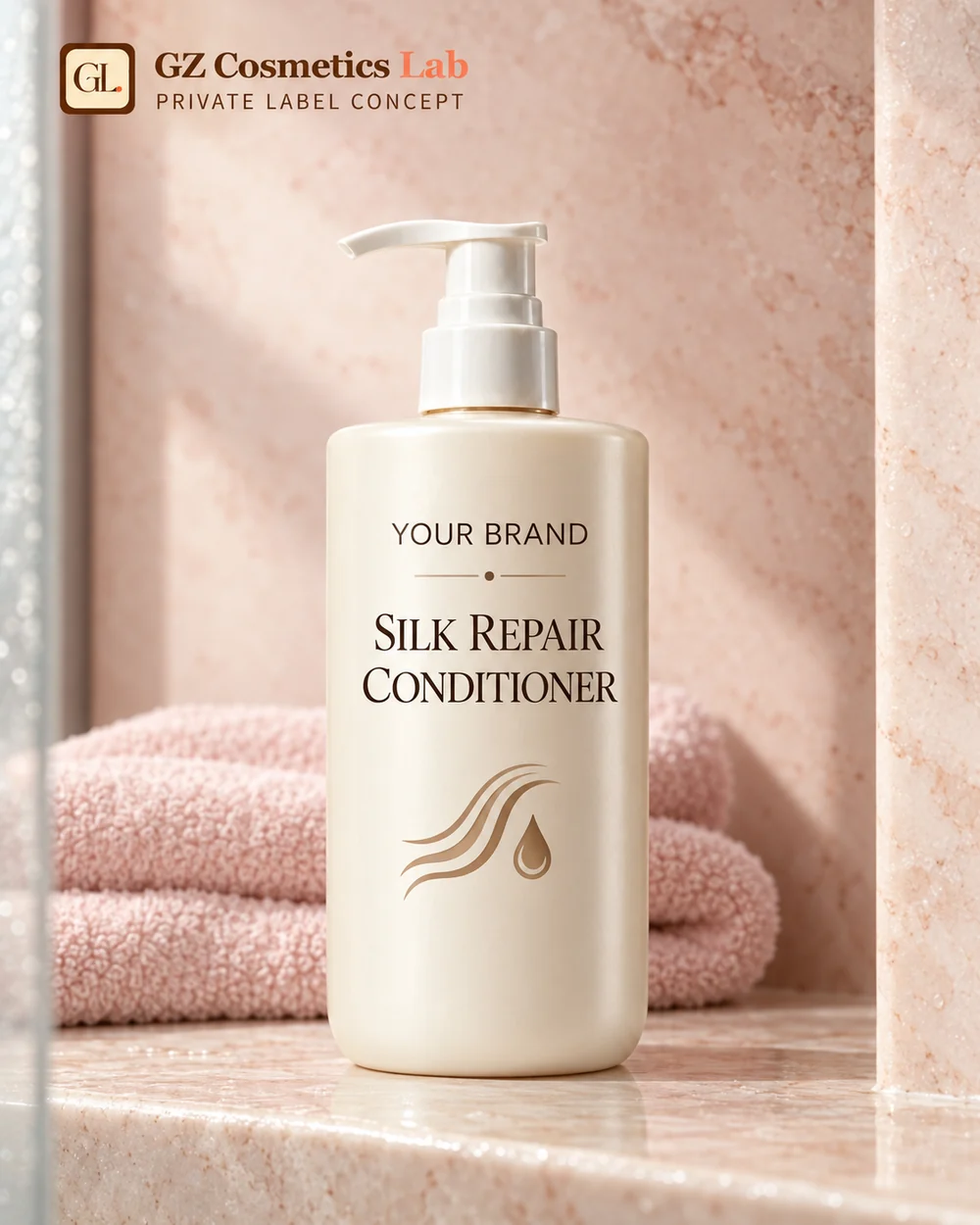 Silk Repair ConditionerA daily conditioner direction for matched-base comparisons.
Existing GZ Cosmetics Lab packaging concepts, not ready-stock products. Their current ingredient directions are not bond-repair claims, and a biomimetic peptide route would be assessed per project.
There are two useful comparisons, and they answer different questions. A matched-base comparison helps investigate what a candidate ingredient contributes. A comparison of fully optimized products helps decide which consumer experience the brand should launch. Ask the developer which type of comparison is being presented.
For development work, a sensible starting discussion is a base control, a candidate using the selected hydrolyzed-keratin grade and a candidate using the selected biomimetic grade. The formulator should justify use levels and any necessary adjustments. Identical percentages do not automatically create a fair comparison between different materials.
Retain the formula version, raw-material grade, treatment amount, contact time and hair-tress details with the results. If the preferred prototype changes later, determine which earlier conclusions still apply. Testing the first prototype does not validate every subsequent version carrying the same project name.
Comparing hair-repair ingredient routes?
Share the target hair profile, format and the result that matters most. We can review the candidate grades and the evidence you would need before samples are made.
Read hair-repair data without changing what it says
A supplier's data pack is a starting point for technical review. Ask whether the study evaluated an ingredient in a model formula, a complete treatment system or the exact product you intend to sell. Then identify the comparator, hair condition, application procedure and measured endpoint.
For example, a test can show lower wet-combing force without answering how dry hair feels after styling. A breakage study can support a defined performance finding without independently proving a named chemical mechanism. A microscopic image may illustrate appearance at a selected location without establishing the typical result across users.
These are questions about the scope of evidence, not reasons to reject testing. The most useful report makes the conditions clear enough to understand where the finding applies and where another assessment is needed.
In US advertising, objective claims require an adequate basis before they are made; an advertisement that promises a particular level of scientific support needs that level of support. FTC's advertising-substantiation policy.
For a brand, that means deciding whether the proposed headline is about feel, observed breakage or a specific repair mechanism. Do not let an ingredient's trade name silently become evidence for a broader finished-product promise.
Test the routine customers will actually follow
A treatment that performs under a long laboratory contact time may not answer a brief for a quick rinse-off product. A leave-in evaluated in isolation may behave differently when layered with a customer's usual styling products. Agree realistic directions before approving the final comparison.
Repeated-use assessment can also be informative. Ask testers to note whether the hair remains easy to style, becomes too coated or feels different after several applications. Do not diagnose every change as “protein overload” from a questionnaire; investigate the complete formula and routine.
Use the target hair profile to set acceptance priorities. In a hypothetical launch for fine, bleached hair, reduced grooming breakage may be essential, but a heavy finish could still make the product unsuitable. For a richer mask targeting coarse lengths, the preferred sensory balance may differ. Neither example establishes a universal ingredient winner.
Include a straightforward benchmark product if appropriate, but describe it as a performance reference. Do not request a copy of a proprietary formula or assume that a similar ingredient declaration establishes freedom to reproduce its technology or claims.
Compare development cost, not just the ingredient invoice
A lower raw-material price does not necessarily produce the lower-cost launch, and a premium ingredient does not automatically justify a premium retail price. Request a cost breakdown at the proposed formulation level, including material supply conditions, development work, packaging and the testing needed for the chosen positioning.
For a named technology, clarify availability through an approved supply channel and any conditions on trademark use or promotional data. Access to a sample does not establish a continuing commercial supply arrangement. Ask what happens if the grade is unavailable and whether substitution would require another review.
Request a compact document set for each candidate grade before approving it for development:
- Technical data sheet for the exact commercial grade, with INCI name and recommended use range
- Composition statement covering carriers, preservatives or other supplied components
- Origin and production-route statement, plus supporting documentation for any vegan position
- Safety data sheet and the supplier's safety summary for cosmetic use
- A certificate of analysis from a recent or sample batch, plus confirmation of which release parameters are tested on every batch
- Study summaries stating the test system, hair type, comparator, protocol and endpoint
- Written conditions for using the trade name, logo or study results
- Supply terms: distribution channel, pack sizes, raw-material shelf life and change-notification practice
Treat the list as a set of questions, not a pass mark. A missing item is something to raise with the supplier, and a complete file still needs technical review.
If the launch promise depends on a particular ingredient, specify it in the approved project documents. An apparently minor substitution can change the evidence, origin story or labeling review. Agree who approves such changes before the first production order.
Three questions to settle before the sample request
Is biomimetic hair repair always better than conventional keratin?
No category-wide conclusion follows from the name. Compare the chosen grades in relevant formulations against the brand's priority outcomes. Supplier studies may identify a promising candidate, but their scope matters.
Does “synthetic human” in an INCI name mean human-derived material?
Do not infer the raw-material source from that phrase alone. For the Croda example above, the supplier explicitly describes recombinant production without human tissue. Other materials require their own documentation.
Can a brand use “bond repair” as soon as a peptide is included?
Ingredient presence alone does not establish every interpretation of that claim. Review the exact wording, supporting evidence and target-market requirements before approving the label or product page.
Prepare a focused haircare development brief
Include the target hair profile, damage history, rinse-off or leave-in format, realistic application time, preferred finish and one primary performance objective. Add the vegan requirement, if any, and identify any named ingredient as a candidate subject to availability and technical review.
The GZ haircare category is the starting point for discussing product formats. You can send a development inquiry with the proposed route and evidence requirements. A catalogue format is not confirmation that a particular proprietary peptide or bond-repair performance is already available; those questions belong in the project assessment.
Choose the route that earns its place in the finished product. A clear result, a usable routine and an accurate claim are more valuable than a complicated ingredient story that the brand cannot demonstrate.
Ready to Start Your Project?
Tell us your product requirements. Within 24 hours, our technical team will reply with a quotation or the questions needed to prepare one.