
Private Label Under-Eye Patches: Pack Counts, Format and Sample Specifications
An eye patch project can run into a quotation problem before anyone compares formulas: the buyer and supplier may mean different things by a "unit".
Consider a hypothetical example. A brand asks for "5,000 units". The supplier reads that as 5,000 patches. The brand meant 5,000 retail boxes, each holding five sachets, each sachet holding one pair. That is 50,000 patches, 25,000 sachets and 5,000 cartons. The quotes that come back can't be compared, because nobody wrote down what a "unit" is. These are illustrative quantities, not a real order, quotation or minimum order.
This guide is for brand owners and buyers preparing a brief for private label under eye patches. It focuses on the physical product: how patches are counted, how they are packed, what has to be specified about the patch itself, and how to review samples without turning a sample box into an unplanned safety test. It does not rank suppliers or recommend retail products.
If your project is a cream, serum or gel with an applicator rather than a patch, our private label eye care sourcing guide covers those formats.
Why under-eye patches need their own brief
A private label under eye mask sounds like a smaller sheet mask, but it brings specific sourcing questions:
- For a two-patch under-eye application, the brief has at least two counting levels (patch and pair) before packaging even starts.
- It sits close to the eye, so intended use, wear directions and warnings belong in the specification.
- Its packaging is part of how the product is used. A jar of 30 pairs and a box of single sachets are different consumer experiences, not just different looks.
- The patch has a physical form — shape, size, thickness, carrier, liquid — that has to stay consistent from approved sample to production.
So the brief has more to define than a formula reference and a bottle size.
Step 1: Separate the five counting levels
Before you ask anyone for a quote, write down each level separately. A clear brief uses these five:
- Patch — one individual piece.
- Pair — two individual patches for the intended two-eye application. Confirm the supplier's definition and product directions.
- Primary pack — what holds the patches directly: a single-use sachet, a tray inside a sachet, or a multi-pair jar.
- Retail unit — what the shopper buys: one sachet, a box of several sachets, or one jar in a carton.
- Order quantity per SKU — how many retail units of each variant you are asking about.
Then add a sixth line for components: if you have two variants sharing one jar but with different labels, the jar quantity and the label quantity are not the same number.
A worked example (fictional numbers)
The figures below are invented to show the arithmetic. They are not a quote, an MOQ, or a stated production capability.
Suppose a brand plans two SKUs:
- SKU A: box of 5 single-pair sachets
- SKU B: jar of 30 pairs in a folding carton
And asks about 2,000 retail units of each.
On a phone, swipe the table sideways to see both SKU columns.
| Level | SKU A (box of 5 sachets) | SKU B (jar of 30 pairs) |
|---|---|---|
| Retail units | 2,000 boxes | 2,000 jars |
| Primary packs | 10,000 sachets | 2,000 jars |
| Pairs | 10,000 | 60,000 |
| Patches | 20,000 | 120,000 |
| Secondary packaging | 2,000 boxes | 2,000 cartons |
| Tools / extras | none | 2,000 spatulas (if included) |

Same "2,000 units" on both lines, but SKU B uses six times as many patches. If the brief only said "2,000 units each", the two quotes would rest on completely different assumptions.
Write quantities in this table form, per SKU, in your RFQ. It also makes it easy to ask: "What changes if SKU B is 15 pairs instead of 30?"
Step 2: Choose the pack format by use, not just by look
There is no format that is safest or cheapest for every project. Each one solves some problems and creates others. The useful question is what each format asks the consumer to do, and what has to be checked on samples because of it.
Single-use sachet (one pair per sachet)
How it's used: tear open, take out one pair, use, discard.
Things to confirm:
- Tear notch position and whether it opens cleanly without spilling the liquid.
- How the patches sit inside: loose, on a liner, or in a small tray. Can the user remove them without touching the side that goes on skin?
- Whether the two patches separate easily from each other and from any liner.
- Seal integrity along all edges, and how that is checked by the supplier.
- Print area on a small sachet: how will the required information be presented across the sachet and any outer box, following the target market's rules? Do not assume an outer box replaces all sachet labelling.
Sachets suit trial sizes, travel kits and gift sets. More sachets per box means more seals, more print and more packing work, so count them.
Tray in sachet
How it's used: open the sachet, peel or lift patches from a formed tray.
Things to confirm:
- Tray material and whether it is part of the quoted price.
- Whether the tray holds the patches flat through shipping, or they slide and fold.
- Tray-to-sachet fit and any extra packing step.
Multi-pair jar
How it's used: open the jar repeatedly over days or weeks, lift out one pair each time, reclose.
Repeated opening adds specific questions:
- Removal method. What removal tool or method is specified in the supplier-approved directions? If a tool is included, specify its quantity and material as a component. Do not improvise removal instructions from a reference image.
- Patch stacking and separation. Do patches stick to each other in the stack? Can one pair be lifted without dragging the next?
- Liquid level and coverage. Are lower patches still covered after several pairs are removed? What does the jar look like at the halfway point?
- Closure. Inner lid, liner or seal under the cap; tamper evidence on first opening; how well the cap closes again after repeated use.
- Directions. Plan hygiene directions for repeated opening (see the FDA note below). Directions such as "use the included spatula" and "close tightly after use" have to match what the pack actually provides.
- Period after opening. Whether a period-after-opening claim is needed and supported is a question for the formula owner and your regulatory reviewer, not something to pick from a competitor's box.
Multi-pair jars are a different product from sachets in testing terms too. If the same patch formula is offered in both, ask whether the supplier treats them as separate packaging configurations for compatibility and stability work.
Matching format to the retail story
Some brands use both: a jar as the hero product and a sachet box as a trial or gift version. That is two SKUs with different component lists, not one SKU in two looks. Brief them separately.
For wider packaging decisions — decoration, outer cartons and supplier responsibilities — see our cosmetic packaging sourcing guide.
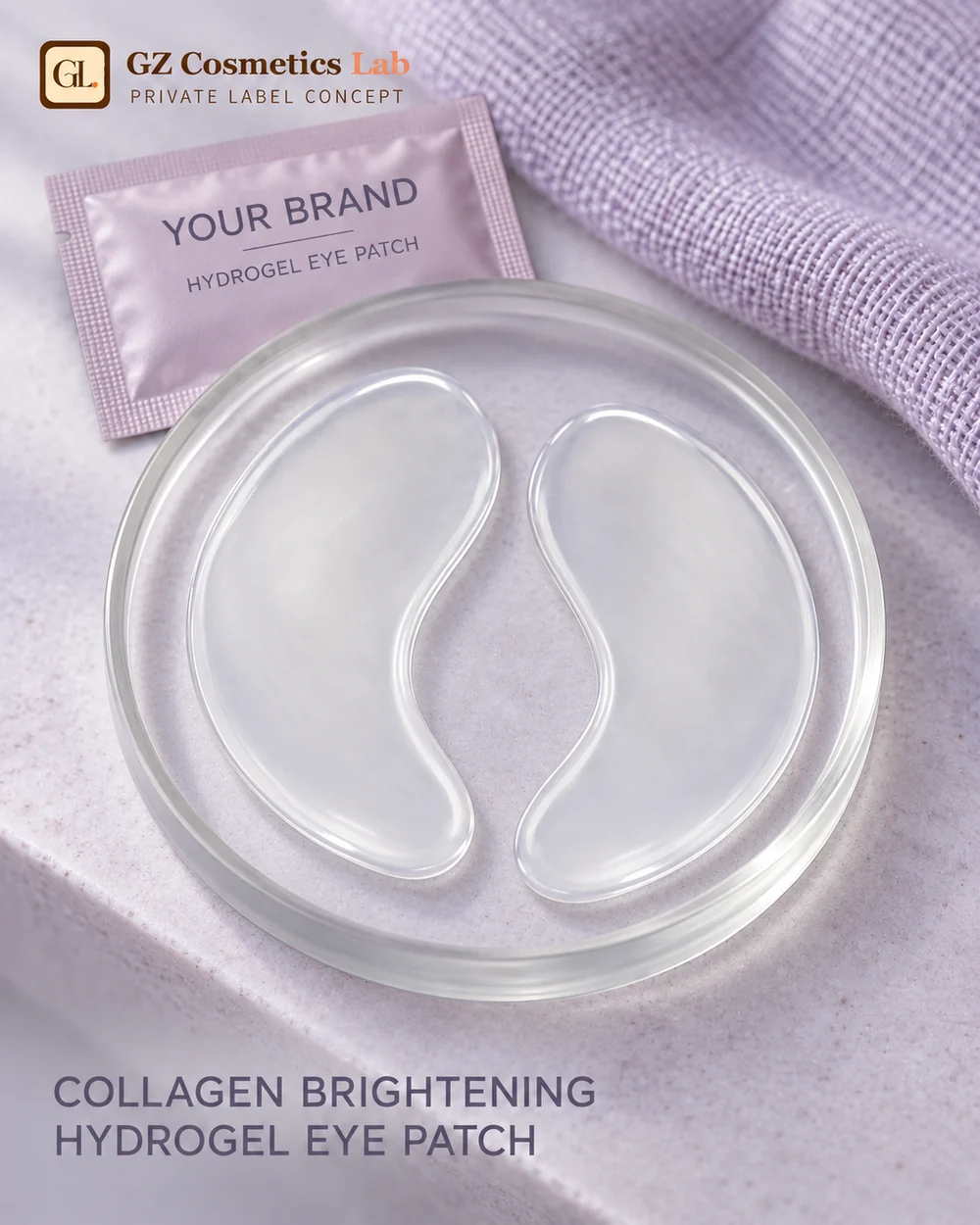
Explore the hydrogel eye-patch development reference
Use the existing product route to discuss your patch and pack brief, with the wider eye-care range as the commercial starting point.
View the eye-patch product reference →
Illustrative private-label concept, not a photograph of a supplied or tested batch. The product name and pictured appearance do not establish claim support. Final material, formula, pack, availability and commercial terms require project confirmation.
Ready to turn the pack idea into a sample brief?
Share your counting table, intended format and target market. Mark open decisions so the project review can address them.
Step 3: Specify the patch itself
Once the counting and packing are clear, define the physical patch. You don't need to arrive with final numbers. You do need to say which properties matter and agree with the supplier how each one is measured.
Shape and size
- Shape: crescent, teardrop, rounded half-moon, or another outline. If you want a non-standard shape, ask whether a die or mold exists or would need to be made. Don't assume every shape is available.
- Dimensions: length, width at the widest point, and any curve. State which way it is measured (laid flat, on its liner, before or after removal from the liquid).
- Tolerances: agreed between both parties, in writing, after you've seen samples. Don't copy a tolerance from another project.
Material and carrier
- Patch type: for example a hydrogel patch. Ask for the supplier's description of the material system and the reference they use for it, so later batches can be traced to the same specification.
- Liner or backing: is there a protective film? Which side faces the skin? Is it removed before use?
- Thickness and handling: record any tearing, folding or visible movement under the supplier's intended handling and use conditions, without assuming thickness is the cause. Ask the supplier to propose a thickness specification and measurement basis, then review it with the complete patch, liquid and pack.
Liquid and fill basis
Patches usually sit in a serum or essence. The tricky part is how "how much" is defined:
- Net content of the pack, the weight of liquid per sachet, and the weight of patches with liquid are three different measures.
- Ask the supplier which basis they use for the label, and how and when it is measured (at filling, after a set time, per pack or per pair).
- For jars, ask how liquid level is set at filling and what the consumer will see when first opening it.
Formula and pack version control
Every approved sample should be tied to:
- a formula reference and version,
- a patch material/specification reference,
- a primary pack reference (sachet film, tray, jar, cap, liner),
- an artwork version, if printed.
If any of these change after sample approval — a different jar supplier, a new liner, an adjusted formula — the approval should be reviewed rather than assumed to carry over. Keep this simple: a one-page version list attached to each sample round can record those references and any open checks.
Step 4: Review samples for the right purpose
Keep the purpose of sample review explicit. A sample box is for checking what the supplier says it is approved for. It isn't a substitute for safety, stability or claims testing.
What a sample review can reasonably cover
Follow the supplier's stated use and directions. Within that, buyers can look at:
- Appearance: shape, colour, clarity, any visible inclusions, edge quality.
- Handling: ease of opening the pack, removing a pair, separating patches, removing any liner.
- Fit to the outline: does the shape suit the intended area as described in your brief?
- Liquid: amount in the pack, drip when lifted, coverage in a jar.
- Sensory notes: scent, feel on removal from the pack, residue on fingers.
- Packaging: seal, print, closure feel, carton fit.
Record feedback against the version list from Step 3, so the next sample round changes one thing at a time.
What a sample review should not become
Don't design your own tests for:
- skin or eye irritation, sensitization or allergy,
- extended or overnight wear beyond the supplier's directions,
- "clinical" before/after results,
- adding preservatives, decanting into other containers, or other home stability experiments.
These need suitable protocols, qualified people and, in some cases, specific markets' requirements. Ask who is responsible for each piece of evidence:
- Product safety assessment for the intended use and market.
- Stability and packaging compatibility for each pack configuration (sachet and jar are not interchangeable).
- Microbiological quality, especially for multi-use packs.
- Claims support, if you plan to make performance claims.
Our cosmetic safety testing guide explains these categories and who usually holds each one.
A note on eye-area use
The U.S. FDA's eye cosmetic safety guidance gives general consumer advice for products used around the eyes: keep products and hands clean, don't share them, use them only as intended for the eye area, and stop using a product that causes irritation. It is useful for writing clear directions and warnings, particularly for reopened jars. It is not an approval of any patch, formula or package, and it doesn't stand in for the safety work above.
Step 5: Write an RFQ that can be answered
You don't need a finished specification to ask for a quote. You do need to name what you're asking about and mark what is still open. A supplier can then price a described option and tell you which assumptions drive the cost.
What to include
Units and quantities
- The five counting levels from Step 1, per SKU, in a table.
- Component quantities where they differ (labels, cartons, tools).
- Minimum quantities per SKU and per component. Ask whether shared jars can be combined across variants and whether labels, films or cartons have their own minimums; do not assume formula sharing combines them.
What the price should include
- Patches and liquid.
- Primary pack: sachet film, tray, jar, cap, inner lid or liner.
- Decoration: printing on sachets, jar labels or direct print, carton printing.
- Secondary pack: retail box or carton, inserts.
- Tools: spatula or tweezers, if any.
- Shipping cartons and how many retail units go in each.
Ask the supplier to list anything excluded, rather than assuming. Separate development or tooling/setup fees, testing costs and the freight basis from the product price. Normalize proposals to the same retail-pack definition and included scope before comparing them; a lower price per patch is not directly comparable with a fully packed retail-unit price.
Variants
- Number of SKUs, and what differs between them: formula, patch colour, pack format, pair count, artwork only.
Market and responsibilities
- Target markets and sales channels.
- Who handles labelling text review, safety assessment, stability and compatibility, microbiological testing, and claims support. If you don't know yet, say so.
Schedule assumptions
- Ask when the quoted schedule starts and which sample, formula, pack and artwork approvals must be complete first.
- Ask how component changes or pending evidence affect the schedule. Your target launch date is a planning reference, not a confirmed delivery promise.
Assumptions and open questions
- What you are assuming ("crescent shape similar to sample X", "liquid basis to be proposed by supplier").
- What you want the supplier's view on ("jar or sachet for a 30-day set?", "is a spatula needed?").
A short RFQ template
Project: [Brand] under-eye patch, 2 SKUs

SKU A: box of [n] single-pair sachets
SKU B: jar of [n] pairs, folding carton, spatula [yes/no/advise]
Retail units requested per SKU: [quantity to discuss]

Patch: hydrogel, [shape], size [to propose / reference sample]
Liquid: [formula reference or brief]; fill basis [to propose]

Price to include: patches, liquid, primary pack, decoration,
retail pack, tools, shipping cartons. List exclusions.
Quote unit, per-SKU/component minimums, setup/testing fees:
Freight basis and schedule start/approval dependencies:

Markets: [list]
Testing & documents: [who is responsible / please advise]
Assumptions: [list]
Open questions: [list]
This is a starting brief. Exact numbers, tolerances and timelines come from the supplier's proposal and your agreement, not from the template.
Common mistakes to avoid
- Quoting "units" without a level. Always say patches, pairs, packs or retail units.
- Treating jar and sachet as the same SKU. They differ in components, use and testing.
- Approving a sample, then changing the pack. Re-check approval when any listed version changes.
- Borrowing numbers. MOQs, tolerances, testing lists and certifications from another supplier's website don't describe your project.
- Testing on yourself. Sample review is for handling and appearance; safety evidence comes from the right people.
Starting an eye patch project with us
If you're planning private label eye patches, you can browse our eye care development options and the collagen brightening hydrogel eye patch reference. These pages describe development directions, including jar and individual-sachet formats. Your project's actual specification, packaging and testing scope are confirmed in the proposal.
When your counting table and open questions are ready — even if half the answers are "please advise" — send us your hydrogel eye patch project brief. Our team can review the specification and open questions with you; sample availability, commercial terms and any next steps are confirmed for your project.
Ready to Start Your Project?
Tell us your product requirements. Within 24 hours, our technical team will reply with a quotation or the questions needed to prepare one.