
Whole Body Deodorant Development: A Guide for Private Label Brands
A private label whole body deodorant needs a more specific brief than its category name suggests. Define where it will be used, what odor-related benefit it should deliver and how people will apply it. “Whole body” is a merchandising description, not permission to claim that every formula is suitable for every body area.

For brands expanding beyond underarm products, those decisions come before choosing a fashionable ingredient or copying a popular pack. They determine the relevant safety assessment, performance testing, instructions and manufacturing route.
A category expansion, not simply a larger deodorant stick
The category is already represented by major brands. P&G announced whole-body deodorant collections across Old Spice, Secret and Native in 2024, describing cream, stick and spray formats. That establishes a real product category; it does not mean the same performance or use-area claims are available to a new private label formula. P&G's whole-body deodorant explanation.
For an independent brand, a useful point of difference can be a well-defined routine: convenient application before getting dressed, a format that travels well, or a fragrance direction that fits the existing bodycare range. Each remains a development objective until the product has been evaluated.
Avoid building the concept on the idea that normal body odor is shameful or that everyone needs another daily product. Identify the customer's actual preference and explain what the product is for. A focused, optional use case is easier to develop and communicate than an indiscriminate promise of freshness everywhere.
Define the intended areas and the exclusions
List proposed external application areas in the development brief and ask the qualified safety assessor to evaluate the final formula for those uses. Do not infer suitability for one area from testing on another. The approved instructions should specify where and how the product is used, together with appropriate exclusions and warnings.
If the concept includes sensitive external areas, make that a deliberate technical and safety discussion at the beginning. Do not add the claim at the artwork stage because another brand uses it. Internal or mucosal use must not be implied by broad “all-over” wording.
Consider foreseeable handling as well as the intended application. Will users apply the cream with fingers, move a stick between areas or spray through clothing? Ask how the proposed package and instructions address those behaviors. Marketing illustrations should match the assessed use, not broaden it.
For a first launch, a narrower set of clearly described uses may be a better development choice than the broadest possible label. That is a scope decision, not a claim that any untested use is safe.
Separate odor control from sweat reduction
The consumer may use “deodorant” and “antiperspirant” loosely, but the development brief should not. Decide whether the product is intended to address odor, impart fragrance or reduce perspiration, and have the target-market reviewer assess the complete concept.
In the United States, FDA includes deodorants among cosmetics, while products that are also antiperspirants have cosmetic and drug functions. A sweat-reduction promise therefore changes the regulatory discussion. FDA's cosmetic-and-drug classification guidance.
Similarly, pleasant fragrance and demonstrated odor control are not interchangeable outcomes. For a fragranced concept, ask the testing specialist how the assessment will distinguish the intended benefit from fragrance preference. For a fragrance-free concept, do not assume the absence of perfume establishes odor performance or tolerance.
Choose the format that fits the routine
On a phone, swipe the table sideways to see every column.
| Format | Development opportunity | Questions to resolve before selection |
|---|---|---|
| Cream in a tube | Controlled application to defined areas | How much is used, how it spreads, drying time and transfer after dressing |
| Solid or gel stick | Familiar, portable application | Glide, deposition, visible residue, package travel behavior and area-to-area handling |
| Non-aerosol pump spray | Application without rubbing a stick over skin | Direction, output, drying, overspray and suitability of the assessed exposure |
| Aerosol spray | A different spray experience and delivery system | Specialized filling capability, component compatibility, safety and transport requirements |
These are starting questions, not fixed advantages of every formula. A cream can be elegant or sticky. A stick can glide easily or drag. A spray can feel convenient or miss its intended target. Compare finished prototypes with their actual dispensers.
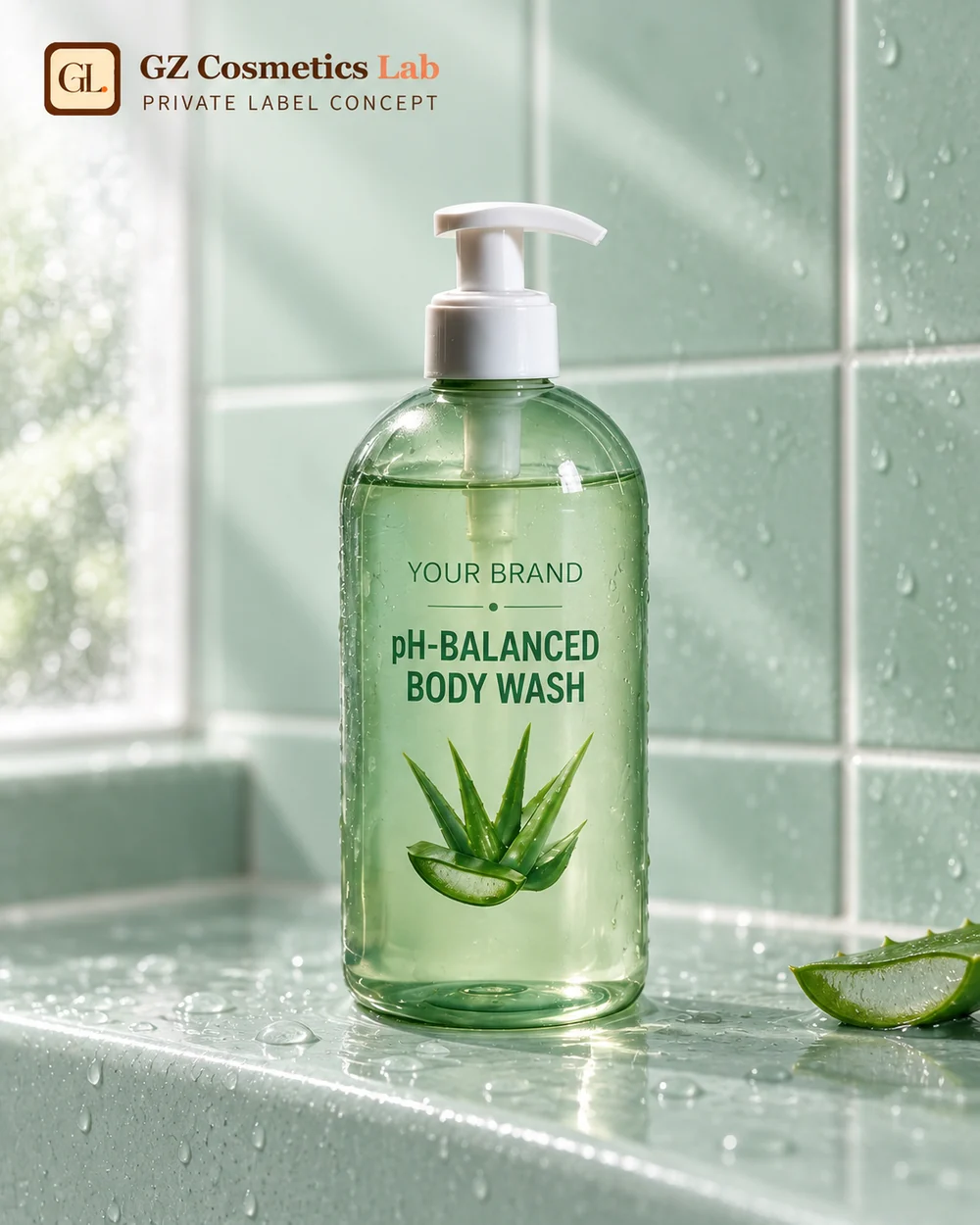 pH-Balanced Refreshing Body WashRange context: an existing body wash direction.
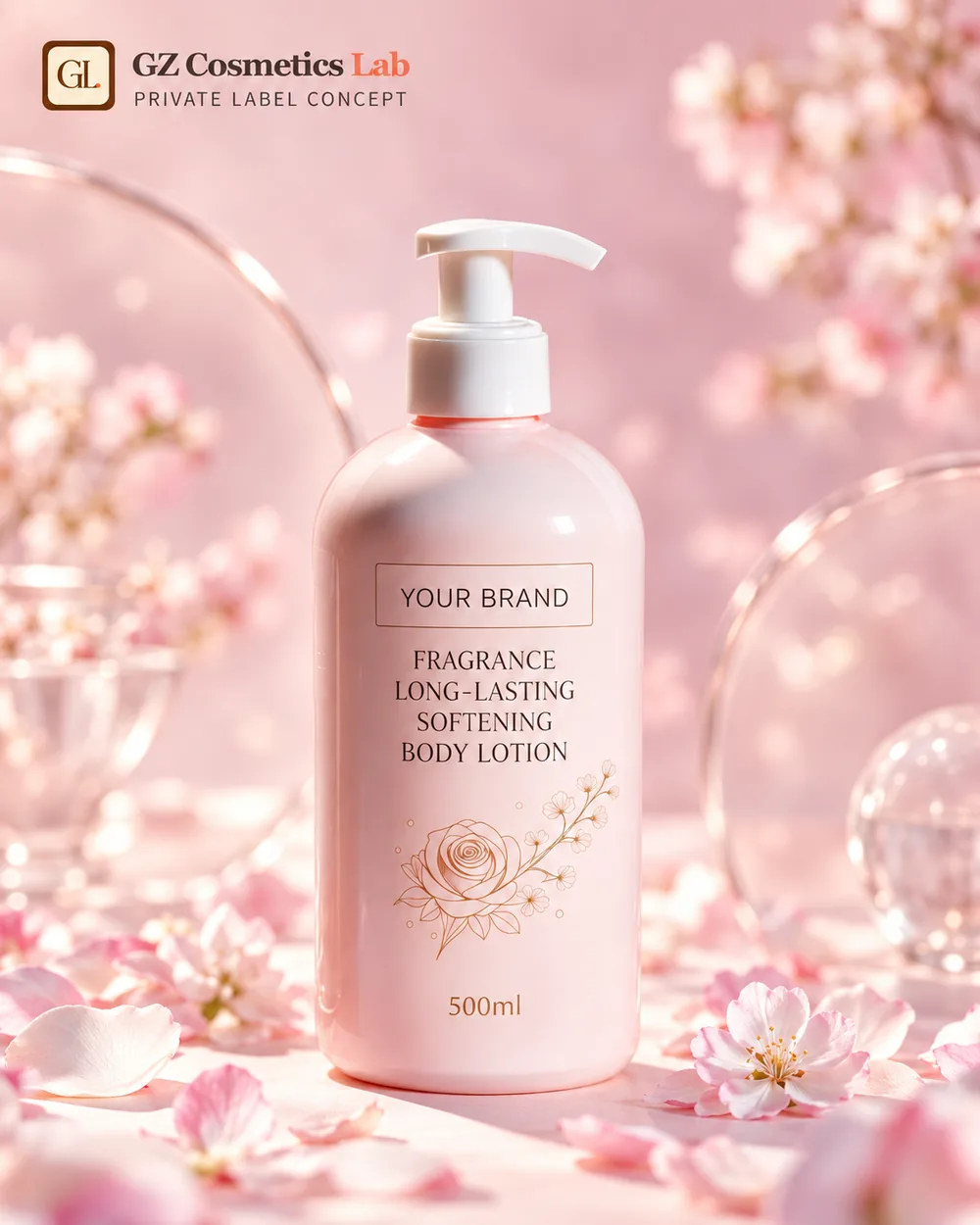 Fragrance Long-Lasting Softening Body LotionRange context: an existing body lotion direction.
Existing GZ Cosmetics Lab bodycare concepts shown for range context. They are not deodorants, and no stock whole-body deodorant or aerosol service is implied.
Do not treat aerosol and pump spray quotations as interchangeable. If an aerosol is central to the concept, confirm the relevant manufacturing and handling capability explicitly. A supplier's general bodycare range is not evidence of that capability.
Build the formula around the chosen outcome
Ask the formulator to explain the proposed odor-control approach, supporting ingredients and sensory system in plain language. The brand should understand what each part is intended to contribute without prescribing a formula from a competitor's ingredient list.
Avoid declaring one ingredient category universally best. A named acid, mineral or botanical still has to work in the selected vehicle, at an appropriate level, with a suitable safety and performance assessment. A supplier's ingredient story does not replace a finished-product result.
Separate formula protection from consumer claims. The product's microbiological quality during storage and use is not the same question as its odor-control benefit on skin. Likewise, a proposed “microbiome-friendly” story needs a definition and supporting evidence; it should not be added because the formula contains a fashionable ingredient or excludes another.
Agree fragrance direction early enough to evaluate the actual intended product. If a fragrance-free and a fragranced version are planned, ask what must be checked for each. Do not assume evidence for one version automatically covers the other.
Scoping a whole-body deodorant?
Share the use areas, format, fragrance direction and target market. We can review feasibility and which safety and performance work the concept would need.
Test odor performance under defined conditions
Before commissioning a performance study, specify the proposed claim, application areas, directions and intended duration. Ask the testing specialist to justify the assessment method, participant selection, comparator and analysis.
Washing, reapplication, activity and other products can change the conditions under which a result is obtained. The report should explain how those variables were handled. If a duration claim is proposed, determine whether the protocol addresses what consumers will reasonably understand from that wording.
Do not borrow a 24-, 48- or 72-hour promise from a category benchmark. In the United States, the FTC's substantiation policy requires an appropriate basis for objective advertising claims before they are communicated. FTC advertising-substantiation policy.
Ask separately about user acceptance. A product may perform against the selected odor endpoint while being inconvenient to apply or slow to dry. Those results answer different questions, and both can affect whether it is a sensible launch.
Clothing transfer and pack handling can decide the winner
Build a practical acceptance round around the intended routine. Review dispensing, spread, dry-down, residue and transfer onto representative light and dark fabrics. Agree the observations and any formal test methods with the developer rather than relying on a single demonstration on a black shirt.
Check the package throughout use. For a tube, assess whether the product dispenses cleanly and leaves excessive residue around the closure. For a stick, examine mechanical operation, product condition and deposition. For a spray, check leakage, spray consistency and the behavior of the final assembly at different fill levels.
A hypothetical cream comparison makes the choice concrete. Prototype A may win on immediate softness but transfer noticeably when the user dresses. Prototype B may dry more cleanly but be harder to spread at the intended amount. The next iteration should address the recorded trade-off rather than simply increasing the headline active.
Use a qualified safety review before human-use evaluation, particularly when the proposed application includes sensitive areas. Informal staff testing is not a substitute for that assessment or for a well-designed claims study.
What a comparable supplier quotation includes
Ask each supplier to quote the same format, pack, intended uses, fragrance options and development scope. Separate formula work, packaging, safety assessment, performance substantiation and other market-specific documentation. A low unit price with those items excluded is not directly comparable with a more complete proposal.
Clarify the ownership of the approved formula specification, test reports and artwork decisions. Agree how changes to fragrance, raw-material grade or packaging will be reviewed. A second scent should not be treated as paperwork only if it changes the evaluated product.
Keep launch timing conditional on actual development milestones. Sample approval, package selection and evidence completion are different events. A supplier should explain which steps remain before offering a committed production schedule.
Map the sourcing stages before asking for a production price
Each stage below produces a decision. The more of them are settled, the more reliable and comparable a production quotation becomes. Anything still open should be written into the quotation as an assumption or exclusion.
On a phone, swipe the table sideways to see every column.
| Stage | Decisions to close | Evidence the brand should hold |
|---|---|---|
| 1. Requirement confirmation | Use areas and exclusions, deodorant or antiperspirant intent, format, fragrance direction, target market | A signed-off brief the supplier has confirmed it can assess |
| 2. Prototyping | Which prototype meets the sensory and handling priorities | Prototype references, formula versions and recorded observations |
| 3. Packaging selection | Tube, stick, pump or aerosol, plus the exact components | Component specifications and any compatibility results |
| 4. Safety and performance evaluation | Who provides the qualified safety assessment for the stated uses, what performance evidence is planned or complete, and who reviews claims for the target market | Safety assessment conclusion, performance evidence plan or results, and the claims review outcome |
| 5. Firm production quotation | Unit price, minimum quantities and schedule for the approved product | A firm quotation tied to the approved formula and pack references, distinct from any earlier indicative price |
An indicative price before stage 4 can help budgeting, but it should be marked as provisional, with its assumptions listed. A price based on an unapproved prototype or pack can change once evaluation results arrive.
RFQ questions that separate pump sprays from aerosols
Send the same questions to every supplier so the answers can be compared. Some apply to every format; others depend on whether the spray is a non-aerosol pump or a pressurized aerosol.
For every format:
- Who will provide the qualified safety assessment, which proposed uses will it cover, and which uses would you decline?
- What prototype rounds are included, and how are formula changes recorded?
- Which performance and safety work is included in the quotation, and which is quoted separately?
- What minimum quantities apply to the formula, and separately to each packaging component?
- Who holds the approved specification, test reports and artwork records after launch?
For a non-aerosol pump spray:
- Which pump and bottle combinations have you filled for comparable low-viscosity products, and what compatibility checks would you run on ours?
- How will you check output per actuation, spray pattern, leakage and clogging over the life of the pack?
- What packing and transit precautions do you propose to prevent leakage in shipment?
For an aerosol:
- Do you fill aerosols on your own line, or is that work subcontracted? If subcontracted, who is the filler?
- Which propellants, valves and cans can be handled, and what compatibility and pressure checks will be run?
- What storage, labeling and transport requirements apply to the finished goods for the intended routes and destination markets?
- How do those requirements change the shipping method, documentation and cost compared with a pump spray?
An answer such as "we can arrange it" is not a capability confirmation. Ask for the specific process, the responsible party and the records the brand will receive.
A focused first-launch brief
An illustrative brief might request an adult, non-antiperspirant deodorant cream in a tube, with specifically defined external use areas subject to safety review. The desired experience is easy spreading, quick dressing and low visible transfer. The brand wants a fragrance-free direction and an odor-control claim, with the duration left open until the evidence is reviewed.
That is enough to begin a meaningful feasibility conversation without promising untested benefits. Add the target country, retail positioning, proposed pack size and existing range context. If the project needs aerosol filling, sensitive-area positioning or a named proprietary technology, identify it explicitly rather than leaving the supplier to infer it.
You can review GZ's bodycare category for broader range context and submit the proposed project brief. This guide is not confirmation of a stock GZ whole-body deodorant or aerosol service; the specific manufacturing scope and validation requirements must be confirmed during feasibility review.
Ready to Start Your Project?
Tell us your product requirements. Within 24 hours, our technical team will reply with a quotation or the questions needed to prepare one.