
Scalp Barrier Serum: How to Brief a Leave-On Product for Your Brand
A scalp barrier serum is a leave-on skin product that has to be delivered through hair. That one fact shapes most of the development work: the applicator has to reach the scalp, the finish has to survive the user's styling routine, and the claim has to match what the finished product can actually support. Briefs that start from a list of fashionable actives tend to produce samples that feel pleasant on the back of a hand and disappoint at the parting.
This guide is for brands and product developers planning leave-on scalp care development with an OEM or ODM partner. It covers how to define the user and routine, choose a format, judge samples, and match claims to evidence. For the product directions we currently develop, see the custom scalp serum and custom scalp spray pages; this article goes into the decisions that sit behind those specifications.

Quick answer
- Start with the user: name the hair profile and the moment of use before choosing ingredients.
- Choose the applicator with the formula: reach, dose and residue decide whether people keep using it.
- Judge samples on the scalp first, then on the hair, at the time point your routine depends on.
- Write the claim before the test: comfort, moisturization and barrier wording need different evidence.
- Keep it cosmetic: hair regrowth, hair loss and dandruff treatment are not ordinary cosmetic briefs.
Why the routine matters more than the ingredient list
"A premium serum for every scalp concern" gives a developer almost nothing to work with. "Lightweight comfort care for a dry-feeling scalp, applied to dry hair between washes, for people with fine straight hair who style daily" gives them a target.
The moment of use changes the formula. A product applied to towel-dried hair after washing can tolerate a different drying time and feel from one used on dry hair just before leaving home. A bedtime product may accept a richer finish, but then needs a morning check for flatness and pillow transfer. If more than one routine matters to your brand, brief and test each one deliberately rather than hoping a single sample covers both.
The hair profile changes what "acceptable residue" means. Fine, straight hair shows root oiliness quickly. Dense or curly hair can make it hard to reach the scalp at all, which shifts the problem from residue to delivery. Write down the primary user's hair type, density and length, whether they use dry shampoo, heat or styling products on top, and the climate and destination market. These details do more for scalp serum formulation than adding another active.
Turn "barrier" into objectives you can test
"Barrier care" is a positioning theme, not a product objective. Split it into two separate lines in the brief.
The sensory objective describes what users should feel and see: fast spreading, little tack after drying, no visible film at the roots by the next morning, a fragrance-free or lightly scented experience. The benefit objective describes what you hope to claim: perhaps moisturization, or relief of a dry, tight-feeling scalp. A claim about barrier function itself is a third step that needs its own evidence and market review, and should not be assumed from the positioning.
Keep medical objectives out of an ordinary cosmetic brief. In the United States, intended use decides whether a product is a cosmetic, a drug or both. FDA gives anti-dandruff shampoo as a product that is both, and names restoring hair growth among claims that make a product a drug (FDA: Is it a cosmetic, a drug, or both?). Other markets draw their own lines; our claims compliance guide for the US, EU and China compares them. Narrowing the brief is not a lack of ambition. It is what makes the ambition testable.
Match the format to the application problem
Leave-on scalp care now borrows formats from facial skincare. Dyson's Amino leave-in scalp bubble treatment, for example, is a foam format positioned around scalp hydration and barrier care (Dyson product page). That confirms the category exists; it does not tell you which format suits your users, and another brand's product data does not transfer to your formula.
On a phone, swipe the table sideways to see every column.
| Format | When it may suit the brief | What to check in the sample round |
|---|---|---|
| Fluid serum with a directional nozzle | Applying along several partings | Stream control, runoff and whether the tip reaches the scalp through the hair |
| Dropper serum | Measured, section-by-section use | Dose consistency, handling with damp hands, drips onto lengths |
| Pump spray with a directional or fine-mist nozzle | Quick application across a wider area | How much lands on scalp rather than hair, overspray and clogging |
| Foam that collapses to a liquid | Seeing where product goes before massaging in | Foam and pump compatibility, collapse time and residue once dry |
| Roller or comb-tip applicator | Massage-led routines | Contact with the scalp, cleaning between uses and microbiological considerations |
These are options to evaluate with your actual formula, not promises about any pack. A nozzle that performs well with water may behave differently with a thickened serum, and a foam concept needs a formula and dispenser that work together. Agree the applicator in the same round as the formula; choosing the bottle after the formula is fixed often reopens the formula.
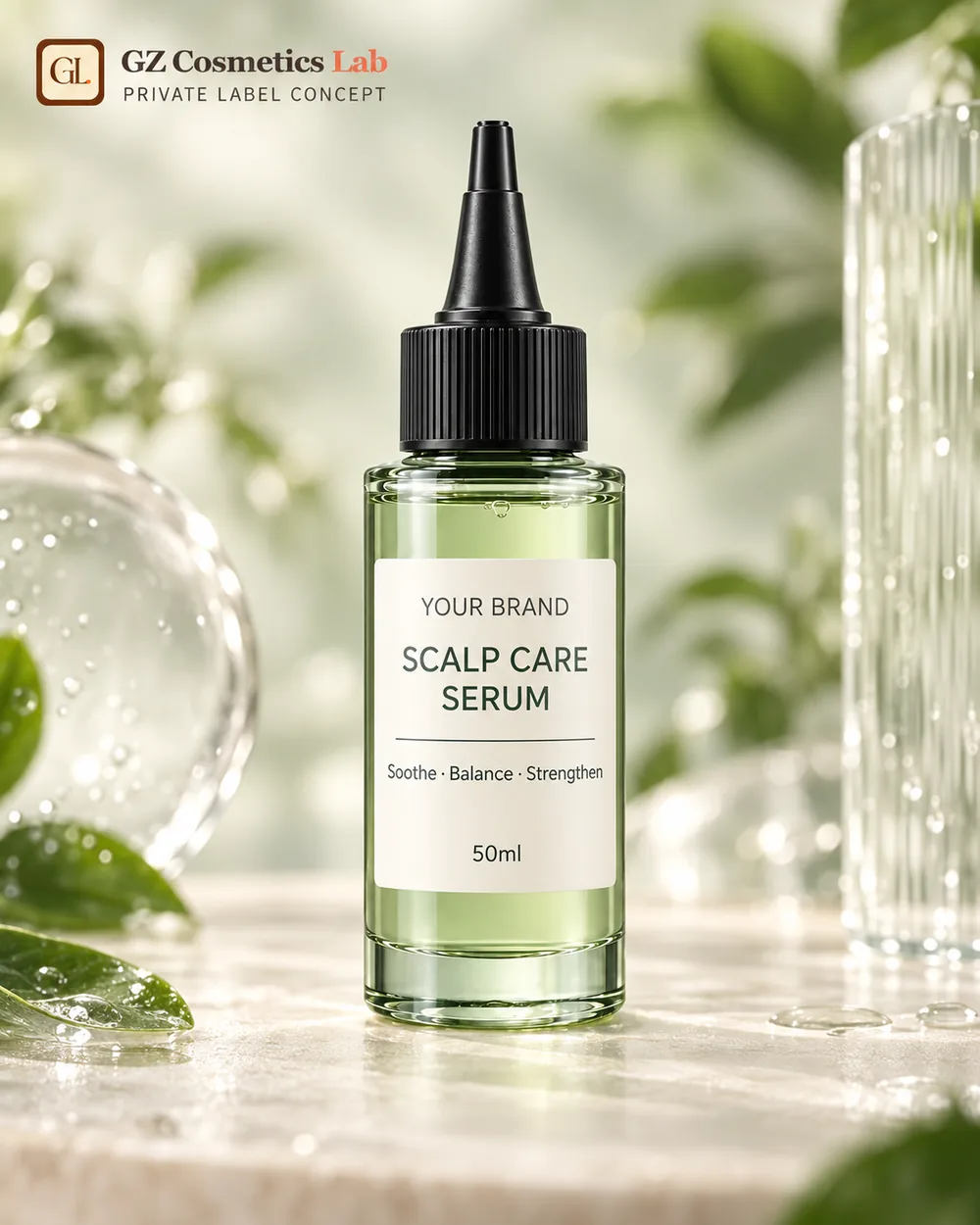 Custom Scalp SerumReview nozzle, dropper or comb delivery with the proposed formula.
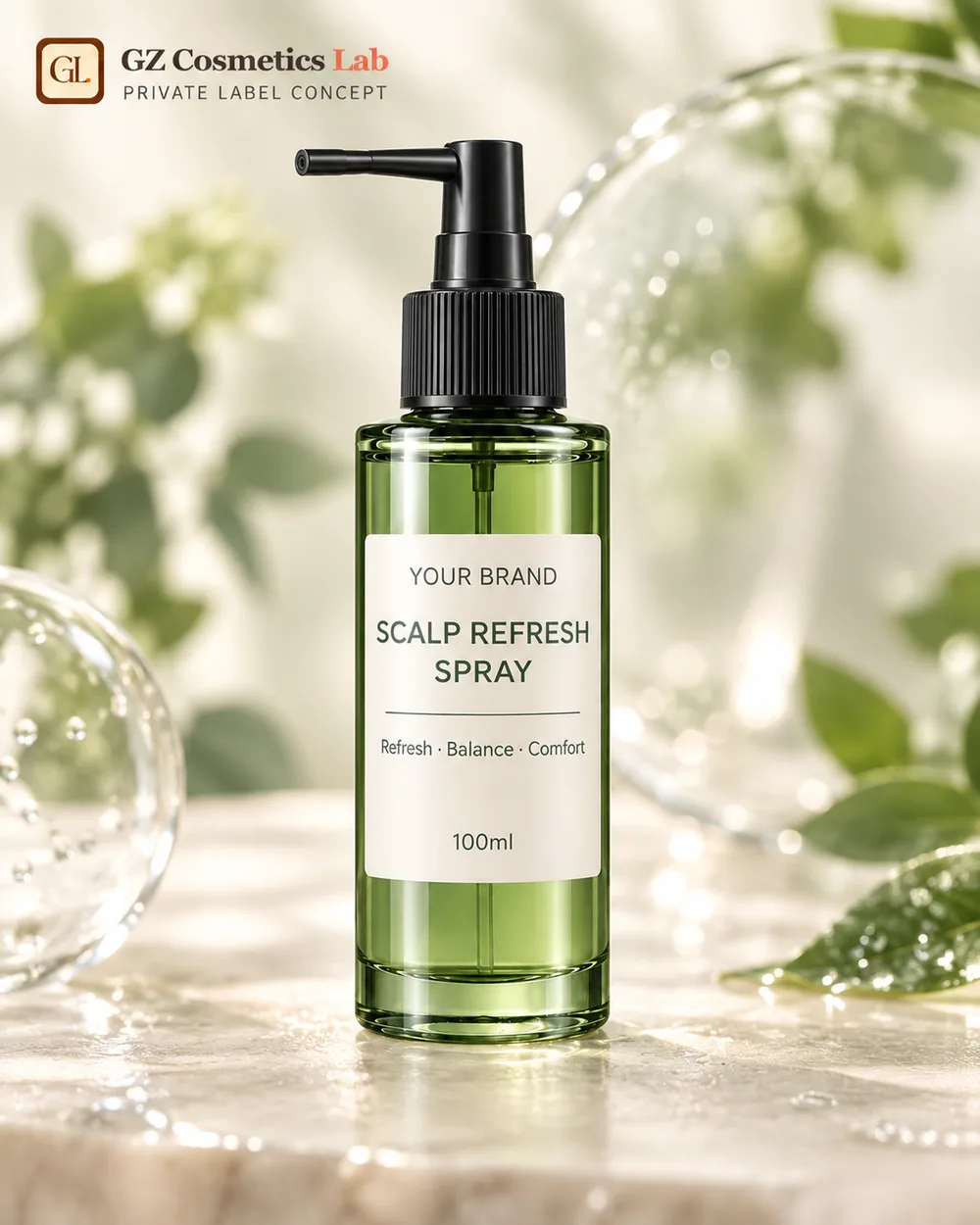 Custom Scalp SprayReview spray pattern, dose, clogging and residue with the proposed formula.
Existing GZ Cosmetics Lab development concepts, not ready-stock products. Final formula, applicator, decoration, fill size and commercial terms are confirmed for each project.
Build the formula around the finish
Start from the experience you want: water-light or cushioned, quick-drying or massage-friendly, fragranced or not. Then let the formulator propose an ingredient system that can deliver it.
Our current scalp serum development directions list options such as niacinamide, panthenol, zinc PCA, humectants and selected botanicals. These are catalogue development options. They are not evidence that a finished GZ product strengthens the scalp barrier or affects hair growth, and each one still has to suit the formula, market and claim.
Every addition has a cost beyond price. A new active can change colour, odour, tack, clarity or the preservation approach, and may need extra stability work. Ask the developer which ingredients serve the benefit objective and which mainly serve the label story, then decide consciously.
For exclusions such as alcohol-free or silicone-free, record why you want them and what trade-off you accept. An exclusion is not, by itself, a tolerance or performance claim.
Planning a leave-on scalp product?
Share the routine, primary hair profile, applicator and claims you have in mind, and we can review feasibility and the evidence route.
Agree how samples will be judged before they arrive
Informal sample reviews go wrong when every tester applies a different amount in a different way. Before the first round, agree the amount or number of actuations, damp or dry hair, how many partings, massage time, and the styling steps that follow. Use coded samples so reviewers react to the product rather than to the ingredient story.
On a phone, swipe the table sideways to see every column.
| Review stage | What to observe | Typical question for the developer |
|---|---|---|
| On the scalp, at application | Reach, spread, runoff, drying time, cooling or tingling | Which variable would speed drying without losing spread? |
| On the hair, once dry | Root lift, separation, tack, shine change, interaction with styling products | Is the residue driven by the humectant, the polymer or the oil phase? |
| At the routine's critical point | Next morning, or just before the next planned wash | Does the finish hold up at the point users decide whether to repurchase? |
| In the proposed final pack | Dose per actuation, leakage, priming, clogging at different fill levels | Does the pack change the result we approved in a lab bottle? |
Decide the pass line with your development team in advance, in words the whole team understands, such as "no visible root film on fine hair the next morning." Avoid borrowing a numeric threshold from another product. Informal feedback selects prototypes; it does not substantiate claims.
Worked example: briefing and choosing between two samples
The following is an illustrative scenario, not a client project or test result.
A brand briefs an adult leave-on cosmetic for a dry-feeling scalp, used on dry hair between washes. The primary user has fine hair and styles daily. The pack is a directional nozzle bottle, the product is fragrance-free, and the first claims are moisturization and comfort. Barrier wording is held back until finished-product evidence exists.
Two prototypes come back. Sample A feels more cushioned and scores better for immediate comfort, but fine-haired reviewers report flat, slightly separated roots the next morning. Sample B dries faster and leaves roots looking unchanged, but feels thinner and needs an extra actuation to cover the same area.
The brief settles it. Because the primary user has fine hair and styles daily, the brand chooses Sample B and asks for one targeted change: adjust the humectant balance to improve comfort without adding residue, then recheck output with the final nozzle. For a brand whose primary user has dense, coarse hair, Sample A might have been the right starting point. Neither sample is better in general; the brief decides which compromise to improve.
Write the claim first, then choose the evidence
Before commissioning a study, write the exact wording you want to print and ask a testing specialist what would support it. Different claims need different kinds of evidence:
- A questionnaire on comfort supports a perception claim, not an instrument-measured one.
- A moisturization result does not, on its own, support every barrier claim you might want.
- Hair that looks less greasy is a different endpoint from reduced scalp sebum.
- Stronger-looking hair is not evidence of new hair growth.
Scalp studies bring their own complications: hair over the measurement site, washing schedules before the test and environmental conditions. Let a qualified laboratory choose and justify the method, rather than requesting a familiar instrument to get a technical-sounding report. In the US, the FTC expects a reasonable basis for objective claims before they are made (FTC advertising substantiation policy). Our cosmetic safety testing guide explains how safety and claim work are scoped for a finished product.
If the applicator touches the scalp or sits very close to it, discuss the use pattern with the safety and microbiology specialists early. A narrow nozzle does not remove the need to assess the product's protection strategy, and our guide to packaging compatibility testing for pumps and droppers covers what to confirm with the final pack.
Frequently Asked Questions
What is a scalp barrier serum?
It is a leave-on scalp product positioned around comfort and moisturization of the scalp's skin. What it may claim depends on the finished formula's evidence and on each destination market's rules.
Can a scalp barrier serum be marketed for hair loss or regrowth?
Not as an ordinary cosmetic in the US. FDA treats claims to restore hair growth as drug claims, and other markets have their own rules. Keep those objectives out of a cosmetic brief unless you are deliberately pursuing a different regulatory route.
Which ingredients go into scalp serum formulation?
Common development options include niacinamide, panthenol, zinc PCA, humectants and selected botanicals. The right system depends on the finish, pack and claims, and listing an ingredient does not prove a barrier benefit.
Should we choose a scalp serum or a scalp spray?
Decide after an application trial with your target hair type. Sprays cover ground quickly but can land on the hair; nozzles and droppers are more targeted but slower. Our scalp spray page shows the spray route.
Is one formula suitable for every scalp?
No formula should be presented as suitable for everyone. Define the primary user, then confirm tolerance and residue with the finished product.
Bring a scalp-care brief we can act on
Tell us the target country, routine, primary hair profile, preferred applicator, claims you are considering and claims you want to avoid. We can review feasibility and the evidence route before samples are made. The custom scalp serum page shows the current development directions, and when you are ready you can send your scalp barrier serum brief for a feasibility review.
Ready to Start Your Project?
Tell us your product requirements. Within 24 hours, our technical team will reply with a quotation or the questions needed to prepare one.