
Cosmetic Packaging Compatibility Testing: Pumps, Droppers, and Airless Bottles
A compatibility study often gets commissioned as “test the packaging.” What comes back is a result for a bottle. Then the product ships with a pump on it, and the pump is the part that fails.
The bottle is one component. The dispenser is a separate assembly with its own materials, moving parts and contact geometry, and it can fail while the bottle behaves perfectly. This guide is for brand owners and procurement teams deciding what evidence to require before artwork, tooling and component orders are locked.
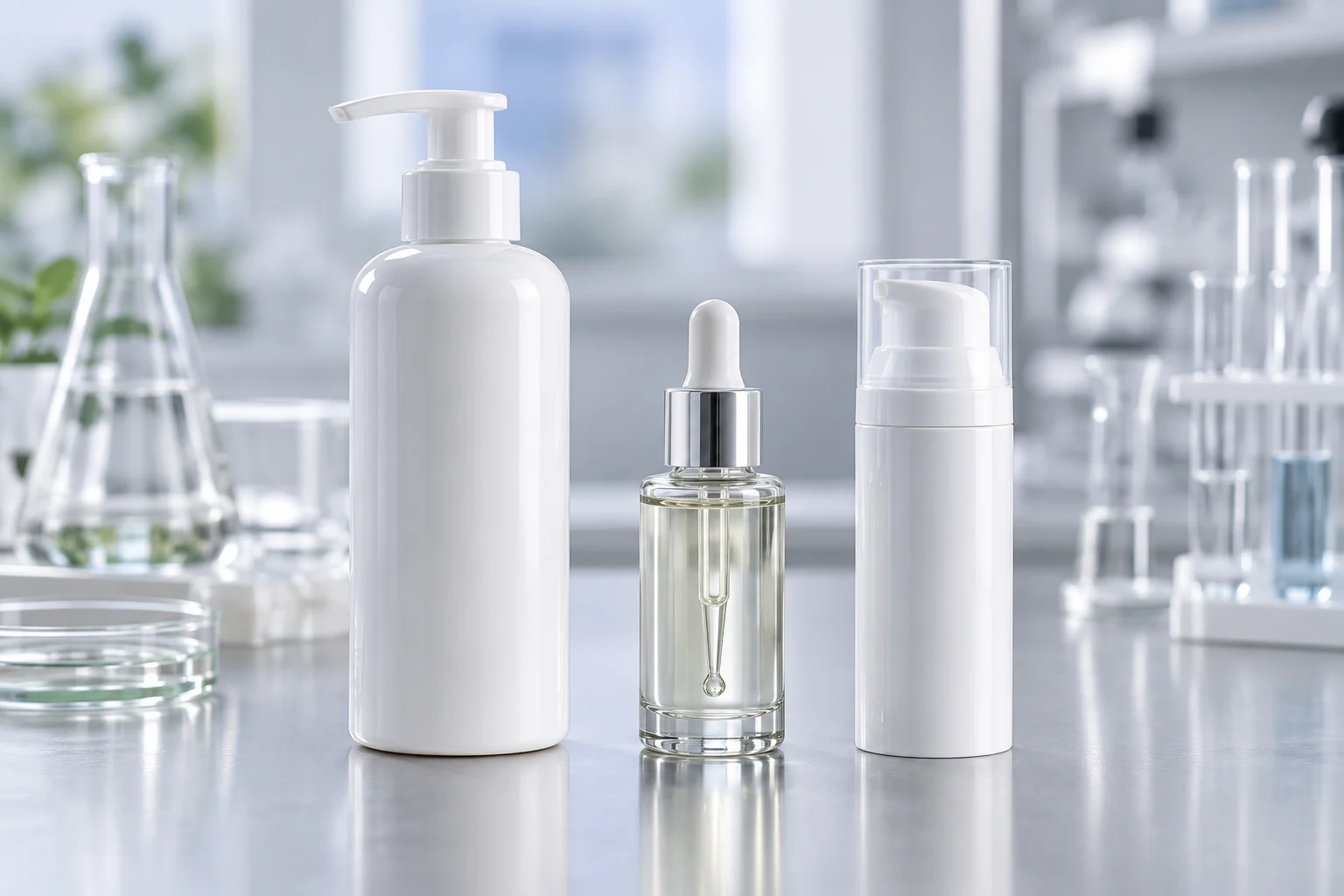
Why the dispenser is a separate question from the bottle
Compatibility is not a permanent property of a formula or a material. It describes one specific formula in one specific component, over time, under the orientations and conditions that component will actually see.
More materials are in contact. A bottle with a screw cap puts the formula against the bottle wall and a liner. A pump may add a dip tube, stem, piston or diaphragm, gaskets or O-rings, a spring and the actuator channel. Those parts may use different polymers and metals from different suppliers.
Moving parts have tolerances. A bottle mainly has to contain. A pump has to keep working. A gasket that swells may bind instead of leak. A spring exposed to an unsuitable formula may stop returning. A dip tube that softens can lose its seat. These are functional failures, so a report that measures only the bulk formula is incomplete.
Orientation changes contact. A dispenser is used upright but may be shipped inverted or on its side. During transit, the formula can sit against the closure and seal system in a way it never does on a shelf.
That is why “the packaging passed” is not enough. Passed in which component, from which supplier, in which orientation, for how long, against what criteria?
What the EU safety file requires
In the European Union, packaging evidence is part of the safety file rather than a decorative afterthought. Regulation (EC) No 1223/2009, Annex I, Part A, requires the Cosmetic Product Safety Report to address the relevant characteristics of packaging material, particularly purity and stability.
Article 3 frames the overall duty around safety under normal or reasonably foreseeable conditions of use. A dispenser is part of how the consumer uses the product, but the Regulation does not prescribe one named compatibility method. The evidence still has to address the final formula, final component and intended use. Confirm the position separately for every destination market; the requirement described here is the EU framework, not a universal rule.
Cosmetics Europe guidance on cosmetic stability testing adds practical study-design detail: use the marketed pack or a materially equivalent version, consider each package type, use an appropriate control such as glass, and assess relevant orientations. It is industry guidance rather than legislation, but it is a useful basis for reviewing a proposed study.
Pumps: compatibility includes mechanical function
A pump can hold up a finished product even when the bottle and bulk formula appear acceptable, because the assembly has to keep functioning throughout use.
- Gaskets and O-rings: elastomers can absorb formula components and change dimensions, affecting sealing and movement.
- Spring position: establish whether the spring sits in the product path and what material it uses.
- Dip tube: softening, distortion or incorrect length can leave saleable product in the bottle.
- Actuator channel: residue can dry or change at the orifice between uses.
- Dose consistency: viscosity drift or a binding mechanism can change the amount delivered per actuation.
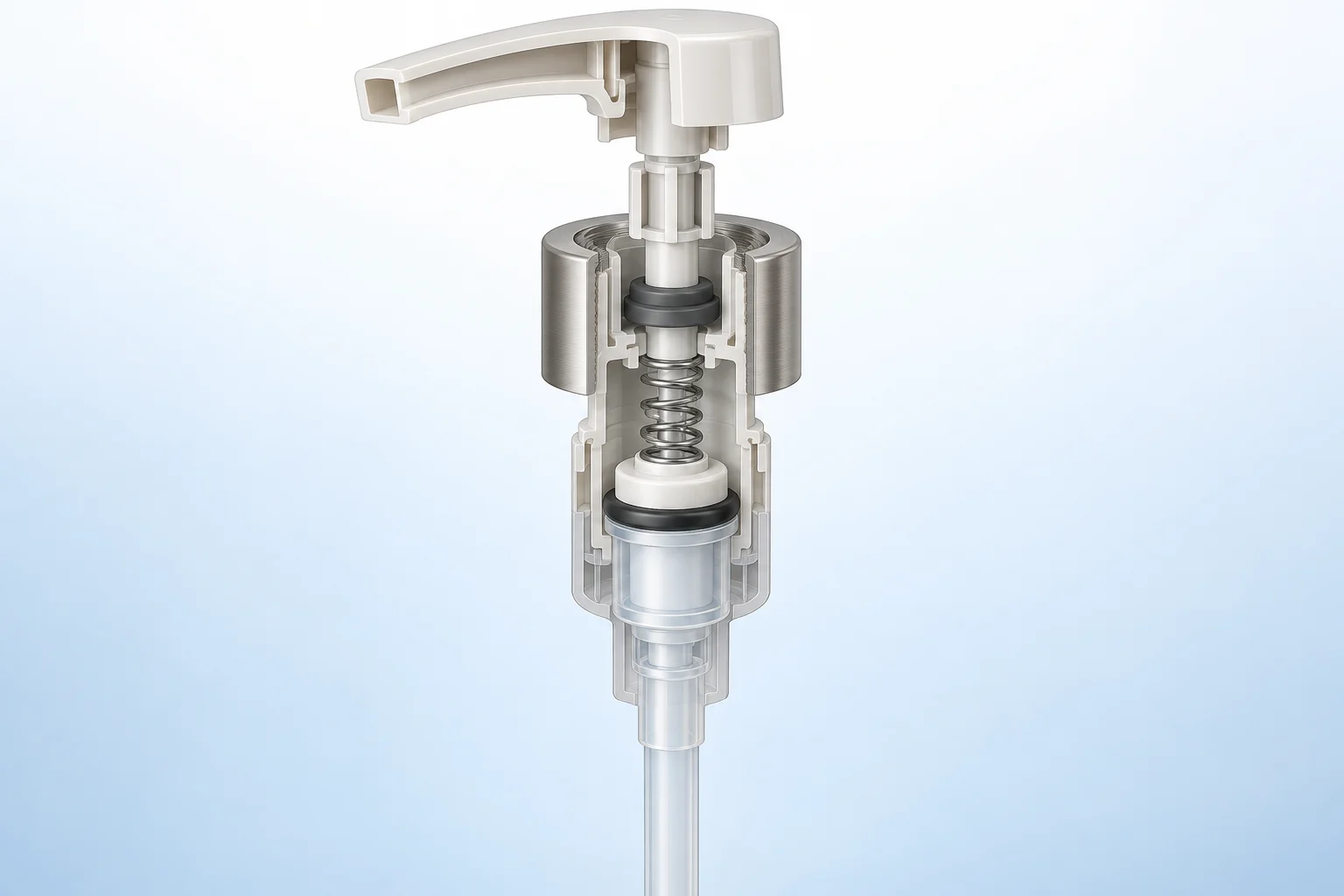
The practical request is straightforward: test the complete pump assembly that will ship, from the supplier that will supply it, and record whether the mechanism still primes, seals and delivers a consistent dose at the end. A liquid specification alone does not answer that question.
Droppers: light, headspace and return contamination
A dropper looks simple, but it introduces three distinct conditions.
Light exposure. Clear and lightly tinted glass gives little protection to a light-sensitive active. If transparency is essential to the design, protection has to come from another part of the system, such as the carton, an opaque variant or a formulation strategy supported by data.
Progressive headspace. Each use removes formula and admits air. The last part of the fill may therefore have a different exposure history from the first part, which matters for oxidation-sensitive systems.
Return contamination. The pipette leaves the bottle and returns to the bulk product. That in-use pathway belongs in the preservation and safety assessment. The compatibility question is narrower: what the bulb and pipette materials do to the formula, and what the formula does to those materials.
Our Multi-HA Hydrating Serum page currently lists a clear or light-coloured dropper bottle. That is a commercial pack option, not proof that every formula using the format will be compatible. The final component must still be assessed with the final formula before artwork and purchasing are locked.
Airless packs: better isolation, different questions
Airless packs are designed to limit air entering the product chamber during use. That can suit oxidation-sensitive systems, but it adds its own component questions.
- Piston seal: it has to remain in contact with the wall while sliding. Swelling, wall deformation or lubricant interaction can cause jamming or bypass.
- Internal lubricant: where a supplier uses one, ask for its identity and suitability for the formula.
- Evacuation: measure how much of the declared fill the consumer can actually dispense, especially with high-viscosity products.
- Barrier over time: polymer walls are not absolute barriers, so water loss and oxygen ingress remain study questions.
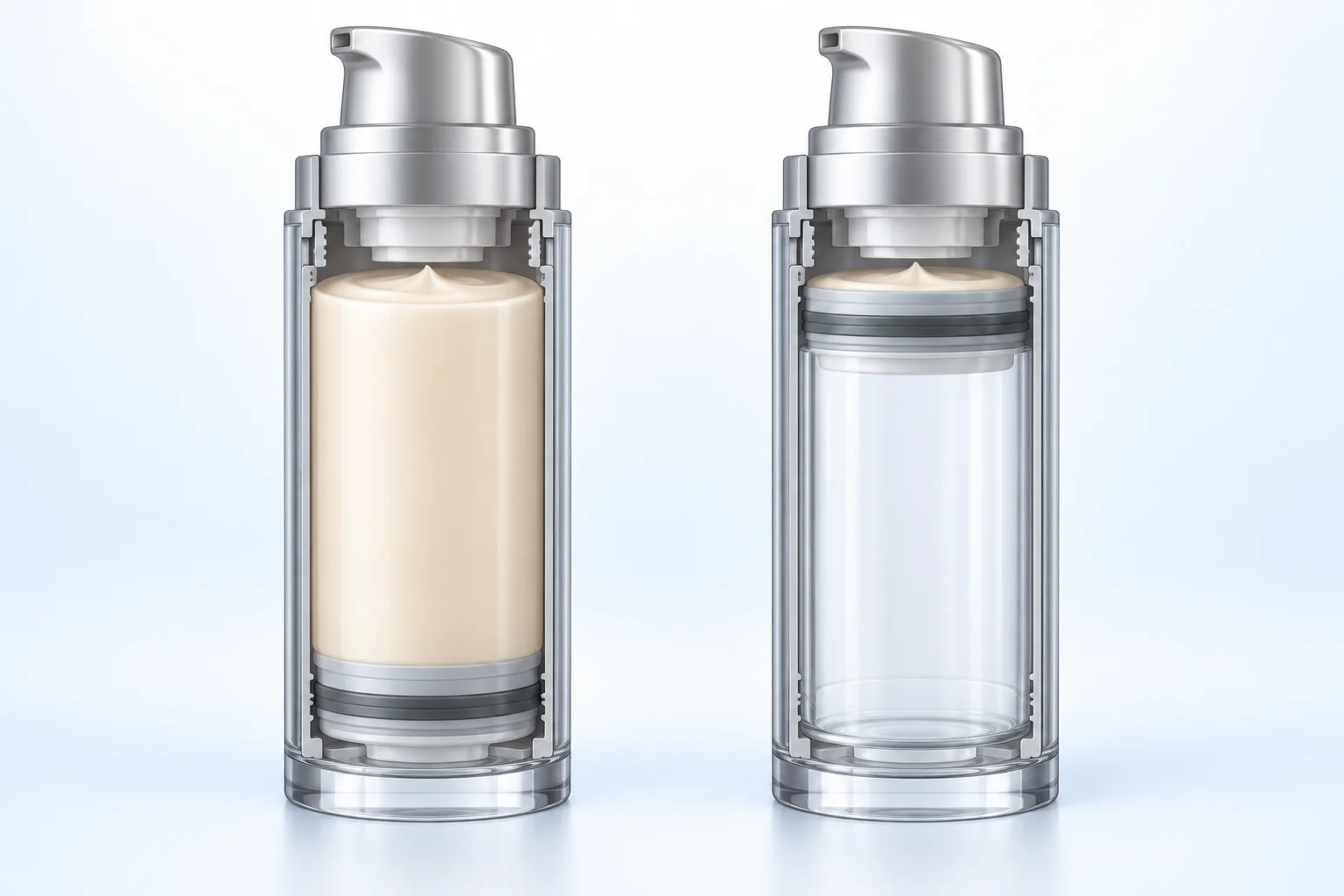
Our Glutathione Brightening Serum page currently recommends an airless pump and lists an opaque or amber glass dropper as an option. That page-level recommendation does not replace component-specific evidence: the exact pump, seal system and supplier reference still need assessment with the final formula.
Material names are a starting point, not a compatibility result
Procurement teams often ask whether glass, PET, PP or PE is “best.” The useful answer begins one level deeper. A material family narrows the questions, but it does not identify the grade, additives, colourants, wall construction, moulding process or closure materials. Two components sold under the same broad material name can behave differently with the same formula.
Glass. Glass is often chosen when low permeability and a premium appearance matter, and it can be a useful control material in a study. The complete pack can still introduce risk through coatings, decoration, liners, bulbs and droppers. Glass also changes the mechanical risk: impact, thermal shock and closure torque need consideration even when the formula itself shows little interaction with the bottle wall.
PET. PET is widely used for clear bottles, but transparency and chemical appearance should not be mistaken for universal suitability. Fragrance components, solvents, oils and elevated temperatures may change the questions that need testing. Wall thickness, recycled content where used, colour masterbatch and the actual bottle-making process belong in the component record.
PP and PE. Polypropylene and polyethylene appear across jars, caps, dip tubes, plugs and airless systems. Their flexibility and chemical resistance can be useful, but different grades and densities have different barrier and mechanical behaviour. A flexible part may deform, a seal may relax, or product mass may change over time without an obvious crack.
Elastomers and liners. Small soft parts can be the decisive parts. A gasket may swell, shrink, harden or become tacky after prolonged formula contact. A liner can absorb volatile material or lose compression. Because suppliers may describe these parts only as “rubber” or “seal,” request the material family and supplier reference rather than relying on the bottle specification alone.
Metal and decoration. Springs, balls, collars and decorative layers may be exposed directly or indirectly. Corrosion, discolouration or coating damage may first appear around the closure rather than in the bulk formula. Printing, metallisation and adhesive labels also need to survive handling, condensation and the intended storage conditions.
A practical material review therefore asks two separate questions: what is each product-contact part made from, and what evidence exists for this exact assembly with this exact formula? A supplier declaration supports the first question. Compatibility data answers the second.
The study-design questions that decide whether a result is usable
Which exact component? “PET bottle with pump” is not a specification. Record the supplier, part reference, material, liner, seal system and any lubricant. A component substitution can make earlier evidence irrelevant.
Which orientations and conditions? Upright, inverted and side storage expose closures differently. The conditions and duration should follow the formula, market, expected logistics and the study protocol rather than a universal number copied from another product.
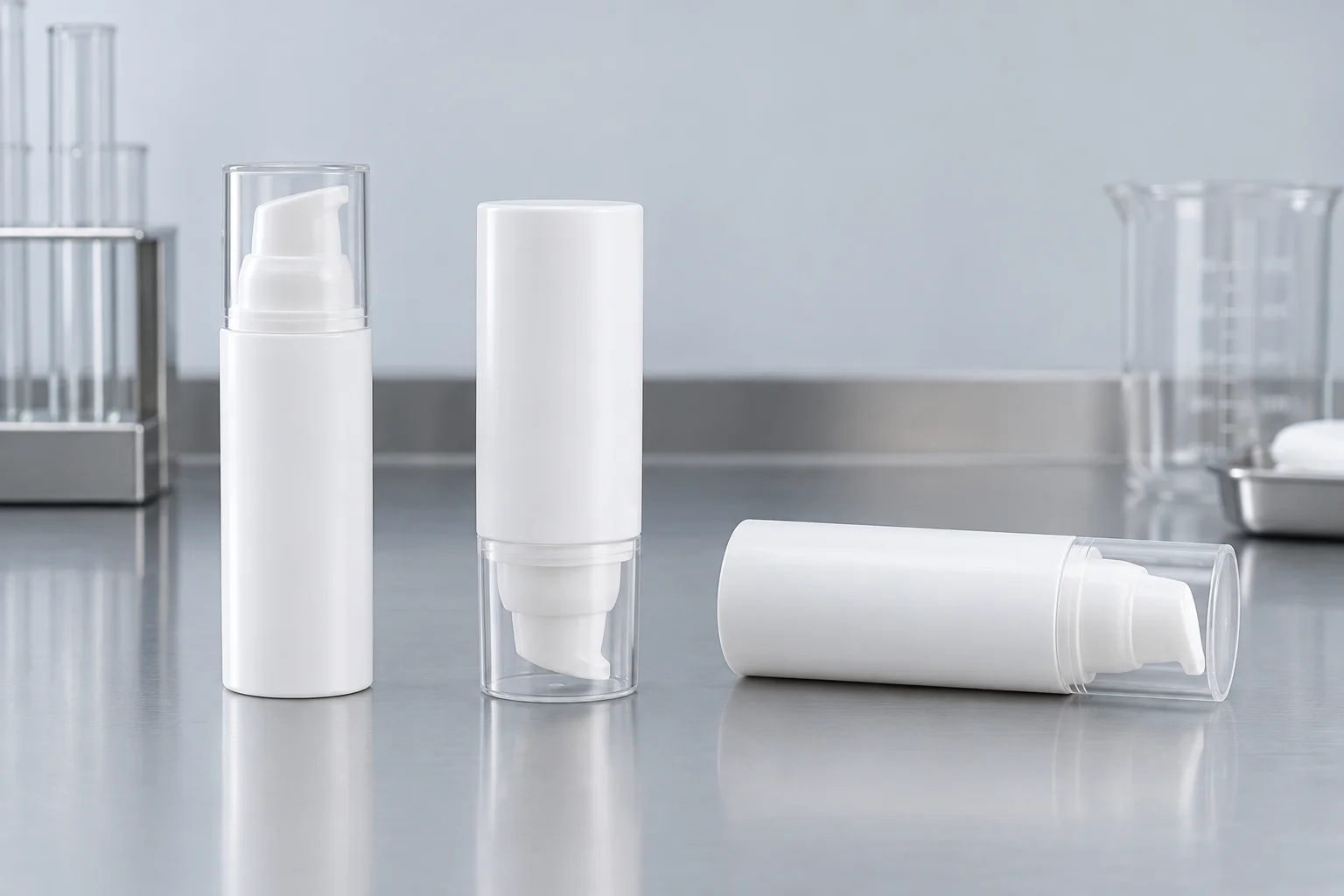
Against what control? An appropriate comparison, such as product held in glass, can help distinguish a formula-wide change from an interaction associated with the intended pack. Without a suitable comparison, a marginal result is harder to interpret. Our guide to reading a stability report explains how to examine the underlying measurements rather than accepting a one-word verdict.
At what scale? A hand-filled laboratory sample is weaker evidence than a representative batch filled using the intended process and final components. Filling temperature, speed and shear can affect both formula and pack.
What acceptance criteria? Set them before the result is seen. For a dispenser, include mechanical function as well as appearance, pH, viscosity, weight change or active content where relevant.
A practical test matrix to request before the study starts
There is no single schedule that fits every cosmetic. The responsible technical team should set conditions from the formula, component, shelf-life objective, logistics and target markets. However, a written matrix makes it much easier for a buyer to see whether important variables have been omitted.
Samples. Identify the formula batch, manufacturing scale and fill date. Include the final market pack, any proposed alternative component and an appropriate control. Use enough units at each condition to allow examination without repeatedly opening the same container and changing its exposure history.
Orientations. Upright storage examines normal shelf use. Inverted and side storage increase contact with closures, liners and actuator pathways. The protocol should say which orientations apply at each condition, not merely state that “packaging was tested.”
Conditions and intervals. Define temperatures, light exposure where relevant, humidity where it affects secondary packaging or labels, and observation points in advance. Ambient or intended-market storage helps show real-time behaviour. Elevated conditions can reveal certain problems earlier, while low-temperature and cycling work can expose crystallisation, loss of prime, cracking or seal movement. Accelerated observations support risk assessment; they should not be presented as an automatic substitute for every real-time requirement.
Product measurements. Select measurements that can reveal meaningful change in the formula: appearance, odour, colour, pH, viscosity, mass, assay or other product-specific attributes. A high-viscosity cream and a volatile fragrance do not need identical panels.
Package measurements. Examine leakage, panel distortion, stress cracking, closure fit, seal condition, label and decoration adhesion, mass change and any visible residue around the dispenser. Photographs taken consistently at each interval are more useful than an undated final image.
Functional checks. Record the number of actuations required to prime, delivered mass or volume across repeated actuations, spray or stream pattern where applicable, actuator return, shut-off and leakage after use. For an airless pack, include evacuation and piston travel. For a dropper, check bulb recovery, pipette fit and whether the closure still seals after repeated opening.
The study plan should also say who reviews an out-of-specification or borderline result. If this decision is postponed until after the data arrive, commercial pressure can quietly replace technical criteria.
Filling, transport and consumer use can change the answer
A component may look acceptable when filled by hand at room temperature and fail on the production line. Hot filling, prolonged hopper residence, high filling speed, capping torque and line handling can introduce stresses that a static laboratory sample never sees. For this reason, the most persuasive confirmation work uses representative product and the intended filling and closing process.
Transport adds vibration, repeated impacts, pressure changes, temperature excursions and periods in the wrong orientation. A compatibility study and a transport test answer overlapping but different questions. Compatibility asks whether product and pack affect each other over time. Distribution testing asks whether the packed product survives its journey. Passing one does not prove the other.
Consumer use adds another layer. A pump may dry between actuations. A jar is repeatedly opened and touched. A dropper can contact skin and return to the bottle. A shower product may sit in high humidity, and a travel pack may be repeatedly compressed. These conditions should inform both the compatibility protocol and the separate microbiological, usability or transport assessments where relevant.
Ask for a short written rationale connecting the laboratory conditions to the actual supply chain. The destination markets, likely warehouse temperatures, freight route, pack orientation and consumer use pattern should be visible in that rationale. Otherwise, even a technically neat report may answer the wrong commercial question.
How to read a packaging compatibility report
A useful report should identify:
- formula name, code and batch reference;
- component supplier, part reference, materials, liner and dispenser assembly;
- the control arm;
- storage conditions, orientations and observation intervals;
- formula measurements such as appearance, colour, odour, pH and viscosity;
- pack measurements such as weight change, deformation, seal integrity and label adhesion;
- dispenser priming, dose consistency, return and sealing at the end of the study;
- acceptance criteria and when they were approved;
- the laboratory, date and responsible signature.
Read the measurements over time, not only the conclusion. A formula that stays comfortably within specification is in a different position from one that reaches a limit at the last interval, even when both summaries say “compatible.”
A buyer's report-acceptance checklist
Before accepting a one-page certificate or a supplier email, check whether you can answer every item below from the evidence provided:
- Does the formula code and batch match the product you intend to buy?
- Is the component identified beyond a generic description, including supplier and part reference?
- Are the pump, dropper, liner, gasket and other product-contact parts within scope?
- Were the market pack, a suitable control and relevant orientations included?
- Are the conditions, intervals and sample quantities stated?
- Were both formula stability and packaging function examined?
- Can you see the measurements at each interval, rather than only “pass”?
- Were acceptance limits approved before results were reviewed?
- Are deviations, substitutions and observations explained?
- Does the conclusion state exactly which configuration it covers?
If several answers are missing, do not assume the work was not done; ask for the study plan, raw observation table and component specification. The gap may be reporting rather than testing. But until the gap is closed, the certificate is weak evidence for purchasing, safety review and later change control.
When something fails: triage in cost order
- Confirm the failure. Check that the specified component was used and the test condition represents the intended product.
- Change the component before the formula. A different gasket, liner or supplier pump is usually a smaller change than reformulation.
- Ask whether the format is fighting the formula. A more protective format may resolve both a compatibility and a stability problem.
- Check the filling process. Deformation or formula change during filling may be a process parameter problem.
- Reformulate last. Reformulation can restart stability, preservation and claim-substantiation work, with the cost consequences that implies.
Three failure patterns and what they usually tell you to investigate
The formula changes in both glass and the market pack. That pattern points first toward formula or process stability rather than a packaging-specific interaction. Review the batch, manufacturing process and storage condition before blaming the component.
The formula remains acceptable in glass but changes in the market pack. Investigate product-contact materials, permeation, seal integrity and component manufacturing differences. Compare observations by orientation. A change concentrated in inverted samples is especially useful because it directs attention toward the closure and dispenser pathway.
The formula measurements pass but the dispenser fails. This is why functional criteria matter. Check viscosity at the same interval, then examine gasket dimensions, spring condition, dip-tube seating, actuator residue and dose results. Replacing a pump or seal may solve the failure without altering a formula that remains within specification.
These patterns are investigation routes, not automatic diagnoses. The report should preserve enough data and samples for the technical team to confirm the cause before approving a corrective action.
What to put in writing with your manufacturer
Scope: Will the study use the final formula, a representative batch and the exact components that will ship? Which orientations, conditions and controls will be used?
Dispenser function: Will priming, dose, return and sealing be assessed at the end, not only the formula specification? What are the gasket and seal materials?
Documentation: Will you receive interval data and the complete component specification, or only a summary certificate?
Change control: Which changes trigger reassessment: formula, component supplier, material, filling process or market? Who makes the decision and who bears the cost?
Responsibility: On an ODM route, the manufacturer developed the formula and its evidence normally begins with them. On an OEM build-to-print route, where the brand supplied formula or components, the responsibility split has to be written down. This sits alongside the rest of your formulation capability checks.
Sequence matters. Choose components before artwork and both before tooling money moves. Our contract packaging guide covers how format choice and component minimums interact.
Need to review a formula and dispenser together?
Send the formula type, intended packaging and destination markets. We will map the questions that need answering before component orders and artwork are locked.
Send Your Packaging Brief →Frequently Asked Questions
What is packaging compatibility testing?
It assesses whether a specific formula and a specific packaging component change each other over time. It examines both the formula and the pack, including dispenser function where a pump, dropper or airless assembly is used.
Is compatibility testing legally required?
The obligation is generally framed around product safety and safety-file content rather than a named method. In the EU, Annex I of Regulation (EC) No 1223/2009 requires the safety report to address relevant packaging characteristics, particularly purity and stability. Confirm the position for each market.
Does a bottle result cover the pump?
No. A dispenser is a separate assembly with its own materials and moving parts. Require the study to use the actual assembly that will ship and to report whether it still functions at the end.
Why can a pump fail when the bottle passes?
A pump has to move, prime, dose and seal. Gaskets, springs, dip tubes and actuator channels can introduce materials and contact conditions that the bottle body does not.
Are airless bottles always better than droppers?
No. Airless formats can reduce air entering during use, but they add questions about piston seals, lubricant, evacuation and long-term barrier performance. The answer depends on the final formula and component.
Can I use a clear dropper for an active serum?
It depends on the active's sensitivity to light and air. If the pack has to be clear, protection may need to come from the carton, the formula or another validated design choice.
What happens if compatibility fails?
Confirm the result, then assess the component, format and filling process before reformulating. Reformulation is usually the most disruptive option because it can restart other qualification work.
Do I need to reassess if a supplier changes a component?
Treat a component change as a reassessment trigger because the result attaches to the component tested. Whether a documented assessment is enough or a new study is needed is a decision for the responsible technical and safety teams.
Ready to Start Your Project?
Tell us your product requirements. Our technical team responds within 24 hours with a detailed quotation.