
Private Label Hand Cream: Tube Size, Texture and Variant Decisions Before Quoting
A hand cream range looks simple on a mood board: one cream, three scents, two tube sizes. By the time it reaches a quotation it is often six or more separate items, each with its own fragrance version, tube print, cap colour and quantity. If those items are not written down separately, two suppliers will price two different projects and the numbers can't be compared.
This guide is for brand owners and buyers preparing a private label hand cream project for quotation. It covers the decisions that change the quote: fill size and tube identity, the texture target, how fragrance versions are tracked, and how many units you are actually asking for per variant. It includes a worked, fictional example that takes a round of samples through to a variant-by-variant quote input and a clear approved / revise / still open handoff.
It is not a retail product guide, a supplier ranking or a review of what hand cream ingredients do for skin.
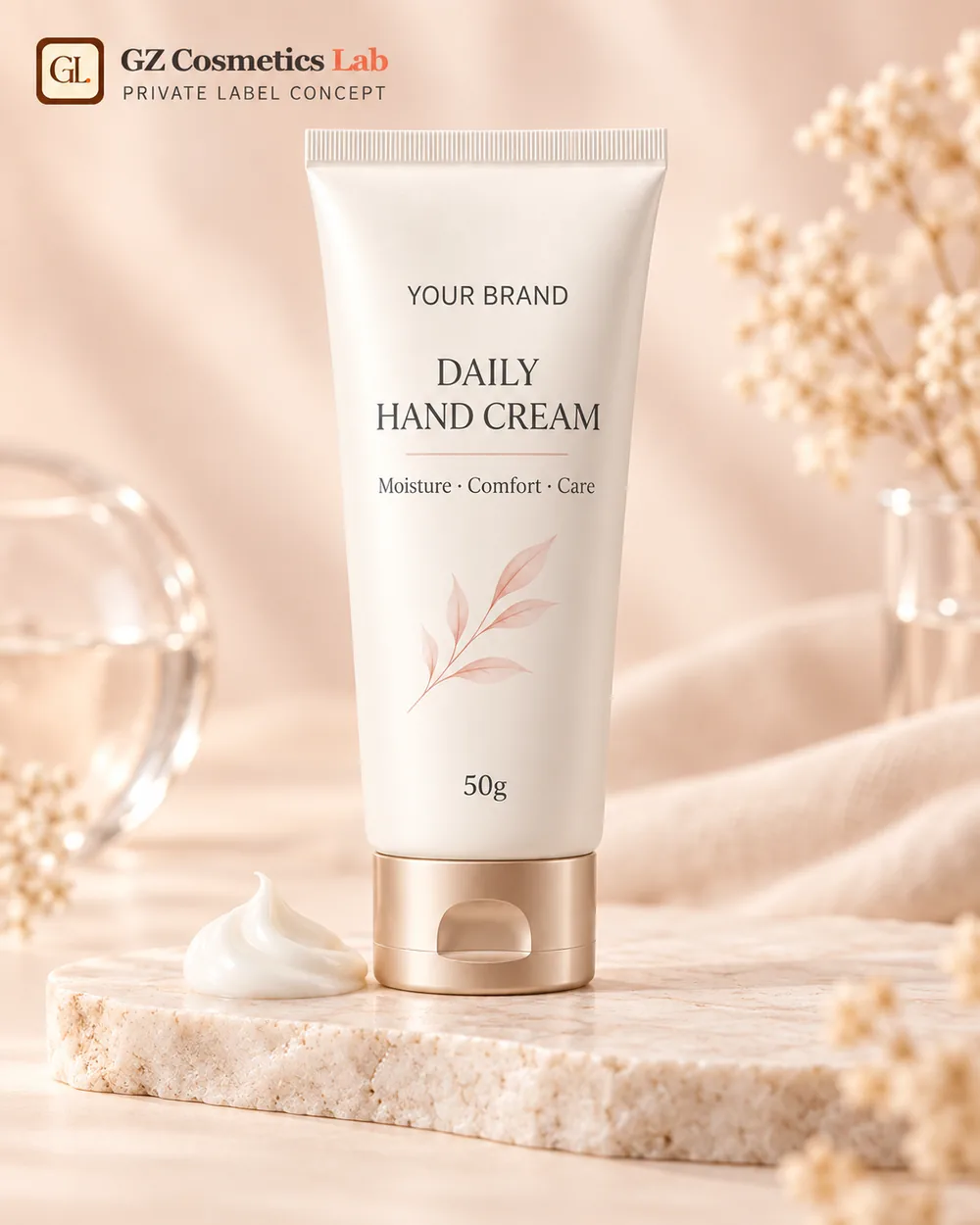
Start with the product direction
Explore the existing hand-cream product page, then keep the formula, fragrance, tube and component choices separate in your request.
Product concept illustration, not a photograph of a supplied or tested batch. The illustrated 50g label is not a specification for the fictional 50ml and 30ml examples below.
Why hand cream quotes drift apart
Most hand cream briefs fail in the same place. The buyer describes the range. The supplier has to quote the parts.
A range description says "a light daily cream in fig, citrus and unscented, 50 ml and 30 ml". A supplier pricing that brief has to decide, without being told:
- whether all three scents sit on one base formula or need adjustments per scent;
- whether "50 ml" is the fill quantity or the tube's nominal size;
- whether each scent gets its own printed tube or a shared tube with a label;
- whether caps are one colour across the range or matched to each scent;
- whether the quantity in the brief is per scent, per size, or for the whole range.
Each of those guesses moves the price and the minimum order conditions. When the quotes come back, one supplier has assumed shared printed tubes and another has assumed six separate print runs. Neither is wrong. They answered different questions.
The fix is not a longer brief. It is a brief that names each variant as a line and keeps formula, fragrance, component and decoration choices in separate columns, so a supplier can tell you where its minimums actually apply.
Fill size and tube identity: decide what you are referring to
"Tube size" in a hand cream brief usually mixes three things that should be recorded separately.
Fill quantity is what goes on the label and what the customer buys. It is a product decision.
Tube reference is the physical component: its diameter, length, wall material and structure, shoulder and orifice, and the cap that goes on it. Two tubes sold as "50 ml" can differ in all of these. The tube you hold during sampling may be a stock tube the supplier had available, not the component that would be used in production.
Closure is part of the tube reference, not a separate afterthought. A flip-top, a screw cap and a nozzle cap handle the same cream differently in use. They also come with their own colour and moulding options.
For quoting, give each tube and cap combination a reference name you can use in every message, such as T1 or T2, and record which physical sample it refers to. If you supply your own tube reference, say so. If the supplier proposes one, ask whether it is a production-intended component or a sampling stand-in. Do not assume that because a sample filled well into one tube, the same cream has been checked in a different tube. Tube or pump compatibility is checked on the finished product with the actual component, and that work is scoped with the supplier.
If your brief says private label hand lotion rather than hand cream, check early what you mean. Some buyers use "lotion" for a thinner product in a pump bottle, which is a different component decision from a tube, and a different thing to sample.
Texture: write the target before you open the samples
Hand cream samples are easy to like or dislike and hard to describe usefully. Before a sample round, write one or two sentences for each intended product describing who uses it and when: frequent daytime use at a desk, a richer product for evening, a gift-set item, a hospitality amenity. Add the climate it is mainly sold into.
This gives your reviewers something to compare against. "Feels too heavy" is a weak note. "Too heavy for the desk-use daily product we described" tells the supplier which direction to move.
Our custom hand cream product page outlines the two concept directions we develop from, a faster-absorbing daily cream and a richer barrier-support cream. Use whichever is closer as a starting reference in your brief, then let the samples tell you how far to move from it.
If you are looking at a white label hand cream, meaning an existing stock formula sold under your brand with little or no formula change, the texture decision is mostly a yes or no on what exists. The tube, fragrance and decoration decisions in this guide still apply, and they are often where the cost and minimum conditions sit.
Fragrance versions are separate decisions
In a hand cream range, the fragrance often carries the product identity. It also creates the most variants.
Track fragrance as its own field with a version, not just a name. "Fig" is a direction. "Fig, version 2, as received in sample S-02" is something a supplier can reproduce, adjust or price. When a fragrance changes between rounds, the version should change too, even if the name on the label stays the same.
Three points matter for quoting:
- A different fragrance version is a different formula input. It may need its own evaluation and testing scope on the finished product, even when the base is the same.
- If you want to match an existing fragrance, provide an approved reference. Whether it can be matched depends on fragrance supplier availability, allergen review and stability work on the finished product.
- Fragrance allergens and label declarations are reviewed per destination market. Name your markets per variant, because two scents sold into different regions may need different label work.
An unscented variant is still a variant. It has its own code, its own label and often its own printed component.
Reviewing samples within the supplier's approved use
Sample review for quotation is an ordinary use check. Follow the supplier's stated purpose and instructions for the samples, use them the way a hand cream is normally used, and record what you notice about feel, scent and handling. Keep notes on the sample code, the tube it came in and who reviewed it.
This is not a safety, efficacy or allergy test, and it should not be turned into one. Don't extend contact time, combine the samples with other products, try to stress the product or use it on broken or irritated skin. Hand cream claims also need care: stay within cosmetic language and avoid presenting the product as a treatment for eczema, dermatitis or cracked skin.
What a sample round can do is tell you which direction you prefer and which questions to send back. The example below shows how that works.
Worked example: comparing hand cream samples
The following is an illustrative example. The brand, sample codes, fragrance names, observations and quantities are fictional. They are not results from a real client project, test or quotation, and they do not describe GZ Cosmetics Lab minimums or specifications.
A small body-care brand, which we will call Harbor Lane, plans a daily hand cream line. Its brief described a light, quick-absorbing cream for frequent daytime use in a temperate climate, in three scent variants, with a possible richer evening product later. The supplier sent five samples. Four internal reviewers used each sample as directed over a normal working day and recorded short notes.
On a phone, swipe this table sideways to read every column.
| Sample code | Base / formula version | Fragrance version | Tube / cap reference | Ordinary use observations | Still to confirm |
|---|---|---|---|---|---|
| S-01 | Base A, v1 (lighter daily) | Unscented | T1: supplier stock tube, nominal 50 ml, flip-top cap | Spreads quickly; three of four reviewers noted a slight tacky feel on the back of the hand shortly after applying | Is the tack from Base A itself or this sample lot? What change is proposed, and will the revision carry a new version code? |
| S-02 | Base A, v1 | Fig, v2 | T1 | Feel similar to S-01; scent noticeably stronger than the fig v1 reference the brand had approved by smell | Is fig v2 the same fragrance at a different level or a different fragrance? Which is the reference going forward? |
| S-03 | Base A, v1 | Citrus, v1 | T1 | Two reviewers reported cream building up around the orifice; the flip-top did not always close cleanly during that review | Is T1 the intended production tube or a stand-in? Are other orifice or cap options available for this texture? |
| S-04 | Base B, v1 (richer) | Fig, v2 | T2: supplier stock tube, nominal 30 ml, screw cap | Richer cushion; reviewers felt it suited evening use more than desk use | Is Base B in scope for this launch or a later phase? Is T2 suitable for this thicker base? |
| S-05 | Base A, v1 | Citrus, v1 | T2 | Dispensing fine; reviewers preferred the 30 ml size for the gift set only | Does the brand need T2 for Base A at all, or only for a gift set? |
Several things are already visible. The brand likes Base A's direction but not its after-feel. The fig version has drifted from what was approved. T1's flip-top may not suit this cream, though the sample alone doesn't show why. And the scope has grown: Base B and a 30 ml size have entered the conversation without anyone deciding they were part of the launch.
Turning observations into supplier questions
A comparison table is only useful if each row ends in a question the supplier can act on. Below, four of the observations above are rewritten as specific requests.
Texture observation to formula question. Reviewers noted tack on Base A v1. The request: "Base A v1 felt slightly tacky shortly after application for three of four reviewers. We want to keep the light daily direction. Please propose an adjustment, tell us which version code the revised sample will carry, and say whether the change affects the base used across all three scents."
Dispensing and closure observation to tube and cap question. Cream built up around T1's orifice and the cap did not close cleanly. The request: "Is T1 the tube you would use in production, or a stock tube for sampling? If production-intended, which orifice and cap options are available for Base A's texture? Please confirm which tube and cap would be used for compatibility work on the finished product."
Fragrance observation to fragrance version question. Fig v2 smelled stronger than the approved v1 reference. The request: "We approved fig v1 by smell. S-02 carried fig v2, which reviewers found stronger. Please confirm what changed between v1 and v2, which version you recommend as the reference, and whether a version change affects the allergen review or testing scope you would propose."
Quantity per variant to component and decoration question. The brand wants each scent in its own printed tube with a matching cap colour, but expects lower volumes for citrus and the gift size. The request: "We are planning three scents, each with its own printed tube and cap colour, plus a gift size, at the per-SKU quantities in our attached sheet. Please tell us where minimums apply: per formula batch, per fragrance, per printed tube design, per cap colour, or a combination. If a shared cap colour or a plain tube with a label would change those conditions, please quote that option separately."
Notice what these questions do not do. They don't ask the supplier to confirm that the cream is stable or that a tube is compatible because the samples seemed fine. An ordinary sample review can show a preference or a handling problem. It cannot on its own prove what caused the tack, show whether the fragrance will hold over the product's shelf life, or establish that the cream and tube work together over time. Those questions belong to the formula and finished-product work the supplier scopes after the direction is chosen.
Still deciding which tube or fragrance version to use?
Share your sample comparison and mark the decisions still open. Keep the requested quantity separate for each variant.
Variant-by-variant quote input
Once the questions are out, Harbor Lane rebuilds its brief as one line per sellable variant. This is the document it will send for quotation, with the supplier's answers filled in as they arrive.
The quantities below are the buyer's own assumed requests for this fictional example. They are not supplier minimums, and no prices, lead times or minimum order quantities are implied.
On a phone, swipe this table sideways to read every column.
| Variant code | Base / formula | Fragrance version | Tube / cap identity | Decoration | Requested units per SKU (buyer assumption) | Open supplier minimum conditions |
|---|---|---|---|---|---|---|
| HL-DAY-UNS-50 | Base A, revised version pending | Unscented | T1 or replacement, pending orifice answer; white cap | Printed tube, design 1 | 3,000 | Minimum per printed design? Per cap colour? |
| HL-DAY-FIG-50 | Base A, revised version pending | Fig v1 scent reference; final fragrance version pending | Same tube as above; green cap | Printed tube, design 2 | 3,000 | Fragrance batch minimum? Does a separate cap colour carry its own minimum? |
| HL-DAY-CIT-50 | Base A, revised version pending | Citrus v1 | Same tube as above; yellow cap | Printed tube, design 3 | 1,500 | Can a lower quantity share a print run? Is a plain tube with label quoted separately? |
| HL-GIFT-FIG-30 | Base A, revised version pending | Fig v1 scent reference; final fragrance version pending | T2, screw cap, colour TBC | Printed tube, design 4, or label on plain tube | 1,000 | Is T2 confirmed for Base A? Minimum for a fourth print design? |
Base B does not appear. The brand decided it belongs to a later phase, and including it in this quotation would only blur the numbers. It stays in the brief as a note, not as a line.
Why the same base does not mean a combined minimum
It is tempting to add up the column: 8,500 units of Base A, so surely the formula minimum is easy to reach. That may be true for the cream batch. It says nothing about the parts that differ between lines.
Each scent may be produced as its own fragranced batch. Each printed tube design may have its own print minimum. Each cap colour may have its own moulding or purchasing minimum. A line can share a base with three others and still be the line that sets the overall minimum, because its tube print or cap colour is unique. That is why the sheet keeps these columns separate, and why the last column asks the supplier where its minimums apply rather than assuming they pool.
If the per-SKU quantities don't reach the conditions the supplier states, the sheet also shows which levers you have: share a cap colour, move a low-volume scent to a plain tube with a label, drop the gift size, or phase a scent in later.
The handoff: approved, revise, still open
The last step turns all of this into a short status the buyer and supplier can both work from. For Harbor Lane, it looks like this.
Approved, as a direction for quoting:
- Base A is the base for the daily line. The light, quick-absorbing direction is right.
- The scent of fig v1 is the chosen reference; the final fragrance version remains open. Fig v2 is not approved.
- Citrus v1 is accepted as a direction.
- Three daily variants at 50 ml fill and one 30 ml gift variant are in scope. Base B is out of scope for this launch.
Revise, needs a new sample:
- Base A, to reduce the after-feel tack, with a new version code. Re-review all three scents on the revised base, because a base change affects every variant.
- Fig, re-sampled against the chosen v1 scent reference in the revised base. Confirm and record the final fragrance version, whether v1 or a new version such as v3.
- Tube and cap for the daily line, if the supplier confirms T1 was a stand-in or proposes a different orifice or closure.
Still open, needs supplier confirmation before quotes can be compared:
- Whether T1, or its replacement, and T2 are the production components, and which ones compatibility work will use.
- Where minimums apply across formula batches, fragrances, printed designs and cap colours, and how the alternatives change those conditions.
- The stability, compatibility, preservation and safety work the supplier proposes for the finished product in each tube, including whether separate fragrance versions change that scope.
- Fragrance allergen and labelling review for each variant's destination market, and who is responsible for it.
"Approved" here means the brand has chosen a direction. It does not mean the product is ready. A sample the team likes has not yet shown that the finished product is stable, safe, compatible with its tube or compliant in the market where it will be sold. Those items stay on the open list until the work is scoped and done. Keeping them there is also what makes two suppliers' quotes comparable: both are pricing the same open work rather than one quietly leaving it out.
Bringing this to a quotation
A hand cream private label quote is only as clear as the variant list behind it. If you have a set of samples, a comparison like the one above and a draft variant sheet, you already have what a supplier needs to give you a useful answer, including the questions you haven't been able to close yet.
To see the hand cream directions we develop from, start with the custom hand cream product page. When you are ready, send your sample comparison and variant sheet with a quote request. Include each variant's base, fragrance version, tube and cap reference, decoration, requested quantity and destination market, plus the questions still open. Pricing, minimums and testing scope are confirmed against those details.
If hand cream is one part of a wider body-care launch, our guide to private label body care manufacturing covers how it fits alongside lotion, wash and scrub. For how quantity and cost decisions interact more generally, see the private label MOQ and cost guide.
Ready to Start Your Project?
Tell us your product requirements. Within 24 hours, our technical team will reply with a quotation or the questions needed to prepare one.