
Hypochlorous Acid Facial Mist: Packaging and Shelf-Life Decisions for Brands
A hypochlorous acid facial mist should be evaluated as a formula-and-package system. A clear liquid that sprays well on the day it is filled is not enough to establish shelf life. For a brand, the essential question is whether the selected product remains within justified specifications in its final bottle throughout the proposed storage and use period.

That makes this a different purchasing decision from choosing a conventional fragranced facial mist. Before discussing bottle decoration or adding more ingredients, agree what will be measured, when it will be measured and how the results will support the proposed product claims.
A short ingredient list does not mean a simple development project
Tower 28's SOS spray currently lists water, sodium chloride and hypochlorous acid. It is a recognizable example of a minimalist HOCl facial-spray format, not a manufacturing recipe or proof that another product can use the same claims. The brand also advises checking packaging for the current ingredient list. Tower 28's product page.
The development work behind a short list can include analytical control, material compatibility and storage validation that are invisible on the retail label. A buyer comparing suppliers should therefore ask about those controls rather than judging complexity by ingredient count.
Avoid adding a botanical, fragrance or another fashionable active solely to make the label look more substantial. Treat each addition as a new formulation question. The development partner should explain its purpose and how compatibility will be assessed in the proposed system.
What the stability literature can and cannot tell you
A 2017 experimental study found that its weakly acidic HOCl solution lost stability under several conditions, including light, elevated temperature and exposure to certain other substances. The study concerned a defined solution and microbicidal activity, not a finished facial cosmetic. It identifies reasons to investigate storage and compatibility; it does not prescribe a universal cosmetic concentration, storage temperature or expiry period. Ishihara and colleagues, Biocontrol Science.
For procurement, the implication is to request data for the actual proposed formula and packaging. A paper about HOCl chemistry is not the same as a stability report for the product bearing your brand. Neither a competitor's stated shelf life nor a bulk supplier's general assurance closes that gap.
Write a measurable specification before comparing samples
The phrase “contains hypochlorous acid” is not a complete release specification. Ask the technical team to identify the measured parameter, analytical method, reporting units and acceptance criteria. If chlorine concentration is reported, clarify exactly what the method measures and how that result relates to the product specification.
Record pH separately. A pH result is not a substitute for a concentration measurement, and two clear-looking samples should not be considered equivalent because their appearance matches.
The purchasing file should connect three points in time: the bulk solution, the filled product at release and the product during the proposed shelf life. Ask the manufacturer to justify the criteria at each point. Do not accept an unexplained initial overage as a substitute for evidence that the final product remains suitable over time.
On a phone, swipe the table sideways to see every column.
| Record | Question it should answer |
|---|---|
| Formula and batch identity | Which exact material and production batch were evaluated? |
| Analytical method and units | What was measured, using which suitable method? |
| Filling and test dates | How old was the product when each result was obtained? |
| Packaging component references | Which bottle, closure and sprayer assembly contained the tested product? |
| Storage conditions and observations | What exposures occurred, and what changed? |
| Acceptance criteria and conclusion | Why do the results support the proposed release and shelf-life decision? |
This table is a suggested review structure, not a substitute for a qualified specialist's specification or safety assessment.
Evaluate the whole spray assembly
“Plastic bottle” is not a sufficiently detailed packaging description. Request the component specifications for the bottle, closure, liner, dip tube and relevant sprayer parts. Identify the product-contact materials and any component changes during development.
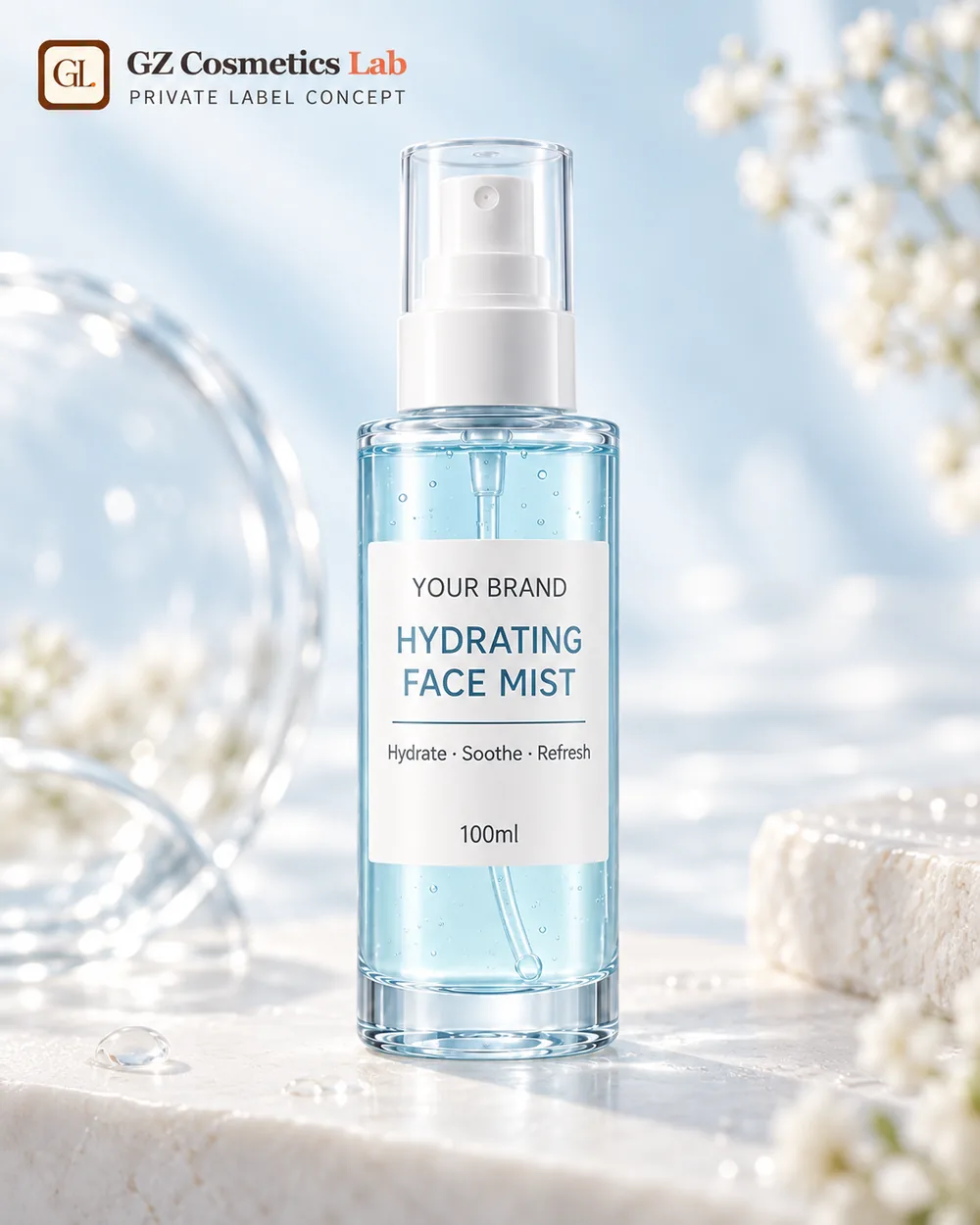
Existing GZ Cosmetics Lab packaging concept for a general face mist. It is not a verified hypochlorous acid product or a confirmed HOCl manufacturing offer.
Then evaluate the complete proposed assembly. Color alone cannot qualify a bottle, and a familiar resin name does not establish that every version of the package is suitable. Wall construction, closure design, actual components and the intended storage conditions all belong in the assessment.
Spray performance deserves a separate check. Review output per actuation, spray pattern, priming, leakage and performance near the end of the pack. For a facial-use concept, have the safety assessment address the intended application and foreseeable exposure; do not select a finer mist solely because it looks more premium in a demonstration.
If the sprayer changes after testing, ask the technical team what must be repeated. A package that looks identical can still have different internal components. Our general packaging compatibility guide explains the broader dispenser questions; the HOCl project still needs its own compatibility decision.
Do not confuse a bulk report with final-pack shelf life
A bulk sample can help establish material quality before filling. It does not reproduce the filled bottle, shipping conditions or consumer's use pattern. Ask the development partner which evidence covers each part of that chain.
For a proposed stability program, discuss appropriate controls or retained samples as the specialist defines them, the final package, relevant storage exposures and the ongoing real-time work. Accelerated studies can inform development, but the specialist should explain how they relate to the proposed shelf life and what they cannot establish alone.
Include a use simulation when appropriate: repeated dispensing, cap handling and the expected period after opening. A refill concept deserves its own assessment rather than simply inheriting the original spray bottle's conclusions. Different handling creates a different evaluation question.
The commercial brief should also describe the route to market. A product held locally in controlled conditions and one shipped through a hot distribution chain may face different exposures. Provide the actual logistics assumptions so the testing plan is not based on an unrealistic journey.
A staged final-pack validation sequence
Laying the work out as a sequence makes it easier to see which result informs which decision. It is an illustration, not a fixed checklist: a qualified specialist decides which steps apply, and with what conditions, intervals and criteria, based on the product, package, target market and risk. The brand should still be able to follow the reasoning.
- Pre-screen candidate packs. Fill short-term samples into the shortlisted bottle and sprayer assemblies and compare them with an appropriate control or retained sample defined by the specialist. Discard options that show early changes in the measured parameter, appearance, odor or spray function before investing in a full program.
- Record T0 for the selected system. Test filled units from a defined batch at the start of the study using the agreed method. Note the filling date, component references and test date so later results have a fixed reference point.
- Plan accelerated and real-time storage. Accelerated conditions can flag weaknesses sooner. Real-time storage in the final pack confirms the shelf life over time. Ask how the specialist will interpret any disagreement between them.
- Simulate consumer use. Dispense repeatedly from opened units over the expected use period and test at agreed points, including near the end of the pack. Review spray output and leakage alongside the analytical results.
- Re-review after any packaging change. A new resin grade, closure liner, dip tube or pump supplier reopens the question. Ask the technical team to state in writing which steps must be repeated before the changed pack is approved.
An initial shelf-life rationale can rest on the data the specialist considers appropriate at launch, with ongoing real-time results confirming it. What matters is that the period is justified for the specific product, not chosen first and then defended.
Planning a facial mist with a demanding active?
Tell us the target market, intended use, proposed claims and spray preference. Capability and the validation work would be confirmed in a feasibility review before any commercial quotation.
Stability, microbiological quality and efficacy are separate questions
Keeping a measured chemical parameter within specification does not by itself prove every consumer benefit. Likewise, an antimicrobial result reported for an ingredient or laboratory solution is not automatically evidence for the finished facial product's safety, protection during use or advertised performance.
Ask the safety and microbiological specialists to define the appropriate evaluation for the complete product and its intended use. Do not assume that a product marketed around HOCl needs no microbiological assessment, and do not assume a standard test can be applied without considering the formula's properties and the method's suitability.
For efficacy, start with the exact proposed benefit and evaluate what evidence supports it. Keep supplier chemistry data, finished-product quality results and consumer-benefit studies in separate sections of the project file. They may inform each other, but they do not answer the same question.
Set the claims before choosing the regulatory route
This guide concerns a facial cosmetic development concept, not a wound-care, disinfectant or disease-treatment product. If the intended claims move in those directions, obtain a separate classification assessment before proceeding with ordinary cosmetic assumptions.
FDA explains that cosmetic labels must be truthful and that disease-treatment or body structure/function claims can bring a product within drug requirements. A competitor's product page is not an FDA-approved list of wording available to other brands. FDA's cosmetics labeling-claims guidance.
Have the target-market reviewer assess the product name, pack copy, website and proposed advertising together. A restrained front label will not resolve a contradictory treatment promise on the product page. Describe only benefits supported for the actual product and permissible in its market.
Compare quotations on the work included
In a hypothetical comparison, Supplier A offers a low filling price with a bulk report, while Supplier B includes a specified final pack and a defined stability program. Those offers are not yet equivalent. Ask both suppliers to price the same scope before selecting on unit cost.
Clarify who owns the analytical specification, which reports will be supplied, what happens after a packaging change and what conditions must be met before approving shelf life. Also distinguish development samples from a finished commercial offer. An attractive sample does not settle production capability, documentation or the launch timetable.
By the end of development, the brand's own file should contain:
- The approved finished-product specification, with parameters, units and acceptance criteria at release and through shelf life
- The analytical method for each specified parameter, with the method version used in the reports
- The stability protocol, the interim results available so far and the final report once the study is complete, for the product in its final pack
- In-use or use-simulation results, if that work was part of the agreed program
- The bill of packaging components, with supplier references and the product-contact materials
- The packaging change record, showing what was re-tested after each change
- Batch identities for the units tested, linked to the corresponding reports
If a supplier cannot share a document, agree in advance what summary the brand will receive instead. A shelf-life statement without its supporting records is difficult to defend later.
Start with feasibility, not a stock-product assumption
Send a short brief covering target market, intended facial use, proposed cosmetic claims, pack size, spray preference and distribution conditions. Ask the prospective manufacturer to confirm capability and the required validation work before requesting a committed commercial quotation.
You can submit this type of project inquiry to GZ Cosmetics Lab for a feasibility discussion. This article does not identify a verified GZ HOCl manufacturing offer or a validated stock formula. For this category, that confirmation is part of the first decision, not something a buyer should infer from the existence of a guide.
Ready to Start Your Project?
Tell us your product requirements. Within 24 hours, our technical team will reply with a quotation or the questions needed to prepare one.