
Argan Oil in Hair Care Formulation: A Buyer's Guide to Samples, Stability, and Claims
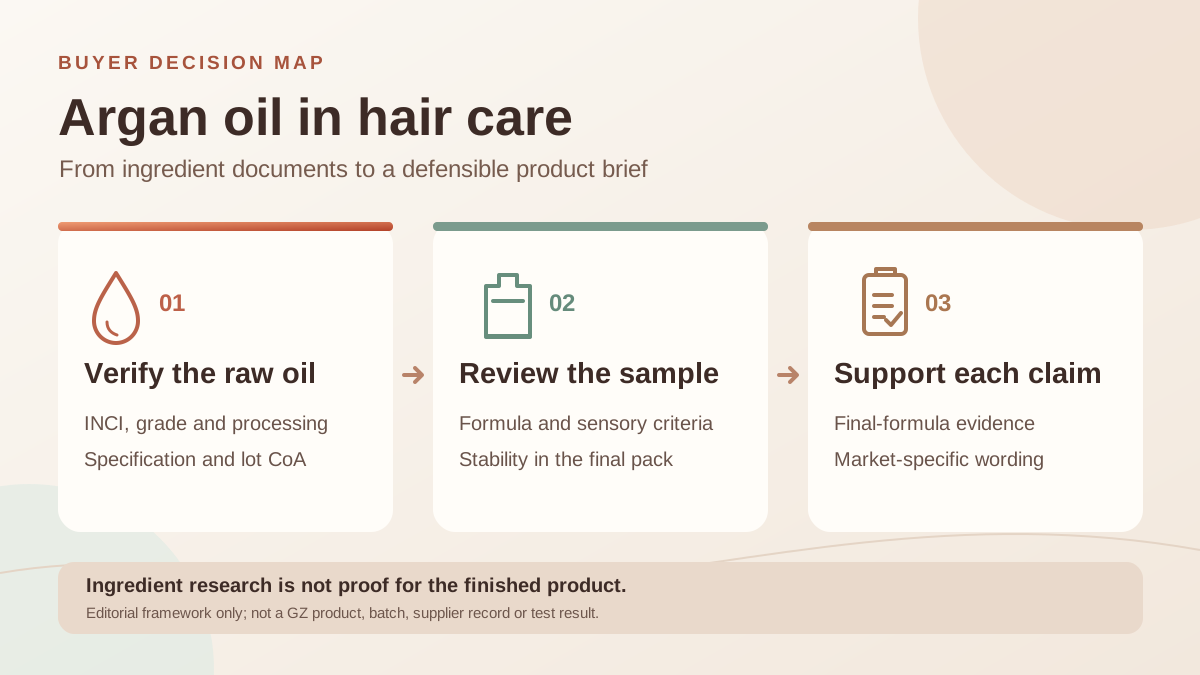
Short answer: If you want argan oil in a private label shampoo, conditioner, mask or leave-in, treat it as three separate questions. First, which argan oil is the supplier actually using, and what records come with it? Second, does the finished formula stay acceptable in your real packaging? Third, what can you honestly say on the label in your target market? Published research on argan oil helps you ask better questions. It does not prove that any particular finished product works, lasts or deserves a specific claim. That evidence has to come from the supplier's documents and from tests on the finished formula.
This guide is for brand owners and buyers who are commissioning an argan-oil hair-care concept and want to judge samples without guessing. It covers the brief, the format choice, the raw-material questions, the finished-product checks, the claim boundary and a closing RFQ checklist.
Start with a brief that defines "argan" for your product
"Argan shampoo" can mean very different products. Argan oil might be a small conditioning addition to a cleansing base, a prominent ingredient in a rinse-out mask, or most of a leave-in oil. Each of those makes different demands on the formula, the packaging and the claim. A supplier cannot pick the right route until you tell them what the product has to do and what would make you reject it.
Put these decisions in writing before the first sample:
- Destination market. Where will the product be sold first? Label rules, permitted claims and required documents depend on it.
- Format. Shampoo, rinse-out conditioner, rinse-out mask, or leave-in. If you are undecided between two, say so and ask for both to be sampled against the same criteria.
- Target user and routine. Hair type and condition, how often the user washes, whether hair is color-treated or heat-styled, and how much product a typical use involves.
- Desired finish. For example soft, smooth, light shine, easier combing when wet, or easier detangling when dry. Pick the two or three that matter most.
- Unacceptable results. Heaviness, greasy roots, visible residue, flat volume, a strong nutty or "toasted" smell, or color that clashes with your packaging. Naming these early saves a sample round.
- Packaging. Bottle or jar material, transparency, pump, flip cap or dropper. Packaging affects light exposure, air contact and how the product dispenses.
- Claim direction. The kind of statement you hope to make, such as "with argan oil" or "leaves hair feeling soft". The claim can be refined later, but the direction shapes what evidence you will need.
- Sample acceptance criteria. How you will decide a sample passes, who will assess it, on what hair, and against which reference product.
Hypothetical example
This is an invented scenario for illustration. It does not describe a GZ customer, project or product.
A hypothetical brand plans a two-product line for the US market: a shampoo and a rinse-out mask, both positioned for dry, color-treated mid-lengths and ends. The buyer wants softness and easier wet combing without weighing hair down. She rejects anything that leaves roots looking oily by the next morning or that smells noticeably of raw oil. Packaging is an opaque bottle for the shampoo and a jar for the mask. The claim direction is cosmetic only: "with argan oil" plus feel-based statements. Acceptance means a small internal panel prefers the sample to the brand's current reference product on feel, with no rejection points, using the same wash routine.
Notice what the buyer did not ask for. She did not set an argan percentage, because she has no evidence that a particular level produces her target finish. She asked the supplier to propose a formula route and explain it.
Takeaway: Define the job, the rejection points and the acceptance test. Leave the argan level as a question for the supplier to justify.
Choose the format by what you can test in it
The format decides what a sample round can tell you. The table below compares what each format lets you assess. It is a planning aid, not a rule about how much oil any formula holds or what it does on hair. Those depend on the full formula.
Swipe horizontally to compare all columns.
| Format | What the buyer can assess in samples | Questions to put to the supplier | What the sample cannot settle on its own |
|---|---|---|---|
| Shampoo | Lather, rinse feel, wet combing, dry feel and root freshness after a normal wash | How the argan oil is incorporated into the cleansing base, and whether it changes foam or clarity | Whether any stated benefit is attributable to argan rather than the rest of the formula |
| Rinse-out conditioner or mask | Slip, detangling, rinse-off time, softness and weight on dry hair | Which conditioning ingredients carry the main feel, and what role the argan oil plays | Long-term results, or results on hair types you did not test |
| Leave-in (oil, serum, cream or spray) | Spread, absorption feel, shine, greasiness and how the next wash removes it | Whether the product is mostly oil or an emulsion, and how odor and color are controlled | How the product behaves after months in the final pack, which needs stability work |
If the leave-in route is still open, our guide to private label hair oil versus serum covers naming, finish, dose and packaging for that choice. This article stays on the argan-specific decisions.
If shampoo is the lead format, use the private label shampoo page to discuss that project route. The catalogue is a starting point for an inquiry; the actual formula and its argan content still require written confirmation.
Takeaway: Pick the format whose sample round answers your real question. No single table can predict how argan behaves in a formula you have not seen.
Raw-material questions to ask about the argan oil
Argan oil is not one interchangeable commodity. The kernels, the extraction and any refining all affect the oil you receive. Ask the supplier the following questions. These are requests for the supplier's own records. Until those records arrive, treat each answer as unconfirmed.
Identity: the INCI name
The usual INCI name for argan kernel oil is Argania Spinosa Kernel Oil. The COSMILE Europe ingredient entry lists it as an oil from the kernels of the argan tree, with skin-conditioning, emollient and fragrance functions, and notes that it occurs in skin and hair care products. Ask for the exact INCI name that will appear in the full ingredient list. Check whether the material is plain kernel oil, a hydrogenated form, or a blend with other oils, a carrier or an antioxidant. A blend changes what the label must say and what "argan oil" means in your marketing.
An ingredient database entry identifies the material; it does not prove that a particular finished product contains it. For your product, request the confirmed final formula and matching full INCI list. Even those records do not tell you how the finished product performs.
Grade and processing
Ask whether the oil is virgin (cold-pressed) or refined, and if refined, which steps were used, for example bleaching and deodorization. Refining can make an oil paler and less fragrant, which some buyers prefer for a neutral-smelling product. It can also change how well the oil resists oxidation.
A 2024 study in Scientific Reports is a useful caution. Researchers compared argan oil made from lower-quality kernels with portions of the same batch that were then physically refined, and stored both under accelerated conditions. Physical refining improved some initial quality measures but sharply reduced oxidative stability, which the authors linked to loss of tocopherols. The authors also noted that kernel quality varies widely. That is one processing route from one starting material. It does not rank every argan grade. It is a reason to ask which grade you are getting and why it suits your format.
Origin and traceability
Ask where the kernels and the oil come from, who pressed and processed the oil, and how a lot can be traced from the oil supplier to your batch. If you plan to make any sourcing statement, such as country of origin or a sustainability or community-sourcing message, ask what document supports it. Do not assume the supplier holds such documents until you have seen them.
Specification and certificate of analysis
Ask for two separate documents:
- The raw-material specification. This is the agreed list of parameters and acceptance limits for the oil.
- A certificate of analysis (CoA) for the specific lot intended for your samples and, later, for production.
Compare the CoA against the specification line by line. Oxidation-related measures such as acid value and peroxide value are worth asking about for argan oil. Use only the parameters and limits that appear in the supplier's actual specification. A missing parameter is a question to ask, not something to fill in from a general source.
Odor and color reference
Argan oil can vary in smell and color between grades and lots. Ask whether the supplier keeps a retained reference sample, or a written odor and color description, against which new lots are checked. For a lightly fragranced or fragrance-free product, this matters more than for a heavily fragranced one.
Storage and packaging of the raw oil
Ask how the oil is stored before it goes into your batch: container type, headspace, protection from light and heat, and whether part-used containers are handled differently. A 2014 study followed raw cosmetic argan oil for one year, measuring acid value, peroxide value and specific absorbance. Oil stored at 40 °C lost quality quickly. At 25 °C the researchers compared samples protected from sunlight with samples exposed to it. The useful lesson for a buyer is that heat and light handling of the raw oil deserve a question. The study tested raw oil only. It says nothing about the shelf life of a shampoo, mask or conditioner that contains argan oil.
Takeaway: Ask for the INCI, grade and processing route, origin records, specification, lot CoA, odor and color reference and storage controls. Every one of these is a document to receive, not a fact to assume.
Finished-formula checks are a separate step
A good raw oil does not guarantee a good finished product. Once argan oil is inside a shampoo or mask, it sits alongside surfactants, conditioning agents, preservatives, fragrance and water, in your chosen packaging. The finished product needs its own checks.
Appearance and odor over time
Ask the supplier to describe how samples are observed for changes in color, clarity, odor, separation or texture. Ask them to keep a reference sample so later samples and the first production batch can be compared against it. Off-odor development matters with plant oils, so ask how odor change is assessed and recorded.
Stability in the real packaging
Stability depends on the actual formula in the actual pack. Ask:
- Which formula version and packaging the stability work covers.
- What storage conditions are used and how long observations run.
- What would count as a failure.
- Whether compatibility with the bottle, jar, pump or cap is checked.
Do not accept the raw oil's stability data, or a different formula's data, as a substitute. If the formula or the pack changes after the stability work, ask whether the work needs to be repeated.
Release and safety checks
Ask which checks the supplier applies before a batch is released, and which safety documentation your destination market expects. Depending on the formula and whether it contains water, applicable topics may include microbiological quality, preservative performance, pH and viscosity ranges; some checks will not apply to an anhydrous oil. Ask the supplier to name the checks planned for your exact product and explain any that do not apply. Confirm with your regulatory advisor what your market requires.
Dispensing and sensory assessment
Assess samples under conditions you can repeat:
- The same hair type or tresses for every sample.
- The same dose, measured rather than estimated.
- The same wash routine: water temperature, lather time, rinse time, and drying method.
- The same reference product alongside every round.
Also check dispensing in the real packaging. Thick masks can be hard to get out of narrow bottles, and oil-rich leave-ins can drip from the wrong pump. For a fuller method, see our shampoo sample evaluation guide. The checklist below adds the argan-specific points.
Argan sample comparison checklist
Use these prompts to compare Sample A, Sample B and a reference product. They are questions to record against your own samples, not results for a GZ product or a supplier document.
Swipe horizontally to compare all columns.
| Check | Record for each sample | Compare before deciding |
|---|---|---|
| Formula identity | Supplier-confirmed formula version and date; matching full INCI list when available. | Are A and B documented as distinct versions? Which version would be carried into the final test plan? |
| Argan oil records | Exact oil INCI, grade, raw-oil lot number, and whether that lot's CoA was received or is still pending. | Do the records match the oil used in each sample? Keep missing documents as open questions. |
| Packaging and dispensing | Pack material, closure or pump, fill size, and how consistently the product dispenses. | Do differences in pack or dose make the samples hard to compare? |
| Fair test setup | Hair type, dose, wash or leave-in routine, drying method, and reference product. | Were all products assessed under the same conditions? |
| Appearance and odor | Color, clarity or separation, plus odor at opening and after the agreed observation period. | Does either sample trigger a rejection point or change compared with its retained reference? |
| In-use feel | Wet slip and combing, rinse feel, dry softness, weight, and shine where relevant to the format. | Which version meets the brief without creating an unwanted finish? |
| Next-day check | Root freshness, visible residue, and feel at the same follow-up time. | Does a version feel heavy or leave residue versus the reference? |
| Decision and follow-up | Accept or reject reason, exact change requested, and unanswered supplier questions. | What needs revision or documentary proof before the next sample round? |
Get formula identity and raw-oil details from supplier-provided records, then write down the packaging and test conditions before sensory assessment. These comparison notes cannot show that argan oil caused a difference. Attribution would need a controlled comparison that changes the oil while holding other relevant variables steady.
Takeaway: Raw-material records and finished-product checks answer different questions. You need both, and neither substitutes for the other.
Claims: keep each kind of evidence in its place
Argan oil marketing often blurs four very different kinds of evidence. Keep them separate when you plan copy.
- Ingredient identity in the final product. A confirmed final formula, matching full INCI list and relevant supplier records can support whether argan oil is present. A public ingredient-database entry cannot. A statement such as "contains argan oil" still needs to match the product actually sold.
- Raw-oil studies. Research like the stability studies above describes the oil itself under test conditions. It tells you about the ingredient, not your product.
- Ex-vivo hair studies. A 2022 study pretreated isolated human hair tresses with argan oil before oxidative damage and reported reduced protein loss in the pretreated groups. That was a laboratory experiment on cut hair using the oil, not a finished shampoo or mask on consumers. It does not show that any particular product delivers the same result.
- Evidence for the final formula. This is what a product claim should rest on: testing of your finished product, in the form and use routine the consumer will follow.
The clinical picture is also limited. A 2022 systematic review of coconut, castor and argan oils for hair in skin-of-color patients concluded that argan oil lacked significant evidence for improving hair growth, hair quality or treating infestation. That review does not prove argan oil is useless as a cosmetic ingredient. It does mean that broad outcome claims cannot lean on the literature.
Claims to avoid
Do not plan copy around:
- Hair regrowth or thicker hair growth.
- Preventing or stopping hair loss.
- Treating scalp conditions such as dandruff, itching or inflammation as a medical matter.
- Repairing or rebuilding the hair's structure.
- Guaranteed reductions in breakage.
- Fixed results or timelines, such as a stated improvement after a set number of washes, unless the finished product has been tested to support exactly that statement.
In the United States, the FDA says cosmetic labeling claims must be truthful and not misleading. It also says a product marketed to treat or prevent disease, or to affect the structure or function of the body, is a drug under the law. Advertising claims fall under the Federal Trade Commission. Other markets have their own rules and evidence expectations. Confirm the final wording with a regulatory advisor for each market you sell in.
Claims a buyer can usually explore
Statements tied to ingredient presence and to how hair looks and feels are the usual starting point, for example "with argan oil", "leaves hair feeling softer" or "helps hair look shinier". Even these need support from the finished product. A feel or appearance statement should be backed by an assessment of your finished formula in the way consumers will use it. Agree with the supplier early on which claims you want to test and how.
Takeaway: Ingredient presence, raw-oil science, laboratory hair studies and finished-product testing support different statements. Match each claim to evidence about the product you will sell.
Buyer-ready RFQ and sample checklist
Use this as the working list for your request for quotation and first two sample rounds. For a range spanning different formats, describe the whole project in one inquiry and confirm a formula route during sampling. Catalogue directions listed on our product pages are starting points. The final formula, INCI and argan oil grade for your project need confirmation in writing.
What the brand sends
- The written brief: market, format, user and routine, finish, rejection points, packaging and claim direction.
- Expected quantity per SKU, intended fill size and target timing. If any is undecided, label it "to confirm" rather than inventing a number or date.
- The reference product, or a clear description of it.
- Packaging details, or the actual components if already chosen.
- Any ingredient restrictions, such as fragrance-free or silicone-free.
- Who will assess samples and how.
What the brand asks back
- The proposed formula route and why argan oil is used in that way.
- The argan oil INCI name, grade and processing route.
- Origin and traceability information, and the documents that support any sourcing statement.
- The raw-material specification and a lot CoA for the oil used in the samples.
- How raw oil storage, odor and color are controlled.
- The plan for finished-product stability, packaging compatibility and release checks.
- Which claims the supplier thinks are supportable, and what testing would support them.
What to compare in two sample rounds
Round 1: Test two formula routes, for example a lighter and a richer version, against your reference with the same dose and routine. Record observations using the checklist. Choose one route and write down precise changes, such as less weight at the roots or a softer odor.
Round 2: Test the revised sample in the intended packaging. Check that the changes you asked for happened and that nothing else got worse. Confirm that the formula version, argan lot and packaging match what will go into stability work.
What remains unconfirmed until documents arrive
- The actual argan oil grade, origin and lot quality.
- Whether the raw oil meets its own specification.
- How the finished product holds up in your packaging over time.
- Release and safety documentation for your market.
- Support for any performance claim.
When the brief and questions are ready, send them through our request a quote page.
Decision summary
- Brief: Define the market, format, routine, finish, rejection points, packaging, claim direction and acceptance test before sampling. Do not set an argan percentage without a reason.
- Format: Choose the format whose samples will answer your real question, and test each format on its own terms.
- Documents and tests: Ask for the proposed argan grade, specification and lot CoA, then assess the actual formula and pack. Raw-oil data does not set finished-product shelf life.
- Claims: Match each proposed statement to evidence for the final product. Do not use ingredient studies to promise growth, treatment or structural repair.
Frequently asked questions
Should I specify an argan oil percentage in my brief?
Only if you have a reason, such as a market positioning you have already decided on. Otherwise describe the finish and rejection points and ask the supplier to propose a level and explain it. A percentage alone does not tell you how a formula will feel, because the rest of the formula has a large effect.
Is refined argan oil worse than virgin argan oil?
Not automatically. Refined oil may be paler and less fragrant, which can suit a light-colored or lightly fragranced product. Research on one refining route found it reduced oxidative stability, so ask which grade is proposed, why, and how its stability is controlled in your formula.
Does a one-year stability study on argan oil mean my shampoo lasts a year?
No. Published stability studies on argan oil tested the raw oil under specific conditions. Your shampoo, conditioner or mask needs stability work on its own formula in its own packaging.
Can I say argan oil repairs damaged hair?
Avoid it. "Repair" can suggest a change to hair structure, and laboratory studies on isolated hair do not support that claim for a finished product. Statements about how hair looks and feels are the safer direction, provided your finished product is assessed to back them.
What should a CoA for argan oil include?
It should report the parameters in the supplier's own specification for that oil, with results for the specific lot and the acceptance limits. Compare the two documents line by line. If a parameter you expected, such as peroxide value, is not on the specification, ask the supplier about it rather than assuming a limit.
Does a supplier's catalogue listing of argan oil mean the product is tested?
No. A catalogue listing shows a formula direction. Ask for the full ingredient list, the raw-material documents and any finished-product test reports that apply to the exact formula you will buy.
Ready to Start Your Project?
Tell us your product requirements. Within 24 hours, our technical team will reply with a quotation or the questions needed to prepare one.