
Leave-In Conditioner Manufacturing: EU Limits & 2027 Dates
Quick answer
A leave-in conditioner cannot be a rinse-off conditioner in a smaller bottle, and the reason is regulatory before it is sensory. The EU sets separate concentration ceilings for leave-on hair products, and the cyclic siloxane deadlines that affect silicone routes fall on different dates for the two formats. Both belong in a development brief before anyone books a sampling round.
- Cationic ceiling, leave-on: behentrimonium chloride 3.0% against 5.0% for rinse-off, under Annex III entry 287 of Regulation (EC) No 1223/2009
- Cationic ceiling, leave-on: cetrimonium and steartrimonium chloride 1.0% against 2.5% for rinse-off, under entry 286 — and 0.5% for leave-on face products
- Both entries interact: the individual limit and the combined limit have to be respected at the same time, not one or the other
- Siloxanes, rinse-off: D4 and D5 restricted below 0.1% since 31 January 2020
- Siloxanes, leave-on: the same 0.1% limit applies from 6 June 2027 — a separate date, not the same one
- The ingredient most factories actually use — behentrimonium methosulfate — carries no Annex III entry at all, which changes where the real constraint sits
Brands ask us for a leave-in version of a conditioner they have already approved, and the request usually arrives with an assumption attached: that it is the same formula, filled smaller, priced higher. It is a reasonable assumption from the outside. A leave-in looks like a concentrated conditioner and is often positioned that way on shelf.
It does not survive contact with the formulation brief. Two ceilings apply to a leave-on product that do not apply to a rinse-off one, and they sit in different places in different regulations. One is a concentration limit in the Cosmetics Regulation. The other is a restriction that arrived through REACH, which is why brands whose Responsible Person watches only the Cosmetics Regulation annexes tend not to see it coming.
This guide works through both, with the entry numbers and the dates, so a development brief can be written against the text rather than against an assumption. Where we are reading a structure rather than quoting a sentence, we say so.
Why Leave-On Limits Exist at All
The logic is exposure duration. A rinse-off conditioner is on the fibre for a minute or two before most of it goes down the drain. A leave-in stays until the next wash. For a regulator assessing the same substance, the two products are not the same exposure scenario, so they do not get the same ceiling.
This is why a leave-on limit is not a stricter version of a rinse-off limit applied out of caution. It is a separate assessment. The practical consequence for a brand is that a formula which is fully compliant as a rinse-off product can be non-compliant the moment it is relabelled as a leave-in, without a single ingredient changing.
The Cationic Ceilings, With Entry Numbers
Conditioning in both formats works the same way: hair keratin carries a net negative surface charge, more so where the cuticle is lifted or damaged, and positively charged quaternary ammonium compounds adsorb onto it preferentially. The mechanism is identical. The permitted level is not.
Annex III of Regulation (EC) No 1223/2009 carries two entries that matter here:
| Substance | Annex III entry | Rinse-off hair | Leave-on hair |
|---|---|---|---|
| Behentrimonium chloride | 287 | 5.0% | 3.0% |
| Cetrimonium chloride and steartrimonium chloride | 286 | 2.5% | 1.0% |
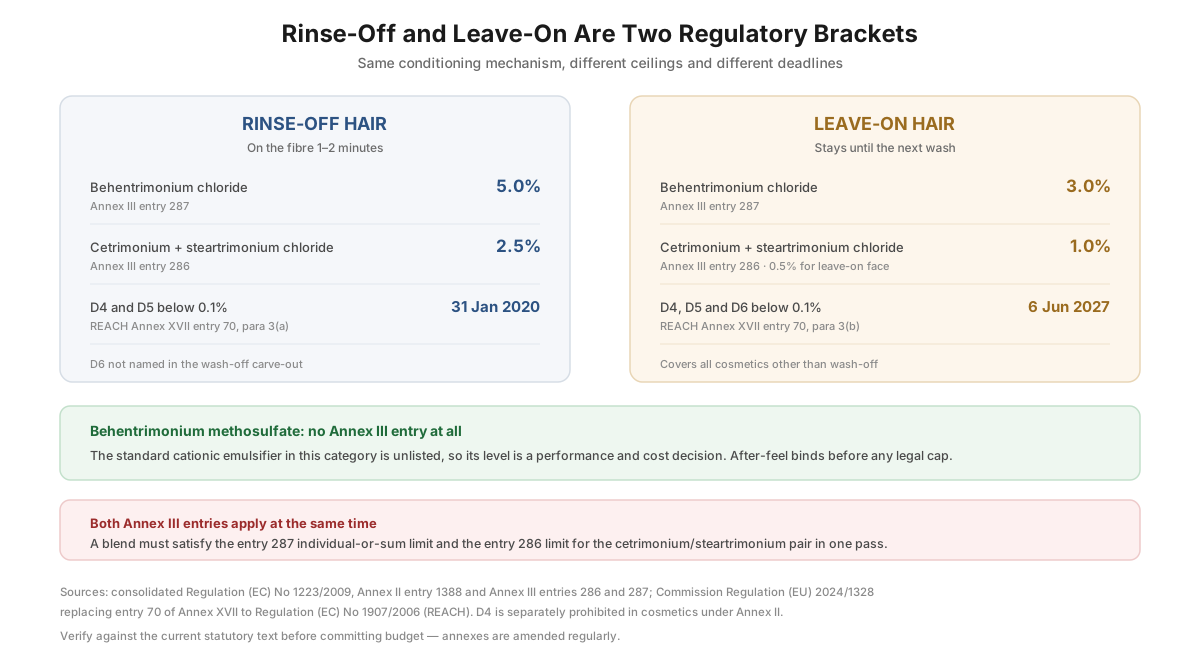
Two things about this table are easy to miss, and both have caught real projects.
The limits are simultaneous, not alternative. Entry 287 permits 3.0% in leave-on hair products for behentrimonium chloride individually, or for the sum of behentrimonium, cetrimonium and steartrimonium chloride together — while at the same time respecting the entry 286 maximum for the sum of cetrimonium and steartrimonium chloride. A formula that satisfies one entry and breaches the other is not compliant. If your brief specifies a blend of chloride quats, the arithmetic has to be run against both entries in one pass.
Entry 286 has a third tier most people never reach for. Leave-on face products cap the same pair at 0.5%. That matters for anyone extending a hair leave-in into a beard or scalp-and-face product, because the format change moves the ceiling again.
Both entries also carry a condition that has nothing to do with concentration: the substance must be present for a purpose other than inhibiting the development of micro-organisms in the product, and that purpose has to be apparent from how the product is presented. In practice this means a cationic agent sitting in the formula as a quiet secondary preservative is not covered by these entries, and the presentation of the product has to support the conditioning function you are claiming it serves.
The Ingredient That Changes the Picture
Here is where a compliance-first reading of this category goes slightly wrong if you stop at the annex.
The standard cationic conditioning emulsifier in this category is behentrimonium methosulfate, usually bought as a BTMS grade blended with fatty alcohols. It is self-emulsifying, which is why a conditioner does not need a separate primary emulsifier. And it does not appear in Annex III at all — not under entry 286, not under entry 287, not anywhere in the annex. Its level is a performance and cost decision, not a regulatory one.
So for most projects the legal ceiling is not the binding constraint. The binding constraint is after-feel. Our own leave-in baseline runs a cationic level around 3% on a BTMS-50 basis with a working range of 2 to 4%, against 4 to 6% on the same basis for a premium rinse-off conditioner and 3 to 4% for a value rinse-off one. It is not the leanest formula in our range — a fine-hair rinse-off conditioner runs lower still, at 2 to 3% — but it sits well under a premium rinse-off product for a reason a regulation does not dictate: every increment of deposit that is never rinsed away is an increment the customer wears all day.
One conversion trap worth writing into a specification: the percentage in a BTMS grade name refers to active content, not total material, which is why every figure above is stated on a BTMS-50 basis. Grade substitutions have to be recalculated on an active basis rather than swapped percentage for percentage, and a quote that does not state the basis cannot be compared with one that does.
The compliance work does not disappear, though. It moves. If a project specifies chloride-based quats instead — because of cost, supply, or an existing formula being transferred in — entries 286 and 287 apply in full, and the leave-on column is the one that governs.
Not sure which route fits your product?
Send us your brief and our formulators will tell you what is realistic on formula, MOQ, and timeline before you commit to anything.
The Siloxane Dates: Four, Not One
The second ceiling is the one brands miss more often, because it did not arrive through the Cosmetics Regulation. Cyclic siloxanes were restricted under REACH, as entry 70 of Annex XVII to Regulation (EC) No 1907/2006, on persistence grounds rather than through a cosmetics safety assessment.
Commission Regulation (EU) 2024/1328 replaced that entry in May 2024. Reading the replacement text, there are four separate dates in play for a hair care range:
| Scope | Substances | Position | Source |
|---|---|---|---|
| All cosmetics | D4 | Already prohibited | Annex II entry 1388, Regulation (EC) No 1223/2009 |
| Wash-off cosmetics | D4 and D5 | Below 0.1% since 31 January 2020 | Entry 70, paragraph 3(a) |
| Cosmetics other than wash-off | D4, D5, D6 | Below 0.1% after 6 June 2027 | Entry 70, paragraph 3(b) |
| General market restriction | D4, D5, D6 | Below 0.1% after 6 June 2026 | Entry 70, paragraph 1 |
The paragraph 3(b) wording is what creates the leave-on date: it covers "all cosmetic products other than the ones mentioned in paragraph 3(a)", and 3(a) is the wash-off carve-out. So a leave-in conditioner has until 6 June 2027, and a rinse-off conditioner has been inside the D4 and D5 limit since January 2020.
One reading worth flagging rather than asserting. Paragraph 3(a) names only D4 and D5. D6 is not in it. On the face of the text, a wash-off product relying on D6 falls outside both cosmetic carve-outs and lands on the general date of 6 June 2026 — a year earlier than the leave-on cosmetics date, which is counter-intuitive enough that it is worth confirming with your Responsible Person rather than planning around our reading of the structure.
What This Means for a Silicone Route
In leave-on hair serums and heat protectants, D5 has historically been used at 5% to 20% as the primary volatile carrier, which is why this is not a small adjustment for products built that way. A leave-in conditioner is a lighter case than a heat protectant, but it sits in the same leave-on bracket for the deadline. Straight-chain grades sit outside the cyclic restriction entirely: dimethicone, amodimethicone, hexamethyldisiloxane and low-viscosity dimethicone grades. We build leave-in formulas on straight-chain grades as standard, which means a brand launching on that base now has no 2027 reformulation ahead of it.
The supply-side trap is naming. Cyclomethicone is a mixture name, not a single substance, and it may contain D4, D5 or D6. Where a raw material is declared as cyclomethicone, the component levels have to come from the supplier before anyone can say whether the formula is inside the limit. That is a question to ask at specification stage, not after the first stability run.
For the wider picture of which EU restrictions touch which formats, our guide to cosmetic ingredients banned and restricted in the EU works through the vitamin A caps, the fragrance allergen labelling expansion and the zinc pyrithione ban alongside these siloxane dates.
Where the Formulation Actually Diverges
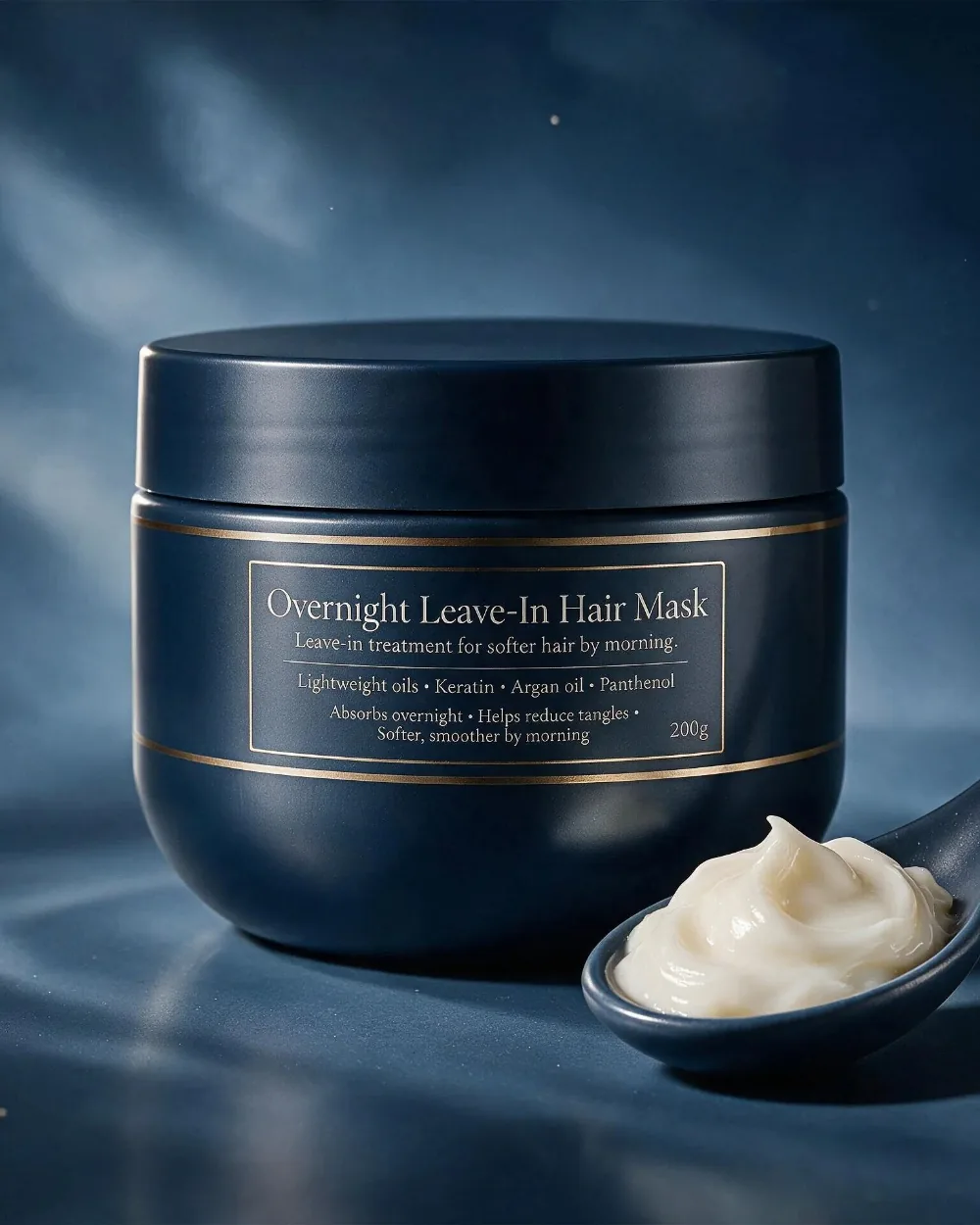
Regulation sets the ceiling. It does not design the product. Three things change in a leave-in beyond the cationic level, and each of them is a reason the format needs its own sample round rather than a fill change.
The oil phase is chosen for absorption, not richness. This is where a leave-in most often fails commercially. A formulator borrows the oil phase from a rinse-off conditioner, the sample performs beautifully in a wet-hair demo, and the customer wakes up with flat roots. Heavy butters and high oil loads that a rinse-off product carries comfortably are deliberately excluded. Our leave-in runs argan at the highest ratio in the range precisely because it delivers slip and shine without a tacky second impression hours later, and the load is judged on next-day condition rather than on application feel. In humid markets that ceiling drops further.
Oxidation becomes a shelf-life problem rather than a footnote. A high load of unsaturated plant oils, packaged for months of use in a hot climate, is a real oxidation risk — an oxidised leave-in develops an off odour and loses exactly the light feel that justifies its price. Tocopherol goes in for that reason rather than as a marketing active, and packaging carries as much of the load as the antioxidant does: an opaque or airless format contributes materially to stated shelf life in high-temperature markets.
Humectants behave differently when they are never washed off. Panthenol suits a leave-in better than almost any other conditioning ingredient, because its benefit builds over hours rather than needing a warm dwell, and because it delivers softness without an oil's weight. But it is a humectant, so in very high ambient humidity an over-loaded formula can draw moisture inward and leave hair limp rather than soft. The level is set against local conditions rather than at the maximum that still tests well in a dry lab.
One thing does not change in the leave-in's favour, and it is worth being straight about it in claim copy: hydrolysed keratin gets hours of contact instead of two minutes, which is a genuine functional advantage over a rinse-off product. What it does with that time is surface smoothing. No leave-in rebuilds the disulphide bonds that bleach or perming break, regardless of contact time. Overnight or all-day repair describes what the product delivers; bond repair does not.
What the Format Costs to Develop
The parts of this that are commercial rather than regulatory, for a leave-in built from our existing base:
- Minimum order: 3,000 bottles per SKU. The 100ml and 150ml sizes count as separate SKUs for minimum purposes.
- Sampling: 2 to 3 weeks for a custom sample round.
- Production: 35 to 45 days once the sample and artwork are approved, with accelerated stability testing inside that window rather than added to it.
- Adjustable without a new base: argan and shea ratio, keratin load and type, cationic level within leave-on limits, silicone or silicone-free route, and cream, milk or pump-spray format.
- A different base rather than a tweak: a vegan claim, because keratin is animal-derived and substituting hydrolysed wheat or soy protein changes the formula rather than the batch sheet.
Two recommendations that sit outside the standard lead time and are worth budgeting for separately. Consumer use testing on next-morning feel, because a leave-on product is judged on the second impression and a lab panel in a dry room does not produce that. And pump or spray packaging over a flip cap, because over-application is the dominant failure mode in this format — a customer who applies a rinse-off-sized dose concludes the product is greasy, and your usage copy should state the dose explicitly.
If a leave-in is going into an existing range, the cost logic differs from adding a second rinse-off SKU. Our guide to building a private label hair range covers what stays shared across a range and where the minimums come from, and the private label hair care guide sets out what is adjustable across shampoo, conditioner and mask formats.
A Brief That Will Not Come Back
The questions a leave-in brief should answer before sampling, in the order they cause problems:
- Destination markets, named. The leave-on ceilings above are EU. They set the strictest common denominator for most ranges, but a market-specific check belongs in the brief rather than after artwork.
- Cationic route: methosulfate or chloride. This determines whether Annex III entries 286 and 287 bind your formula at all.
- Silicone route: straight-chain, cyclic, or silicone-free. If cyclic, the 6 June 2027 date applies and the reformulation has to be scheduled, not noted.
- Raw materials declared as cyclomethicone. Component levels from the supplier, before quoting.
- Claim set, written out. Manageability, softness and combing are defensible. Structural repair is not, in any market we ship to.
- Climate at point of use. Humidity changes the humectant level, the oil load and the packaging spec, not just the fragrance.
For the testing side of this, how to read a stability testing report covers what a credible report contains and why a preservative challenge test has a fixed minimum duration that cannot be compressed.
Frequently Asked Questions
Can you fill our rinse-off conditioner into a smaller bottle as a leave-in?
No, and it is worth knowing why because it is a common request. A rinse-off conditioner is built on the assumption that most of it leaves the hair within two minutes, so its deposit level reads coated and greasy if it stays. The legal ceilings differ too: Annex III sets leave-on caps for chloride-based cationic conditioners at roughly half the rinse-off figures. A leave-in is a separate development with its own sample round.
What is the EU limit for behentrimonium chloride in a leave-in conditioner?
3.0%, under Annex III entry 287 of Regulation (EC) No 1223/2009, against 5.0% for rinse-off hair products. That figure applies to behentrimonium chloride individually or to the sum of behentrimonium, cetrimonium and steartrimonium chloride, and it has to be respected at the same time as the entry 286 limit for the cetrimonium and steartrimonium pair, which is 1.0% for leave-on hair products.
Does behentrimonium methosulfate have an Annex III limit?
No. It does not appear in Annex III, so its level is a performance and cost decision rather than a regulatory ceiling. In practice the after-feel limit binds well before any concentration a formulator would consider, which is why our leave-in baseline sits around 3% on a BTMS-50 basis rather than near a cap.
When do the D5 restrictions hit leave-on hair products?
6 June 2027, under paragraph 3(b) of entry 70 of REACH Annex XVII as replaced by Commission Regulation (EU) 2024/1328, which covers all cosmetic products other than wash-off ones. Wash-off products have been inside the same 0.1% limit for D4 and D5 since 31 January 2020. D4 is separately prohibited in cosmetics under Annex II entry 1388 of Regulation (EC) No 1223/2009.
Is a silicone-free leave-in harder to manufacture?
Not harder, but it is a different sensory target rather than the same product minus an ingredient. Straight-chain silicones such as dimethicone and amodimethicone sit outside the cyclic restrictions and remain available, so most projects that want to avoid a 2027 deadline do not need to go silicone-free at all. A genuinely silicone-free brief is a separate development, and the honest position is that it feels different rather than identical.
How much should the consumer use?
Far less than for a rinse-off conditioner, and the usage copy should say so explicitly. Over-application is the main failure mode in this format: a consumer who uses a rinse-off-sized dose will conclude the product is greasy. This is also why we recommend a pump or spray over a flip cap, and why the 100ml size often outsells the 150ml on repeat.
Does the longer contact time make the keratin work better?
It gets more of the surface benefit, yes. Hours of contact rather than minutes means hydrolysed keratin has time to settle into gaps in a lifted cuticle, so hair combs with less snagging. What it does not do at any contact time is rebuild the cortex or reverse bond breakage from bleaching, so the claim stays on smoothness, manageability and visibly less frizz.
Where to Start
The single decision that saves the most time on a leave-in project is the cationic route, because it determines whether the Annex III entries bind the formula at all. After that, the silicone route decides whether 6 June 2027 is a date on your calendar or a date that does not apply to you.
Everything cited above comes from the consolidated text of Regulation (EC) No 1223/2009 and from Commission Regulation (EU) 2024/1328 as published. The one reading we have flagged as ours rather than the text's is the position of D6 in wash-off products. Verify the current position against the statutory text before committing budget, since annexes are amended regularly, and send us the destination markets and target format if you want the formulation side checked against what the limits allow.
Ready to Start Your Project?
Tell us your product requirements. Our technical team responds within 24 hours with a detailed quotation.