
Custom Nail Polish Manufacturers: Sourcing Guide
Nail polish is usually not made where the rest of your beauty range is made.
Traditional nail lacquer is a nitrocellulose film former dissolved in organic solvents — largely esters and alcohols. That makes it a flammable liquid, which typically requires a site set up for solvent handling: dedicated equipment, appropriate explosion-protection measures in the filling area, and the licences that allow those solvents to be stored and used at that address. Requirements vary by jurisdiction and by the specific solvents involved, so the practical question is not which rule applies in the abstract but whether this particular supplier is set up for this particular product.
That reorders how you approach sourcing. The first question to put to custom nail polish manufacturers is not who offers the lowest price. It is whether the factory in front of you is physically and legally able to make the product you are describing.
This guide covers what determines feasibility: which of the three nail categories you are really entering, what the regulatory position is in your target markets, and what to confirm in writing before money moves.
Decide which product you are making, because these are three different businesses
People say "nail polish" and mean one of three things that have little in common at the manufacturing level.
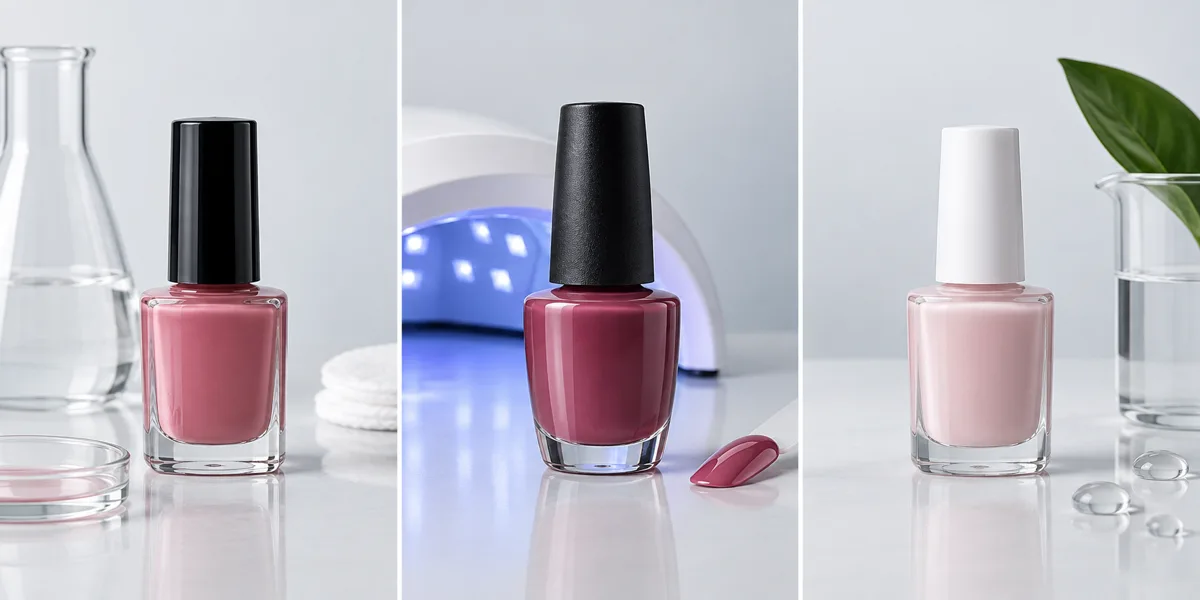
Traditional lacquer. Solvent-based, air-drying, the category described above. Flammable, and subject to dangerous-goods handling in many freight lanes.
Gel polish. Cured under an LED or UV lamp rather than dried by solvent evaporation. This is a photopolymerisation system, not a solvent system. Different raw materials, different filling considerations, and — as covered below — a distinct regulatory position in the EU.
Water-based or so-called breathable polish. Marketed on low odour and easier removal. A different chemistry again, with its own trade-offs around wear and adhesion.
These are not variations on a theme. They typically need different production environments, they can carry different transport classifications, and in the EU they answer to different rules. A supplier credible in one is not automatically credible in the others, so it is worth confirming category experience directly rather than inferring it from a broad capability list.
What "nail polish manufacturer" should mean when you evaluate one
The phrase covers everyone from a solvent-licensed producer to a trading company with a catalogue. A few questions separate them.
Is the line yours, at this address? Ask who signs the batch records. If the answer routes through a third party, you may be buying through an intermediary. That can be a workable arrangement, but it should be priced and planned as one.
Do you hold the licences to store and handle these solvents? For traditional lacquer this is not a paperwork detail. It is what makes production lawful at that site.
For gel: how is cure verified? Under-cured product is associated with both performance complaints and, as the EU position below sets out, with the skin-contact scenarios that drive the safety concern. A supplier should be able to describe cure verification as a process control rather than as a matter of judgement.
What is the minimum batch on the specific line that would run my product? Not the company minimum. Lines differ, and the relevant number is the one for your product on the line that will actually run it.
Can you show me documentation for a shade you already produce? Asking for the certificate of analysis, and the colour certification lot number where one applies, for something already on their floor is a direct way to see how their documentation is organised.
The same test applies whether you approach the market looking for a nail polish maker, browsing nail lacquer manufacturers, or searching for oem nail polish capacity. The search term does not change what you are checking: licensed site, own line, retrievable documentation.

Not sure which route fits your product?
Send us your brief and our formulators will tell you what is realistic on formula, MOQ, and timeline before you commit to anything.
Gel polish manufacturer selection is a regulatory question first
This is where an error is most expensive, so it deserves specifics rather than generalities.
In the European Union, two substances widely used in gel and artificial-nail systems — HEMA (2-hydroxyethyl methacrylate) and Di-HEMA Trimethylhexyl Dicarbamate (Di-HEMA TMHDC) — are restricted by name. Commission Regulation (EU) 2020/1682 of 12 November 2020 amended Annex III to Regulation (EC) No 1223/2009 to impose that restriction. The reasoning set out in the Regulation's own recitals is worth following, because it describes what a compliant product looks like rather than only what is prohibited:
- The restriction followed provisional measures adopted by the Swedish Medical Products Agency in 2014, after a nail cosmetic product had caused a high number of undesirable effects.
- The Scientific Committee on Consumer Safety, in its opinion of 21–22 June 2018, concluded that these substances applied appropriately to the nail plate are not likely to pose a risk of sensitisation, provided their use is restricted to the nail plate only and contact with the adjacent skin is avoided. The same opinion describes both substances as weak to moderate sensitisers that do pose a sensitisation risk from misuse, from inappropriately carried out application, or from unintentional contamination of the skin adjacent to the nails.
- Because "normal or reasonably foreseeable conditions of use" must account for imprecise application, the Commission concluded there was a potential risk to human health from consumer use.
- The resulting requirement distinguishes professional from consumer use: such nail products should be used only by professionals, and the packaging must carry the warnings "for professional use only" and "can cause an allergic reaction."
Sources: Commission Regulation (EU) 2020/1682 · parent framework Regulation (EC) No 1223/2009
Three consequences for a brand:
- The monomer system affects your addressable market and your channel. Under the EU position above, a HEMA-containing gel is directed to professional use, with the corresponding pack warnings. If the plan is consumer retail in the EU, that constrains the formulation decision rather than the marketing decision.
- Labelling follows formulation. The required warnings are a consequence of what is in the bottle. They cannot be added or removed at the copywriting stage, and nail packaging is physically small, which is where artwork tends to get reworked.
- Ask which monomer system is proposed, and for which market. A supplier who can answer that in regulatory terms is easier to take through a compliance review than one who cannot.
Rules change and apply by market. Treat the linked regulation as the starting point for your own current check, not as a substitute for it. Nothing here is legal advice.
Colorants are approved by where they are used, and the categories are separated
A pigment cleared for one application is not automatically available for another. Permissions are use-specific, and nails, lips and the eye area are treated separately.
In the United States, colour additives are regulated under the Federal Food, Drug, and Cosmetic Act, and a group of them are subject to batch certification: FDA examines samples from the batch and issues a certificate showing an assigned lot number. The mechanics are in the regulations:
- 21 CFR Part 80 — Color Additive Certification: the request procedure (§ 80.21), samples that must accompany it (§ 80.22), issuance of the certificate and the assigned lot number (§ 80.31), and the circumstances in which a certificate expires or ceases to be effective (§ 80.32). § 80.32 repays attention: a certificate can cease to be effective if the colour changes in composition, and expires when the shipping package is opened, subject to stated exceptions. Certification attaches to the batch — not to the company, and not to the formula.
- 21 CFR Part 70 — Color Additives, general provisions. § 70.3 defines "batch," "batch number," "lot number," "area of the eye" and "externally applied." § 70.5 is the one to read closely: listing or certification does not authorise use in the area of the eye unless the listing specifically provides for it.
Sources: 21 CFR Part 80 · 21 CFR Part 70
In sourcing practice this gives you a concrete document to ask for: the certification lot number alongside the certificate of analysis, for a shade the supplier already produces. Where a colour is subject to certification, that number exists — so the request is answerable, and how readily it is answered tells you something about how the supplier's documentation is kept.
The "free-from" number is a marketing claim, not a compliance status
Every brand in this category advertises a count. Three-free, five-free, seven-free, nine-free, twelve-free.
There is no authority that defines these tiers and no register that certifies them. The early exclusions came from reformulation away from substances with real toxicological or regulatory questions attached; the count later became a point of competitive differentiation.
Two practical consequences. First, a free-from claim needs substantiation, which in practice means a written declaration from your manufacturer naming every substance excluded. A brand that claims nine-free and cannot name the nine is carrying an easily tested claim.
Second, and more important than the number: specific substances are restricted in specific markets by name, and that is the list that governs whether you can sell. Compliance is built from those instruments, market by market, not from a number on the front of the bottle.
Private label nail polish manufacturers: what you are actually buying
Working with private label nail polish manufacturers — or with private label gel polish suppliers specifically — means buying an existing base and selecting shades rather than developing a chemistry. That is a legitimate and often correct route to market. It is worth being clear about what it includes.
It usually includes a proven base, a shade library, and a faster path to a finished product. It may not include exclusivity on that base, and it may not include the right to move the formula elsewhere later. Ask the ownership and transferability question early and in writing, because the answer determines whether you are building an asset or a dependency.
Two mechanical points worth planning around:
Minimums are commonly quoted per shade. A collection that needs to look like a collection multiplies the commitment by shade count. The arithmetic to run before committing is the minimum batch per shade on that line, multiplied by your shade count — not the headline minimum for a single product. Confirm which basis the quote uses, because per-shade and per-order minimums produce very different totals.
Shade demand is unlikely to be evenly distributed, and it is difficult to predict the winners before selling. Setting reorder triggers per shade from the start, rather than per product, is a cheap hedge against being out of stock on the two shades that move while the rest sit.
The brush is a functional component, not packaging. Application quality depends substantially on the brush interacting with your viscosity, and it is commonly quoted as part of the packaging bill of materials.
Sourcing from China: what to verify
A large share of global nail category capacity is based in China, and china nail polish manufacturers is a well-used search for that reason. The evaluation criteria do not change with geography, but two points deserve specific attention.
Freight classification is part of cost and part of feasibility. Traditional lacquer is a flammable liquid. That affects which lanes are available, how it must be packed and declared, and who is entitled to sign the declaration. Warehouses limit how much flammable material they hold, and some third-party fulfilment providers decline the category or apply a surcharge. Confirm this with your intended fulfilment partner before committing to a production quantity — storage constraints discovered after arrival are expensive to solve.
Documentation practice, not just documentation existence. The useful request is specific: the certificate of analysis for a named batch, together with the colour certification lot numbers where those apply. Asking for two production batches of the same shade and comparing measured values rather than specification ranges is also informative — specification ranges describe what was promised, measured values describe what the process produced.
For a fuller treatment of supplier evaluation in China across categories, see our guide on how to choose a cosmetics manufacturer in China.
What to confirm in writing before you pay a deposit
- The minimum batch per shade on the specific line that will run your product, and the unit price at the quantity you are ordering now.
- Whether that line is theirs, at that address, and who signs the batch records.
- For traditional lacquer: that they hold the licences to store and handle the solvents involved.
- For gel: the monomer system proposed, the markets it is intended for, and how cure is verified as a process control.
- Whether lead time starts at purchase order or when your components arrive at their warehouse. Establish which reading applies, since the two can differ materially.
- Over-run and under-run tolerance, who bears the difference, and whether invoicing follows actual production or the ordered quantity.
- Colour tolerance against retained physical references, judged under a standardised daylight lamp rather than from a photograph or a screen.
- A certificate of analysis per batch, including colour certification lot numbers where they apply, plus retained samples held by both sides.
- Substantiation for any free-from claim, naming every excluded substance.
- That no raw material, pigment grade or sub-supplier may be substituted without written approval and retesting. Pigments that look interchangeable on a datasheet can behave differently in a base and may hold different regulatory status.
- Ownership and transferability of any tooling you pay for, including where it is stored and whether it can be moved.
Testing that has to happen in the real pack
Test your actual bottle, your actual liner, your actual brush and your actual cap with your actual formula, stored upright and on its side, at elevated temperature.
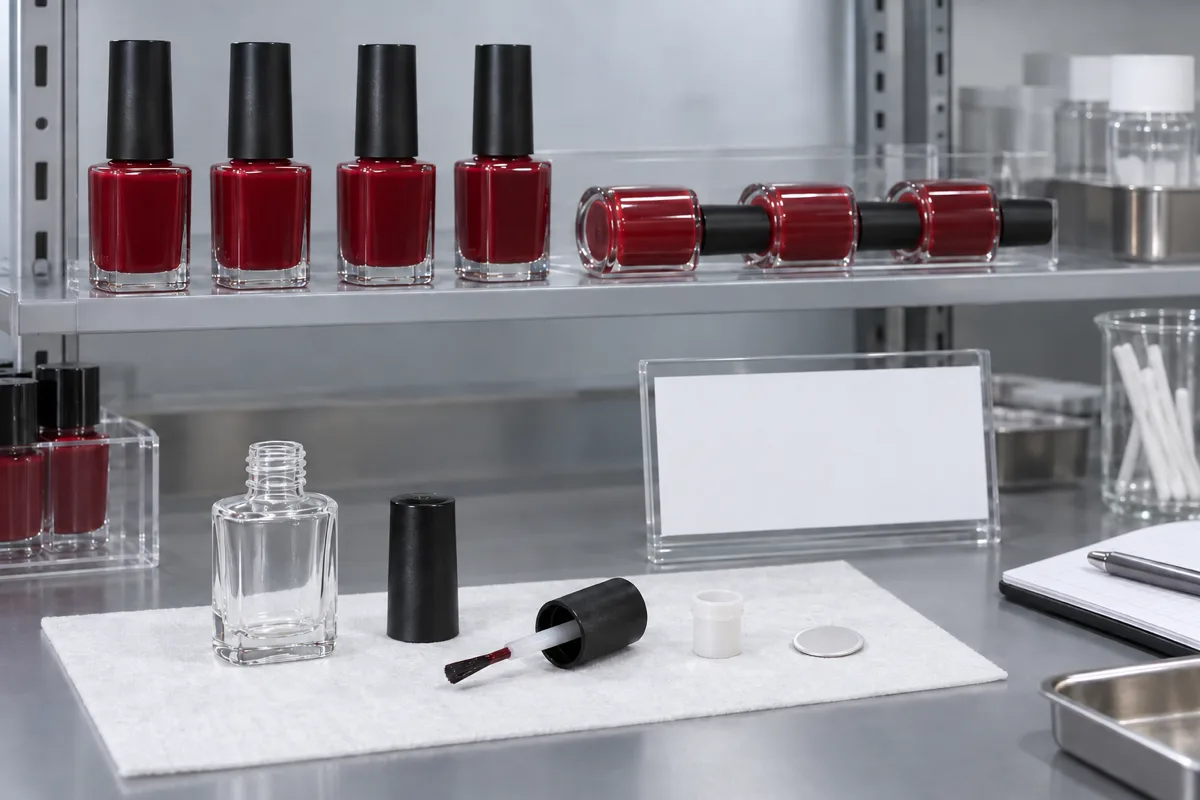
Pack interaction is worth testing early because the failure modes are specific to this category and not visible on day one: solvent attack on a liner, pigment settling that will not redisperse, colour that shifts from the first coat of a bottle to the last, a brush that stiffens over time.
Poor suspension shows up as hard settled sediment, or as drifting colour within a single bottle.
Wear testing on real people takes the time it takes and cannot be compressed, so it is better started during development than after. Our overview of cosmetic stability testing covers the general principles that apply across categories.
The short version
Nail polish sits at the intersection of three constraints at once: a manufacturing base that in the traditional-lacquer case is restricted to sites equipped and licensed for solvents, a dangerous-goods logistics profile, and a regulatory position that differs between traditional lacquer and gel. Those are not things you negotiate. They are things you design around.
Screen custom nail polish manufacturers on line capability, cure verification, per-shade minimums and freight restrictions before you get to price, and the shortlist sorts itself.
If you are mapping a nail programme and want a second read on the sourcing questions above, get in touch and tell us which of the three categories you are looking at and which markets you intend to sell in. Those two answers determine most of the rest.
Ready to Start Your Project?
Tell us your product requirements. Our technical team responds within 24 hours with a detailed quotation.